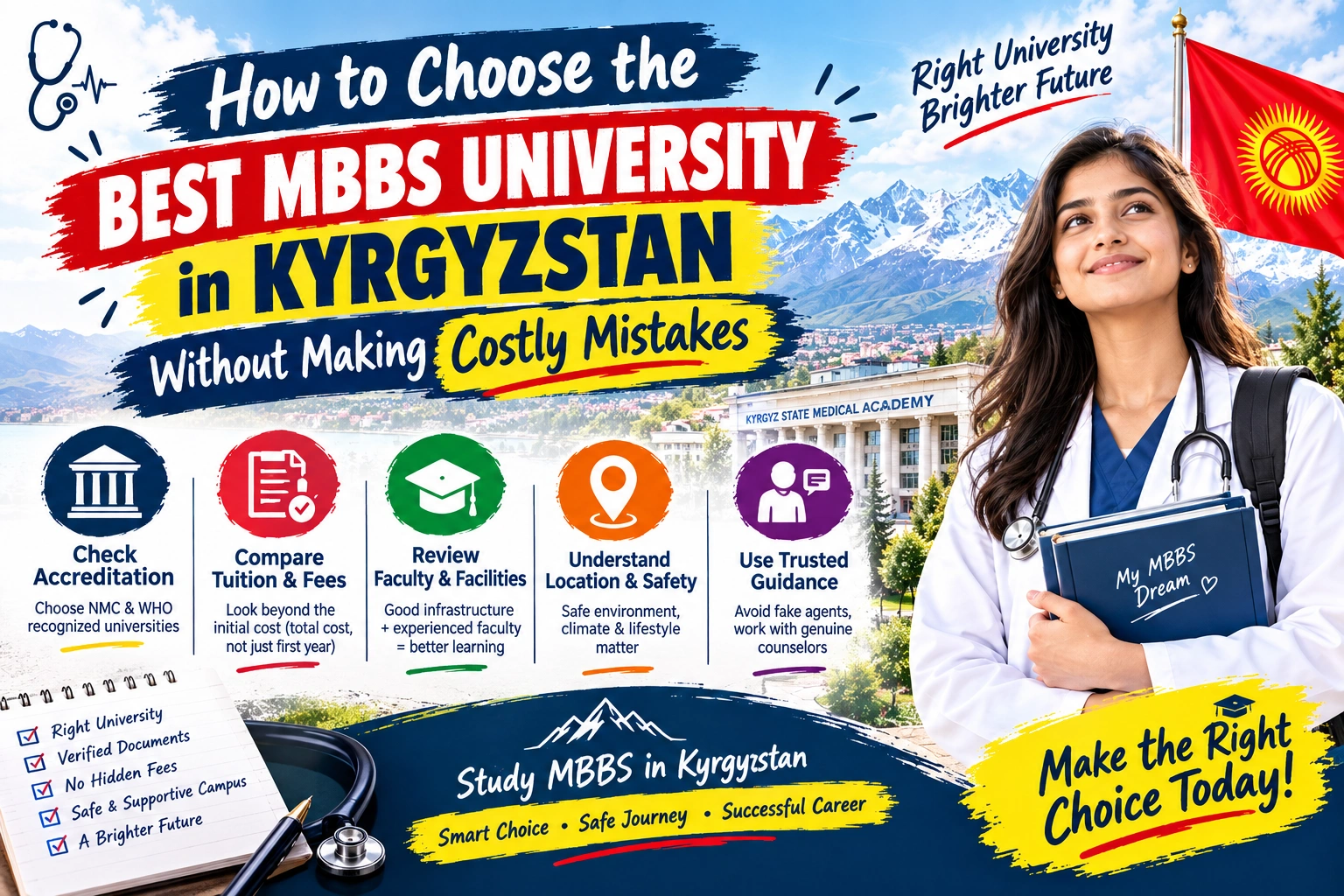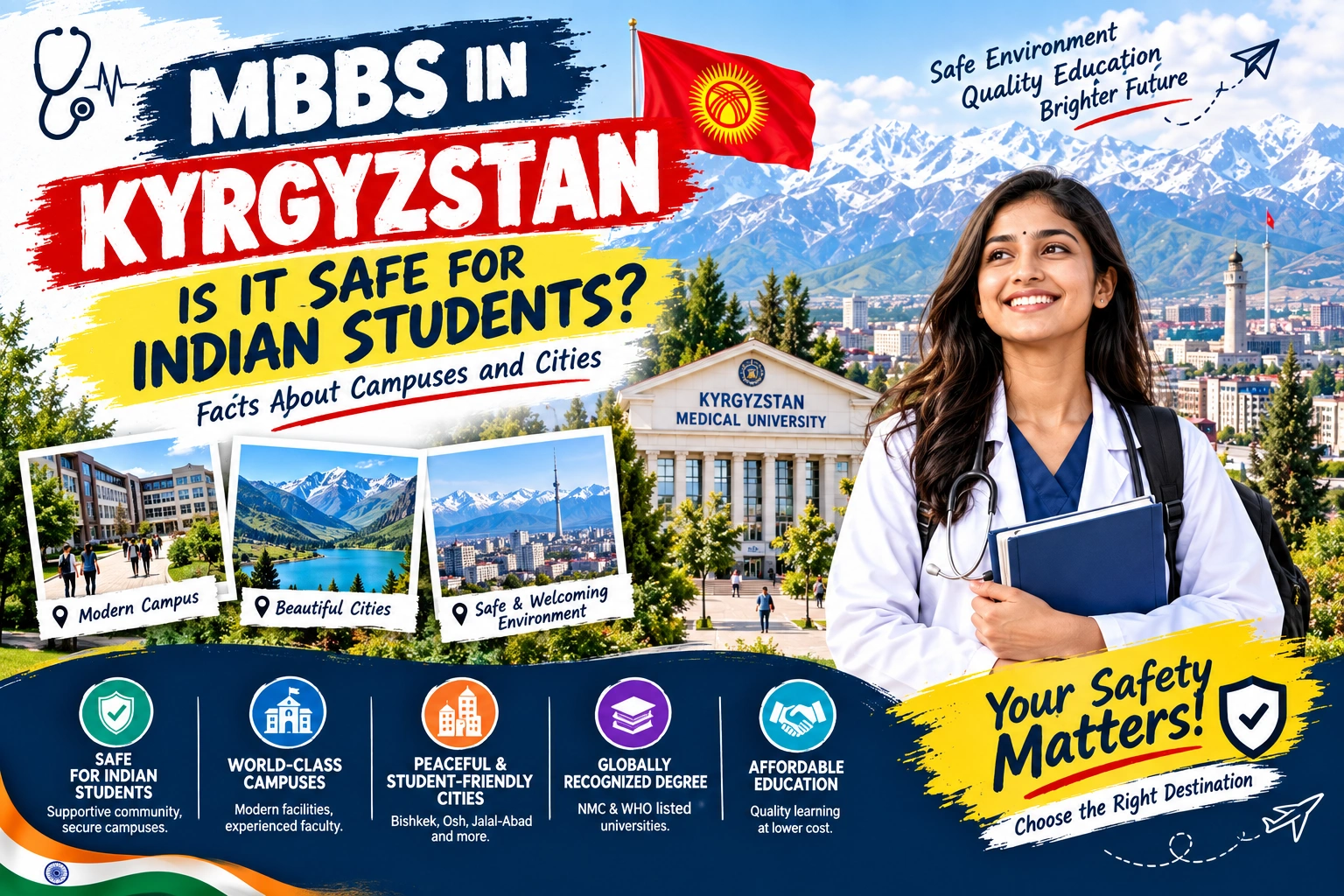
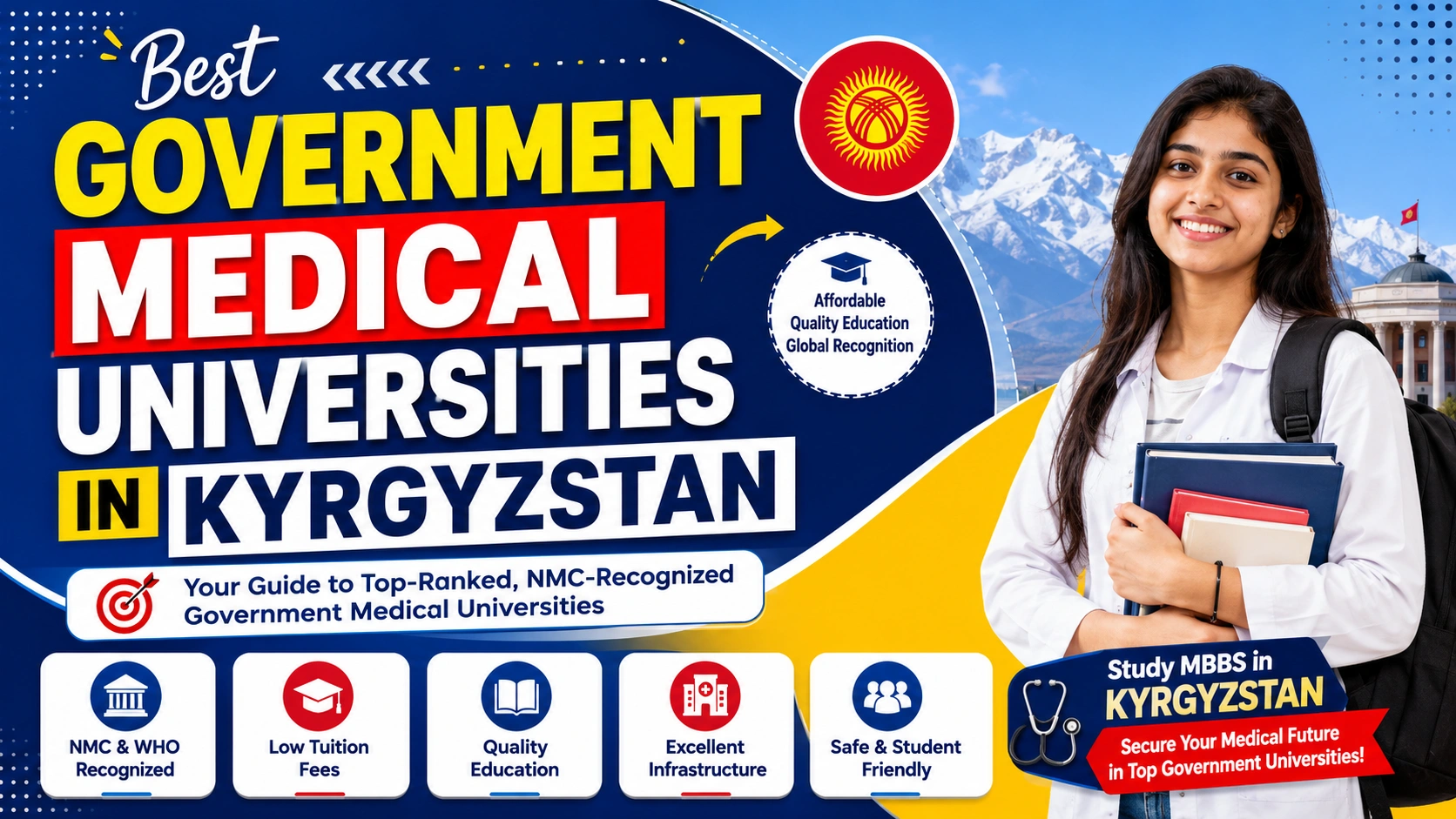
For every Indian international student planning to pursue an MBBS degree in Kyrgyzstan, the core first question they almost all encounter when researching local medical school programs is “should I choose a public or private medical university”.
Kyrgyzstan’s public medical universities have a range of common advantages, but these public institutions are not homogeneous, and students cannot select a school based solely on its public university status.
The core goal of this paper is to sort out Kyrgyzstan’s top public medical universities, compare their tuition fees and accreditation statuses, and deliver actionable school selection support for Indian medical students studying abroad in Kyrgyzstan.
The four public institutions included in this analysis are Kyrgyz State Medical Academy (KSMA), Kyrgyz-Russian Slavic University (KRSU), Osh State Medical University, and Jalal-Abad State Medical University.
All four are recognized by India’s NMC, listed in the WHO World Directory of Medical Schools, offer 6-year English-medium MBBS programs, charge lower tuition than most local private universities, and have access to well-developed clinical training resources at public hospitals.
These public universities also share a set of additional common advantages:
Their tuition is low and stable.
They have mature cooperative systems with teaching hospitals.
Their accreditation credentials have been valid for long periods.
They boast a large alumni network that includes a great number of Indian graduates.
Their administrative stability is better than that of some private universities.
It should be noted that some private universities also have their own unique strengths, especially well-built support systems for international students; this paper only focuses on sorting out public university options.
Kyrgyz State Medical Academy (KSMA)
KSMA, founded in 1939 and located in Bishkek, the capital of Kyrgyzstan, is the earliest and most established public medical university in the country.
It has trained thousands of international students, including a large cohort of Indian students.
In addition to NMC and WHO accreditation, it is also recognized by FAIMER, has sufficient teaching faculty, modern laboratory facilities, and a highly comprehensive clinical network connected to local public hospitals.
Kyrgyz-Russian Slavic University (KRSU)
KRSU, a joint institution co-founded by Kyrgyzstan and Russia, holds an outstanding academic reputation.
Its students’ performance on the FMGE exam consistently ranks among the top in Kyrgyzstan, and it is accredited by the NMC, WHO, and the Supreme Council of Higher Universities.
Osh State Medical University
Osh State Medical University, located in Osh, Kyrgyzstan’s second-largest city, was founded in 1951, and also offers a 6-year English-Russian bilingual MBBS program.
Jalal-Abad State Medical University (JASU)
For international medical students who prefer low-cost living areas outside the capital of Kyrgyzstan, we first recommend Jalalabad State Medical University (JASU), a public institution founded in 1993 and affiliated with the country’s Ministry of Health, Science and Education.
JASU holds three authoritative accreditations:
NMC
WHO
We have also conducted a one-by-one comparison of Kyrgyzstan’s other public medical universities including KSMA, KRSU, and Osh State University, alongside private institutions such as ISM and the Asian Medical Institute, across the dimensions of:
Ownership
Tuition fees
Academic history
Hospital partnerships
Internationalization orientation
to serve as a reference for students selecting their school.
Accreditation and Eligibility Requirements
To apply for an MBBS in Kyrgyzstan program, applicants must first verify the qualification status of their target institution: the country’s Ministry of Health conducts regular re-evaluations of medical school qualifications, so accreditation status is not permanent.
All applicants must confirm their chosen school’s current valid qualification via the official directories of NMC and WDOMS, and must not trust outdated articles or claims made by education agents.
Local public medical universities require applicants to:
Have completed 10+2 education with completed coursework in Physics, Chemistry, Biology and English.
Earn a minimum overall score of 50%, or 45% for reserved category applicants.
Be at least 17 years old at the time of enrollment.
Hold a passing score on the NEET-UG.
Do not need to submit IELTS or TOEFL scores for English-taught programs.
Admission Process
Indian applicants planning to pursue an MBBS degree at public universities in Kyrgyzstan must first confirm that their target institution holds accreditation from the NMC and WHO, and that they have passed the NEET-UG exam.
We have compiled a standardized 8-step application process for you to complete.
Initiate your application 3–4 months ahead of the intake season.
Well-known public universities fill up rapidly.
The annual tuition fees for the four top public universities, including the Kyrgyz State Medical Academy, are presented in both US dollars and Indian rupees to enable easy cross-institutional comparison and help you properly plan your study-abroad budget.
Tuition Fees and Cost Warning
Attention all Indian students applying for the MBBS in Kyrgyzstan:
First, we issue a pre-payment cost risk warning.
All cost figures mentioned in this paragraph are approximate.
Before making any payments, you must confirm the exact Indian rupee-denominated tuition fees for the Kyrgyzstan MBBS Fees program directly with the admissions office of your target university, to avoid unnecessary losses arising from information errors.
Advantages and Disadvantages
Next, we organize core application information for local government-run medical universities using modular subheadings.
First, we list:
6 core application advantages of government-run medical universities.
We then sort out:
5 application disadvantages that require advance consideration.
Career Opportunities
This is a full 6-year program that includes an internship.
After graduation, students can sit for various professional qualification exams including:
FMGE
NEXT
USMLE
PLAB
Others
Granting them diverse career development options.
We then list 4 mainstream government-run medical universities accredited by NMC and WHO, including KSMA, which was founded in 1939, as well as KRSU, JASU, and other institutions.
The total 6-year cost for programs at these government-run universities is approximately 25–33 lakh Indian rupees.
All original English names of qualifications and university abbreviations are retained to allow students to independently verify related information.
Frequently Asked Questions
Finally, we compile 7 common application questions for Indian students.
We have finalized answers for the first 6 questions.
The last FAQ has not yet been completed.
Conclusion
The arrangement of all modules fully aligns with the decision-making sequence of Indian students applying to medical schools in Kyrgyzstan.
It comprehensively covers all core decision-making needs for the application process, spanning from:
Risk warnings
Advantage-disadvantage comparisons
Career pathways
University lists
Frequently asked questions
Indian students planning to pursue MBBS in Kyrgyzstan must first meet the core admission threshold:
Obtaining a passing score on the NEET-UG is a mandatory requirement to apply for NMC registration and to take the FMGE/NEXT examination after graduation.
The qualification of any host university must be verified via the official websites of the NMC and WDOMS, as institutional qualifications are subject to change during annual regular audits.
Four compliant public medical universities are recommended:
KSMA
KRSU
Osh State Medical University
JASU
All these institutions have long academic histories, close cooperative partnerships with hospitals, and maintain continuous certification from the NMC and WHO, making them top high-cost-performance options for students.
Before submitting an application, students must verify the latest institutional qualifications, and compare tuition fees and facilities to ensure they match their personal needs.