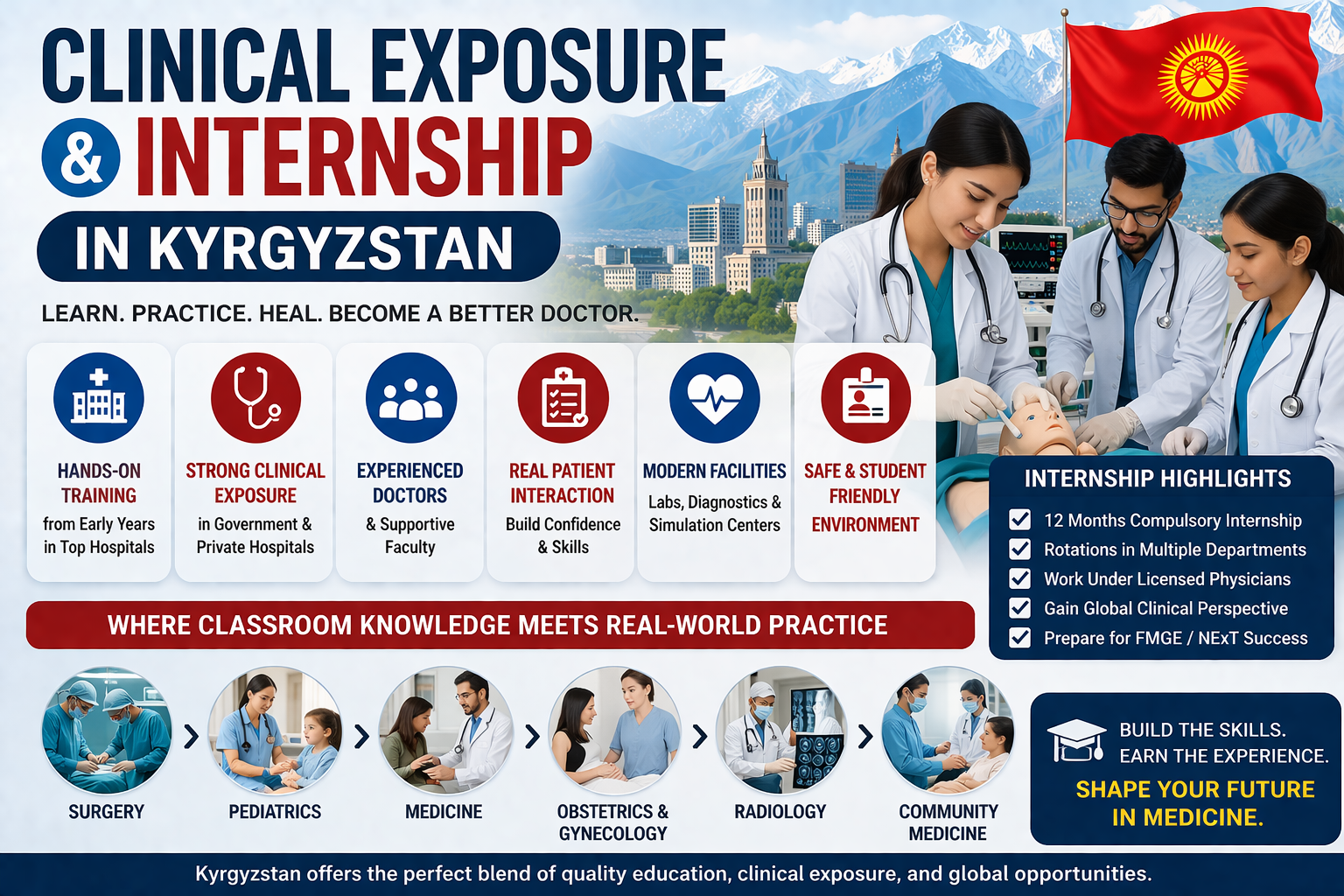
Clinical exposure and internship are essential components of medical education, especially for Indian students pursuing MBBS abroad. Kyrgyzstan has become a popular choice due to its affordable education, English-medium programs, and universities aligned with global standards.
Understanding how clinical training and internships are structured helps students prepare for licensing exams like FMGE/NExT and build a successful medical career.
Importance of Clinical Exposure
Clinical exposure bridges the gap between theoretical knowledge and practical application.
Key Benefits:
Develops real-life patient handling skills
Enhances diagnostic and treatment abilities
Builds confidence in clinical environments
Prepares students for practical-based exams like FMGE/NExT
Insight: Strong clinical exposure is crucial for becoming a competent doctor and succeeding in licensing exams.
Clinical Training in Kyrgyzstan Universities
Medical universities in Kyrgyzstan provide training through affiliated multispecialty hospitals.
Areas Covered:
Medicine
Surgery
Pediatrics
Obstetrics & Gynecology
Community Medicine and Public Health
Training Includes:
Patient examination and case analysis
Diagnosis and treatment planning
Participation in hospital rounds
Exposure to outpatient (OPD) and inpatient (IPD) care
Most classroom teaching is in English, while patient interaction may involve local languages such as Kyrgyz or Russian.
Observation: Clinical training aligns with international standards and supports preparation for FMGE/NExT and global licensing exams.
Internship Structure (Rotatory Clinical Training)
The MBBS program typically includes:
5 years of academic study
1 year of compulsory internship
This structure follows guidelines of the National Medical Commission.
Internship Features:
Rotations across major departments
Hands-on clinical experience
Supervised patient care
Department-Wise Exposure:
Internal Medicine & Surgery: Diagnosis, case management, assisting in procedures
Pediatrics: Child healthcare, vaccinations, common treatments
Obstetrics & Gynecology: Prenatal care, deliveries, women’s health
Community Medicine: Public health programs, rural healthcare exposure
Insight: Rotatory internships provide comprehensive clinical understanding and practical readiness.
Hospitals and Facilities
Universities are affiliated with both government and private hospitals.
Facilities Include:
Diagnostic laboratories
Operation theaters
Emergency units
Specialized medical departments
Top institutions such as Kyrgyz State Medical Academy, Osh State Medical University, and Asian Medical Institute offer advanced labs and clinical infrastructure.
Observation: Access to diverse hospital environments helps students gain exposure to a wide range of medical cases.
Benefits of Clinical Exposure in Kyrgyzstan
Improves practical and diagnostic skills
Enhances interaction with experienced doctors and faculty
Strengthens preparation for FMGE/NExT
Provides exposure to modern medical practices
Encourages participation in community healthcare programs
Challenges and Solutions
1. Language Barrier
Patients often communicate in Kyrgyz or Russian
Universities provide basic language training
Solution: Learn basic local language for better patient interaction
2. Limited Exposure in Smaller Hospitals
Some hospitals may have lower patient flow
Solution: Choose universities with multiple hospital tie-ups
3. Adapting to Different Medical Systems
Clinical practices may differ from India
Solution: Attend workshops and align preparation with FMGE/NExT syllabus
Insight: With proactive effort, these challenges can be effectively managed.
Tips to Maximize Clinical Learning
Actively participate in ward rounds
Seek guidance from senior doctors
Maintain case notes and clinical records
Attend seminars, workshops, and conferences
Practice communication and diagnostic skills regularly
Conclusion
Clinical exposure and internship in Kyrgyzstan medical universities provide a balanced combination of theoretical learning and practical training. Students studying in universities aligned with the World Directory of Medical Schools and standards of the World Health Organization benefit from:
Structured rotatory internships
Hands-on clinical experience
Preparation for FMGE/NExT
Exposure to modern healthcare systems
Success ultimately depends on the student’s active participation, consistency, and choice of a well-recognized university. With the right approach, Kyrgyzstan offers a solid pathway toward a successful medical career in India or abroad.