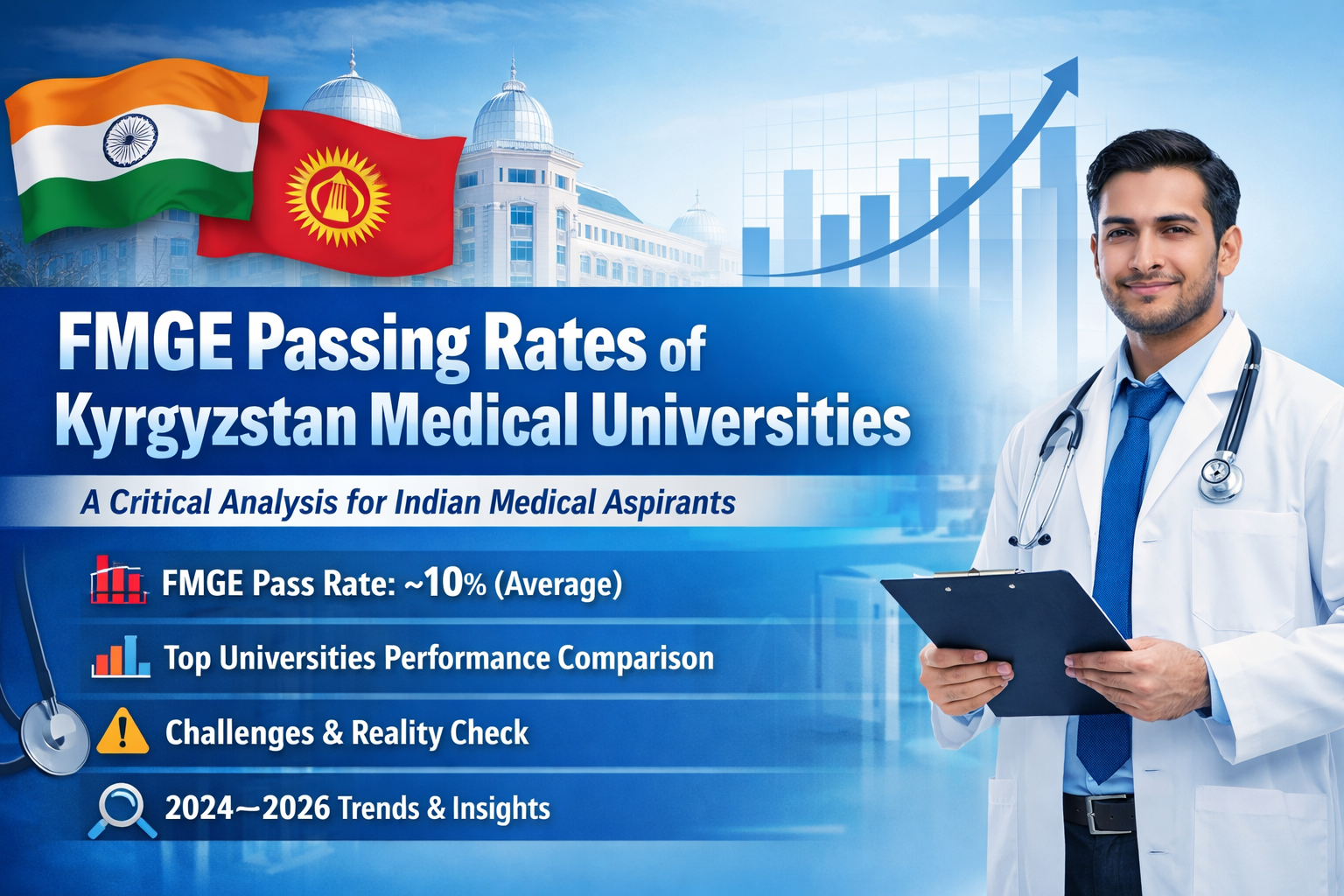
With poor performance by foreign medical graduates in FMGE (Foreign Medical Graduate Examination), it has become a hot topic of the town between students, educators and policymakers in recent years. Now, both India and Kyrgyzstan are keenly scrutinizing the passing percentages of FMGE for MBBS students in Kyrgyzstan.
As more and more Indian students enrol in Kyrgyzstan’s medical universities, it is vital to address questions regarding quality education as well as preparation for their exams and global recognition. In this article, we will check FMGE performance trends and challenges followed by reasons for this discussion amid aspirants.
Understanding FMGE and Its Importance
FMGE: This is the license exam that takes place in India for students completing their MBBS degree abroad. Students who study MBBS in Kyrgyzstan and want to practice in India are required.
Key Points:
Organised by National Board of Examinations (NBE)
It is needed for National Medical Commission (NMC) registration
Tests theoretical and clinical knowledge
FMGE is a prerequisite for students to start their medical careers in India.
The FMGE Passing Rates In Controversy
Due to varying FMGE scores across universities, the passing rates of Kyrgyzstan MBBS students have become a talking point.
Key Reasons:
huge differences in academic quality between the universities
Variations in teaching methodologies
Lack of standardized preparation support
National Medical Commission putting more and more scrutiny
As a workaround, students would be careful when choosing universities now.
Trends of FMGE Performance for Universities in Kyrgyzstan
Gradual progress is visible in the FMGE passing percentage of students from Kyrgyzstan over the past years.
Observations:
(Structured teaching leads to better results from some top universities)
High self-preparation students outperform in a significant difference
The coaching support is a huge part of it
Kyrgyzstan MBBS students are now starting to pay close attention to taking exam-oriented preparation.
Guidelines from NMC & Role in Enhancing Results
Intake of students studying abroad to undergo stricter guidelines by NMC
Key Regulations:
Minimum length of course 54 months
Mandatory internship
English-medium instruction
Recognition of university
These regulations are established to guarantee adequate training of students following MBBS in Kyrgyzstan and making them eligible for FMGE/NExT.
WHO and WDOMS recognition significance
The global body's recognition is very vital in ensuring educational standards.
Key Organizations:
World Health Organization (WHO)
World Directory of Medical Schools (WDOMS)
Universities accredited by these organizations uphold international standards. This helps improve FMGE results.
Students need to confirm that the university they are choosing for MBBS in Kyrgyzstan falls under these authorities.
Challenges Faced by Students
Even with all these improvements, students still struggle to pass FMGE.
Common Issues:
It is the Indian curriculum of 9th to 12th grades.
Lack of early FMGE preparation
Some universities have limited clinical exposure
Language barriers during patient interaction
Therefore, students going for MBBS in Kyrgyzstan need to deal with this proactively.
Significance of Selecting a Proper University
Not all are academically equal. It is very important to choose the correct institute for improving FMGE results.
Factors to Consider:
NMC recognition
Listing in WDOMS
Clinical exposure opportunities
FMGE track record
And it very much increases the chances of success if you choose a reputed university for MBBS in Kyrgyzstan.
Role of Coaching and Self-Preparation
Preparation strategies play a vital role in passing FMGE.
Effective Preparation Tips:
Preparation from the first year
Use Indian medical textbooks
Join FMGE coaching programs
Practice mock tests regularly
Consistent preparation is needed for students pursuing MBBS in Kyrgyzstan.
How Kyrgyzstan Universities Are Responding
Many universities in Kyrgyzstan are adopting better academic systems owing to the increased speculation on FMGE results.
Improvements:
Curriculum updated as per global standards
Increased clinical training
Introduction of FMGE coaching support
Better faculty training
This will lead to better performance of MBBS students studying in Kyrgyzstan.
Student Awareness and Smart Decision-Making
Students today have more information than ever before.
What Students Should Do:
Research university rankings
CHECK RECOGNITION BY NATIONAL MEDICAL COMMISSION, WORLD HEALTH ORGANIZATION AND DIRECTORY OF MEDICAL SCHOOLS
Check FMGE passing records
Consult experts or alumni
This knowledge helps students choose wisely when it comes to MBBS in Kyrgyzstan.
Future Outlook for FMGE/NExT
It also aims to replace the FMGE with a NExt (National Exit Test), bringing standardization in evaluation.
Expected Benefits:
Uniform exam for all students
Better assessment of clinical skills
Improved transparency
MBBS students in Kyrgyzstan should keep a close eye on these changes.
Global Opportunities Beyond FMGE
However students have global career opportunities, even though FMGE is very important for practicing here.
Opportunities:
USMLE (USA)
PLAB (UK)
Other international licensing exams
Worldwide opportunities granted by the world health organization world directory of medical schools.
Conclusion
The analysis of FMGE passing percentage of Kyrgyzstan medical universities emphasizes the critical aspect of quality education and adequate preparation, which can only be provided through proper research before choosing a university. Despite challenges, better academic systems and more awareness among students help to improve the situation.
To sum up, Studying MBBS in Kyrgyzstan is still a great and affordable option for Indian students. Success in FMGE is taking admission in the right type of university, following the guidelines laid down by the National Medical Commission, and it requires constant preparation.
If you wish to reach great heights, Kyrgyzstan is an achievable destination for medical education approved by the World Health Organization and listed in the World Directory of Medical Schools. Students need to take the right steps on the path for academic success—as well as clearing the best exams—but overall, pursuing medical education there has better prospects.