Introduction
Becoming a doctor is an ambition that lures thousands of Indian students every year to attempt the NEET -UG exam. However, for many, the dream becomes an exercise in futility due to the widening gap between the number of government medical college seats and the affordability of private medical colleges. Kyrgyzstan has become one of the top choices to pursue MBBS abroad for these students.
What does this journey look like from the date of the NEET result to the date of becoming a registered medical practitioner in India? This article aims to outline the realistic steps involved to become an Indian medical doctor after studying MBBS in Kyrgyzstan.
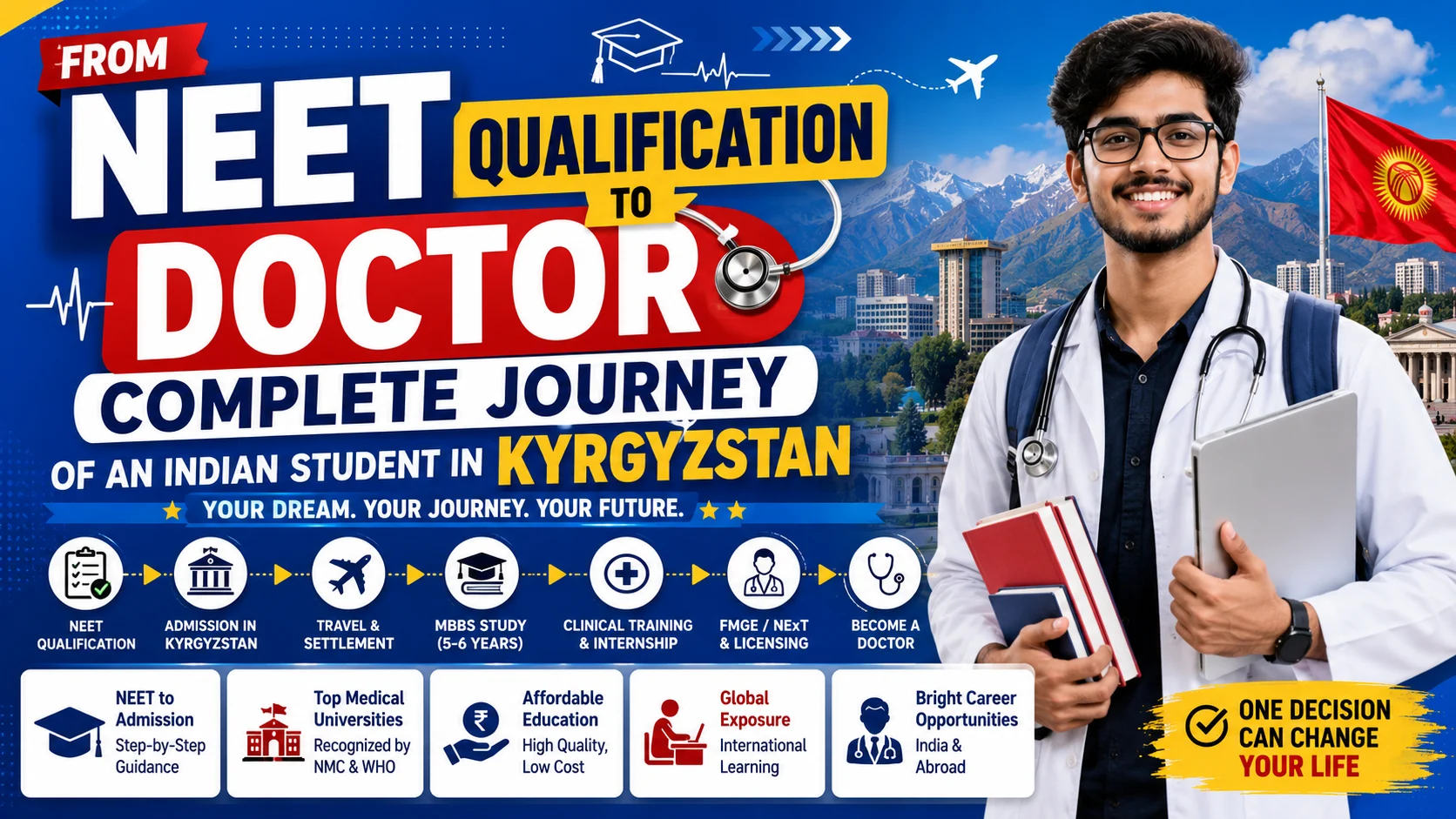
What does the process of NEET qualification to become a medical doctor after studying MBBS in Kyrgyzstan look like?
The process is clearing the NEET-UG, choosing a WDOMS listed and NMC compliant endeavor in Kyrgyzstan, completing the admission and visa process, studying for 5 to 6 years with an internship, returning to India, clearing the FMGE screening exam (which will soon be the NExT exam), and registering with the National Medical Commission or State Medical Council to get legal sanction to practice medicine in India.
Step 1 - Clearing the NEET-UG
The first step of the journey is to clear the NEET-UG, the entrance exam to pursue a medical education in India or abroad. NMC regulations bind Indian students wishing to pursue MBBS abroad to clear the NEET-UG exam.
Unlike domestic admissions, studying abroad has no higher rank limitations since only the minimum qualifying percentile needs to be achieved, while the NEET scorecard is valid for three years for international admissions.
Step 2: Realizing the Domestic Seats are Not Enough
The next step in the process is often frustrating to students; the government provides very few seats, and the private medical colleges in India charge between ₹70 lakh and ₹1 crore. This pushes many families to pursue MBBS in Kyrgyzstan and other cheaper options.
Step 3: Researching Kyrgyzstan
The first step of research after making the decision to leave the country to study is that Kyrgyzstan has the following advantages:
Reduced course and living costs from other countries.
English MBBS programs.
Considerable Indian student population.
Established Indian community.
World Directory of Medical Schools.
Recognized by NMC.
Eligibility to Study MBBS in Kyrgyzstan
Criteria | Requirement |
Qualifying Exam | 10+2 with Physics, Chemistry, Biology (PCB) |
Minimum Marks | 50% aggregate; 45% for reserved categories |
Entrance Exam | Valid NEET‑UG score |
Age Limit | Minimum 17 years |
Medium of Instruction | English |
Course Duration | 5–6 years (includes internship) |
Step 4: The Admission Process
After selecting the college, the admission process for Kyrgyzstan MBBS admission generally includes the following steps:
Submission of all required documents with NEET scorecard and passport.
Receive the official invitation letter from the college.
Pay the initial registration fee and apply for a Kyrgyzstan student visa.
Travel to Kyrgyzstan and complete all enrollment formalities.
Applications are typically submitted several months before the start of the school year because most universities begin their academic sessions in September.
Step 5. Understanding the Fee Structure
Before the family of a future medical student takes a one-way flight to Kyrgyzstan to study medicine, they want to know Kyrgyzstan's medical fees in India rupees. Total course costs (including tuition and accommodation) will be between ₹15 lakhs and ₹25 lakhs, which is substantially lower than the cost of private medical schools in India. Do not trust a consultant's cost estimate. Request an official document from the university with the detailed and itemized fee structure.
Step 6. The First Year – Adjusting to a New Life
The first year living in a new country is the most difficult year out of the entire journey. New medical students face the following challenges:
Adjustment to a new culture and climate.
The balancing act of making new friends and overcoming homesickness.
The balancing act of breaking down new foundational courses (anatomy, physiology, and biochemistry).
The balancing act of learning to speak Russian or Kyrgyz for basic daily interactions.
Step 6 is for the Kyrgyzstan MBBS journey. Regarding Step 6, most students believe staying in touch with older students from that university and joining student groups helps the adjustment the most.
Step 7. Establishing Academic and Clinical Foundations
The later years of the Kyrgyzstan MBBS journey are focused on clinical education. To integrate the digital world and prepare students to care for patients, universities are beginning to implement simulation labs and case-based learning.
Step 8. The Year of the Internship
Once students complete the academic years of the MBBS program, a compulsory rotating internship provides students with the first-hand experience of working in all the major areas of medicine (general medicine, surgery, gynecology, and emergency medicine).
Internship Requirements
This internship is mandated for the Foreign Medical Graduate Licentiate Regulations (FMGL) 2021. It must typically be performed at the same institution where the applicant completed their academic training.
Step 9: Arriving Back in India and Getting Ready for the FMGE/NExT
After the completion of the MBBS program, graduates return to India to prepare for the Foreign Medical Graduate Examination (FMGE), which is in the transition process of being replaced by the National Exit Test (NExT). This is a qualifying examination which ensures that overseas medical graduates possess the requisite clinical competencies to be comparable to Indian graduates, before being allowed to practice.
Step 10: Getting Registered and Becoming a Medical Practitioner
Upon successful completion of the FMGE or NExT, graduates are eligible to become registered members of the National Medical Commission or the medical council of the respective State. Thereafter, they are eligible to:
Practice medicine in any government or private hospital in India
Pursue MD/MS
Opt for research or academics
Consider professional practice in other countries after obtaining the requisite licensing
Advantages of This Route
Significantly lower overall cost compared with pursuing private MBBS in India
Quality of education is good and is conducted in English
Education is in a multicultural environment
Clear and definite pathway to practice in India via FMGE/NExT
Strong peer community of fellow Indian students
Disadvantages
First year emotional adjustment can be difficult
Varying quality of infrastructure requires students to research before selecting a university
FMGE/NExT must be passed, requiring dedicated preparation
Distance from family for long periods
Changes in currency can impact the cost of fees
Most Popular Universities for Indians in Kyrgyzstan
Kyrgyz State Medical Academy (KSMA)
Osh State Medical University
International School of Medicine (ISM)
Jalal-Abad State Medical University
Asian Medical Institute
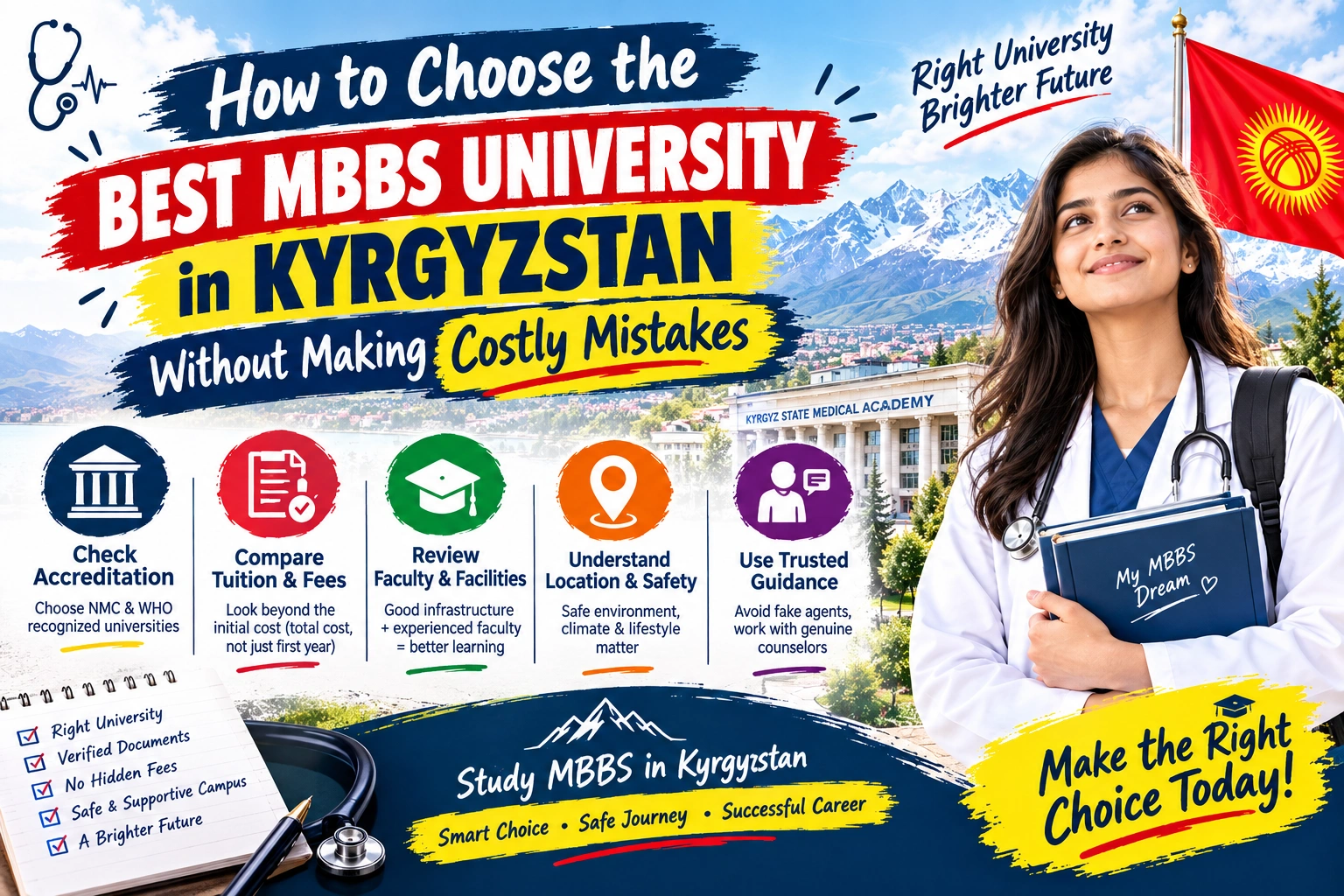
Always check a university’s current status and recognition in the WDOMS and the NMC websites before making your final decision.
Future Career Opportunities
Doctors who cover the entire pathway NEET + FMGE/NExT have the same career prospects as doctors who graduate in India. This includes earning the right to practice a specialty as well as taking up research in hospitals. WHO and other global health bodies stress the importance of having well trained doctors with global exposure and experiences among their professions, thus providing an enormous advantage to those doctors who have a global view and perspective, and who want to bring new ideas to the Indian healthcare system.
Roadmap to the Journey
Step | Tentative Time | Up to Here — Key Milestone |
NEET‑UG Qualification | 1 year preparation | Valid scorecard for 3 years |
University Selection and Admission | 2–3 months | Admission confirmation, invitation letter |
Invitation and Visa | (time varies) | Visa issued, travel arranged |
Academic Years — Theoretical and Clinical MBBS | 5 years | Completion of academic coursework |
Internship — Compulsory Rotatory Training | 1 year | Internship completed |
FMGE/NExT Preparation | 6–12 months | Ready to attempt FMGE/NExT |
Common Queries
Q1. Is a high NEET ranking mandatory for MBBS admissions in Kyrgyzstan?
No, qualifying NEET-UG with a minimum required percentile, and not a high ranking, is sufficient to obtain admissions abroad.
Q2. How many years of study does it take to become a physician after completing NEET?
On average 7 to 8 years, factoring in MBBS, the internship, and studying for the FMGE/NExT after returning to India.
Q3. What about the study MBBS in Kyrgyzstan? Is it accepted in India?
Yes, if the university is listed in WDOMS and recognized by the NMC, and if the graduate passes the FMGE or the NExT.
Q4. What do you think is the most difficult thing to adjust to?
The biggest hurdle, for many students, is the emotional adjustment in the first year overseas, plus the FMGE/NExT upon returning.
Q5. Can one pursue post-graduation after MBBS in Kyrgyzstan?
Yes, graduates are eligible to pursue post-graduation as specializations, after FMGE/NExT and registering with NMC, like doctors in India.
Q6. Is it mandatory to complete an internship in Kyrgyzstan?
Yes, as per FMGL 2021 guidelines, internship must be done in the same institution where the MBBS was done.
Conclusion
The path from NEET to obtaining a medical license is seldom a direct journey, but for numerous Indian students, MBBS in Kyrgyzstan has been a tried, true, and economically feasible means to obtain a medical degree. Clear strategies with patience to negotiate each stage from selecting a university to the FMGE/NExT are crucial to this journey which, with sufficient effort, brings a fulfilling medical career in India.