Deciding on a medical university is one of the biggest decisions an Indian student has to make when applying to study MBBS in Kyrgyzstan. Kyrgyzstan has a spot in the list of preference for several candidates due to English-medium medical programs, a simple process for admissions, cheaper tuition fees, and universities that welcome international students.
The biggest dilemma students face is whether to join a government medical university or a private medical college in Kyrgyzstan.
Choosing between a government or private medical college is not the only consideration. For Indian students, the duration of the program, clinical training and practice, the university’s accreditation, the curriculum, the medium of instruction, international recognition, the total cost, and the status of the university in the World Directory of Medical Schools are more important.
According to the World Health Organization's country health system review, Kyrgyzstan has private and public institutions of higher medical education. The review stated that as of February 2022, there were 5 public and 17 private institutions of higher medical education.
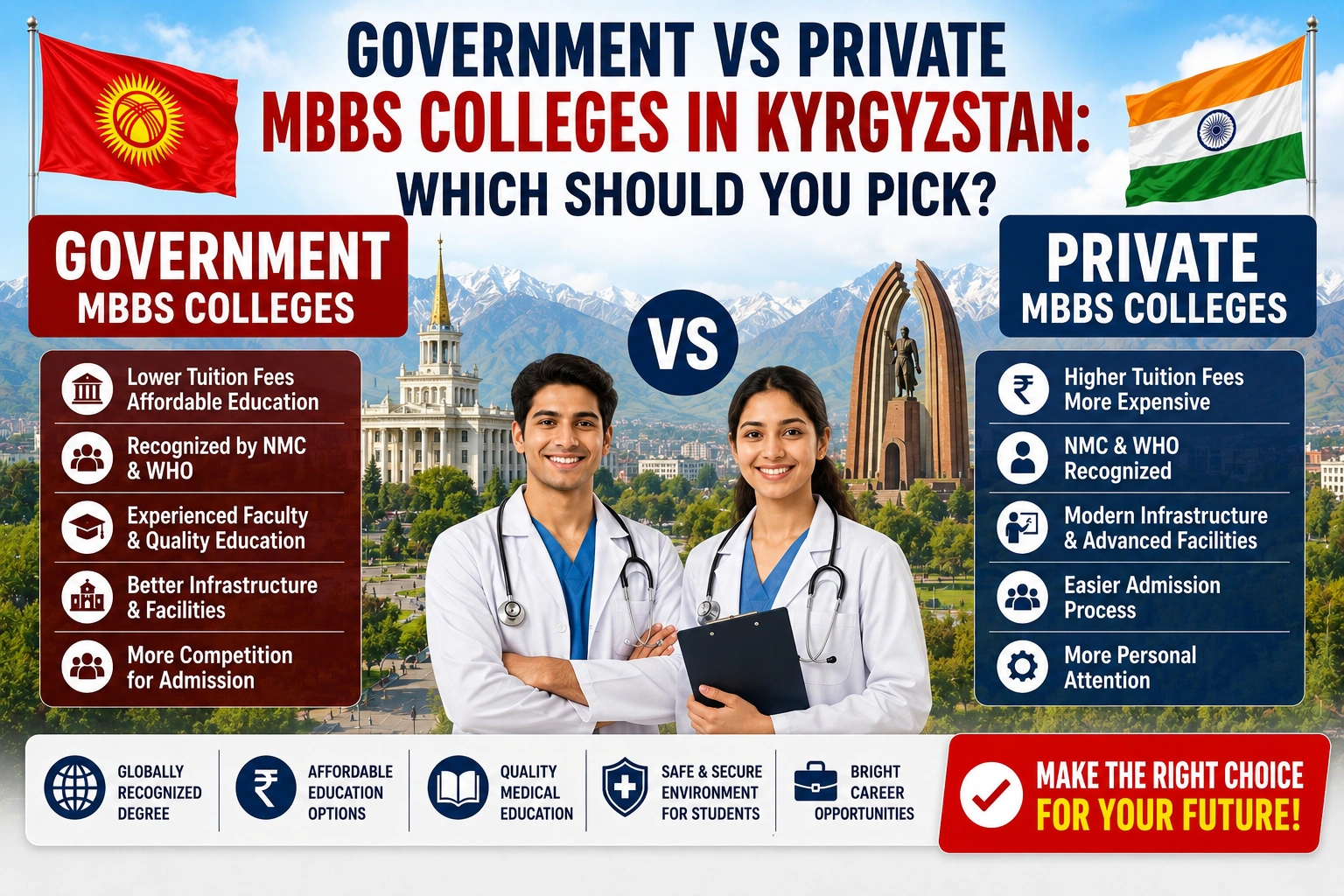
Government vs. Private Medical Colleges in Kyrgyzstan: A Quick Comparison
Factor | Government Medical Colleges | Private Medical Colleges |
Ownership | State/public | Privately managed |
Tuition | Affordable | Moderate to high |
Competition | High | Accessible |
Infrastructure | Found across older universities | Varies by university |
Clinical exposure | Hospital affiliations | Depends on hospital |
International Students | Available | Common |
English medium | Available | Common |
Programs | Flexible | More flexible |
Student support | Varies | Focused on international students |
Best for | Affordability and established institutions | International student support and modern facilities |
The table covers a quick general overview. Individual universities vary significantly and students should examine the medical programs themselves because each government college is not better than each private college.
Government Medical Colleges in Kyrgyzstan
Government medical universities are state-supported public institutions and provide medical education in most cases in older universities. They often have established teaching hospitals with experienced faculty and clinical infrastructure.
One benefit of older public institutions is that students may have access to a larger clinical ecosystem and affiliations. For example, WDOMS shows information of accredited medical programs in Kyrgyzstan with long standing operations.
Advantages of Government Medical Colleges
Long term established reputation in academia
Potentially lower tuition costs
While tuition is often cheaper at government institutions, the exact amount is often specific to the university and the program. Students need to have the most recent official fee schedule, as estimates from consultants are misleading.
Established clinical infrastructure
Many public medical universities have affiliated hospitals and a large patient population. This may be useful for students who need more consistency for clinical exposure.
Wider academic environment
Government universities may have larger student communities, multiple departments and established postgraduate or research areas.
Limitations of Government Colleges
Being a government college does not guarantee NMC eligibility for students in India. In India, many private institutions offer medical programs. Just because a medical college is a government college does not mean the program is NMC Regulatory compliant.
So, students should dig in and understand the exact medical program to which the ownership category is applied.
Private Medical Colleges in Kyrgyzstan
For international students, private medical schools have grown in number and reputation. Many private colleges have designed their techniques and services to cater to international students.
For example, the WDOMS list International Medical University in Kyrgyzstan as a private medical school, and on this list is a medical program for international students. There is accreditation data for this medical program supplied by the Kyrgyzstan accreditation agency.
Advantages of Private Medical Colleges
International student-centered services
Many private universities have recruitment programs designed specifically to attract international students. They also offer support for international students in the areas of admissions, accommodations, and other student support and services.
Options in English
There are English-medium and international student-oriented programs. Details with WDOMS for Kyrgyz medical programs include these.
Some universities have focused on improving facilities
There are some private universities that have made considerable investments in laboratories, simulation, classrooms and student accommodations. That said, this is college specific.
Generally more flexible systems
Private institutions may have more flexible admission systems. That said, Indian students still require NEET clearance and foreign medical education approval.
Other related issues
The issue of quality is the biggest concern.
Not all private medical colleges offer the same levels of clinical training, faculty strength, hospital exposure and academic infrastructure. The NMC has warned students about foreign private medical colleges that do not comply with requirements.
Therefore students should not select any college based merely on the fee charged by the college, or on an agent's claim of it being “NMC approved.”
The NMC's Regulations trump Private or Government Status
For Indian students, it is the most important aspect.
The NMC has laid down the standards that Indian students have to comply with in order to get their medical registration in India upon returning from foreign medical education.
The NMC standards outline the duration, the medium of instruction, clinical training, and the internship as well as the curriculum. The Commission also advises students on the due diligence they must do as a pre-requisite to join a foreign medical institution.
Students should look up the NMC official website for the latest rules before paying the admission fee.
An NMC advisory states that deviations regarding duration, method of instruction, the syllabus, the arrangement for clinical training or internship may affect registration in India. This advisory also mentions the requirement of a minimum period of education in a single institution, a 12-month internship and English as the medium of education.
From this, we can infer:
The primary concern shouldn’t be whether the college is government or private. The primary concern should be whether the college is NMC compliant.
What Should Students Check in the WDOMS Listing?
Indian students also have to confirm their university and medical program through the World Directory of Medical Schools (WDOMS).
WDOMS provides relevant information about medical schools such as the duration in years, medium of instruction, international admissions, and accreditation information, if any. For example, WDOMS records for different universities of Kyrgyzstan show programs of 5 or 6 years and different accreditation.
Before choosing a university, students can check the WDOMS official website.
The WDOMS listing in itself does not warrant registration for the Indian medical profession. Students must confirm the NMC requirements.
The Role of WHO in Selecting a Kyrgyzstan Medical College
For the health and medical education of different countries, including Kyrgyzstan, the official WHO website provides information.
However, students should understand the distinctions among WHO, WDOMS listing, and Indian regulatory approvals.
WHO: Provides international health-system and public-health information.
WDOMS: contains information on medical schools and the programs offered.
NMC: identifies regulatory requirements for Indian medical graduates seeking registration in India.
NEET: evaluates the applicable requirements for the admission of Indian students to medical education abroad.
Therefore, college cannot be considered “safe” or “WHO approved,” simply because of a claim made by someone.
NEET Requirement for Indian Students
Indian students who wish to pursue an undergraduate medical degree overseas must pay attention to NEET eligibility.
NMC's regulations and notices have mandated that Indian citizens/OCIs qualifying for admission to a MBBS or equivalent medical degree course abroad must clear NEET as per the requirements. NMC has clarified that qualifying NEET fulfills the eligibility requirement for admission to medical courses abroad under the applicable Act.
Students should further confirm the prevailing requirements on the NEET portal and the NMC regulations before seeking admission.
Government vs Private: Which Has Better Clinical Exposure?
Clinical exposure is probably the most important factor in comparing universities.
A university may have excellent classrooms and an impressive campus, but no clinical exposure. The other may have substandard classrooms, but a proven track record of easy and direct access to quality hospitals and a large patient base.
Before applying, students should ask the following questions:
Which hospitals are associated with the clinical placement process?
Is clinical training offered in Kyrgyzstan?
When does clinical placement begin?
Is the clinical placement completed in the same institution / system?
What is the student to patient ratio?
Are clinical rotations documented?
Is the medium of instruction in line with NMC requirements?
These questions matter more than whether the college is private or government owned.
Government vs Private MBBS Fees in Kyrgyzstan
Due to varying fees among universities, quoting one comprehensive figure to represent government or private college fees is not sufficient.
Generally, government universities have low fees and are popular among students who are fee conscious. Private colleges may have high fees.
However, tuition fees only account for a small fraction of the overall fees.
Indian students should consider the following:
Tuition
Hostel fees
Food
Medical insurance
Visa and registration fees
Air fare
Study materials
Local Transport
Personal expenses
Currency exchange expenses
A college with better clinical placement facilities and more affordable accommodation may have a higher tuition.
Which is Better for Indian Students?
It is difficult to answer which is better.
Choose a Government Medical College If:
There is an established public university.
There is a preference for lower fees.
The university has a good clinical infrastructure.
The program satisfies the requirements of the NMC.
The placement is documented in WDOMS.
There is a preference for more structured academics.
If:
You wish for more support as an international student.
You enjoy better up-to-date facilities.
You require an English-medium program specially designed for international students.
The institution has strong clinical affiliations.
The total cost is within your budget.
Your chosen program meets the requirements of the NMC.
How to Choose a Medical College in Kyrgyzstan
Indian students considering an MBBS program in Kyrgyzstan should follow a careful, step-by-step verification process before making any payment or accepting an offer. The decision should be based on regulatory compliance, academic quality, clinical exposure, and the institution’s ability to support a reliable pathway toward medical registration in India.
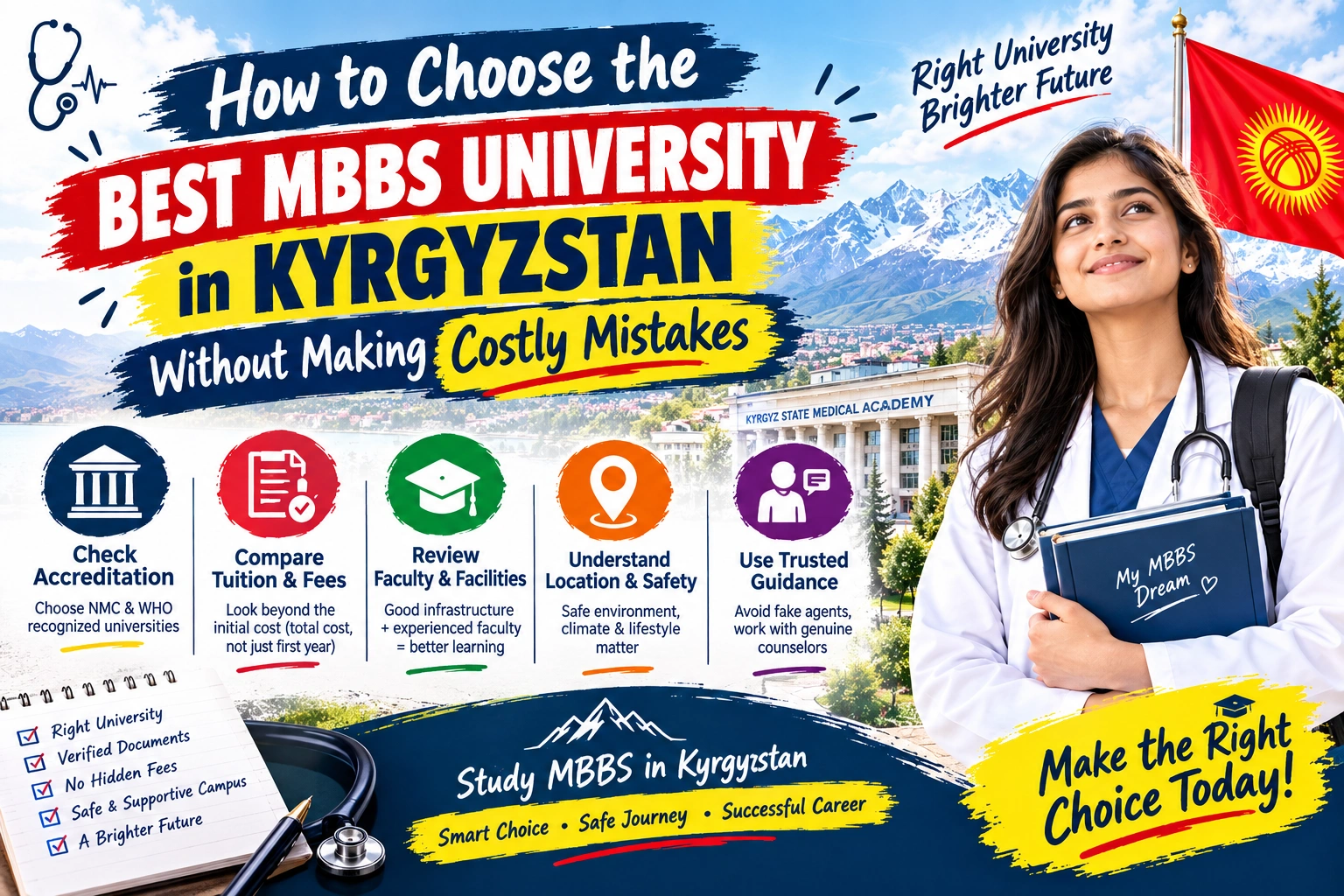
1. Verify the University
Start by confirming the basic status of the university:
Verify the university’s official name, location, and current operational status.
Check whether it is properly recognized and accredited in Kyrgyzstan.
Do not rely only on advertisements, agent claims, rankings, or general reputation.
A university may be well known, but that does not automatically mean that every medical program it offers is suitable for Indian students.
2. Verify the Specific Medical Program
The medical program itself must be assessed separately from the university.
Check the specific MBBS or medical degree program through the World Directory of Medical Schools (WDOMS).
Confirm the course duration, structure, curriculum, and qualification awarded.
Ensure that the academic calendar reflects the required duration of study.
Verify whether the program includes the required clinical training and internship components.
Different programs within the same university may vary in duration, teaching language, clinical exposure, and eligibility outcomes. Therefore, do not make a decision based only on the university’s overall reputation.
3. Check NMC Compliance
For Indian students, compliance with the National Medical Commission (NMC) requirements should be a primary consideration.
Review the latest Foreign Medical Graduate Licentiate Regulations and related NMC requirements.
Confirm that the course structure, duration, internship, and clinical training meet the applicable standards.
Ensure that the student has qualified NEET, where required, before admission.
Verify that the program offers a clear and appropriate pathway toward medical registration in India.
Regulatory compliance is more important than low tuition fees, hostel offers, scholarships, or “special” admission packages.
4. Confirm Clinical Training
Clinical exposure is an essential part of medical education. Students should directly contact the university and seek written clarification about:
Hospital affiliations
Clinical rotations
Patient exposure
Clinical placements
Internship arrangements
Departments available for practical training
Do not assume that a college provides adequate clinical training simply because it advertises a medical program. Ask for specific details about where, when, and how students complete their practical and clinical education.
5. Confirm English-Medium Instruction
If the program is advertised as English-medium, obtain formal confirmation from the university.
Verify whether the full medical curriculum is taught in English.
Ask whether lectures, examinations, study materials, and clinical instruction are available in English.
Request an official confirmation letter stating that the program is delivered in English.
This written confirmation can be important for future documentation and regulatory verification.
6. Compare the Total Cost
Students should compare the complete cost of studying, not just the annual tuition fee.
Consider the following expenses:
Tuition fees
Hostel or accommodation charges
Food and living expenses
Medical insurance
Visa and registration costs
Travel expenses
Examination fees
Books, equipment, and other academic charges
Additional charges for clinical training or internship, if any
A college with lower tuition may not necessarily be more affordable once all expenses are included. Ask for a detailed written fee structure before making any payment.
7. Government vs Private Colleges
It is not always useful to ask whether a government or private medical college is better. Both types of institutions can have strengths and limitations.
Type of college | Possible advantages | Important consideration |
Government medical college | Historical status, affordability, established hospitals, and existing clinical systems | The specific program still needs verification for compliance, teaching language, and student support |
Private medical college | International student services, modern facilities, English-medium programs, and student support | Recognition, fees, clinical exposure, and program structure must be independently verified |
A compliant, established private medical university can be a suitable option for Indian students. Likewise, a government college should not be selected automatically without verifying the exact medical program.
8. Ask the Right Question
Instead of asking, “Is a government college better than a private college?”, students should ask:
“Which medical program offers the best combination of NMC compliance, proper clinical training, recognized academic status, appropriate course structure, transparent fees, and a reliable pathway to medical registration in India?”
The answer depends on the individual university and the particular medical program—not simply on whether the institution is government-run or private.
Conclusion
Before finalizing admission to a medical college in Kyrgyzstan, confirm the following:
University name, location, recognition, and operational status
Listing and details of the specific medical program on WDOMS
Course duration and complete academic calendar
NMC compliance and NEET eligibility requirements
English-medium instruction, supported by an official letter
Clinical rotations, hospital training, placements, and internship arrangements
Accreditation and academic recognition
Complete written fee structure, including all additional expenses
Clear documentation from the university before paying any fee
For Indian students pursuing MBBS in Kyrgyzstan, the most important decision is not choosing between a government and private college. It is selecting a specific medical program that provides valid academic status, proper clinical training, transparent costs, regulatory compliance, and a dependable route toward medical registration in India.