
Introduction
The first consideration for anyone interested in the MBBS program in Kyrgyzstan is accreditation. It cannot be a one-time activity. Kyrgyzstan's medical universities and India's medical regulatory boards re-evaluate the accreditation regularly. The most recent reviews in 2026 are crucial for prospective students and we discuss them in this article.
Here, you will find everything you need to know about MBBS in Kyrgyzstan, including the accreditation system, recent changes, and the process to check the accreditation status of a university. You will also find information on eligibility, the admission process, fees, the best universities to choose from, and the career options available after graduation.
Section Summary: Short Response
What are the things to consider when checking Kyrgyzstan university accreditation updates? When checking Kyrgyzstan university accreditation updates, consider three elements: the Kyrgyz Ministry of Health accreditation results (which determine the duration a university may legally operate), the university's current status in the WHO World Directory of Medical Schools (WDOMS), and whether the Indian National Medical Commission has listed any alerts for the university. In the 2026 Kyrgyzstan state accreditation review, only 24 of the 34 medical universities were evaluated. Four universities received a 6-year accreditation, seven received a 1-year accreditation, and 13 were denied accreditation.
Reviewing Kyrgyzstan's Accreditation Process for 2026
Kyrgyzstan's Ministry of Health will assess medical universities every so often to check the quality of their infrastructure, faculty, clinical training, and overall academic standards.
The latest state accreditation process shattered the complacency of many who perceived the quality of every Kyrgyz medical university to be the same.
Accreditation Outcomes
Accreditation Outcomes
Number of Institutions
Implications for Students
6-year accreditation
4 universities
Certification of long-term operational stability.
1-year accreditation
7 universities
Must be evaluated again in a year.
Did not pass
13 institutions
Failed to provide the necessary quality of education and infrastructure.
Did not participate
10 institutions (out of 34)
Status unknown. Requires on-site verification.
hold the strongest, longest accreditation status. That's a significant detail agents rarely highlight upfront — and exactly why independent verification matters more than ever if you plan to study MBBS in Kyrgyzstan.
Why This Differs from NMC Recognition
Two different tiers of approvals must not be conflated:
Kyrgyz state accreditation — from Kyrgyzstan's Ministry of Health, indicating the university fulfills the operational requirements locally.
NMC approval and WDOMS listing — a distinct international recognition of the university, and if the Indian graduates would be eligible to sit for the FMGE/NExT licensing exam.
A university can in fact have WDOMS listing and lack local accreditation, or the other way around. Per the recent NMC compliance data, there is currently no advisory against any of the Kyrgyz medical universities. However, that status is constantly being reviewed in light of the NMC's Foreign Medical Graduate Licentiate (FMGL) Regulations, 2021, thus it is not a "check and forget" situation.
What Students Should Actively Verify Before Enrolling
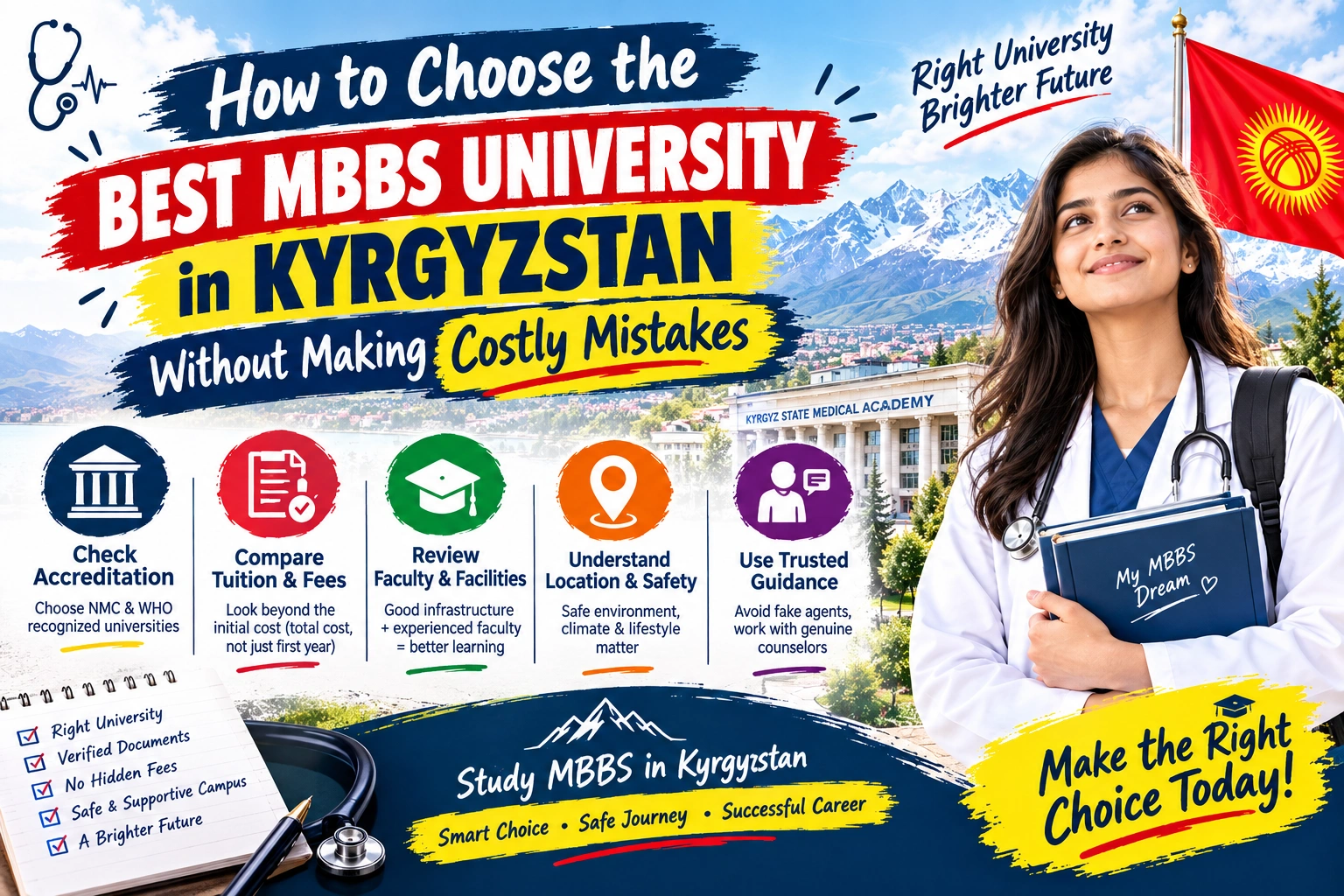
Accreditation from the Kyrgyz Ministry of Health — directly ask the university for the current accreditation certificate and its validity period.
WDOMS listing — look up the university’s complete name in the WHO World Directory of Medical Schools directly. Do not use a screenshot provided by an agent.
NMC compliance — ensure there is no advisory or delisting on the NMC’s official website.
Minimum instructional duration — according to the NMC, the course duration should be 54 months, excluding the internship.
English-medium confirmation in writing — request this from the university’s admission office.
Eligibility Criteria for MBBS in Kyrgyzstan
What you should have once you have listed fully accredited universities:
Min 50% aggregate score in PCB (Physics, Chemistry, Biology) in Class 12 (40% for SC/ST/OBC);
Class 12 from a recognized board;
Valid NEET UG score as per NMC;
Min age of 17 years by 31st December of the year of admission;
Valid passport for the entire duration of the course.
Admission Process for MBBS in Kyrgyzstan
Shortlist universities with Kyrgyz State Accreditation and NMC/WDOMS accreditation.
Ensure you have qualified the NEET and keep your academic documents ready.
Apply to the university directly or via an accredited agent.
Ensure you receive the admission/invitation letter directly from the university.
Apply for the Kyrgyz student visa.
Transfer the first year tuition fees to the university’s official bank account.
Complete the required travel, local registration, medical checkup, and residence permit formalities.
MBBS in Kyrgyzstan Fees
Kyrgyzstan MBBS cost for a WHO/NMC recognized Medical degree, remains among the most affordable globally. However, the fees vary significantly due to university tier and city accreditation.
Benefits of Choosing a Properly Accredited University
Have more confidence that your degree will be accepted to take India's licensing exam.
Less chance of accreditation-related disruptions while you are studying.
Better clinical training infrastructure aligned with higher tiers of accreditation.
More peace of mind making a big financial commitment.
Visa and documentation processes with more stability.
Disadvantages and Risks for Ignoring Accreditation Changes
There is uncertainty with a 1-year accredited university for long-term accreditation.
Universities that have lost accreditation may be operating while appeals are underway and cause confusion among current students.
Agents may downgrade their accreditation to avoid losing a sale.
Switching universities due to accreditation issues can be a wasted cost and time.
Even accredited universities need to comply with the NMC, so a status check is needed periodically, not only during admission.
Top Universities for MBBS in Kyrgyzstan to Investigate
University
Kyrgyz State Medical Academy (KSMA)
City
Bishkek
Recognition Highlights
Established 1939; NMC, WHO, WDOMS, ECFMG recognized.
Kyrgyz Russian Slavic University (KRSU)
Bishkek
Good FMGE results among Kyrgyz universities.
Osh State University
Osh
Public university, established 1951.
Jalal-Abad State University (JASU)
Jalal-Abad
Public university, established 1993.
International School of Medicine (ISM)
Bishkek
Large number of international students.
Asian Medical Institute (ASMI)
Kant
Accredited by NMC, WHO, ECFMG, FAIMER.
Even for the institutions of this list that are considered to be reputable, always check the accreditation status with the university and not older articles or brochures, as the status changes after review cycles.
Career Options After MBBS in Kyrgyzstan
Graduates of currently accredited Kyrgyz universities, NMC approved, and WDOMS listed, can:
What are my licensing options after graduating from a medical school in Kyrgyzstan? After passing the FMGE/NExT, you may receive a license to practice medicine in India. You may also take the USMLE or UKMLA to obtain licensure in the USA or the UK, respectively. You may also choose to practice medicine in Kyrgyzstan or take advantage of the lax border regulations to practice medicine in neighboring countries, though you may be subject to their regulations as well.
There is a correlation between a medical school’s accreditation status and the quality of their clinical training. Poor clinical training will leave medical graduates unprepared for licensing examinations.
Frequently Asked Questions About Kyrgyzstan Medical Schools
Q1: What happened in the 2026 University Accreditation Reviews in Kyrgyzstan?
Of the 34 medical universities, only 24 took part in the state accreditation. 4 were provided with a 6 year accreditation, 7 were provided with a 1 year accreditation and 13 were found to be non-compliant with the expected standards.
Q2: If a university loses Kyrgyz state accreditation will it also lose NMC recognition?
Not necessarily. However, if a university loses either accreditation, the other will be lost too. Students must verify both local and NMC/WDOMS accreditation of the university independently as one does not guarantee the other.
Q3: How do I verify the accreditation status of a medical school?
You must request the official accreditation certificate directly from the university. You can check the listing on the WHO World Directory of Medical Schools and the NMC registries to confirm accreditation.
Q4: Is NEET mandatory regardless of Kyrgyzstan University’s Accreditation status?
Yes, obtaining a qualifying score in NEET UG is mandatory for all Indian students wishing to gain medical licensure under NMC guidelines regardless of the accreditation status of any Kyrgyz medical universities.
Q5: Should I stay away from universities with 1 year of accreditation?
Not exactly, but be careful. Request the university's plan for improvement and their scheduled accreditation visits. Compare that risk with other universities that offer long-term accreditation.
Q6. Where can I find the most official and current accreditation information?
You should rely on news from the Kyrgyzstan Ministry of Health, the WHO WDOMS directory, and the official NMC website. User generated data, especially that which is based on agents, must not be used.
Conclusion
Accreditation should not be something you check once. It is a very important and ongoing indication of how reliable your medical education is. The assessment in 2026 has shown how not every medical university in Kyrgyzstan can be judged equally and that the need for independent verification has only increased.
If you are considering MBBS in Kyrgyzstan for Indian students, the best practice is to always check the accreditation status with the official sources prior to important decisions that can impact your career. The additional time spent today can protect years of that investment and your medical career.