
Success after a foreign medical degree rarely looks like the smiling graduation photograph shared online. That picture captures one day. It doesn’t show six years of examinations, Russian-language practice, hospital postings, document verification, FMGE preparation, failed mock tests, internship, and the nervous wait for registration. Indian graduates of MBBS in Kyrgyzstan have followed different professional routes. Some cleared FMGE and entered supervised clinical training in India. Some needed more than one attempt. Others used their medical education for research, medical review, pharmacovigilance, or healthcare-related roles while continuing to work toward clinical licensing. Public testimonials do not always publish full names, registration numbers, university records, or examination scorecards. So a careful reader should distinguish a genuine personal account from a promotional success claim. Real success exists. Verification still matters.
Success Story One: Returning to India After Clearing FMGE
One of the most familiar success paths begins with an Indian student who qualifies NEET, joins a medical university in Kyrgyzstan, completes the programme and internship, returns to India, and clears FMGE after a dedicated preparation period. Publicly shared graduate accounts often describe the same difficult transition. University examinations abroad may involve written answers and oral assessments, while FMGE demands fast recall across a broad medical syllabus. The graduate suddenly has to revise everything—Anatomy, Pharmacology, Community Medicine, Surgery, Obstetrics, Paediatrics, and the shorter subjects too.
Those who succeed usually don’t rely on one last-minute revision. Their preparation often includes:
Topic-wise MCQs during university years
Indian public-health programmes
Regular image-based practice
Two or three complete revisions
Full-length mock examinations
Careful analysis of incorrect answers
Proper sleep during the final weeks
After passing, the graduate still needs to complete the verification, internship, and registration formalities applicable to their admission batch. Success is not merely seeing “qualified” on a result page. It is completing the lawful route into medical practice.
Success Story Two: Clearing the Exam After an Unsuccessful Attempt
What happens if a graduate doesn’t qualify on the first attempt? For many foreign medical graduates, this is the point where the polished success-story version ends. Real life keeps going. Several publicly shared FMGE journeys show doctors succeeding after changing their study method rather than simply studying longer. The first attempt may reveal weak clinical subjects, incomplete revision, poor mock-test stamina, or too much passive video watching.
A second-attempt success often begins with uncomfortable honesty:
Which subjects caused the most lost marks?
Were notes revised more than once?
How many full tests were completed?
Were guessed answers reviewed?
Did anxiety affect time management?
Was the student solving questions or only watching lectures?
One Kyrgyzstan graduate publicly discussed building a medical-review career after repeated FMGE difficulty, showing that a medical degree can support non-clinical work while the graduate reassesses the licensing route. Another set of graduate interviews describes eventual FMGE clearance after focused revision and repeated question practice. The lesson is simple. One result does not erase six years of education. But the next attempt needs a changed plan, not the same plan repeated louder.
Success Story Three: Using Clinical Rotations to Build Confidence
A quieter success story begins inside the hospital, long before graduation. An Indian student enters the clinical years knowing the theory but struggling to speak with local patients. The lectures may be in English, yet the patient describes symptoms in Russian or Kyrgyz. Initially, the student stands behind the group and waits for translation. Then comes daily language practice. Ten medical phrases, then twenty. Basic questions about pain, fever, medication, allergies, and previous surgery. Slowly, the student begins taking supervised histories and presenting cases. By final year, that same student can connect symptoms with examination findings, investigations, and initial management. This may not attract a viral social-media post, but it is genuine academic progress. Students pursuing MBBS in Kyrgyzstan often say local-language effort changes the quality of clinical training. Hospital attendance alone is not enough. Meaningful exposure requires participation. That practical confidence later helps during FMGE preparation, Indian internship, and clinical interviews. A textbook can teach diagnostic criteria. A real patient teaches uncertainty.
Success Story Four: Moving Into a Non-Clinical Medical Career
Not every medical graduate enters clinical practice immediately. Some use their medical knowledge in medical writing, clinical research, pharmacovigilance, insurance review, healthcare operations, medical coding, or drug-safety work. The publicly discussed journey of a Kyrgyzstan medical graduate moving into a medical-review role after difficulty with FMGE is a useful reminder: a foreign medical degree can support careers beyond direct patient care, although job eligibility varies and such roles do not provide the right to practise medicine independently.
Possible non-clinical pathways include:
Medical reviewer
Pharmacovigilance associate
Clinical-research coordinator
Medical writer
Health-insurance medical analyst
Clinical data associate
Medical-content editor
Healthcare operations executive
Public-health programme assistant
Honestly, these careers are often treated as a consolation prize. They shouldn’t be. Some graduates discover that research, writing, analysis, or healthcare systems suit them better than ward practice. Still, the distinction must remain clear: a non-clinical job does not replace medical registration where clinical practice is required.
Success Story Five: Preparing for Postgraduate Training
Another successful route starts after Indian registration. Once the graduate has met the applicable licensing, internship, and registration requirements, postgraduate medical education becomes the next target. This stage is competitive. Very. A foreign medical graduate may need to move directly from licensing preparation into postgraduate entrance study. The syllabus overlaps, but the level of competition and speed can be different. Students with strong concepts from their MBBS in Kyrgyzstan years are better placed than those who studied only to pass university examinations.
A practical progression looks like this:
Stage | Main Goal |
Medical degree abroad | Complete all academic and clinical requirements |
Licensing examination | Demonstrate required medical knowledge |
Indian internship | Adapt to the Indian healthcare setting |
Registration | Obtain lawful authority to practise |
PG preparation | Compete for specialist training |
Residency | Develop supervised specialist competence |
There is no instant jump from graduation to consultant practice. Medicine takes time. That is true whether the first degree comes from India or abroad.
What Successful Graduates Usually Did Before Admission
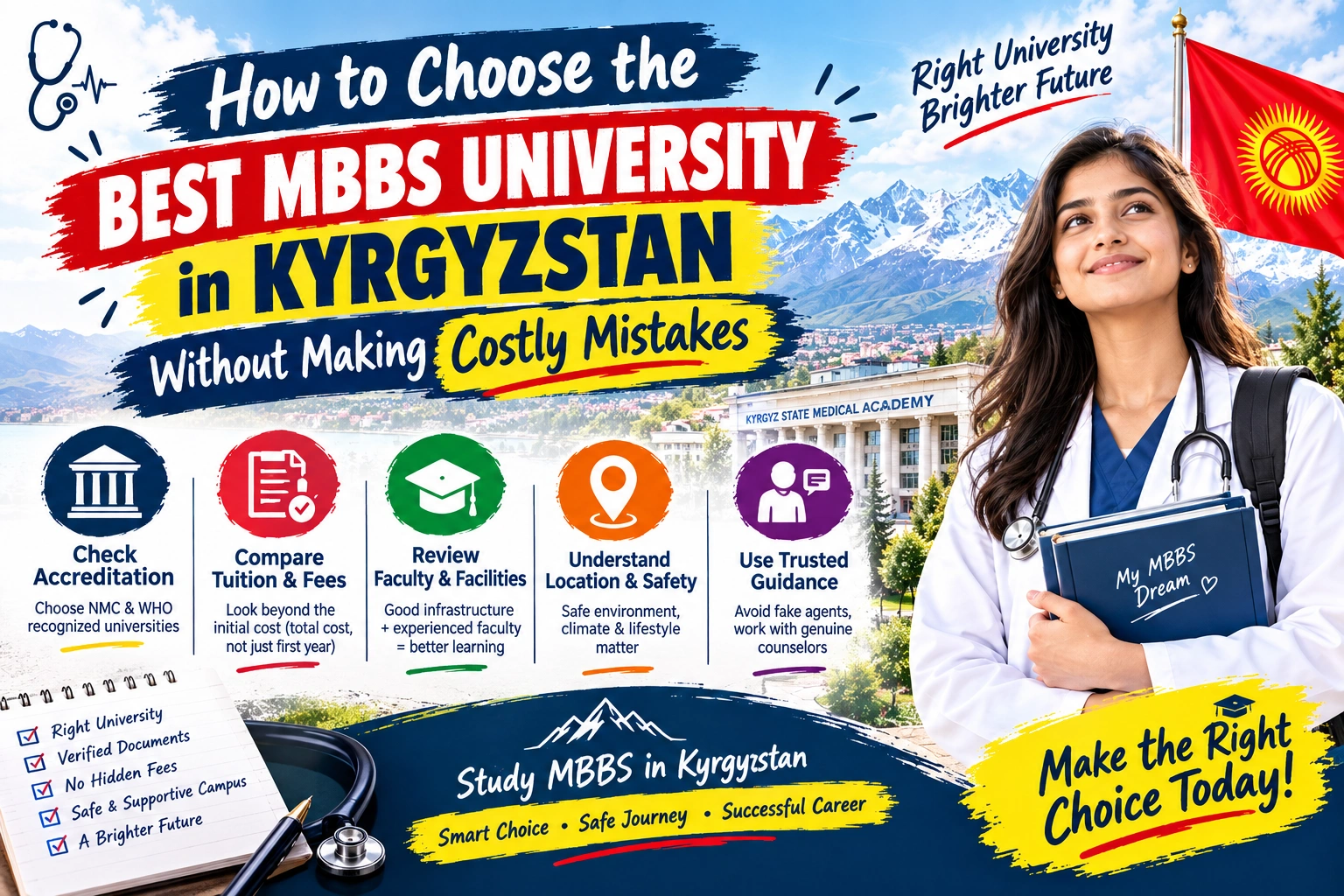
The better stories often begin with careful university selection. Students and parents who verify the programme early face fewer surprises later.
Before choosing a university, they check:
Exact course duration
Foreign internship structure
English-medium instruction
Affiliated hospitals
Clinical group size
Local licensing eligibility
Total six-year cost
Student visa requirements
Current Indian regulations
Programme information in the World Directory of Medical Schools
A WDOMS entry is useful, but it does not guarantee FMGE eligibility or Indian registration. The individual course must satisfy the rules applicable to the student. Successful graduates usually understand this distinction before paying, not after graduating.
NEET Was the First Formal Checkpoint
Indian students covered by applicable regulations must generally qualify NEET-UG before beginning a foreign undergraduate medical course if they plan to seek registration in India. The qualifying marks change each year because the standard is percentile-based. Candidates should verify current information through the official NEET portal and preserve the application form, admit card, scorecard, and result details. Many students who later succeed in licensing examinations did not necessarily have extremely high NEET scores. They did, however, qualify under the applicable rules and use medical school as a fresh academic start. A modest entrance score does not permanently define a student. Six years of study can change a lot. Only if the student studies, of course.
Recognition and Compliance Were Never Optional
The National Medical Commission sets the regulatory framework relevant to Indian medical education and foreign medical graduates. Depending on the admission date, graduates may need to satisfy requirements involving:
Minimum duration of foreign medical education
A prescribed foreign internship
Mandatory medical subjects
English-medium instruction
Hands-on clinical training
Completion in the required institution and country
Eligibility for medical registration in Kyrgyzstan
Supervised internship in India
The applicable licensing examination
A degree is not made compliant because an adviser calls the university “NMC approved.” Students need written academic records and a course that meets the rules. Successful graduates keep every document—passport stamps, visas, mark sheets, clinical logbooks, internship records, and translations. Boring habit. Excellent habit.
What FMGE Pass Rates Do—and Don’t—Tell You
University-level FMGE performance can help families ask better questions, but a percentage should not be treated as a personal guarantee. Suppose 40 out of 100 graduates from one institution qualify. That does not prove the next student has a 40% personal chance. Preparation quality, admission batch, clinical exposure, attendance, coaching, and individual discipline all affect the outcome.
Before trusting a claimed success rate, ask:
Which FMGE session is being quoted?
How many candidates appeared?
How many passed?
Is the source official?
Does the figure refer to one campus?
Is it a single session or multi-year average?
Statements such as “highest FMGE result” need evidence. The big font isn’t evidence. Students selecting MBBS in Kyrgyzstan should use official result data where available and speak with recent graduates, not only admission-year students.
The Role of WHO and Global Recognition Claims
The World Health Organization works on public health, healthcare systems, disease control, and international health cooperation. It does not personally license doctors or certify a foreign graduate for Indian practice. Advertisements may say a university is “WHO recognised.” That phrase should not replace checks involving national recognition, WDOMS information, NMC compliance, and local licensing eligibility. Likewise, “valid worldwide” is not a serious professional promise. Each country has its own medical regulator and may require examinations, language proof, internship, primary-source verification, and supervised practice. Successful graduates understand that the degree opens an application route. It does not remove the regulator.
The Daily Habits Behind the Better Outcomes
Success stories often sound dramatic after the result. The daily work was usually ordinary.
Students who performed well commonly followed habits such as:
Attending lectures and practical classes
Learning Russian or Kyrgyz for patient communication
Revising completed subjects every semester
Solving MCQs from the early years
Maintaining an error notebook
Using one main source per subject
Taking clinical postings seriously
Keeping documents organised
Asking seniors for practical advice
Beginning full mock tests before graduation
No secret book. No magical timetable. The advantage comes from repeating useful actions when the examination is still years away.
The Financial Side of a Success Story
Tuition in Kyrgyzstan may broadly range from around USD 3,000 to USD 6,000 annually, while hostel fees may sit around USD 500–1,200 per year. Actual charges vary by institution and intake. A six-year budget may fall around ₹20–35 lakh or higher after including food, flights, insurance, visa costs, local transport, winter clothing, and licensing preparation. Families should verify current fees directly.
Success may also carry post-graduation expenses:
Expense | Approximate Planning Area |
FMGE preparation | ₹20,000–₹1.5 lakh+ |
Examination application | As notified |
Accommodation during study period | Depends on city |
Document verification | Translation and authentication costs |
Internship relocation | Rent, food, and transport |
Repeat examination | Application and preparation costs again |
A family budget should include at least a 10–15% contingency amount. Unexpected expenses aren’t exactly unexpected across six years.
What Parents Should Learn From These Journeys
Parents naturally focus on safety, fees, hostel conditions, and whether Indian food is available. Those questions matter. Academic structure matters more.
Before admission, parents should ask the university or authorised representative:
Is the programme compliant with the rules applicable to the student?
Does it include the required internship?
Where do international students receive clinical training?
Can graduates pursue local medical licensing?
What is the full fee across all years?
Which expenses are excluded?
Can the family speak with recent graduates?
A current first-year student may give an honest hostel review. Only a graduate can explain documentation and licensing problems.
FAQs
Do Indian students really clear FMGE after graduating from Kyrgyzstan?
Yes, Indian graduates from Kyrgyzstan have cleared FMGE and continued through the Indian internship and registration pathway. Outcomes vary by university, batch, and individual preparation.
Is passing FMGE guaranteed by choosing a top university?
No. University quality matters, but passing depends heavily on the student’s knowledge, revision, question practice, and clinical foundation.
Can a graduate succeed after failing FMGE once?
Yes. Many foreign graduates qualify after revising their strategy, strengthening weak subjects, and taking more full-length tests. There is no automatic guarantee, though.
Are non-clinical careers available without Indian medical registration?
Certain roles in writing, research, pharmacovigilance, insurance, and healthcare operations may not require a clinical licence. Requirements depend on the employer and job description.
Is WDOMS listing enough to practise in India?
No. WDOMS is a directory. The graduate must separately satisfy applicable NMC rules, licensing examination, internship, verification, and registration requirements.
When should FMGE preparation begin?
Light MCQ practice can begin during the first two years. Structured revision should become serious from the fourth or fifth year, followed by full mock tests near graduation.
Conclusion
A genuine success story includes the difficult middle: learning the local language, attending wards, failing a test, correcting mistakes, protecting documents, and studying when graduation still feels far away. Some graduates clear FMGE quickly. Others take longer. A few build rewarding non-clinical careers or later pursue another country’s licensing route. The outcomes are different, but none happen automatically. Students considering MBBS in Kyrgyzstan should look beyond polished testimonials and study the complete pathway—admission, course compliance, clinical training, licensing, internship, and registration. Inspiration is useful. Verification and preparation are what turn it into a career.