Which Is Better for MBBS: Kazakhstan or Kyrgyzstan?
For Indian medical students planning to pursue an MBBS degree abroad in 2026, the core school-selection question they first face is: between Kazakhstan and Kyrgyzstan, which country is more suitable for completing their medical studies?
Every year, thousands of Indian medical students who pass the NEET exam fail to secure an admission spot at a domestic government-run medical college. Tuition fees at India’s private medical colleges reach as high as 6 million to over 100 million rupees, a cost far beyond what ordinary families can afford, so studying MBBS abroad has become a practical alternative for countless Indian medical students.
Kazakhstan and Kyrgyzstan have become the most popular study-abroad destinations because the medical schools in both countries meet NMC requirements, are listed in the WHO directory, use English as the medium of instruction, allow their graduates to take national medical licensing exams including the FMGE, NExT, USMLE, and PLAB, and also feature low tuition fees and simple application processes.
However, most Indian applicants remain confused about which country can offer better overall value, academic opportunities, and career prospects. Though both are located in Central Asia, the two countries have significant differences in education quality, infrastructure, clinical resources, living conditions, and total cost. This comprehensive comparison will help 2026 applicants make a rational school-selection decision.
Overview of Medical Education in Kazakhstan and Kyrgyzstan
As the largest country in Central Asia, Kazakhstan has a mature higher education system, with leading infrastructure, scientific research, and clinical resources. Its popular institutions include Al-Farabi Kazakh National University, Kazakh National Medical University named after Asfendiyarov, Astana Medical University, Semey Medical University, and South Kazakhstan Medical Academy.
Kyrgyzstan, meanwhile, is a top destination for affordable MBBS programs, with a student body covering India, Pakistan, Nepal, and Bangladesh. The core differences between the two countries will be analyzed in depth in subsequent sections.
Why Kyrgyzstan Is Popular Among Indian Students
For the group of Indian medical students who meet the eligibility requirements of the NEET exam, the core competitive strength of MBBS in Kyrgyzstan study abroad programs is first and foremost high cost-effectiveness.
Currently, there are 5 official, internationally accredited medical schools in the country:
Kyrgyz State Medical Academy
Osh State University
Jalalabad State University
Asian Medical Institute
International Medical School
All of which can meet the application needs of Indian students.
Comparison Framework for MBBS in Kyrgyzstan and Kazakhstan
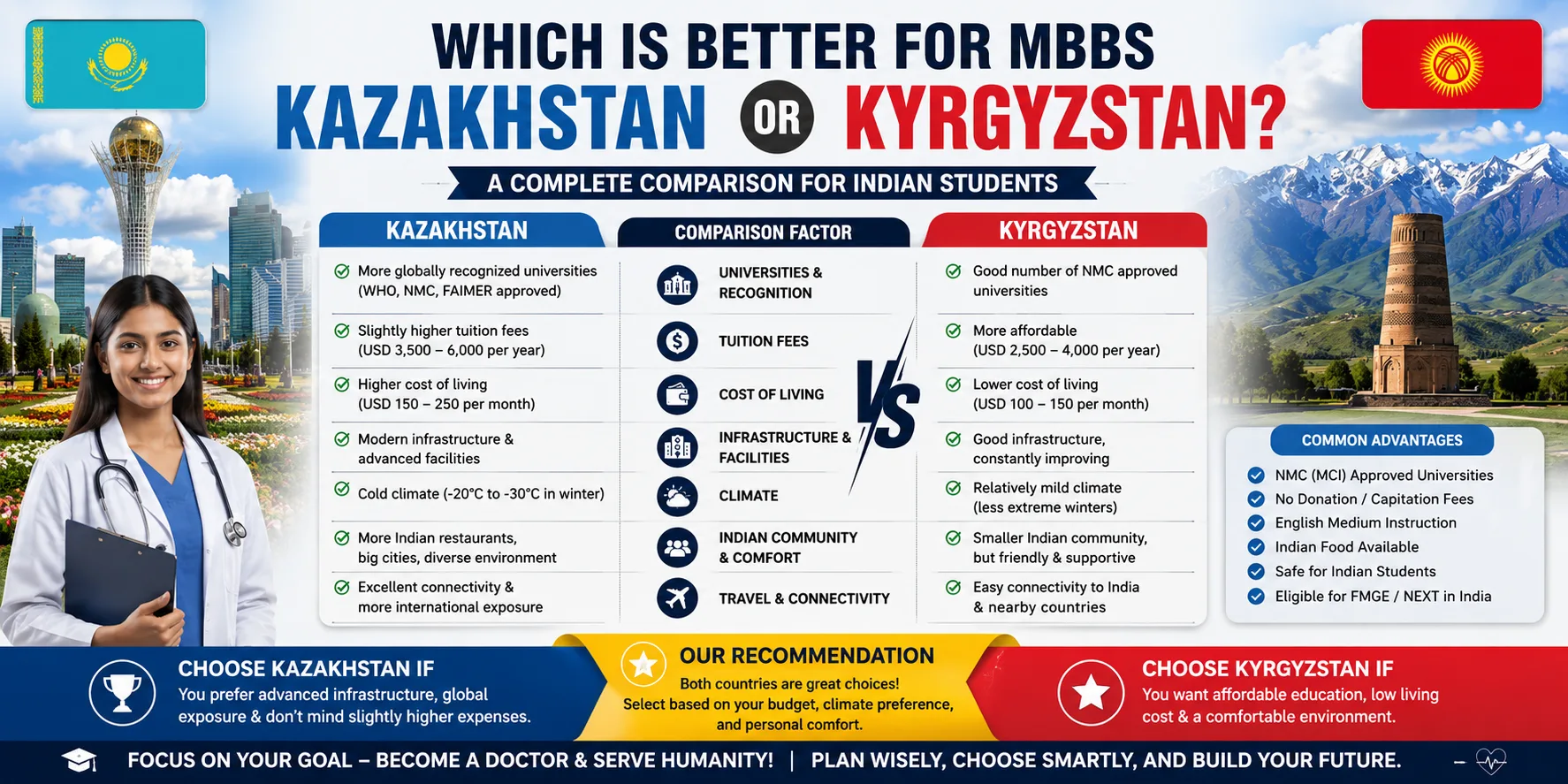
To help applicants clearly select a suitable school, we have compiled a comprehensive side-by-side comparison table of 12 metrics for the MBBS programs in Kyrgyzstan and Kazakhstan.
The metrics cover:
Program duration
Language of instruction
NEET requirements
Eligibility to register for the National Medical Commission (NMC) of India’s examination
WHO accreditation
Average tuition
Cost of living
Campus infrastructure
Clinical resources
The size of the Indian student population
Research opportunities
Local climate
Overall cost-effectiveness
All fees are listed in dual denominations of Indian Rupees and US dollars, and all core qualifications are marked with NMC and WHO accreditation—credentials familiar to Indian students and their parents—to lower barriers to information understanding.
We adopt a two-tier information architecture:
First, the overview table meets users’ need for quick scanning and comparison.
We then conduct an in-depth breakdown of the three core decision-making dimensions that Indian students care about most:
Tuition fees
Cost of living
Education quality
We provide specific cost ranges and respective strengths and weaknesses for programs in both countries.
This framework not only highlights Kyrgyzstan’s core competitive advantage of high cost-effectiveness, but also objectively presents Kazakhstan’s leading position in infrastructure and research resources.
The entire design aligns with Indian students’ school-selection logic, and fully addresses all their core concerns when choosing a program.
Key Factors Indian Students Should Compare
Indian students planning to pursue an MBBS degree in Kazakhstan and Kyrgyzstan can verify and compare their school choices against seven core dimensions one by one to make a well-suited decision.
Clinical Training Resources
Medical schools in Kazakhstan generally operate large affiliated hospitals, which have sufficient patient volume, advanced equipment, and diverse case types to fully guarantee the quality of practical learning.
In Kyrgyzstan, clinical resources vary drastically between schools, so international students must check in advance:
The qualifications of a target school’s affiliated hospitals
The number of cooperative teaching hospitals
Access to patient-doctor interaction
Internship frameworks
Students should prioritize schools with strong reputations.
FMGE/NExT Performance
Second, performance in the FMGE/NExT exams is a core reference for Indian students when selecting schools.
While passing these exams depends primarily on individual preparation, school quality also exerts an influence.
The overall pass rate for students from Kazakhstani medical schools is higher than that of their peers in Kyrgyzstan; the pass rate of some Kazakhstani schools exceeds 50%.
Kyrgyzstan’s overall average pass rate is relatively low, but multiple local schools are working to improve their teaching quality.
It must be clarified that individual effort remains the core influencing factor, and there is no shortage of students in Kyrgyzstan who successfully pass the exams, so absolute generalizations about the situation should be avoided.
Infrastructure and Academic Facilities
In terms of infrastructure, the campuses, scientific research simulation laboratories, hospital technologies, and student support facilities of Kazakhstani schools align with those of modern European universities.
In Kyrgyzstan, schools can only guarantee basic resources such as:
Comfortable dormitories
Standard laboratories
Teaching hospitals
There are clear gaps in resource levels between different local schools.
Student Safety and Support
International student safety is a core concern for Indian families.
Both countries are generally friendly to international students, and all schools have dedicated security and support services in place, but students must still follow universal standard overseas safety protocols.
Food and Community Adaptability
Regarding catering and community adaptability, Kyrgyzstan has a large population of Indian international students, with fully established Indian canteens, vegetarian options, and support for cultural festivals, resulting in a low barrier to integration.
The Indian community in Kazakhstan is growing gradually, and Indian food and South Asian communities can be found in the country’s major cities, though access to these supporting resources varies by city location.
Climate Conditions
Winters in both countries are far colder than most regions of India.
Winter temperatures in some parts of Kazakhstan can drop below -20°C.
Kyrgyzstan’s winters are slightly milder, but students in both locations must prepare for long cold seasons.
Licensing Exams and Career Pathways
Post-graduation career opportunities will be discussed in a subsequent section.
For Indian students planning to pursue an undergraduate Bachelor of Medicine, Bachelor of Surgery (MBBS) degree abroad, this analysis first outlines the core clinical practice requirements for medical students in the world’s major study-abroad destination countries.
In addition to India’s mandate that all Indian students who study medicine overseas must pass the Foreign Medical Graduate Examination (FMGE) or the National Exit Test (NExT) to practice medicine upon returning home, other leading destination countries have also established their own exclusive practice thresholds, such as:
United States Medical Licensing Examination (USMLE) for the U.S.
Professional and Linguistic Assessments Board (PLAB) for the UK
On this basis, we first anchor to the core rules governing Indian students’ eligibility to practice after returning to India, then define the core screening prerequisites for overseas higher education institutions.
All institutions considered for eligibility must meet both the regulatory requirements of India’s National Medical Commission (NMC) and the universal international standards for medical education.
Schools can also be verified through the WDOMS directory before application.
Advantages and Disadvantages of Kazakhstan and Kyrgyzstan
Next, we compare the advantages and disadvantages of pursuing an MBBS in Kazakhstan versus Kyrgyzstan.
Kazakhstan
Higher overall infrastructure standards
Well-developed English-medium instruction programs
Better research and clinical facilities
More convenient daily life for international students
Slightly higher study costs
Kyrgyzstan
Lower budget threshold for international study
Straightforward application process
More accessible for students with average academic backgrounds
Strong Indian student community
Some institutions have slightly weaker international recognition
Conclusion
Combining students’ individual needs—including their affordable budget, personal academic goals, and expected adaptability to life in a foreign country, alongside the 2026 application deadline—we reach the final decision:
The priority of selecting a study destination ranks far lower than the compliance status and teaching quality of a target institution.
Students must first lock in an institution that meets the core requirements, then match their personal circumstances to a suitable study destination.