The affordability, how globally recognised these degrees are, and the structured academic curriculum have made Study mbbs in kyrgyzstan an admirable choice for Indian students. Kyrgyzstan MBBS is a 5 to 6-year program that may or may not include clinical training in the curriculum itself but follows international standards for medical education as recognized by the World Health Organization and in the World Directory of Medical Schools.
While the course focuses on building a solid foundation in medical sciences, students also benefit from considerable clinical exposure, making them globally ready for securing jobs or licensing exams — such as FMGE / NExT conducted and regulated by the National Medical Commission.
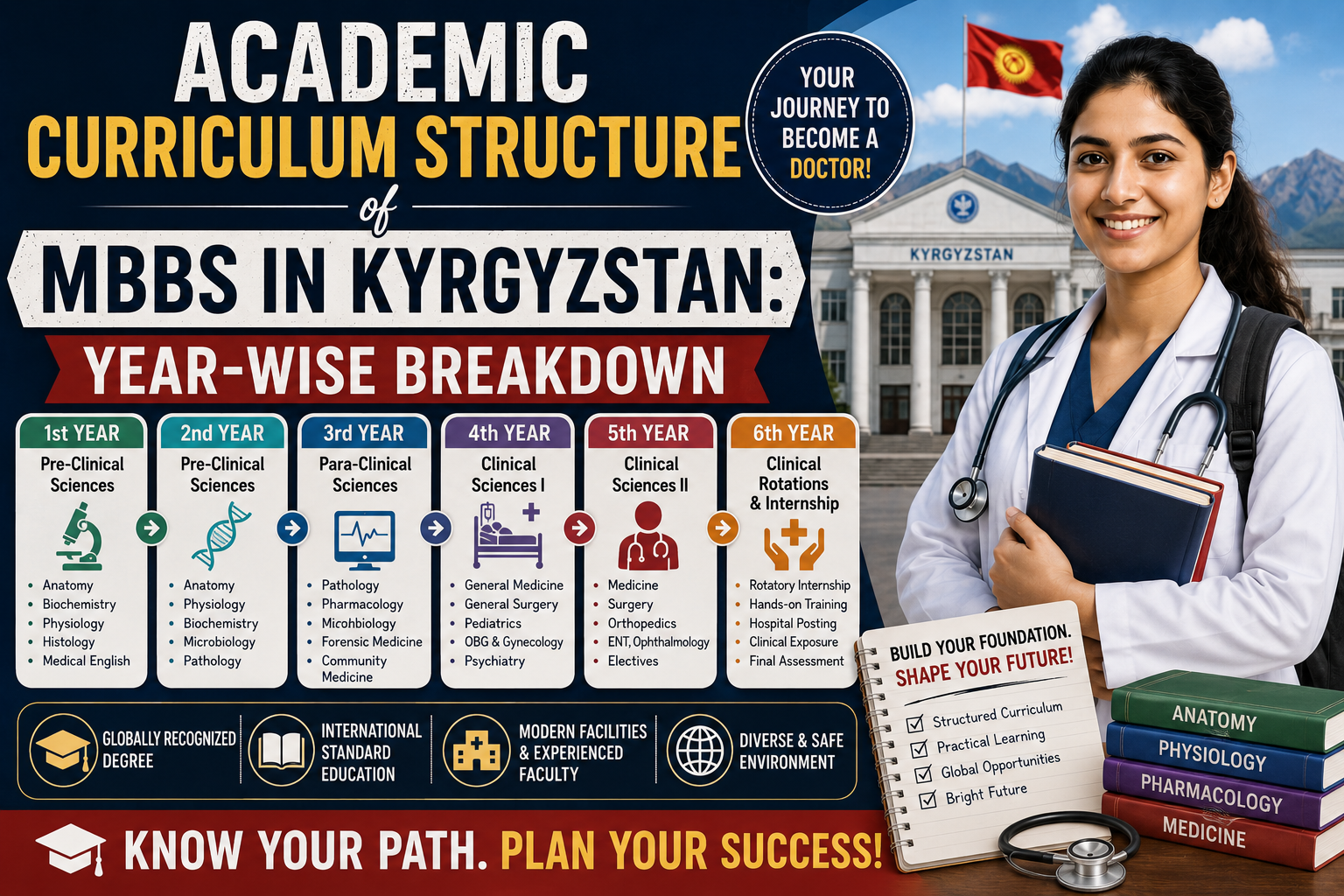
Year 1: Pre-Clinical Foundation
The first year is largely devoted to creating a solid foundation in the fundamental sciences underlying medicine as it has been since previously.
Subjects Covered:
Anatomy
Histology
Biochemistry
Physiology
Medical Biology
They start with theoretical knowledge along with practical lab sessions. It lays emphasis on the understanding of human body structure and functions which is the foundation of training of any medical professional.
Year 2: Advanced Pre-Clinical Studies
The second year of the program focuses on more advanced pre-clinical studies.
Year two continues on from the body systems to help consolidate understanding of specific core subjects, whilst also presenting topics around disease.
Subjects Covered:
Pathology
Microbiology
Pharmacology
Physiology (advanced)
After this, students begin studying mechanisms of disease, microorganisms and drug interaction. Early clinical exposure and lab work connect theory with practice.
Year 3: Clinical Subjects Introduced
The third year of medical training is known as the "clinical" or post-pre-clinical stage.
Subjects Covered:
General Medicine (basic concepts)
Pathophysiology
Pharmacology (continued)
Community Medicine
The students learn about hospitals and how to interact with patients. Clinical posts commence and students start watching patients in the hospital, witnessing real-life diseases providing physical signs aiding diagnosis.
Year 4: Core Clinical Training
This is an important year, with particular reference to your learning of most clinical subjects and practical experience.
Subjects Covered:
General Medicine
General Surgery
Obstetrics and Gynecology
Pediatrics
ENT (Ear, Nose, Throat)
Students actively engage the hospital through rotations, case studies, and patient examinations. During this phase, practical knowledge takes centre-stage.
Year 5: Advanced Clinical Training
The 5th year is an advanced clinical skills and specialization.
Subjects Covered:
Neurology
Orthopedics
Emergency Medicine
Internal Medicine
Psychiatry
Students explore specialized areas of medicine, which involves extensive clinical practice and helps develop their diagnostic and patient management capabilities.
Internship (Final Year / 6th Year)
In the final year, students must complete internships in affiliated hospitals with supervision.
Key Features:
Rotations across multiple departments
Real patient handling
Practical application of medical knowledge
Development of professional skills
It is an important step to acquiring practical experience, and in India as well as abroad it is often a desideratum for admission into various medical licensing examinations.
Worldwide Acknowledgment & Work Prospects
Students graduating from medical universities designated under the World Directory of Medical Schools can appear for all international exams such as USMLE, PLAB, FMGE.
The global perspective is also assured by guidelines from the World Health Organization on global standards for health and medical care domains of education. Even Indian students have to comply with regulations imposed by the National Medical Commission in order to be able to practice in India.
In addition, along with Kyrgyzstan, students consider MBBS in Georgia which provide the same type of global exposure, modern infrastructure and internationally recognised medical degree.
MBBS in Kyrgyzstan Highlights
Duration: 5–6 years (including internship)
Medium of Instruction: English
Centre for Practical & Clinical training
Globally recognized degree
Affordable tuition fees
Conclusion
The academic curriculum of mbbs in kyrgyzstan is suitable for students who are looking for a quality medical education. The quality of the university’s course structures year wise, great clinical exposure and high recognition globally have led to Kyrgyzstan becoming favored by aspirants wanting to become doctors.
Students can achieve their ideal medical career in India and outside, as long as they opt for the right university and remain secure with her/his studies.
Students planning to practice in India after graduation must also qualify NEET as mandatory eligibility criteria.