Qualifying the FMGE (Foreign Medical Graduate Examination) or the upcoming NExT (National Exit Test) is essential for Indian students pursuing MBBS abroad to practice medicine in India. Consequently, Kyrgyzstan is a top choice because of the low fees and recognized medical degrees. But the most pertinent question to an Indian aspirant is how do Kyrgyzstan graduates fare in FMGE/NExT?
Here is a guide on passing rates, factors affecting the success rate, challenges faced and tips to consider for Kyrgyzstan MBBS graduates.
What Are FMGE and NExT?
the Licensing exam by National Board of Examinations (NBE) for foreign medical graduates to practice in India including Kyrgyzstan. To pass, one must receive a minimum of 50% marks.
About NExT: It is a single unified exam that will replace FMGE and Indian final MBBS exit exam. It is going to act as the licensure test for foreign graduates and a basis for postgraduate admissions.
NMC approved medical universities available on WDOMS, as well as recognised by WHO, are also eligible for FMGE and ATMA NExT.
Why Passing Rates Matter
It is compulsory for Indian students graduating MBBS in Kyrgyzstan to clear FMGE/NExT to get a medical license in India.
These pass percentages indicate how well foreign medical colleges match up to Indian standards.
Kyrgyzstan Graduates FMGE Passing Rates
Country‑specific rates may not always be published in official NBE data, however multiple sources and compiled statistics offer insight:
General FMGE Trends
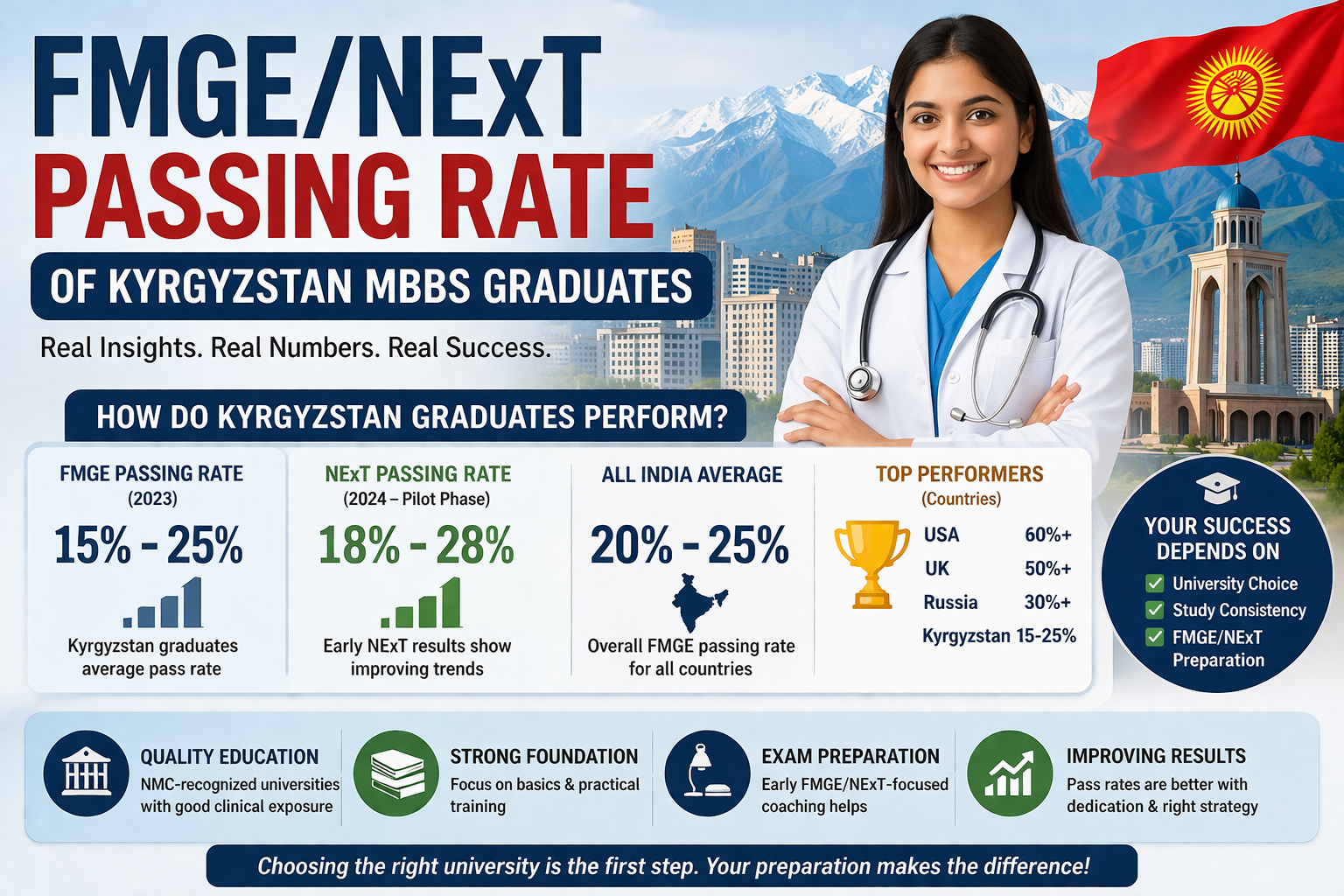
Over all FMGE pass percentages of various countries were nearly ~23‑29% in the last few sessions.
Country-wise, Kyrgyzstan’s pass rate is historically lower than the overall average but shows a positive trend over time.
Recent Kyrgyzstan FMGE Statistics
Overall pass rate for Kyrgyzstan graduates in 2023: ~17.94% (combined June & December, aggregated NBE data)
This translates to about 18 in 100 Kyrgyzstan MBBS students who took FMGE passed it.
Some Kyrgyz universities performed more or less well — exam records show that pass rates varied widely between 2024 — from as low as under 10% to about 31%.
University‑Level Results (Indicative)
Osh State University: ~26.6 percent pass rate
Kyrgyz State Medical Academy (KSMA) ~31.5%
Jalal‑Abad State University: ~24.6%
International Medical University: ~23.2%
International Higher School of Medicine — ~24.1%
Asian Medical Institute: ~19‑21% previously
Central Asian International Medical University 30% (depending on batch size)
These numbers are strong evidence of variation, depending on institution and student preparation.
Curriculum Differences
The structure of the MBBS syllabus in Kyrgyzstan may vary from that of India, which could result in certain gaps during FMGE preparation.
Clinical Exposure Variability
Clinical training, particularly in English and patient touchpoints observed to be relevant in the Indian healthcare context, could also be experience-starved for certain cohorts of students.
Late FMGE Preparation
After foreign internships students start focusing on FMGE/NExT as after completing MBBS it becomes hard for them to manage work with families and studies.
Language Barriers
Lectures might be in English but local languages can come into play during clinical rotations, creating some linguistic barrier to understanding.
NExT: The Future Licensing Path
The campus-based exam will replace FMGE and also serve as the final MBBS exam for all graduates, Indian or foreign.
NExT is anticipated to be more clinically relevant and rigorous than FMGE.
Kyrgyzstan MBBS graduates will still have to give NExT if they no longer wish to practice in India after pursuing MBBS abroad.
Here Are Some Tips To Increase Chances of Cleared Exam of FMGE/NExT:
FMGE/NExT–start the preparation during MBBS not after graduation.
Focus on FMGE/NExT‑Specific Resources
Refer to Indian standard textbooks (Skull, Harrison’s, BD Chaurasia etc.) and coaching materials.
Integrate Clinical Exposure
Participate actively in hospital rounds and patient case discussions to reinforce practical knowledge.
Join Coaching & Mock Tests
Mock tests, online coaching and study groups can help to improve performance.
Final Thoughts:
The passing rate for FMGE/NExT for MBBS graduates of Kyrgyzstan has historically been less than the overall aggregate in the foreign MBBS pass percentage category in recent years, ranging from 15% to 30%.
Optionally reputed, NMC‑approved universities from the WDOMS list and recognized by WHO will pave a better academic base.
As FMGE has been replaced with NExT, an emphasis on clinical competency is likely to impact success in the longer term.
These trends give insight to Indian students studying in Kyrgyzstan for MBBS about what this decade holds as they start preparing for the FMGE or NExT and eventually plan a medical career in India.