Over the past few years, Kyrgyzstan has become a popular destination for Indian students pursuing MBBS abroad due to affordable fees, English-medium programs, and recognition by bodies like the National Medical Commission, World Health Organization, and inclusion in the World Directory of Medical Schools.
However, when it comes to licensing exams like FMGE/NExT, there is often a gap between what students expect and what actually happens.
What Are FMGE and NExT?
FMGE (Foreign Medical Graduate Examination): A mandatory screening test for Indian students who complete MBBS abroad.
NExT (National Exit Test): Upcoming unified exam that will replace FMGE and act as a licensing + final MBBS exam in India.
Only students from universities recognized by the National Medical Commission and listed in the World Directory of Medical Schools are eligible.
Expectations vs Reality
Common Expectations
Many students believe:
English-medium MBBS = easy FMGE/NExT success
Passing rates are high for Kyrgyzstan graduates
Clinical exposure abroad is enough for Indian exams
Curriculum is similar to India
Minimal extra preparation is needed
Ground Reality
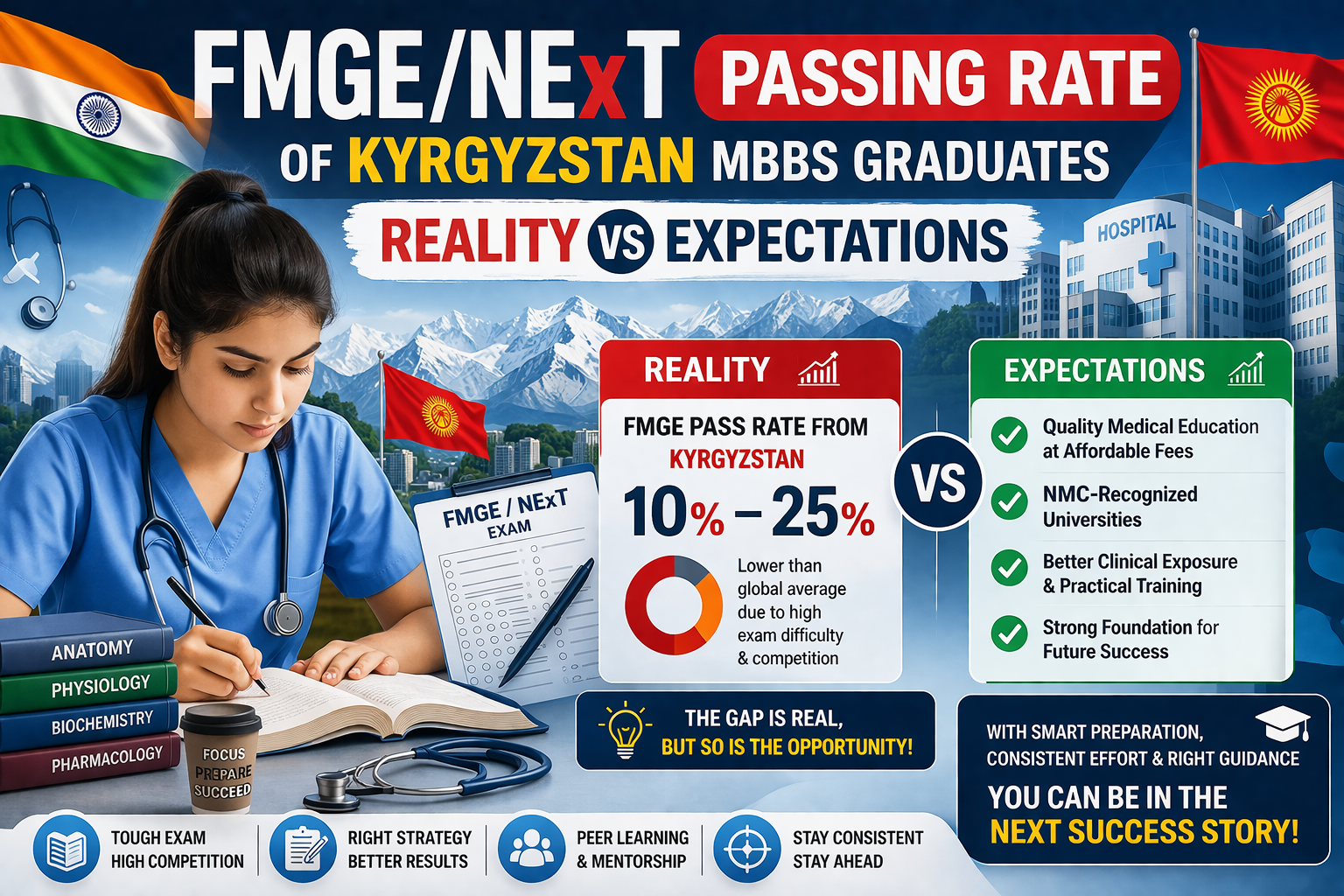
1. FMGE Pass Rate Is Low
Average FMGE pass rate: around 20–30% overall
Kyrgyzstan graduates: often in the 15–30% range
Some universities even fall below 20%
Passing is competitive and not guaranteed.
2. Curriculum Gap Exists
Kyrgyzstan follows an international curriculum
FMGE/NExT focuses on:
Indian disease patterns
Community medicine
Indian clinical scenarios
3. Clinical Exposure Is Not Enough for Exams
Good hospital training is provided
But:
Not always aligned with exam pattern
Less focus on MCQ-based learning
Clinical skills help, but exam strategy is separate.
4. Late Preparation Hurts Performance
Many students start preparation:
After final year
During internship
This is often too late for strong results.
5. Language Barriers in Hospitals
Teaching is in English
Patients often speak Russian or Kyrgyz
This can affect case understanding and clinical confidence.
What the Data Suggests
Performance varies from one university to another
Smaller batches with guidance often perform better
Students using Indian coaching resources tend to score higher
There is no guaranteed success based on the country alone.
What Students Should Realistically Expect
English-medium helps but is not enough
Recognition ensures eligibility, not success
FMGE/NExT requires Indian-standard preparation
Self-discipline matters more than location
How to Improve FMGE/NExT Success
1. Start Early
Begin preparation from the 2nd or 3rd year instead of waiting for an internship.
2. Use Indian Reference Books
Focus on standard Indian authors and exam-oriented MCQ books.
3. Join Test Series or Coaching
Helps in understanding exam patterns and improving accuracy.
4. Strengthen Clinical Concepts
Actively participate in ward rounds and case discussions.
5. Track Progress
Take regular mock tests and identify weak subjects early.
Final Reality Check
Expectation | Reality |
Easy FMGE/NExT clearing | Requires consistent effort |
English-medium ensures success | Helps, but not sufficient |
Clinical exposure is enough | Needs exam-focused preparation |
All universities are equal | Quality varies significantly |
Conclusion:
MBBS in Kyrgyzstan offers affordability and global exposure, but success in FMGE/NExT depends entirely on the student’s preparation strategy rather than just the country or university.
Even if your university is approved by the National Medical Commission and listed in the World Directory of Medical Schools, clearing the licensing exam requires early preparation, strong conceptual understanding, and consistent practice with Indian exam patterns.
With the right strategy and disciplined approach, students can achieve success in FMGE/NExT and build a strong medical career in India or abroad.