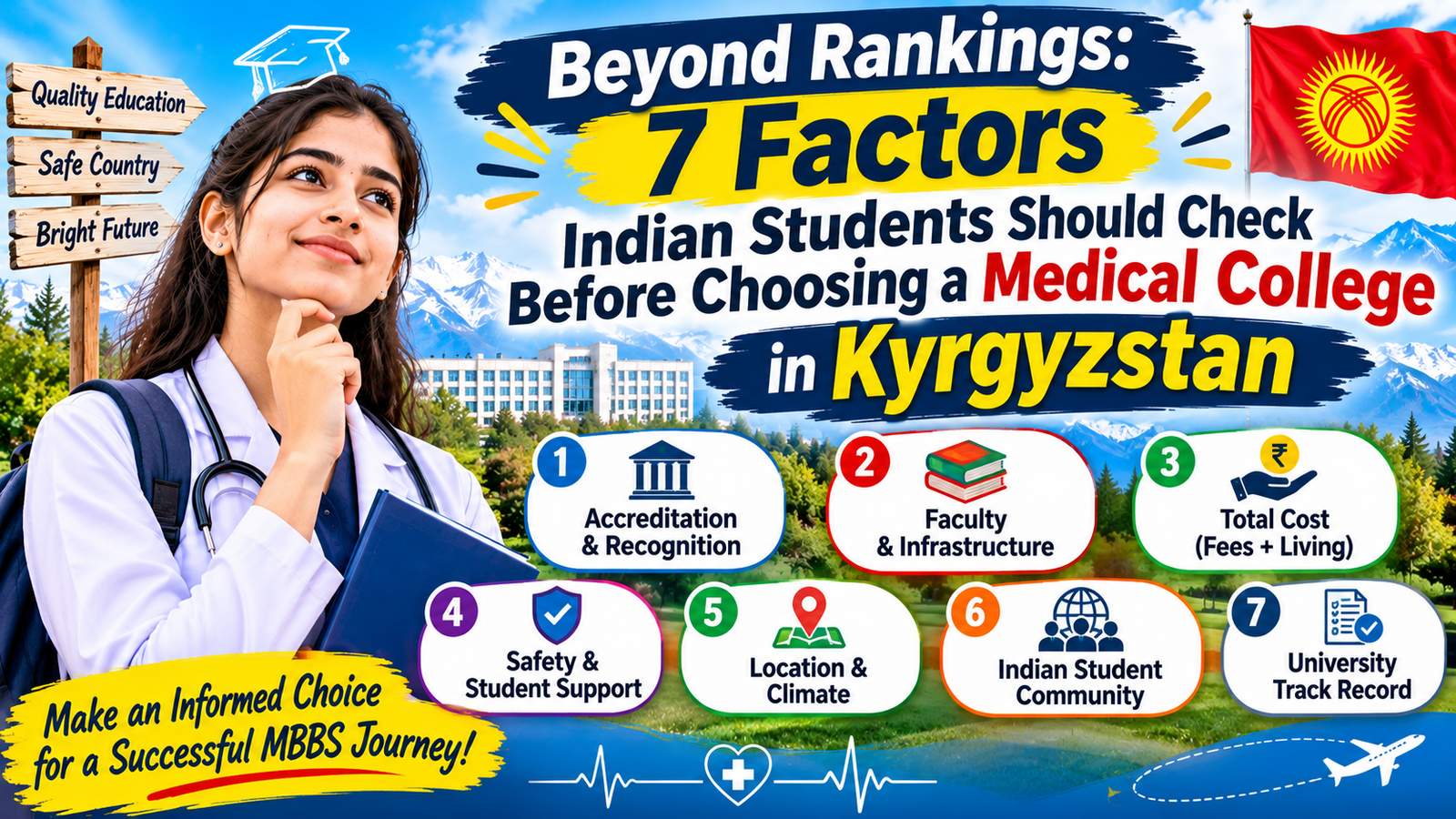
Deciding on a medical college abroad for an MBBS-equivalent qualification is an essential selection for Indian college students. Despite the fact that Kyrgyzstan has attracted the attention of aspiring doctors due to its variety of scientific establishments, worldwide scholar groups and moderately priced study options, choosing a college sincerely based on a ranking listing or popular destination status might also show to be a high-priced mistake.
College scores and lists of popular locations can be helpful suggestions, however they not often offer the whole tale. Those sources hardly ever include info on the high-quality of medical education, affordability, provision of English-medium programmes, or whether a specific programme meets the standards applicable to your clinical qualification.
Earlier than paying the admission charge, it is a great concept to conduct independent research, conduct a multi-college evaluation and verify critical claims with authentic sources. A university may fit properly for one pupil, but it may not align together with your educational and personal goals.
This newsletter outlines 7 factors Indian students ought to check when comparing Kyrgyzstan clinical faculties to make sure they're selecting the right college to pursue an MBBS-equivalent qualification, instead of merely searching at a rating listing or popular vacation spot.
1. Reputable Recognition, College Reputation and Regulatory Compliance
The primary component to investigate is the college’s legal reputation and the information of the clinical programme it offers. Before evaluating the availability of hostel centers, tuition charges and trendy campus life, it is important to ensure the institution offers a legal medical programme at your desired level of study.
Visit the college’s official website and verify the agency’s full name, campus address, programme details and the organization that awards the degree. This is crucial when admission sellers provide a shortened name, a translated name or other information that doesn't reflect the statistics.
Whilst the World Directory of Medical Schools (WDOMS) is a useful aid for searching for medical schools and reviewing institutional records, a world directory listing does not guarantee recognition by India’s National Medical Commission or official eligibility in India. You must verify this separately.
Indian aspirants ought to review the latest guidelines through the National Medical Commission (NMC) prior to deciding on a university and reviewing the regulations that apply to foreign medical qualifications. Students ought to pay close attention to guidelines pertinent to course duration, medium of instruction, clinical education and internship, and eligibility for registration.
Before making a final selection, check:
Whether the institution is legally authorised to provide the clinical programme.
Whether the college’s location and programme details match what's listed in the admission offer.
The precise qualification provided upon graduation.
The details of the course and its alignment with applicable requirements to qualify as a medical practitioner in India and similar countries.
Whether the course’s clinical and internship arrangements are clearly explained.
Whether the information provided by the agent can be independently verified.
Do not expect that every college in Kyrgyzstan follows the same academic arrangements. Double-check the institution and programme you plan to enrol in.
2. Quality of Clinical Education and Hospital Exposure
To qualify for clinical certification, it is not enough to complete theoretical lectures and pass written examinations. Clinical students need proper exposure to develop the knowledge and skills required for their future careers.
It is therefore one of the most important factors to investigate when comparing medical colleges in Kyrgyzstan, and a college’s affiliations with hospitals and its training arrangements are critical to determining the standard of education.
Ask the college which teaching hospitals offer clinical training and determine exactly what this means for your education. Ask whether clinical rotations are an official component of the curriculum and, if so, when they begin. Inquire about how placements are organised and whether training is supervised by qualified professionals, as well as opportunities for students to observe patient care and develop appropriate practical skills.
Important questions include:
What teaching hospitals are associated with the college?
Are clinical rotations a component of the curriculum?
At what point in the course do clinical rotations begin?
How do students apply for positions in different departments?
What opportunities are there to study patient care and develop appropriate practical skills?
How are practical skills and clinical abilities assessed?
What happens if a clinical placement cannot be completed?
Wherever possible, request information about teaching hospitals directly from the college and talk with current students who have completed clinical rotations.
It is also important to analyse the balance between theoretical and practical education, especially concerning specific subjects. Anatomy, physiology, pathology, pharmacology, medicine, surgery, paediatrics, obstetrics and gynaecology are all vital components of medical education, but they each require different educational methods and practical learning opportunities.
For Indian college students who intend to return home upon graduation, it is essential to make sure that the university’s training arrangements align with the relevant regulations in force for foreign medical graduates. Do not be misled by a general guarantee from an agent that hospital exposure will be sufficient.
3. Overall Cost of Education Beyond Tuition Fees
Affordability is one reason Indian students consider completing their clinical education in Kyrgyzstan. However, while the advertised tuition fee may seem affordable, it represents only one element of the overall costs. It is important to compare the total estimated cost of the programme and avoid selecting the university with the lowest first-year tuition fee.
Request a written breakdown of all relevant charges and the payment schedule from each shortlisted college. Confirm whether fees are fixed or likely to change during the course of study.
Expense | What students should check |
Tuition fees | Annual fees, payment dates and possible increases |
Admission and registration | Application, enrolment and administrative fees |
Accommodation | Hostel costs, room type, deposits and facilities |
Food | Meal plans, groceries and cooking arrangements |
Medical health insurance | Coverage, exclusions and renewal expenses |
Visa and documentation | Application-related fees and renewal requirements |
Flights and travel | Airfare, luggage and airport transfers |
Books and study materials | Textbooks, equipment and practical resources |
Local transportation | Travel between accommodation, campus and hospitals |
Personal expenses | Clothing, mobile services, toiletries and activities |
Emergency fund | Unexpected travel, health or financial costs |
Exchange-rate fluctuations and banking fees should also be taken into consideration. It is important to understand the currency in which expenses need to be paid and the official payment recipient, as well as any applicable international banking charges.
It is also essential to understand refund policies. Ask what happens if a visa application is refused, admission is cancelled or the student decides not to enrol. Obtain the relevant conditions in writing before paying a deposit.
A realistic approach is to prepare a year-by-year breakdown of the expected programme expenses and set aside funds for any unexpected costs. Compare at least three universities using the same cost categories. This will make it easier to identify the genuinely affordable alternative rather than deciding based on a promotional tuition figure.
4. Medium of Education and Local Language Support
The language used for instruction could have a significant impact on a student’s ability to achieve the desired education and complete medical training successfully.
Although some medical universities in Kyrgyzstan advertise English-medium programmes, students should ask how the language of education will be used throughout the course and whether it extends to examinations, laboratory sessions and textbooks.
Clarify whether the teaching language changes during the clinical rotation or whether students need to also be proficient in Russian or Kyrgyz to communicate effectively in hospitals.
Local language proficiency can be particularly useful when speaking with patients who do not speak English fluently. As such, it can be useful to gain at least a basic understanding of Russian or Kyrgyz.
Prior to admission, ask:
Is English used consistently for classroom teaching and examinations?
Are medical textbooks and other materials available in English?
Does the college offer Russian or Kyrgyz language classes?
Are language lessons integrated into the academic programme?
How are students supported when encountering medical terminology?
What language proficiency is needed for clinical placements?
Students should also talk with current international students about their experiences. This may help clarify whether the advertised medium of instruction reflects everyday academic practice.
A university with language support can ease the transition to a new educational environment, but students should be aware that an English-medium course does not always eliminate the need to learn the local language.
5. College Quality, Laboratories and Academic Support
A clinical university’s reputation should be based on its facilities and resources rather than a single ranking list. Experienced faculty, appropriately structured practical classes, suitable laboratory arrangements and academic support are all essential considerations.
Prior to applying, investigate the qualifications of the teaching staff and inquire about the organisation of lectures and practical sessions. Ask whether students can seek academic guidance from faculty members.
You should also request information about the availability of facilities such as:
Anatomy laboratories and practical teaching rooms.
Medical science laboratories and demonstration centres.
Libraries with medical textbooks and digital resources.
Classrooms with suitable teaching equipment.
Skills-training centres, where applicable.
Computer facilities and reliable internet access.
Academic advisers and student support services.
Ask whether students receive regular practical classes and have access to the required equipment. If possible, request an online campus tour or visit the institution before committing to admission.
Academic support is equally important. Medical education offers a demanding workload, and students may require help with difficult subjects, examinations, attendance requirements or language barriers.
Inquire whether the college offers tutoring services and supplementary examinations, in addition to academic counselling and clearly defined procedures for repeating a subject or semester.
Students should be wary of universities or agents advertising unusually easy academic conditions. The objective should be to obtain a sound medical education that prepares them for professional practice.
6. Hostel Facilities, Student Safety and Everyday Living
A college’s location and living conditions may affect a student’s well-being and academic experience. Indian students must investigate accommodation options, meals, transportation, medical access and safety before finalising an admission decision.
First, confirm whether the college offers hostel accommodation and whether a room is guaranteed for international students. Inquire about sharing arrangements, deposits, maintenance, heating, hot water, electricity, internet access, laundry services, kitchen facilities and distance from the campus.
Given the cold winter temperatures in Kyrgyzstan, students should specifically ask about heating systems and additional clothing requirements, as well as any additional costs.
Food should also be a consideration, particularly for students who wish to eat Indian food. Inquire whether suitable food is available nearby, whether hostel kitchens can be used and what a realistic monthly grocery budget might be.
Safety and support services should also be considered. Ask the university about:
Hostel security and supervision.
Emergency contact arrangements.
Access to local medical services.
Airport pickup and arrival assistance.
Help with student registration and immigration procedures.
Support for international students facing academic or personal difficulties.
Talk with current students and ask about their experiences with accommodation and the local community. Whilst online reviews may be helpful, it is important to compare multiple accounts rather than relying on a single testimonial.
Students and parents should also review relevant travel advisories and be aware of procedures for seeking help in an emergency. A university with clear communication and accessible student services can make living abroad more manageable.
7. Student Feedback, Career Planning and Future Registration
The final factor to investigate is how well the university fits your long-term career plans. Ranking lists and marketing cannot provide all the information about what it is like to study at an institution and how its programme can support your post-graduation requirements.
Whenever possible, it is a good idea to talk with current students from different academic years and graduates who have completed the course. Ask about lecture frequency, examination arrangements, clinical training, hostel conditions, administrative support, and any extra costs.
Useful questions include:
Are classes conducted regularly according to the academic schedule?
Are faculty members available to answer questions?
Is the clinical training organised and supervised?
Are the advertised facilities accessible to students?
Are changes to fees communicated clearly?
What support is available when students experience difficulties?
Look for consistent patterns across multiple independent accounts. Remember that individual experiences may differ, and online reviews should be checked against official information.
Plan for Your Medical Career in India
If you intend to return to India after completing your medical qualification, investigate the applicable rules for foreign medical graduates before enrolling. Review the current NMC requirements and understand the conditions that may apply to your qualification, course structure, clinical training, internship, and registration pathway.
The National Medical Commission (NMC) is an important official source for regulatory information. The World Directory of Medical Schools (WDOMS) can help you research institutions, but a directory listing alone is not proof of eligibility to practise in India.
Indian students should also consult the official NEET website for applicable examination and eligibility information. Requirements may change, so verify the rules relevant to your admission year and intended career pathway.
Do not accept promises of guaranteed Indian registration, licensing-examination success, or future employment. These outcomes depend on applicable regulations, individual qualifications, and other relevant conditions.
For additional information about medical education opportunities in the country, students can explore MBBS in Kyrgyzstan. For broader health-related information, students may also refer to the World Health Organization (WHO).
How to Compare Medical Universities Before Applying
Once you have researched the seven factors, prepare a comparison sheet for at least three universities. Give each institution a consistent assessment instead of relying on promotional rankings.
Comparison factor | What a strong option should demonstrate |
Official status | Verifiable institutional and programme details |
Regulatory compliance | Clear information relevant to applicable Indian requirements |
Clinical training | Defined rotations and identifiable teaching hospitals |
Total cost | Transparent fees and a realistic full-course budget |
Language support | Clear teaching-language arrangements and local-language assistance |
Academic facilities | Accessible laboratories, libraries and teaching resources |
Student welfare | Suitable accommodation and accessible support services |
Career planning | Reliable documentation and clear information about future requirements |
Before paying, confirm the admission offer directly with the university using contact details obtained from its official website. Read the contract, check the refund policy, and retain payment receipts and written correspondence.
Conclusion
Choosing a medical college in Kyrgyzstan should involve much more than checking rankings or selecting the university with the lowest advertised tuition fee. Indian students need to examine official institutional status, regulatory requirements, clinical training, total expenses, teaching quality, language support, and student welfare.
The best choice is the university that fits your academic needs, financial circumstances, and long-term professional goals while meeting the applicable requirements for your intended career pathway.
Take time to compare different institutions, speak with current students, and independently verify the information provided by admission agents. Keep all important financial and academic commitments in writing, and never make a rushed decision based on promotional claims.
A careful selection process can help you enter medical education with realistic expectations and a clearer understanding of the responsibilities involved. Ultimately, verified information, quality education, and long-term career suitability should matter more than rankings alone.