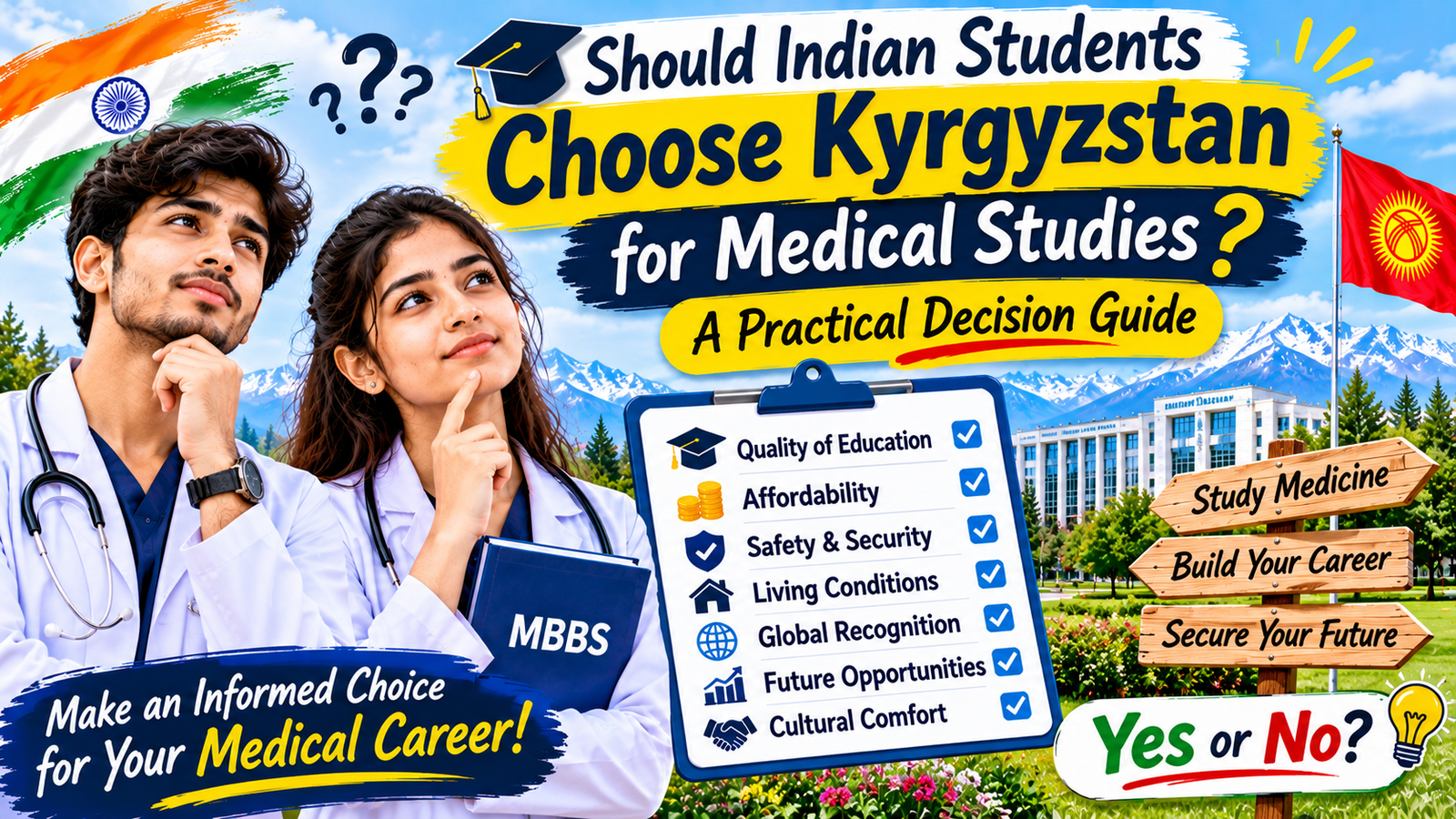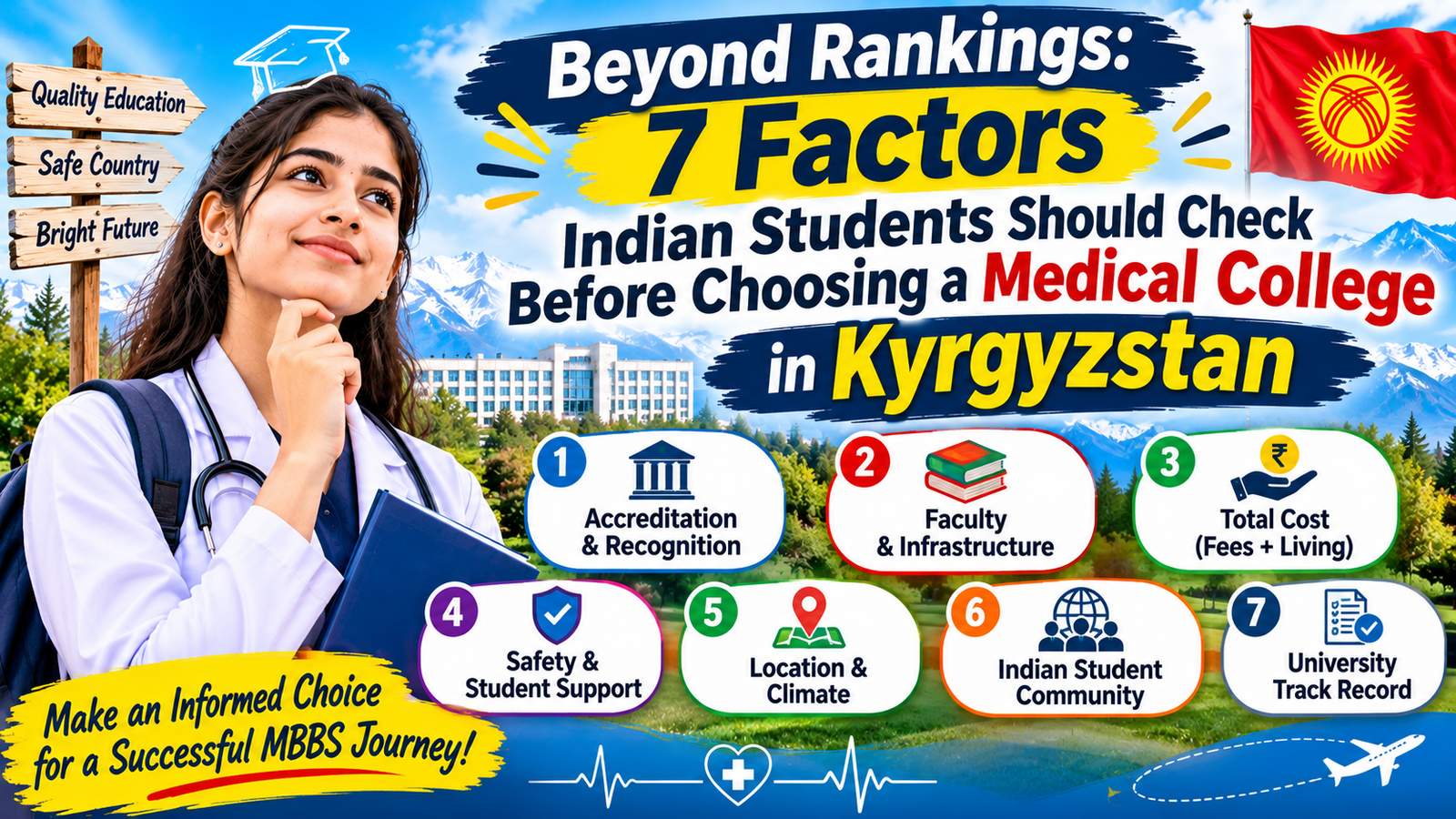

Selecting a medical college abroad is an essential decision for Indian students pursuing an MBBS-equivalent medical degree. Kyrgyzstan has become a popular study destination because of its relatively affordable tuition fees, international student communities, and medical universities offering programs for students from different countries. However, choosing a college involves more than simply comparing admission fees or selecting the institution with the most attractive advertisements.
Indian students need to assess several factors, including overall education costs, clinical training, teaching quality, language requirements, hostel facilities, and campus safety. A college that appears inexpensive at admission may involve additional charges or may not provide the clinical exposure a student expects.
This guide compares the main factors students should examine when evaluating MBBS colleges in Kyrgyzstan. It explains how to assess tuition fees, clinical training, facilities, student life, and future career requirements so that students and parents can make an informed decision.
1. Why Compare MBBS Colleges in Kyrgyzstan?
Different medical universities in Kyrgyzstan may offer different fee structures, teaching arrangements, campus facilities, and student support services. Even when two colleges advertise similar programs, the overall educational experience can vary.
A thorough comparison helps students:
Understand the total cost of studying medicine.
Evaluate the quality and availability of clinical training.
Check university information and relevant eligibility requirements.
Compare hostel facilities, food, transport, and campus support.
Assess language barriers and the learning environment.
Understand the requirements for returning to India for medical registration.
Students should prioritise verified information from official university sources and relevant regulatory authorities rather than relying only on social media posts or admission agents. Students exploring MBBS in Kyrgyzstan should compare universities carefully before making an admission decision.
2. Comparing Tuition Fees and Total Education Costs
Tuition fees are among the first factors Indian families consider when choosing an MBBS college in Kyrgyzstan. However, tuition fees are only one part of the total expenditure. Students should also budget for accommodation, food, travel, insurance, visa formalities, books, and personal expenses.
Annual Tuition Fees
Tuition fees vary by university, program, and admission year. Some institutions may advertise relatively low annual fees, while others may charge more because of their facilities or program structure.
For initial budgeting, students may use an illustrative annual tuition range of approximately US3,000–US6,000 for some programs. This is not an official fee quote or a guarantee that every university falls within this range. Always obtain the current written fee schedule directly from the university before paying.
When comparing colleges, check:
Annual tuition fees and the expected duration of the program.
Whether fees remain fixed or may increase.
Whether laboratory, examination, or registration charges are separate.
Payment deadlines and accepted payment methods.
Refund rules if a visa is refused or admission is cancelled.
Whether any scholarship or discount has written terms.
Hostel and Living Costs
A university with lower tuition fees might not necessarily have the lowest overall cost. Accommodation charges, food options, heating, and transport can significantly affect a student's budget.
Students should ask whether the university offers on-campus hostels, shared rooms, meals, internet access, laundry facilities, and suitable heating during winter. If private accommodation is required, rent and utility bills should be included in the calculation.
Expense category | What to confirm |
Tuition | Annual fee, payment schedule, additional academic charges |
Hostel | Room type, facilities, heating, utilities |
Food | Mess availability, meal plans, grocery costs |
Transport | Distance from hostel to campus and teaching hospitals |
Documentation | Visa, registration, insurance, and related costs |
Personal expenses | Mobile, clothing, books, and daily necessities |
Practical tip: Compare the estimated cost for the entire program rather than only the first-year admission package. Request a written breakdown in the university's billing currency and check exchange-rate changes before converting the amount into Indian rupees.
3. Comparing Clinical Training and Hospital Exposure
Clinical training is one of the most important factors when comparing medical colleges in Kyrgyzstan. Medical students need more than classroom knowledge; they should gradually learn how to examine patients, understand symptoms, interpret investigations, communicate professionally, and develop clinical reasoning.
Hospital Affiliations and Patient Exposure
Before choosing a university, ask which hospitals are used for clinical teaching and whether students receive supervised practical training there. Do not assume that a university has strong clinical exposure simply because it advertises partnerships with hospitals.
Check the following points:
The names and locations of affiliated teaching hospitals.
Whether students visit hospitals regularly as part of the curriculum.
The availability of clinical departments, including medicine, surgery, paediatrics, obstetrics, and gynaecology.
Opportunities to observe patient examinations and participate in supervised clinical activities.
The number of students assigned to each clinical group.
Whether clinical rotations are formally included in the program.
For example, the official website of Kyrgyz State Medical Academy describes its clinical departments and training arrangements. Students can review its published information on the official KSMA website.
Clinical Training Language
English-medium classroom instruction does not always mean that patients in affiliated hospitals will speak English. Russian and Kyrgyz can be important in clinical settings.
Students should ask how the university helps international students communicate with local patients. Language classes, supervised interactions, and interpretation support can make a meaningful difference to clinical learning.
Internship and Practical Learning
Students should also verify the complete course structure, including practical rotations and internship requirements. Indian students intending to practise in India must compare these details with the current National Medical Commission (NMC) foreign medical graduate regulations.
Course duration, internship arrangements, and other eligibility conditions must be checked before admission, not after graduation. Students should consult the official National Medical Commission website for current rules and guidance.
4. Comparing Teaching Quality and Academic Facilities
A medical university should provide a structured academic environment that supports both theoretical learning and practical skill development.
Faculty and Teaching Methods
Ask about faculty qualifications, teaching experience, student-to-teacher ratios, and the availability of academic support. A useful medical curriculum should help students understand subjects such as anatomy, physiology, biochemistry, pathology, pharmacology, and microbiology before progressing to advanced clinical learning.
Look for evidence of:
Regular lectures and practical classes.
Laboratory sessions with suitable equipment.
Scheduled internal assessments and examinations.
Access to academic guidance and additional learning support.
Libraries, digital learning resources, and study areas.
Clear attendance and examination policies.
Laboratories and Simulation Centres
Laboratories allow students to connect textbook concepts with practical learning. Simulation facilities can help students practise selected clinical skills under supervision before working with patients.
During a campus visit or virtual tour, request current photographs, facility details, and information about how frequently students use these resources. Promotional photographs alone are not sufficient evidence that facilities are available or regularly used.
5. Recognition, University Status, and Eligibility for Indian Students
Before comparing lifestyle or campus facilities, verify that the medical program is suitable for your academic and career goals.
Check the World Directory of Medical Schools
Search for the university in the World Directory of Medical Schools (WDOMS). Confirm the institution's exact name, location, operational status, and program information.
However, a WDOMS listing by itself does not guarantee accreditation, endorsement, or eligibility for medical registration in India. Students must verify the applicable regulatory requirements independently.
Review NMC Requirements
Indian students must check the relevant rules for foreign medical graduates before enrolling. Obtain course and fee information directly from the institution and ensure that the program meets the requirements applicable to the student's admission year.
Review the official NMC website for current regulations and guidance. Also check the NEET official website for applicable examination and eligibility information.
Important questions include:
Does the course meet the applicable duration and curriculum requirements?
Is the medium of education suitable for the student's needs?
Are clinical training and internship arrangements clearly documented?
Can the university provide official documents explaining the degree awarded?
What examinations, internship requirements, and registration steps apply after graduation?
Avoid relying on statements such as "NMC-approved university" without verifying the specific requirements relevant to your admission year and course.
6. Comparing Student Life and Accommodation
Living conditions affect a student's comfort, health, and study routine. Indian students should evaluate the residential facilities and support services offered by each university.
Hostel Facilities
Check whether accommodation is available on campus or near the university. Ask about room sharing, heating, hot water, internet, laundry, security, and access to cooking facilities.
Kyrgyzstan experiences cold winters, so heating and suitable winter accommodation deserve particular attention. Students should also understand hostel rules, visitor policies, curfews, and any additional charges.
Food and Indian Meals
Food is another important consideration. Some students prefer a university mess or Indian food service, while others may wish to cook independently.
Before admission, find out:
Whether Indian meals are available consistently.
Whether vegetarian food is offered.
How much students usually spend on groceries and meals.
Whether the hostel has suitable cooking facilities.
How far the nearest supermarkets and food shops are located.
Do not assume that an advertised Indian mess will operate throughout the academic year. Ask current students about availability, meal quality, and actual costs.
Safety and Student Support
Compare campus security, emergency contacts, transport arrangements, and access to healthcare. Students should know whom to contact if they lose important documents, become ill, or need help with accommodation or local formalities.
A university with responsive international student support can make the transition to a new country easier, particularly during the first semester.
7. Comparing Cities and Campus Locations
The city where a university is located can affect living costs, travel time, and access to hospitals and everyday services.
For example, a university in Bishkek may offer a different urban experience from one in Osh, Jalal-Abad, or a smaller town. However, the city name alone does not establish the quality of a medical program.
Compare each university's actual location and consider:
Distance between the hostel, teaching campus, and hospitals.
Availability of public transport and affordable taxis.
Access to groceries, pharmacies, and banking services.
Winter travel conditions and commute times.
Availability of student communities and support networks.
Distance from the nearest major airport.
A convenient location can reduce daily travel time and make it easier to balance classes, self-study, and clinical rotations.
8. Career Preparation and Future Opportunities
Students should select a university based on the quality and suitability of its education, rather than on promises of guaranteed employment or medical registration.
Indian graduates of foreign medical programs must fulfil the applicable examination, internship, and registration requirements before practising in India. The NMC's foreign medical qualification guidance should be reviewed before admission.
Before enrolling, ask whether the university offers academic support for licensing examinations, access to medical reference materials, and guidance on postgraduate pathways. Such support can be helpful, but it cannot guarantee examination success, admission to postgraduate training, or employment.
Students considering practice abroad should separately research that country's licensing rules, language requirements, and qualification recognition processes.
9. Common Mistakes to Avoid When Comparing Colleges
Avoid these frequent mistakes during the selection process:
Selecting a university solely because it advertises the lowest tuition fee.
Comparing first-year expenses without calculating the entire course budget.
Assuming a WDOMS listing guarantees eligibility to practise in India.
Accepting unverified claims about hospital training or patient exposure.
Ignoring language requirements in clinical settings.
Paying large admission amounts without reviewing official documents and refund policies.
Relying completely on an agent's verbal promises.
Overlooking hostel conditions, winter expenses, and student support services.
Students and parents should obtain written information directly from the university and keep copies of receipts, admission letters, fee schedules, and relevant correspondence.
10. A Practical Checklist for Comparing MBBS Colleges in Kyrgyzstan
Use this checklist to compare your shortlisted universities.
Comparison factor | What a student should confirm |
Tuition fees | Official annual fees and full-course estimate |
Additional expenses | Hostel, food, insurance, visa, and travel |
Clinical training | Hospital affiliations, rotations, and supervision |
Academic quality | Faculty, laboratories, and teaching resources |
Language | Classroom medium and patient communication |
Recognition and eligibility | WDOMS details and applicable NMC requirements |
Accommodation | Hostel safety, heating, food, and internet |
Student support | International office and emergency assistance |
Career preparation | Licensing requirements and academic guidance |
Score each institution using verified evidence rather than advertisements. If a university cannot clearly answer important questions about clinical training, course duration, fees, or documentation, seek clarification before making a financial commitment.
Conclusion
Comparing MBBS colleges in Kyrgyzstan requires a balanced assessment of tuition fees, clinical training, academic quality, university status, accommodation, and student life. The lowest advertised fee is not necessarily the best value, and an impressive campus does not automatically guarantee strong clinical education.
Indian students should request official fee schedules, investigate hospital training arrangements, assess language requirements, and review current NMC regulations before selecting a university. They should also speak with current students where possible and verify important claims independently.
A well-researched decision can help students choose a medical program that fits their budget, learning needs, and long-term career plans. Most importantly, verify all admission and eligibility conditions before paying fees or travelling to Kyrgyzstan.