Introduction
Every counselor has a query they dread hearing, and for the majority, it is this: “What If I dislike my university — is there an option to switch to other universities in Kyrgyzstan?” Maybe the university’s hostel amenities were misrepresented, or a colleague from another university is getting better clinical practices. It’s somewhat reasonable to want a do-over if you think you are getting a worse experience than your peers.
But, before you attempt a transfer, you should consider the authority that has rules that supersede any university’s admission office: the National Medical Commission (NMC) of India. This article outlines the current regulations regarding transferring between medical universities while studying MBBS in Kyrgyzstan, why the regulations you are most likely familiar with are stricter, and what reasonable options you have. We will also discuss eligibility, admission procedure, fees, top universities, and career options.
Featured Snippet: Quick Answer
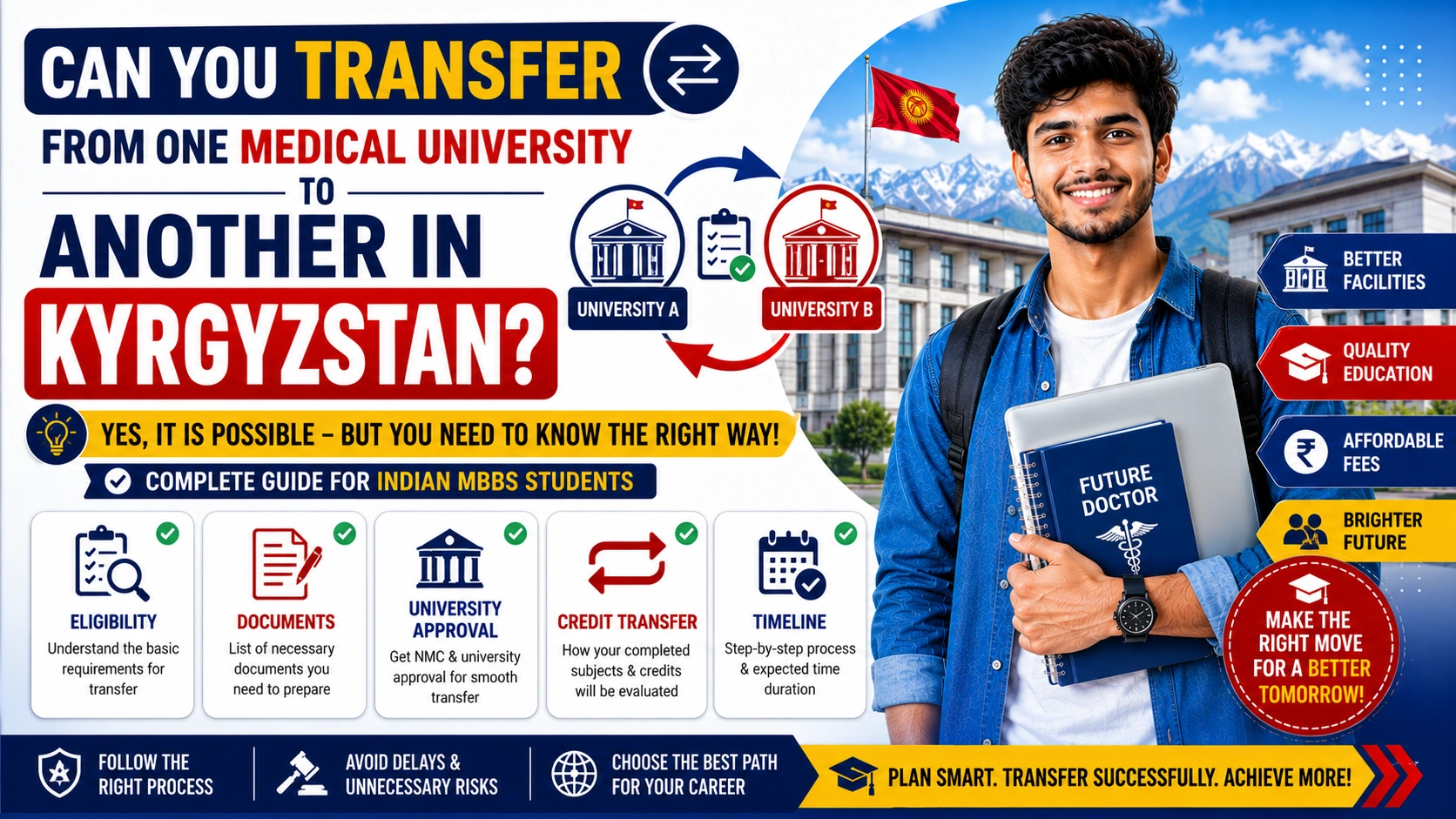
Is it possible to transfer for Indian students between medical universities in Kyrgyzstan? No, it is not possible according to the current NMC regulations. After the implementation of the Foreign Medical Graduate Licentiate (FMGL) Regulations 2021, for Indian students who enrolled after November 18, 2021, those students are required to complete their entire MBBS along with the 12-month internship in the same foreign medical institution to be eligible for the licensing exam (FMGE/NExT) in India. During their foreign studies, they are not allowed to transfer to any other university even if the university is located in the same country of Kyrgyzstan, unless there are extraordinary situations approved by the government, such as war or the closure of the university.
University Transfers: Why Are They Restricted?
Before the FMGL Regulations of 2021, if you enrolled prior to the regulations, partial transfer to another university was possible after the first year in case of valid reasons such as medical emergencies or relocation of the immediate family.
The old arrangements are gone. Now, the 54 months of the academic program plus the 12 months of the internship must all be done at one institution.
Why State This as A Requirement?
It is less about the punishment and more about the logic of the NMC. Since no two medical schools, even in the same country, have identical teaching curriculums and clinical training, moving mid-course creates a lot of gaps that they cannot analyze fairly. In place of a case-by-case approach to analyzing gaps, the NMC states a rule of completing the course and internship at one given institution.
Regulation Fragment
FMGL Regulations 2021 State
Minimum course duration
54 months of academic study
Internship duration
12 months at the same institution
Mid-course transfer
Not allowed (for students admitted after Nov 18, 2021)
Change of country
Normally not allowed
Exceptions
Only in extraordinary circumstances (war, institutional closure), after government approval
Does This Apply Even Within Kyrgyzstan?
Yes. There is a common myth that it is acceptable to change universities as long as the country remains the same. For example, it is not acceptable to change universities within Bishkek. The rule is institution-specific, not country-specific. Even changing universities among NMC approved, WHO listed universities in Kyrgyzstan will be considered a breach of the “single institution” requirement and a risk to your eligibility to take the FMGE/NExT exam in your home country.
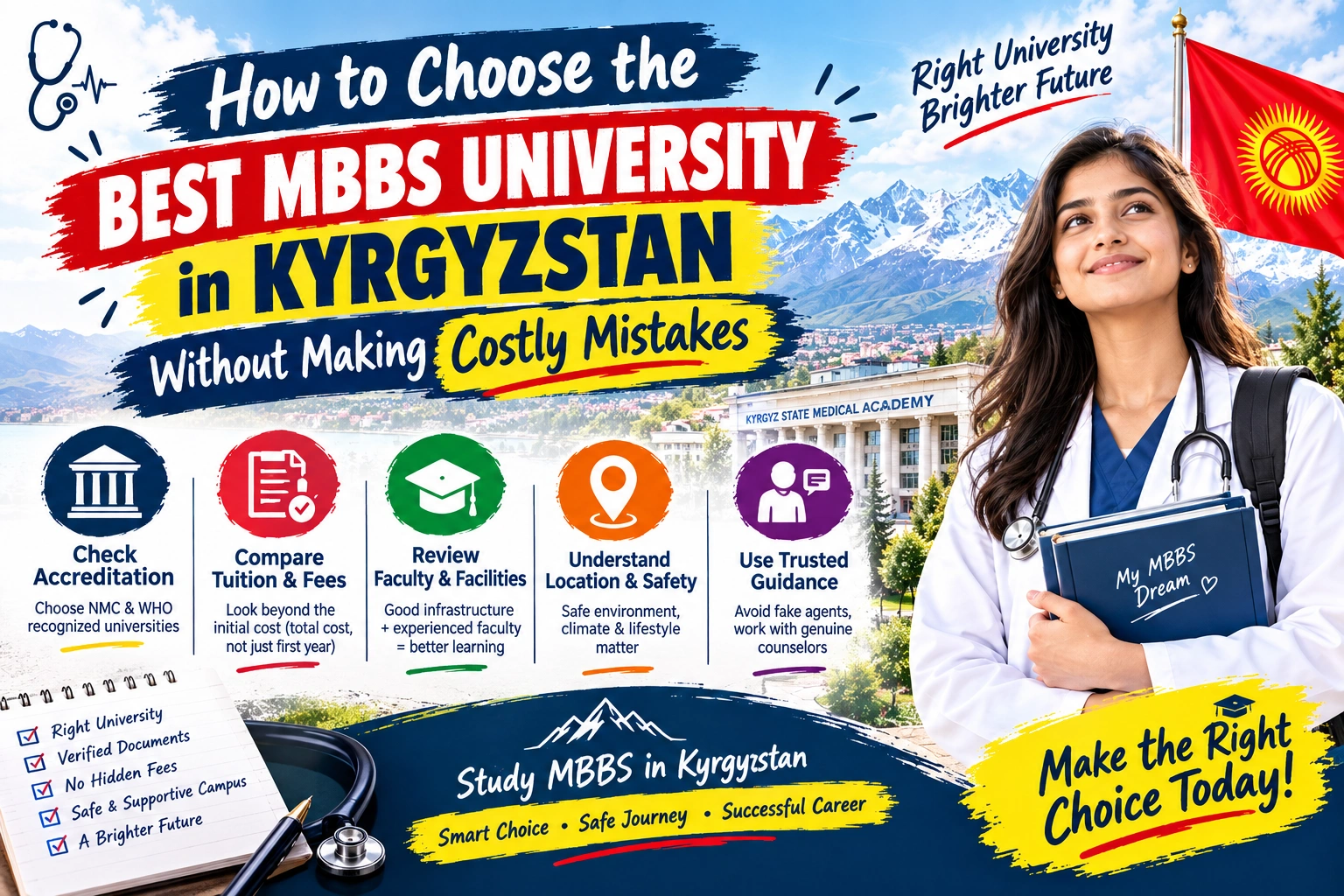
When opting to pursue an MBBS in Kyrgyzstan, carefully selecting your university matters more than you think, as you cannot simply depend on moving to the right one later on.
What can you really do when you are not satisfied with the university you are in?
For a few issues that relate to faculty, hostels, or clinical postings, the first thing for you to do is address your concern with the university administration. These primarily concern issues relating to faculty, hostels, or clinical postings, that are addressable at the university level.
Before you jump to the conclusion that taking a transfer is the only option, seek guidance from your education counselor or the international office at your university.
In the event of serious safety issues or even closures of the institution, you may document these as genuine extraordinary cases, as the NMC has granted exceptions in these scenarios, but it will not be an easy task.
Steer clear of unofficial or informal "mobility programs". The NMC have expressly stated that programs that are offered elsewhere, and have been labeled as such, will not be accepted for Indian students.
MBBS in Kyrgyzstan eligibility requirements
Given that transfers are not a feasible safety net, you must satisfy the following requirements if you want to get MBBS in Kyrgyzstan:
An aggregate mark of at least 50% in PCB (Physics, Chemistry, Biology) in Class 12, and 40% for SC/ST/OBC.
You must have completed Class 12 from a recognized board.
According to NMC regulations, all Indian students must have a valid score in NEET UG.
You must be at least 17 years of age by 31 December of the year of admission.
A valid passport with sufficient validity for the entire course duration.
Getting MBBS in Kyrgyzstan
Research thoroughly and finalize your options. Transfers won't be available after this, so it deserves proper investment of time.
Verify NEET eligibility and collect academic documents.
Applications have to be submitted to either the university directly or through a registered and verified representative.
Get your official admission/invitation letter from the university directly.
Apply for the Kyrgyz student visa.
Pay your first year’s tuition, directly to the official university bank account.
Travel and complete local registration, medical check-up, and residence permit.
MBBS in Kyrgyzstan Fees
Kyrgyzstan MBBS fees are among the cheapest in the world for a WHO-recognized and NMC recognized medical degree. However, the costs are determined by the university and the city.
Cost Component
Tuition (Public Universities)
$3,200 - $4,800
Tuition (Private Universities)
$3,500 - $5,600
Hostel and Living Expenses
$1,800 to $3,000
Total 6 Year Cost
₹15 Lakh to ₹32 Lakh
These are estimates and may change. Benefits of Getting Your University Choice Right the First Time
No risk of losing FMGE/NExT eligibility from a mid-course transfer
Same curriculum and clinical training for the whole program
Continuous connections with faculty and mentors
Stops the emotional and financial costs of starting documentation in a new location
Continuous academic record that's easily verified for licensing.
Disadvantages and Risks of Assuming Transfers are Possible
Students that transfer (especially through unofficial or unrecognized programs) put their entire degree at risk to be invalid for Indian licensing.
Time and money spent at the first university may not be counted for eligibility at a new one.
Family and societal pressures, along with educational loans, lead individuals to pursue education along a predetermined, linear path.
In the long term, applications to alternative programs often lead to emotional distress.
Factors to Consider When Looking for the Best Universities for MBBS in Kyrgyzstan
Before you make an irreversible commitment to an institution, do your research.
Why You Should Commit to Your Research
Kyrgyz State Medical Academy (KSMA)
Bishkek
Has a large network of hospitals, founded in 1939.
Kyrgyz Russian Slavic University (KRSU)
Bishkek
Has a good FMGE history.
Osh State University
Osh
Has good relations with regional hospitals
Jalal-Abad State University (JASU)
Jalal-Abad
Many clinic relations for internships.
International School of Medicine (ISM)
Bishkek
Has a large international student community.
Asian Medical Institute (ASMI)
Kant
Has a diversified and international student population, middling hospital relations.
As this decision is irreversible, double-check things like accreditation, hospital relations, and student opinions, independent of agent comparisons.
Career Opportunities After MBBS in Kyrgyzstan
Those who complete their entire degree and the internship in the same Kyrgyz University (NMC-approved and WDOMS-listed) are eligible to
Take India's FMGE/NExT and practice in India.
Take other countries' postgraduate education to qualify to practice (e.g. US USMLE, UK PLAB/UKMLA).
Fulfill the requirements to practice in Kyrgyzstan (or neighboring countries).
Keeping the course continuity at one University safeguards the rest of your career options.
Frequently Asked Questions (FAQs)
Q1.
Can I transfer to a different medical university in Kyrgyzstan and keep my NMC eligibility? No, according to the FMGL Regulations 2021, Indian students must complete their entire medical program and their entire internship at one single medical school. This rule applies whether a transfer is within Kyrgyzstan or in a different country.
Q2.
Was there ever a possibility to transfer for Indian medical students studying abroad? Yes, before the 2021 Regulations, some transfers after the first year were allowed for valid reasons. However, this has now been fully removed for students enrolling after November 18, 2021.
Q3.
Is a No Objection Certificate (NOC) required from the NMC for transferring to another foreign university? NMC says a formal NOC is not mandatory because foreign universities are not under their jurisdiction. However, it does not make the transfer safe and it will still violate the single-institution continuity and affect your licensing eligibility.
Q4.
Are there any exceptions to the transfer rule? Rare exceptions for transfers have been considered, such as wars and the closure of an institution. However, even in these cases, transfer requests are not guaranteed to be approved.
Q5.
What can I do if I don't like studying at my university in Kyrgyzstan? First, address your concerns to the university administration and your international student office. If your concerns are not resolved your transfer may be possible. Most routine issues can be resolved without transferring to a new institution.
Q6.
Is NEET mandatory despite the transfer regulations? Yes, for all Indian students pursuing MBBS in Kyrgyzstan, NEET UG qualifying marks are still compulsory, irrespective of the transfer situation.
Conclusion
The fact is, for Indian students, the option of changing medical universities in Kyrgyzstan does not exist. And, unfortunately, medical curricula can be very inflexible. For this reason, the most critical aspect of your medical education is your initial research. This includes the university's accreditation, the hospitals it is associated with, the teaching faculty, and real student feedback.
If you are in the process of considering your options for MBBS in Kyrgyzstan, the time to select an appropriate option is now. There is no valid second opportunity after you have enrolled. The first choice you make for your education is almost always the best one. There is little evidence to support the idea that a transfer will present a better opportunity.
This article is restricted for information purposes only. Always check the transfer and eligibility guidelines with the NMC official guidelines for the most updated information prior to making any decisions regarding admissions.