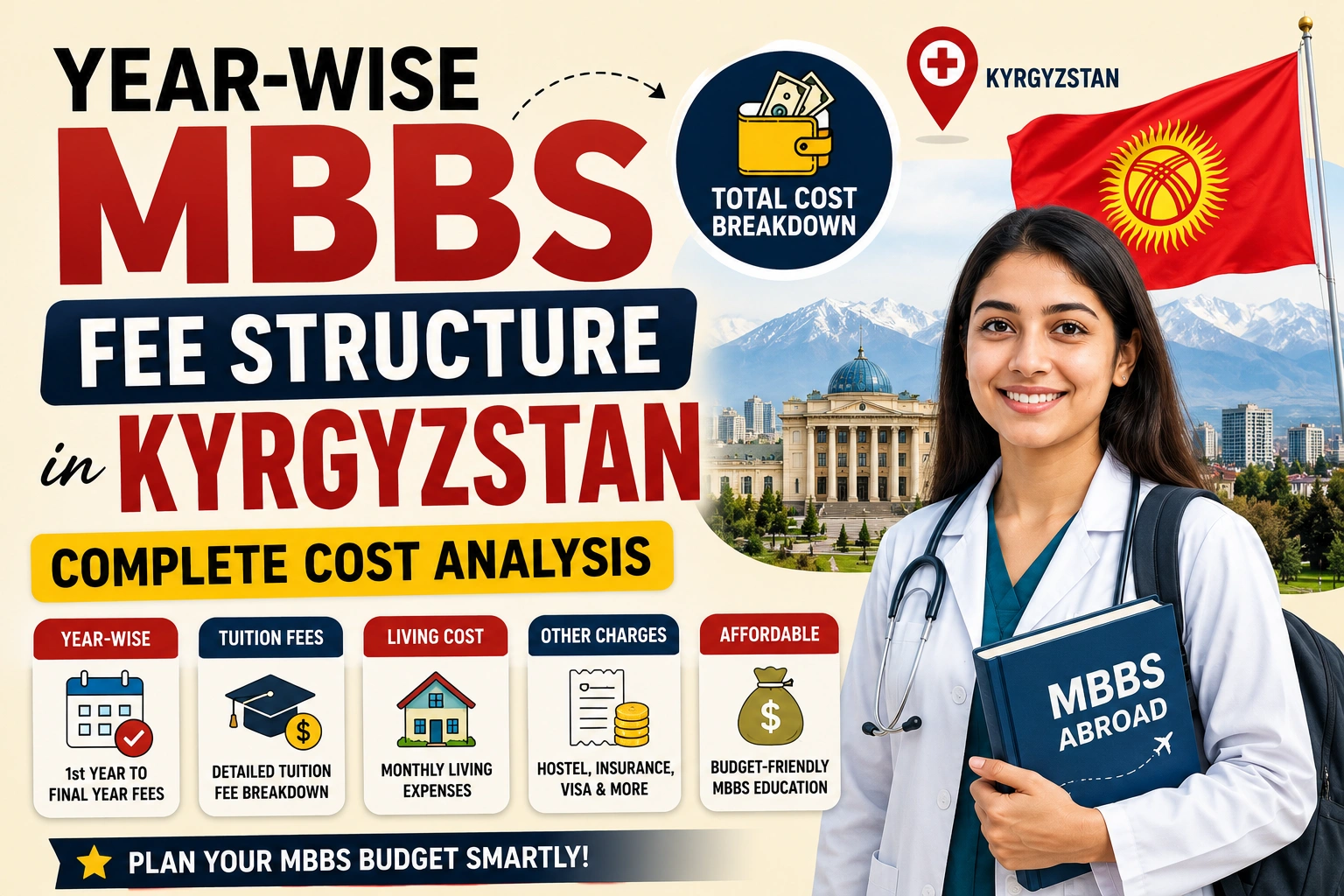
Over the years, Kyrgyzstan has developed a formidable reputation as an inexpensive choice for Indians considering MBBS abroad. Aside from affordable tuition, Kyrgyzstan hosts a significant number of Indian students, charges reasonable living expenses, and has several universities. Although tuition is one of the factors that determine the affordability of a university, the budget for studying MBBS in Kyrgyzstan also includes expenses for hostel, food, insurance, visa, travel, university, and other miscellaneous expenses.
Many universities in Kyrgyzstan charge fees in the range of 2.5 to 5 lakhs for the duration of one academic session. Although some universities fall in this range, there are many who charge a fee lower or higher than this, so students are advised to check the fee schedule carefully before making a payment.
Cost Analysis at a Glance: MBBS in Kyrgyzstan
The medical program in Kyrgyzstan is six years in duration, and students should check with the university and confirm that the program adheres to the requirements of Indian students. Hostel and living expenses form the major expenditure, head of which is tuition fee.
For Indian students, pricing the package as the least expensive available is a common mistake. A university that costs a little more than this package could be better in terms of clinical exposure, hostel, academic facilities, and student support. Indian students are advised to consider the total cost for the six years of study instead of merely comparing tuition.
According to published data, the overall spending at universities can vary even with different lifestyles. An existing Kyrgyzstan fee guide places the estimated cost for a degree at approximately ₹15–25 lakh over 5 years, with hosting and living expenditure added separately.
Year-Wise MBBS Fee Structure in Kyrgyzstan
The following structure has been specified to give an idea of how finances may be distributed across a period of 5 years. The figures shown may vary as the universities have the right to revise the fees at any time. The amount realized in Indian Rupees may also vary due to fluctuations in currency rates.
First Year: Initial Expenses
The first year usually requires the most financial preparation as students have to pay several admission related charges in addition to tuition and accommodation. Along with university fees, students should be prepared to cover costs of documentation, visa, travel, insurance and a first year budget should be kept for initial settlement.
A reasonable range for first year tuition fees may be around ₹2.5–₹5 lakh and hostel or accommodation may cost approximately ₹40,000 – ₹1 lakh (depending on university and room assigned). Other first year expenses may often include registration, visa/documents, travel and insurance.
For this reason, students must assure a high budget for the first year expenses as there may be other costs that the tuition does not cover.
Second Year: Mainly Tuition, Hostel Expenses and Living
In the second year, the financial preparation becomes easier, assuming the first year expenses for admission and travel are complete. During this year, the main expenses are tuition, hostel, food and general living.
Tuition fees at different universities can range from about 2.5 to 5 lakhs per year. Hostel fees may cost around 40 thousand to 1 lakh per year, while food and personal expenses depend on your needs.
For Indian students who use an Indian mess or cook their own food, food costs need to be accounted for separately. Food and living expenses may range from 8 thousand to 15 thousand rupees per month, but some students may even have higher expenditures.
Third Year: Academic and Clinical Expenses
This year is important because students move more towards clinical subjects and learning. As always, tuition is the biggest academic cost, but students also need to consider the costs of books, equipment, local transport, and other study-related costs.
It is better to go beyond estimating tuition costs for just one year. Students should have a flexible annual budget to cover unplanned academic or personal costs. This helps avoid financial stress during the course of study.
Fourth Year: Clinical Learning and Regular Expenses
During the fourth year, students also have to spend on tuition, hostel, food, and other academic expenses. Clinical Learning becomes important, and students should check what exactly the University fee includes.
Students should confirm if the quoted fee includes clinical training, university charges, examination fees, hostel, and other compulsory charges. Similarly, two different universities may have different overall costs for the same quoted tuition.
Fifth Year: Advanced Academic Expenses
Most students will have continuing tuition and living expenses, but students should start preparing themselves financially for the last leg of their education and begin thinking about licensing requirements after they complete medical school.
For Indian students, it is important to check the National Medical Commission (NMC)’s latest guidelines. The Foreign Medical Graduate Licentiate Regulations and related FAQs are currently published by the NMC. The regulations page was last updated by the NMC in 2026.
Sixth Year: Internship and Final-Year Planning
The final year of medical school requires a lot of financial preparation due to the arrangements of the internship, accommodation, food, travel, and the postgraduate requirements. Students should review the internship policy of the medical university, and confirm that their medical education is in accordance with the regulations pertaining to foreign medical graduates.
The NMC published clarification in 2026 pertaining to the internship of students admitted post-Frame work of FMGL. This clarification is relevant to the current applicants, and thus it is important for them not to rely on old admissions information.
Tuition Fee vs Total Cost of Studying MBBS in Kyrgyzstan
A realistic financial plan includes all the costs involved, and not just tuition:
Tuition fees
Hostel or accommodation
Food and Indian mess
Visa and documents
Health Insurance
Air tickets
Textbooks and study materials
Local transport
Miscellaneous
University or examination charges
Estimated costs place hostel expenses somewhere between 2 to 5 lakh rupees, and the expense for food, accommodation, and other miscellaneous expenses are expected to cost many lakhs more. So, take the total expense for the entire six years into account when considering studying at any University.
How NEET affects MBBS Studies in Kyrgyzstan
NEET is an essential part of the admission process and an important part of the Medicinal Studies abroad for Indian students. According to the official website of NEET UG, it is the entrance exam for medical study at the undergraduate level in India. Additionally, the NMC (National Medical Council) has made it compulsory to clear NEET as a prerequisite for Indian students looking for a medical degree abroad.
Students must understand that the admission process of a foreign university does not grant them the authority to pursue medical practice in India. They must verify NEET as well as the NMC requirements before admission.
What Students Should Verify
Before making any payment to a university or a consulting firm, students must verify the current status and the eligibility criteria of the medical school on their own. For Indian students, the NMC recognition or eligibility is of utmost importance since studying at a foreign medical school does not offer the right to practice medicine in India.
Students should check the university’s entry on the World Directory of Medical Schools (WDOMS) and WHO as well. WDOMS is a directory maintained by the WFME and FAIMER/Intealth, and contains the contact details of medical schools worldwide. WDOMS indicates that having a school listed in the directory does not signify recognition, accreditation, or an endorsement by WDOMS.
This is a very significant point. WDOMS listing should never be considered equivalent to NMC approval or medical registration in India.
Variations in the annual MBBS budget can include the location of universities. There may be different kinds of hostel or accommodation associated with the cost of studying at different universities in major cities as opposed to smaller cities. Another factor can include shared or private accommodation.
Variations in currency exchange rates can also affect students, as a lot of international universities quote their fees in foreign currencies. A fee that may appear affordable in one currency may become expensive in another due to changes in currency values. Students need to create a safety buffer.
Your personal lifestyle plays an important role as well. Students may incur considerably more expenditure than other students, if they opt for private accommodation, frequent travel, and eating out on a regular basis. More budget-friendly options include university hostels and Indian Mess facilities.
Cost Saving Tips for Studying MBBS in Kyrgyzstan
To save money, planning is the key. Before you take admission in Kyrgyzstan, you must be able to answer the question, "How much will I be spending during admission, and what will be my total spending until I graduate?"
Students should realize the importance of choosing a good quality university at the right price, living in university hostels with a proper meal plan, managing their travel expenditure, having an emergency fund, and sticking to the budget they set. They should never aim at reducing the cost at the expense of their future, by settling for a university which does not fulfill their requirements.
How Affordable is Studying MBBS in Kyrgyzstan for Indian Students?
The affordability of Kyrgyzstan for students who wish to study MBBS abroad is decent. Many universities and the country as a whole charge annual fees in the range of a few lakhs of Rupees. Everything you spend would ultimately depend on your spending habits and the chargeable extras of the university, along with the travel and food expenditure, and the cost of living for a year, in rupees.
Affordability, along with quality, is the key. A university which charges a low price, does so because it fails to fulfill international standards.
Conclusion
Kyrgyzstan is a good option for Indian students if they want to build their education career. The total cost of the first year is expensive because of the many costs like travel, settlement, admission, visa, and other formalities. Once you have settled in, subsequent years will require few additional costs and will be less expensive when compared to the first year.
Prospective students should look up the university's current fee structure and verify the applicable NMC regulations and the NEET qualification, and check the institution through WDOMS and other official sources before confirming admissions. Especially consider the total cost of the medical education over six years instead of only the advertised tuition fees. Through this method, families can estimate the total cost of sending their children to medical school in Kyrgyzstan and avoid last minute surprises.