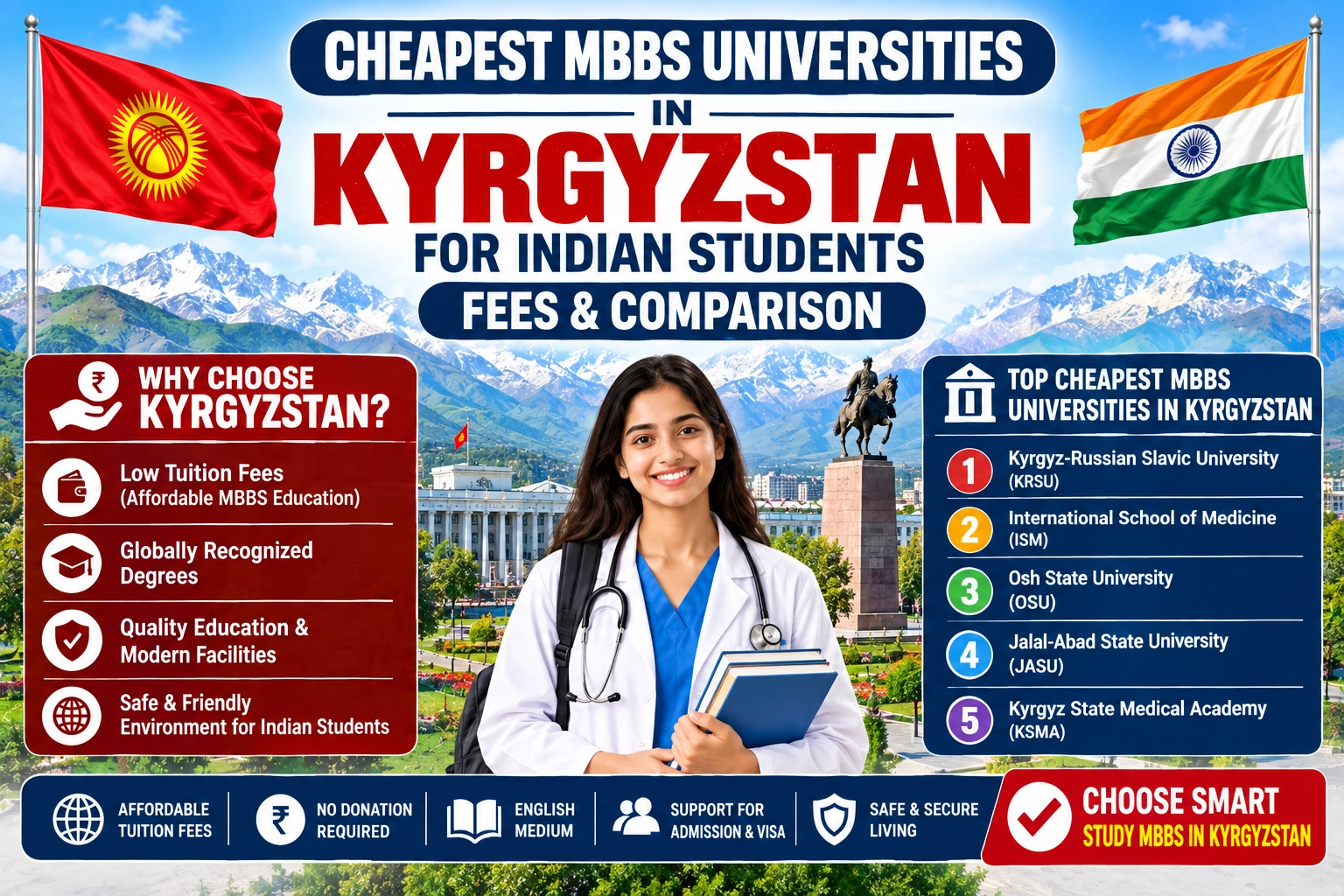
A medical degree abroad sounds affordable until the small expenses start joining the bill. Tuition is one thing. Hostel, food, visa renewal, insurance, travel, registration charges and currency fluctuations are another. That is exactly why students searching for the cheapest medical university shouldn't compare tuition fees alone. The final six-year spending matters more.For Indian students, MBBS in Kyrgyzstan has become a familiar option mainly because several universities offer medical education at a cost much lower than many private medical colleges in India. Depending on the university and lifestyle, tuition fees may roughly fall between ₹2.5 lakh and ₹5 lakh per year, while the overall academic and living budget can be considerably higher.Cheap? Yes, comparatively.But the cheapest university on paper isn't automatically the best choice.Recognition status, course duration, internship structure, medium of instruction, clinical exposure and eligibility to practise in India after graduation need equal attention. A difference of ₹50,000 or ₹1 lakh per year shouldn't push a student toward a program that creates problems later.Here is a practical comparison of affordable medical universities in Kyrgyzstan, what Indian students may actually spend, and what should be checked before paying the first-year fee.
Why Is Kyrgyzstan Considered an Affordable MBBS Destination?
The cost difference is the obvious reason. Private MBBS education in India can involve a very large overall investment, whereas medical programs in Kyrgyzstan are generally offered at lower tuition levels.There is another reason too. Living expenses.A student maintaining a normal lifestyle may spend around ₹10,000–₹18,000 per month on food and personal expenses, although the actual figure depends heavily on the city, accommodation, exchange rate and spending habits. Bishkek can feel more expensive than smaller locations. Indian mess facilities and private accommodation can push the monthly budget higher as well.Most programs marketed to international students are also taught substantially in English. Still, students shouldn't assume that English-medium teaching means they can ignore Russian or Kyrgyz completely. During clinical years, communicating with local patients becomes part of practical learning.And that's where language suddenly matters.For students researching MBBS in Kyrgyzstan, affordability therefore needs to be considered alongside the actual quality of clinical training.
Cheapest MBBS Universities in Kyrgyzstan: Quick Fee Comparison
Fee structures change. Currency exchange rates do too. The figures below should therefore be treated as approximate planning ranges rather than final quotations. Students should obtain the latest official fee structure from the university before making any payment.
Medical University | Approx. Annual Tuition | Approx. Tuition Budget for Course* | Cost Position |
Osh State University | ₹3–4 lakh | ₹18–24 lakh | Affordable |
Jalal-Abad State University | ₹3–4 lakh | ₹18–24 lakh | Affordable |
International Higher School of Medicine | ₹4–5 lakh | ₹24–30 lakh | Mid-range |
Kyrgyz State Medical Academy | ₹4–5 lakh | ₹24–30 lakh | Mid-range |
Asian Medical Institute | ₹2.5–3.5 lakh | ₹15–21 lakh | Lower-cost range |
International Medical University | ₹3–4 lakh | ₹18–24 lakh | Affordable |
*Approximate planning figures only. The actual payable amount can differ because of annual fee revisions, program structure, exchange rates and university charges. Hostel, food, visa, insurance, travel and other expenses are generally separate.This table tells only half the story. A university charging slightly more but offering stronger hospital exposure, a clearer internship arrangement and a compliant course structure may make much more sense for an Indian student.
Osh State University: Affordable and Popular Among Indian Students
Osh is usually one of the first names students hear while comparing lower-cost options. There is a reason for that. The university has been receiving international medical students for years, and the city itself can be relatively manageable from a cost perspective.Tuition for international medical students can roughly sit around ₹3–4 lakh annually, depending on the applicable intake and fee schedule. Add hostel, food and routine expenses, and a realistic annual budget can move closer to ₹5–6.5 lakh.Not dirt cheap. Still manageable.Osh also has a sizable international student environment, something first-time students often appreciate more than they expect. Indian food availability and an existing Indian student community can make the initial adjustment easier.The bigger question should be clinical training. Before admission, ask where clinical rotations take place, how much patient interaction students receive and how local-language training is handled.
Jalal-Abad State University: Another Budget-Friendly Choice
Want lower fees without automatically choosing the least expensive name on an admission list? Jalal-Abad State University often enters that discussion.Depending on the applicable fee schedule, tuition can be approximately ₹3–4 lakh annually. Hostel and living expenses need to be calculated separately. For a student living sensibly rather than spending freely, the complete annual expense may remain within a comparatively affordable bracket.One thing deserves attention here. Don't select a university simply because an agent shows you a low first-year package.Ask for the second, third, fourth and later-year fees too.Some packages include first-year processing, hostel or admission-related charges while later years follow a different structure. Compare the entire course cost in writing before deciding. It sounds basic, but plenty of families skip this step.
Asian Medical Institute: Among the Lower-Cost Options
Here the price gets interesting.Asian Medical Institute is frequently considered by students whose budget is particularly tight. Approximate tuition can fall around ₹2.5–3.5 lakh per year, though current fees must be confirmed directly before admission.That can make the academic cost attractive.Still, low tuition should trigger more questions, not fewer. Students should independently check the current medical program, teaching hospital arrangements, internship structure, medium of instruction and whether the qualification satisfies Indian regulatory requirements applicable to their batch.Check the institution and medical qualification through the World Directory of Medical Schools where applicable. A WDOMS listing is useful for verifying information about a medical school, but students shouldn't treat directory listing by itself as proof that every regulatory requirement for Indian registration has been satisfied.Small distinction. Big consequences.
Kyrgyz State Medical Academy: Cheapest? Not Quite, but Worth Comparing
Some students make one mistake repeatedly: they sort universities from cheapest to most expensive and stop there.Kyrgyz State Medical Academy generally isn't the lowest-fee option in Kyrgyzstan. Its tuition may roughly fall around ₹4–5 lakh per year depending on the current international fee structure. Yet students still compare it seriously because cost isn't the only consideration.Location in Bishkek, institutional history, teaching facilities and clinical environment can justify looking beyond the cheapest number.The annual overall expense may be higher once accommodation and city living are included. So if your budget is extremely restricted, Osh, Jalal-Abad or another lower-cost institution may initially look more attractive.If the difference across six years is manageable, though, compare academics before rejecting KSMA solely on price.
International Higher School of Medicine: A Mid-Budget Alternative
A slightly higher budget opens another category.International Higher School of Medicine, commonly called IHSM, attracts a considerable international student population. Depending on campus, intake and current fee policy, tuition may be around ₹4–5 lakh annually.For some families, that's no longer "cheapest."Fair enough.But a ₹1 lakh annual difference becomes easier to judge once you compare teaching hospitals, clinical opportunities, student support, location and the complete program structure. This is why MBBS in Kyrgyzstan shouldn't be selected through fee comparison alone.Ask for a complete academic calendar and written fee schedule. Not a WhatsApp message saying "total package around 25 lakh." An actual breakdown.
What Is the Real Total Cost of MBBS in Kyrgyzstan?
Here is where advertised figures often become confusing.Suppose tuition is ₹3.5 lakh annually. A family may quickly calculate six years as ₹21 lakh and assume that's the total MBBS cost.It isn't.
A practical budget could look something like this:
Expense | Approximate Cost |
Tuition | ₹2.5–5 lakh per year |
Hostel | ₹50,000–₹1.2 lakh per year |
Food/Indian mess | ₹8,000–₹15,000 per month |
Personal expenses | ₹3,000–₹8,000 per month |
Medical insurance | ₹8,000–₹20,000 annually |
Visa/registration-related costs | Variable |
Air travel from India | ₹25,000–₹60,000+ per trip |
Books, coat, equipment, local transport | ₹20,000–₹50,000 annually |
A reasonable overall budget for a complete medical education may therefore reach roughly ₹25–35 lakh or more for many students, depending on university, program duration, exchange rates and lifestyle.Could somebody complete it for less? Possibly.Could somebody spend substantially more? Easily.Honestly, this is the part that deserves more discussion. Families often spend weeks negotiating ₹20,000 from tuition and then forget to calculate six years of food, flights and currency movement.
Course Duration Needs More Attention Than the Fee
Six years is not just a number on a brochure.Indian students admitted to foreign medical programs need to examine the course structure against the National Medical Commission rules applicable to foreign medical graduates. Under the FMGL framework, NMC requirements include specified medical education and internship conditions, and its FAQs state that the internship abroad must be at least 12 months in the same foreign medical institution. NMC also requires qualifying foreign graduates to complete the applicable Indian internship and licensing requirements.So don't ask only:"How many years is MBBS?"Ask:"How are academic teaching, clinical training and internship distributed across those years, and does the structure satisfy the regulations applicable to an Indian student joining this intake?"Much better question.The NMC regulations page currently lists the Foreign Medical Graduate Licentiate Regulations 2021 along with updated FAQs, so students should verify the latest position there rather than depending on an old YouTube video or admission brochure.
Is NEET Required for Indian Students?
Yes, Indian students planning foreign medical education should treat NEET qualification as a core requirement for the Indian pathway.The official NEET website is maintained by the National Testing Agency and carries current information bulletins, results, notices and eligibility information.For university admission itself, requirements may vary, but a typical applicant is expected to have completed Class 12 with Physics, Chemistry, Biology/Biotechnology and English while satisfying the applicable eligibility rules.Don't confuse "no entrance exam by university" with "NEET isn't required."Those are completely different things.Students considering MBBS in Kyrgyzstan with plans to return to India should keep NEET documentation safely throughout the admission process and verify current rules before departure.
Recognition: NMC, WDOMS and WHO — What Should You Actually Check?
Recognition language can get messy very quickly.You may see phrases such as "NMC approved," "WHO approved," "internationally recognised," or "globally accepted" across advertisements. Don't make a financial decision based on a logo collage.Start with the actual institution and qualification.Use WDOMS to check the medical school's directory information. Review the current NMC regulations to understand what an Indian foreign medical graduate must satisfy. For broader international health information, students can also refer to the World Health Organization.Most importantly, understand that the university's existence in an international directory and an individual Indian student's eligibility for registration in India are separate questions.The latter depends on compliance with the applicable Indian regulations.Here—well, this is exactly where students need to slow down. One regulatory mismatch can matter far more than saving ₹2 lakh across the degree.
FMGE and NExT: What Happens After Graduation?
Your foreign degree isn't the final step if India is where you want to practise.Under the current regulatory framework, foreign medical graduates must satisfy India's prescribed licensing and registration pathway. NMC's FMGL FAQs state that FMGs must clear NExT or another test mandated by NMC, while NMC's regulations page notes that NExT was deferred and continues to list the applicable regulatory notices.That means students shouldn't choose a university based on old claims such as "FMGE doesn't matter anymore" or "NExT has completely replaced everything."Rules can change during a six-year course.What doesn't change is the need for strong basics.Anatomy. Pathology. Pharmacology. Medicine. Surgery. Actual patient interaction. If your medical education is weak, the low fee won't feel like a bargain when you begin preparing for a licensing examination.
Hidden Costs Students Commonly Miss
The brochure says $3,500. The family calculates the rupee equivalent. Done?Not really.Currency conversion alone can alter the final amount. If tuition is denominated in US dollars and the rupee weakens during your course, later-year payments become more expensive without the university increasing its dollar fee.Then come the smaller charges: visa extensions, residence registration, medical tests, insurance, airport transfers, winter clothing, SIM cards, local transport, examination charges where applicable and trips back to India.Indian mess costs deserve separate attention too. Cooking yourself may reduce expenses, but not every student wants to cook after lectures and clinical classes.Keep a contingency fund of roughly 10–15% above your calculated budget. Six years is a long period. Something will change.Usually more than one thing.
Which Kyrgyzstan Medical University Is Cheapest?
If price is the only filter, institutions such as Asian Medical Institute and some other lower-fee options may appear near the bottom of the cost range, while Osh State University and Jalal-Abad State University can also be comparatively affordable.But I wouldn't create a ranking purely from tuition.For example, University A costing ₹3 lakh annually versus University B costing ₹3.7 lakh creates a difference of roughly ₹4.2 lakh over six years. That's meaningful money. Still, if University B provides a better compliant course structure, stronger clinical training and clearer internship arrangements, the additional expense could make sense.The right question isn't "Which is the cheapest?"It is "Which is the cheapest suitable university for my career plan?"That one word changes the entire comparison.
Pros and Cons of Choosing Kyrgyzstan on a Tight Budget
Students considering MBBS in Kyrgyzstan usually like the comparatively low tuition, manageable living costs, availability of programs for international students and established Indian student communities at several institutions.The concerns are equally real. Quality can differ between universities. Local-language skills matter during hospital interaction. Extreme winter weather takes adjustment. Currency rates can change your budget, and returning to India means meeting the applicable NMC licensing, internship and registration requirements.So yes, Kyrgyzstan can make financial sense.Just don't make it a price-only decision.
How to Select an Affordable University Without Making a Costly Mistake
Before transferring any money, create your own comparison sheet. Put tuition for every academic year, hostel charges, food estimate, course duration, internship, teaching language, clinical hospitals and refund policy into separate columns.Then verify the medical school independently.Check WDOMS information. Read current NMC rules. Confirm the exact course and internship arrangement in writing with the university. Ask current students about patient exposure rather than only hostel rooms and Indian food.Also ask whether fees can increase during the course and which currency controls payment.One final check: calculate the entire degree cost using a slightly worse exchange rate than today's rate. If the family can still afford it without serious financial stress, the budget is much safer.
FAQs
Is Kyrgyzstan really cheap for MBBS for Indian students?
Compared with many private medical education options, yes. Tuition at lower-cost Kyrgyzstan universities may roughly range from ₹2.5–₹4 lakh annually, while some institutions can cost ₹4–₹5 lakh or more. The complete budget is higher after accommodation, food, travel, insurance and other expenses are included.
Which is the cheapest medical university in Kyrgyzstan?
There isn't one permanent answer because university fees change by intake and academic year. Asian Medical Institute and several regional options are often placed in the lower-cost category, while Osh State University and Jalal-Abad State University are also frequently considered by budget-conscious students. Always verify current official fees.
Can I study MBBS in Kyrgyzstan without NEET?
If you're an Indian student intending to follow the pathway for medical registration in India, don't plan foreign medical admission by assuming NEET can simply be skipped. Check the current eligibility requirements through the official NEET portal and NMC before admission.
What is the total cost of MBBS in Kyrgyzstan?
For practical planning, many students may need roughly ₹25–35 lakh or more across the complete program once tuition, hostel, food and routine expenses are considered. This isn't a fixed package. University choice, exchange rates, airfare and personal spending can move the final figure considerably.
Is MBBS from Kyrgyzstan valid in India?
A foreign medical qualification does not provide automatic permission to practise medicine in India. Indian students must meet the NMC regulations applicable to foreign medical graduates, including education, internship, licensing examination and registration requirements relevant to their admission batch.
Is the cheapest university the best option for Indian students?
Usually, no. Fees matter, especially for families working with a fixed budget, but clinical exposure, course structure, internship arrangements, teaching quality and regulatory compliance matter more over the long term. Saving a few lakh isn't useful if the program creates difficulties after graduation.
Conclusion
Choosing the cheapest university is easy. Choosing an affordable university that still fits your future medical career is harder.For students considering MBBS in Kyrgyzstan, a realistic tuition range may start around ₹2.5–₹3 lakh annually at some lower-cost institutions and move beyond ₹5 lakh depending on the university. Once hostel, food, travel, insurance and personal expenses are added, planning roughly ₹25–35 lakh or more for the complete journey gives families a more practical starting point than brochure tuition alone.Compare Osh, Jalal-Abad, KSMA, IHSM and other options on the same sheet. Check the current fee structure. Verify the course duration and internship. Read NMC regulations yourself.Then decide.A medical degree lasts a lifetime. Saving money is smart, but spending it on the right university is smarter.