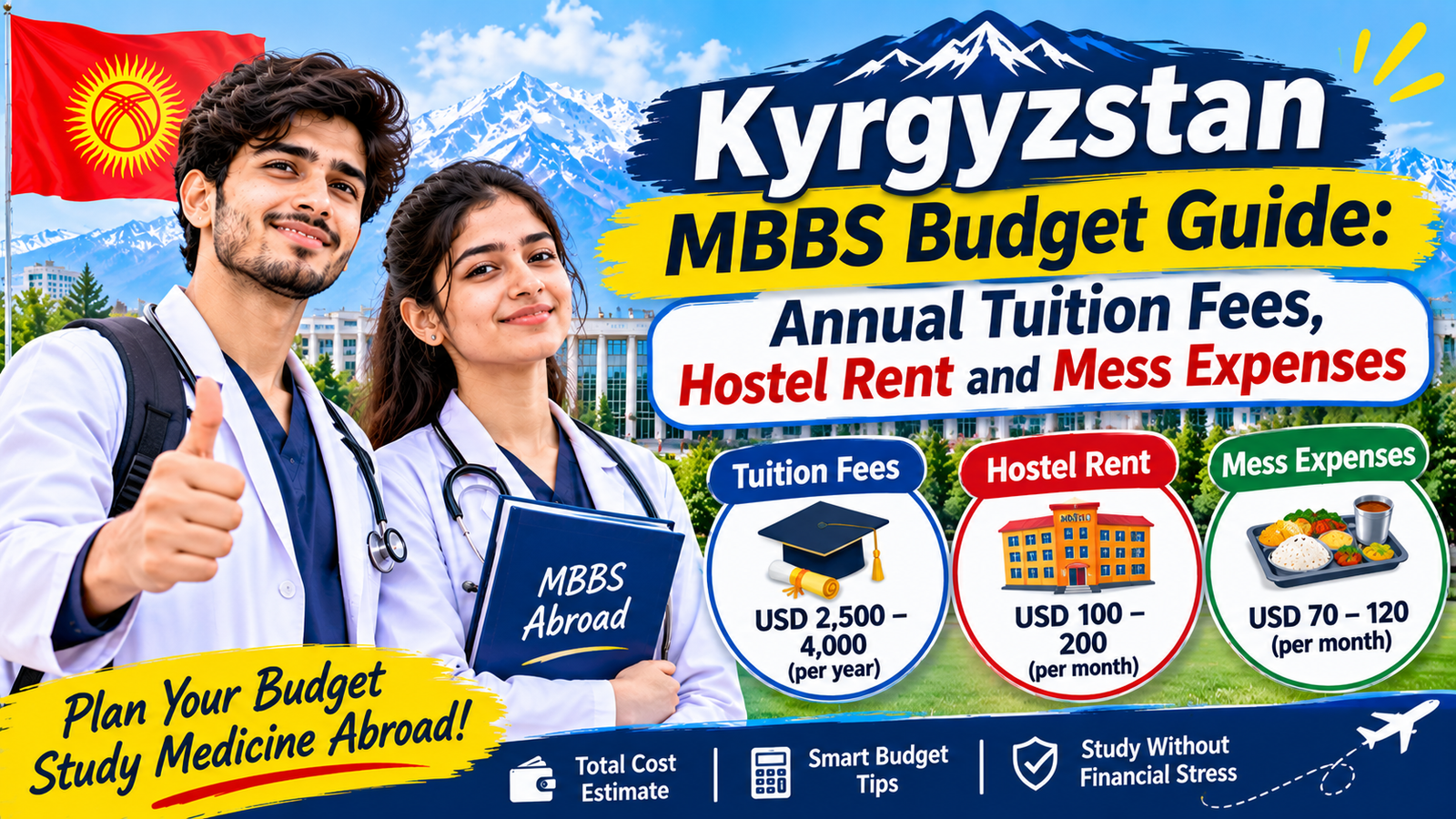
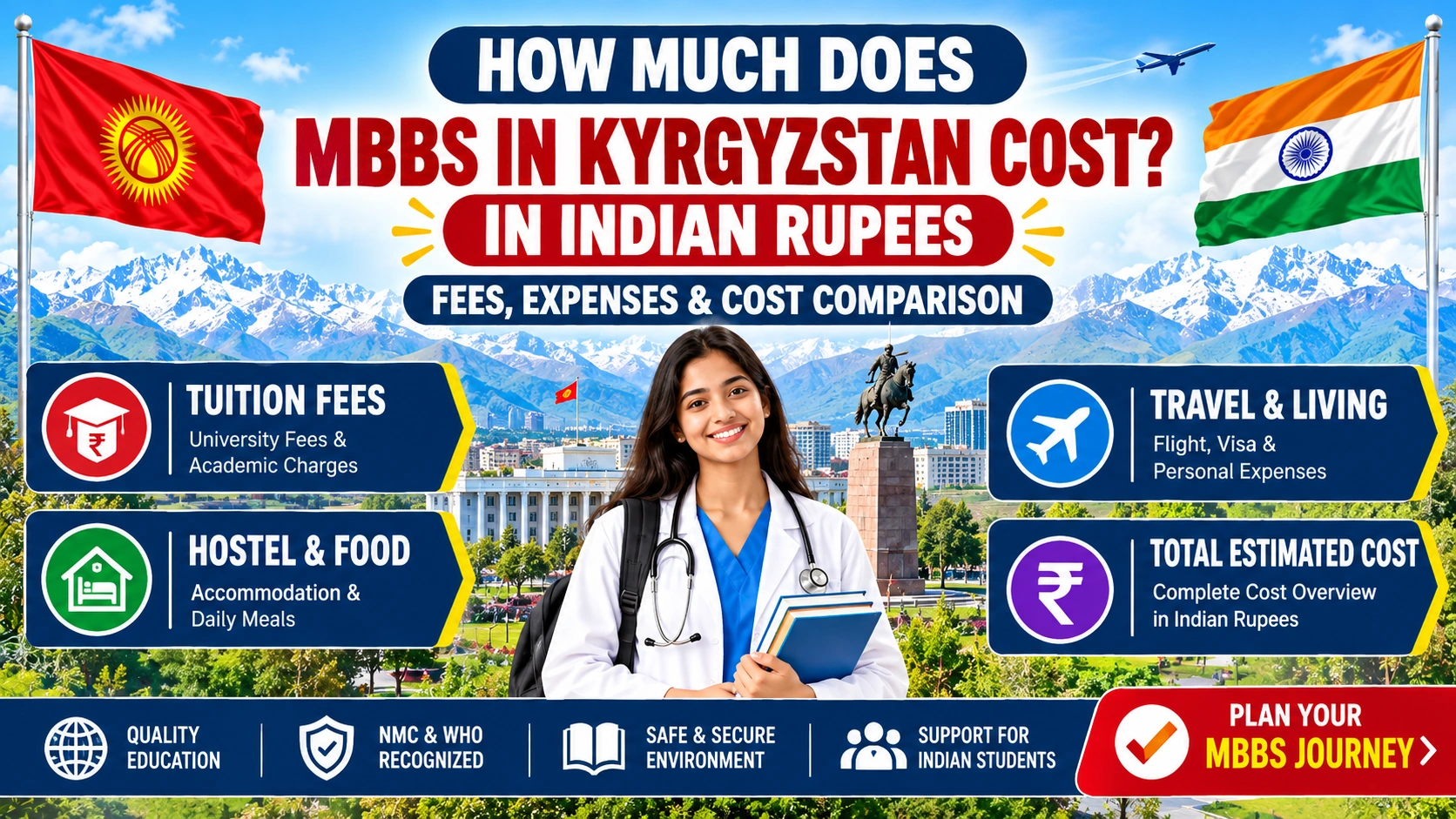
For many Indian families, the first question about MBBS in Kyrgyzstan isn't about weather, campus life, or even university rankings. It is much simpler: How much money will we actually spend?Fair question. Because a university may advertise tuition of around ₹3–5 lakh per year, but that isn't the amount your family will finally pay. Hostel charges come in. Food matters. Then visa renewal, insurance, flights, registration charges, local transport, books, and sometimes separate clinical or administrative expenses. Small amounts individually. Not so small after five or six years.For an Indian student, a practical working budget for medical education in Kyrgyzstan can broadly fall around ₹22 lakh to ₹35 lakh for the complete study period, depending heavily on the university, course structure, exchange rate, hostel choice, lifestyle, and what exactly is included in the quoted package. Some institutions may work out cheaper; others can cross this range.That's why looking only at the first-year fee is a bad idea.Students considering MBBS in Kyrgyzstan should calculate the entire degree cost before paying an admission deposit. And one more thing: affordability matters, but compliance with Indian medical education rules matters even more. A cheap medical degree that creates registration problems later isn't cheap at all.
MBBS in Kyrgyzstan Fees in Indian Rupees: Quick Estimate
Let's start with numbers. A typical Indian student may see annual tuition somewhere around ₹3 lakh to ₹6 lakh, although the actual amount differs significantly between universities and programs. Add accommodation and everyday expenses, and the yearly financial requirement becomes higher.
Here is a realistic broad estimate rather than a suspiciously precise figure:
Expense | Approximate Cost |
Tuition Fee | ₹3–6 lakh per year |
Hostel | ₹50,000–₹1.20 lakh per year |
Food/Mess | ₹70,000–₹1.50 lakh per year |
Medical Insurance | ₹8,000–₹20,000 per year |
Visa/Registration Related Expenses | ₹10,000–₹30,000 per year |
Books & Study Material | ₹10,000–₹25,000 per year |
Local Transport & Personal Expenses | ₹40,000–₹90,000 per year |
Flights to/from India | ₹30,000–₹60,000+ per trip |
Estimated Overall Degree Budget | ₹22–35 lakh approximately |
These are planning ranges, not official fee quotations. Currency conversion alone can change the INR figure during a student's course. University fee structures also change, so always request the latest written fee schedule directly from the institution before making payment.
Why Is MBBS in Kyrgyzstan Considered Affordable?
Here is the obvious reason: tuition.Private medical education in India can become extremely expensive, particularly once tuition, hostel and additional institutional charges are combined. Kyrgyzstan entered the consideration set for Indian students because several universities offer medical programs at a considerably lower tuition level.But "affordable" needs context.A student paying ₹4 lakh annually in tuition isn't spending only ₹4 lakh that year. After accommodation, meals, flights, documentation and daily living expenses, the actual annual budget could move closer to ₹5–7 lakh or beyond.Still comparatively manageable for many families. That's the attraction.The lower cost is one reason MBBS in Kyrgyzstan continues to receive attention among NEET-qualified students who can't secure an affordable Indian medical seat. Yet cost should be a filtering factor, not the only selection factor.
University-Wise MBBS Fees in Kyrgyzstan
This is where parents usually want a neat table with an exact rupee figure. Unfortunately, that can create false confidence. Fees can change by intake, currency exchange rate, hostel category and program structure, while different admission channels may quote different packages.
A broad planning comparison looks something like this:
Medical University | Approx. Tuition Range Per Year | Approx. Overall Budget |
Kyrgyz State Medical Academy | ₹4–6 lakh | ₹27–35 lakh |
Osh State University | ₹3–5 lakh | ₹23–30 lakh |
Jalal-Abad State University | ₹3–4.5 lakh | ₹22–28 lakh |
International Higher School of Medicine | ₹4–6 lakh | ₹27–34 lakh |
Asian Medical Institute | ₹3–4.5 lakh | ₹22–29 lakh |
Kyrgyz-Russian Slavic University | ₹4–6 lakh+ | ₹27–35 lakh+ |
Treat these figures as approximate budgeting ranges only, not current official quotations. Before admission, students should confirm tuition, course duration, hostel fee, internship structure and every compulsory charge in writing.And don't choose the lowest number automatically. That shortcut can get expensive later.
Course Duration Can Change Your Total Cost
A one-year difference doesn't sound dramatic until you calculate another year of hostel, food, insurance and living costs.The National Medical Commission FMGL Regulations specify requirements relevant to Indian students pursuing their primary medical qualification abroad. Among other conditions, the foreign medical course must involve at least 54 months of education and a minimum 12-month internship at the same foreign medical institution; the prescribed requirements also cover English-medium instruction, mandatory subjects and eligibility for registration/licensure in the country where the qualification is awarded.This deserves attention because programs in Kyrgyzstan aren't all structured identically. Current World Directory of Medical Schools entries show examples of both five-year and six-year medical programs, while some programs provide additional information about arrangements specifically applicable to Indian students.So don't ask only:"How many years is MBBS?"Ask exactly how the program satisfies the applicable NMC requirements for your admission batch, including internship and clinical training.Much better question.
Tuition Fee Is Only Half the Story
I have seen families focus heavily on getting tuition reduced by ₹20,000 or ₹30,000 while barely asking about accommodation and recurring living expenses. That's backwards.Suppose tuition averages ₹4 lakh annually. If hostel, food and personal expenditure together cost another ₹1.5–2 lakh every year, those non-tuition expenses can add roughly ₹9–12 lakh over six years.Suddenly that "₹24 lakh degree" isn't ₹24 lakh anymore.For MBBS in Kyrgyzstan, always calculate two numbers separately: academic cost and actual family outflow. The second figure is the one that matters.
Hostel and Accommodation Cost
Hostel charges can approximately range from ₹50,000 to ₹1.20 lakh per year, though the actual amount depends on university, city, room occupancy and facilities.Shared rooms are generally cheaper. Private or better-equipped accommodation costs more.Some students eventually prefer rented apartments, particularly after becoming comfortable with the city. That can work, but rent isn't the only expense. Electricity, heating, internet, security deposit and transportation may appear separately.For first-year students, university accommodation is often easier simply because everything is new. New country. New languages around you. New academic system.Less complication helps.
Food and Monthly Living Expenses
Food is one expense that looks harmless on a monthly basis and becomes substantial over several years.A student managing expenses carefully might spend roughly ₹8,000–₹15,000 per month on food, transport, mobile services and basic personal requirements, although lifestyle makes a huge difference. Frequent restaurants, shopping and private transport can push the figure much higher.Cooking can reduce costs.Indian food availability also depends on the city and accommodation setup. Some hostels or student services may offer Indian-style meals, but students should check the actual current meal plan rather than assuming "Indian mess available" means everything is included in hostel fees.Honestly, this detail gets missed surprisingly often.
Don't Forget Airfare
Students studying abroad eventually want to come home.A Kyrgyzstan-India round trip can add a meaningful amount to the annual budget, particularly if tickets are purchased close to peak travel dates. Depending on route, season, baggage and booking time, families might budget roughly ₹30,000–₹60,000 or more per round trip.If a student flies home every year, multiply it.Also check baggage rules carefully. Medical students don't travel particularly light, especially during their first and final trips.
Currency Exchange Can Change the Final MBBS Cost
This is one reason no responsible consultant should guarantee the exact six-year cost in Indian rupees.Foreign university charges may be denominated in USD or another currency. If the rupee weakens during your course, the same foreign-currency tuition payment costs more in INR.For example, imagine an annual payment of USD 4,000. A change of even ₹5 in the USD-INR exchange rate changes the rupee payment by ₹20,000.Multiply that across several years.Keep a 5–10% financial buffer above your calculated budget. You may not need all of it, but planning without any margin isn't sensible.
NEET Requirement for Indian Students
Can you simply finish Class 12, pay the fee and leave for Kyrgyzstan?Indian students intending to pursue medical education abroad and later follow the Indian registration pathway need to pay close attention to the applicable NEET and NMC rules. Candidates should use the official NEET website for current examination notices, eligibility information and official updates rather than depending entirely on social-media posts or admission advertisements.A typical candidate should have completed 10+2 with Physics, Chemistry, Biology/Biotechnology and English while satisfying the applicable eligibility conditions for the relevant admission year.Don't treat NEET as paperwork.For students planning MBBS in Kyrgyzstan, qualification and documentation should be checked before admission money is transferred, especially if the long-term goal is medical registration in India.
Recognition: What Should Indian Students Actually Check?
The word "recognized" gets thrown around too casually in overseas medical admission marketing.Start with the World Directory of Medical Schools, but understand what the directory itself says: a school's appearance in WDOMS does not by itself mean recognition, accreditation or endorsement by WDOMS, WFME or FAIMER.That's a very important distinction.Students should independently check the university, exact medical program, duration, medium of instruction, internship arrangement, clinical training, local licensure eligibility and compliance with the current NMC requirements.The World Health Organization is also a useful authoritative source for international health information, but don't interpret vague claims such as "WHO approved university" as proof that a degree automatically qualifies an Indian graduate for medical registration.Marketing language and regulatory eligibility aren't the same thing.
FMGE/NExT and the Cost Nobody Calculates
There is another cost. Not university fees — preparation.Indian foreign medical graduates have to satisfy the licensing requirements applicable when they return. Under current NMC regulations and clarifications, qualifying foreign medical graduates must clear the mandated licentiate examination requirements and complete the required supervised internship in India before permanent registration.The examination framework can evolve during a multi-year degree, so students entering now should follow official NMC notices throughout their studies rather than assuming today's examination arrangement will remain unchanged years later.This matters financially too.Some students purchase FMGE/licensing-exam coaching, question banks, online subscriptions and additional preparation material. Depending on what you choose, this can add anything from a relatively small online-course expense to well above ₹1 lakh.So yes, include post-graduation preparation in the family budget.
Hidden Costs of MBBS in Kyrgyzstan
Here is where advertised packages and actual expenses can start separating.Beyond tuition and hostel, students may encounter charges for visa processing or renewal, local registration, health insurance, medical tests, residence documentation, university registration, laboratory requirements, books, winter clothing, SIM/data, transportation and examination-related expenses.Then there are personal expenses.A laptop stops working. You need additional winter clothes. Flight prices jump. You move accommodation. Something always comes up.For that reason, keeping roughly ₹1.5–3 lakh as an overall contingency fund across the study period is a sensible approach for families who can manage it.Not necessarily to spend. Just to avoid panic.
What Could a Six-Year Budget Actually Look Like?
Let's create a simple hypothetical example. Assume a student pays an average tuition equivalent of ₹4 lakh annually and studies under a six-year structure.Tuition could total roughly ₹24 lakh.Now suppose accommodation averages ₹75,000 annually. That's another ₹4.5 lakh. Food and routine personal expenses averaging ₹10,000 monthly could reach ₹7.2 lakh over six years.Already you're near ₹35 lakh.Of course, some packages include certain expenses, some students spend less, and tuition may also be below our hypothetical figure. That's precisely why one universal "total MBBS fee" doesn't work.Another student at a lower-cost university, paying roughly ₹3 lakh tuition and controlling living expenses carefully, could finish much closer to the mid-₹20 lakh range.Same country. A very different bill.
Is the Cheapest Kyrgyzstan Medical University the Best Choice?
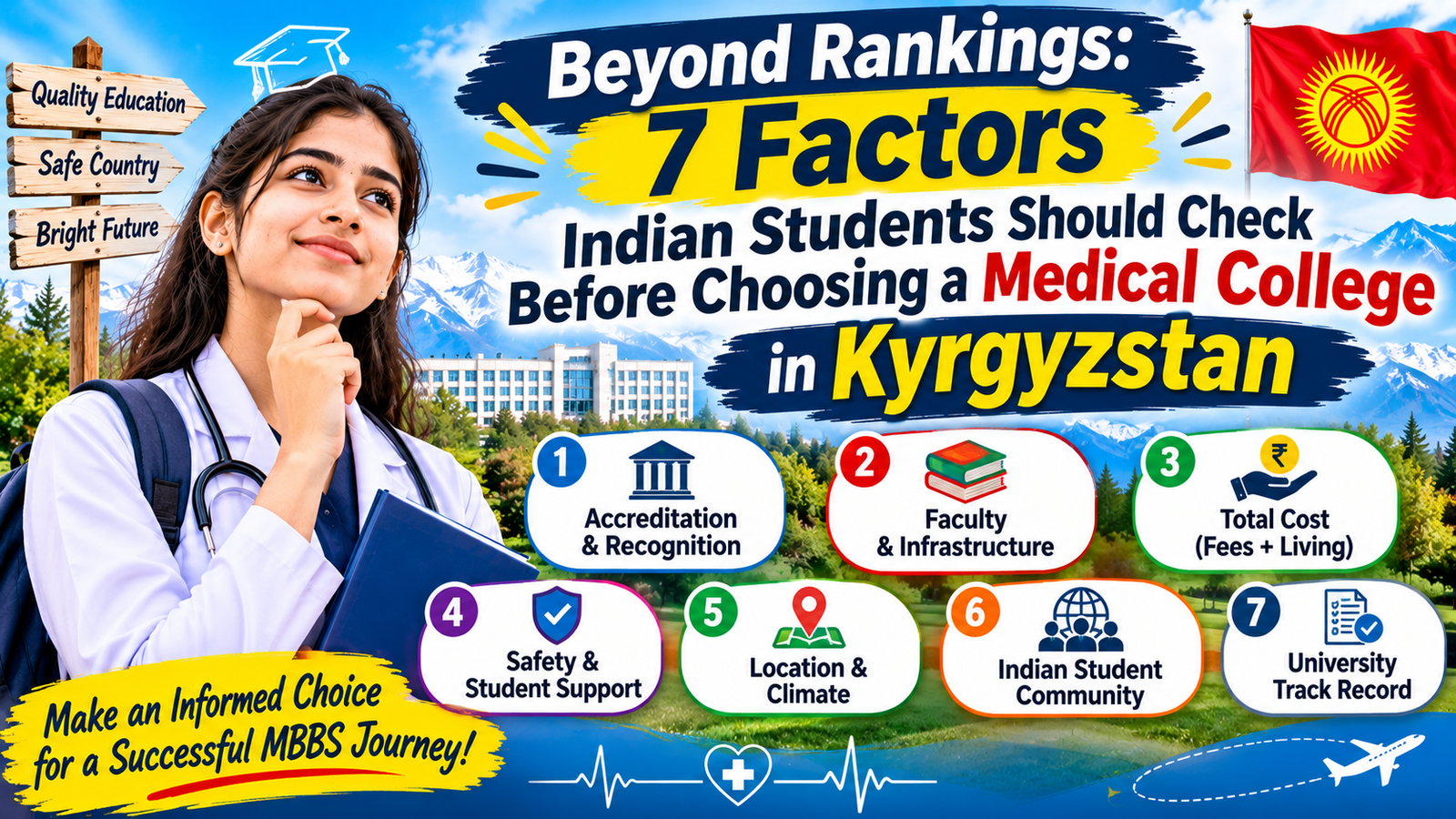
No. And this is probably the easiest mistake to avoid.Imagine University A costs ₹22 lakh overall while University B costs ₹26 lakh. Saving ₹4 lakh sounds attractive. But what if University B has a clearer NMC-compliant curriculum structure, better teaching hospitals, stronger clinical exposure and a more established system for international students?That ₹4 lakh difference suddenly needs context.While comparing MBBS in Kyrgyzstan, check academics before price: curriculum, hospital exposure, faculty, medium of instruction, internship, local licensing eligibility, accreditation status, program duration and track record with Indian students.Then compare fees.In that order.
Admission Process and When Expenses Begin
Admissions generally involve university selection, document review, application, admission/invitation documentation, fee payment, visa formalities and travel arrangements. Intake timelines can vary between institutions, so students should verify the current admission calendar directly rather than relying on last year's dates.Documents commonly requested may include Class 10 and 12 certificates, passport, photographs, NEET-related documents and medical or other supporting certificates as required by the institution and authorities.The financial part starts earlier than many parents expect. Application and documentation expenses can arrive before the main tuition payment.Before paying anything, ask for a written breakdown showing tuition + hostel + mess + insurance + registration + visa-related charges + any one-time fee.One page. Everything is visible.
Pros and Cons From a Cost Perspective
The biggest advantage is straightforward: Kyrgyzstan can provide a comparatively lower-cost route to overseas medical education for students who choose an appropriate university and program. Tuition can be manageable, living expenses may remain reasonable with disciplined spending, and several institutions have experience enrolling foreign students.But lower fees don't erase the risks.Exchange-rate movements can increase costs. Cheap institutions aren't automatically suitable for Indian students. Clinical exposure varies. Licensing-exam preparation requires serious effort. And a university selected only because an agent quoted the lowest package can turn into a poor financial decision.Affordable doesn't mean effortless.
FAQs About MBBS in Kyrgyzstan Cost
What is the total cost of MBBS in Kyrgyzstan in Indian rupees?
A reasonable broad planning range is approximately ₹22–35 lakh for the complete medical education period, including tuition and major living expenses. The actual total can be lower or higher depending on university, duration, exchange rate, hostel, food, flights and personal spending.
How much is the yearly MBBS fee in Kyrgyzstan?
Tuition at many universities can broadly fall around ₹3–6 lakh per year. Don't use this as an official quotation; check the current university fee schedule before admission because fees and currency conversions can change.
Is ₹25 lakh enough for MBBS in Kyrgyzstan?
It may be possible at some lower-cost universities with controlled living expenses, but ₹25 lakh shouldn't automatically be treated as a guaranteed all-inclusive budget. Ask for the complete course fee structure and separately calculate accommodation, food, flights, insurance and other recurring costs.
Is NEET compulsory for MBBS in Kyrgyzstan?
Indian candidates should check the current NEET and NMC requirements applicable to their admission year, particularly if they intend to return and seek medical registration in India. Use the official NEET portal and NMC notifications rather than relying on unofficial claims.
Which medical university in Kyrgyzstan has the lowest fees?
Universities such as Osh State University, Jalal-Abad State University and Asian Medical Institute are frequently considered in the lower-to-moderate cost bracket, but fee schedules change. The cheapest institution shouldn't automatically become your first choice; program compliance and clinical quality need to be checked first.
Can an Indian student practice in India after MBBS from Kyrgyzstan?
Potentially yes, provided the student and foreign medical qualification satisfy the applicable NMC regulations and the graduate completes the licensing, internship and registration requirements applicable to them. NMC's current regulations prescribe specific conditions for foreign medical graduates, so verify your exact university and program before joining.
Conclusion
If you're planning MBBS in Kyrgyzstan, don't build the family budget around the lowest advertisement you find online. A safer approach is to calculate tuition for the complete program, add hostel and living expenses, include annual travel and documentation costs, and then keep a reasonable contingency margin.For many students, ₹22–35 lakh is a useful broad planning bracket, though the final amount depends heavily on the chosen university and personal spending.Kyrgyzstan can certainly be affordable. That's not the difficult part. The difficult part is finding a university where the fee, course structure, clinical training and Indian regulatory requirements all make sense together.Check the numbers. Check the rules. Then decide.Students comparing universities, estimated fees, eligibility and admission options can explore the latest information on MBBS in Kyrgyzstan before finalising their shortlist.