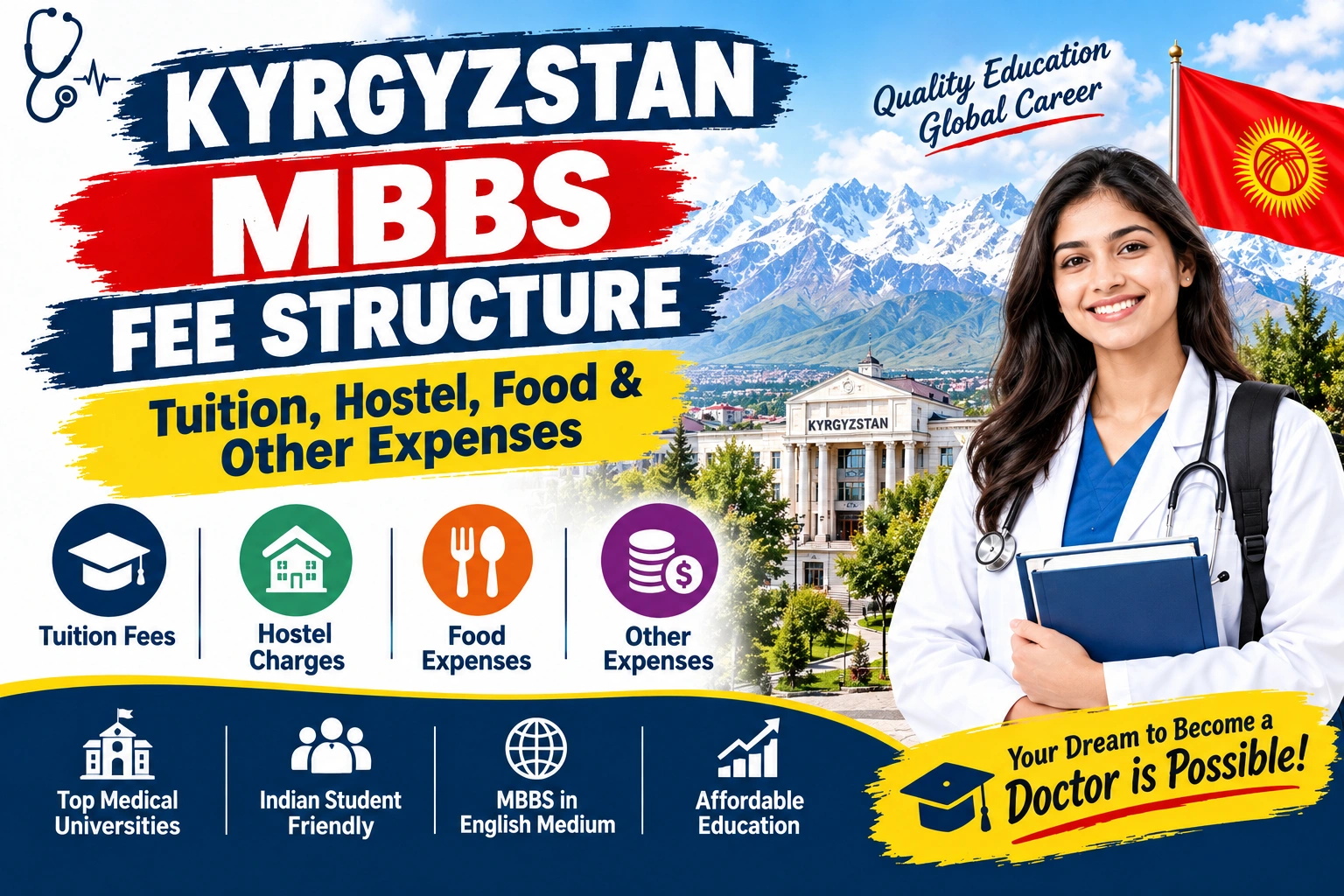
A low tuition figure can look convincing on a college poster. USD 3,500 per year. Affordable, right? Maybe. But tuition is only one part of the actual medical education budget. Once hostel rent, Indian mess, visa renewal, insurance, airfare, winter clothes and university paperwork enter the calculation, the final amount changes—sometimes by several lakhs. For an Indian student, the complete cost of MBBS in Kyrgyzstan generally falls between ₹27 lakh and ₹42 lakh. A budget university in Osh, Kant or Jalal-Abad may remain near the lower end, while a higher-fee institution in Bishkek can take the expense beyond ₹40 lakh. Lifestyle makes a difference too. So does the exchange rate. Families should therefore calculate the entire course, not just the first year. Fees are usually quoted in US dollars and may be revised for a new intake. Every amount mentioned below is an approximate planning figure. Before paying, request the latest official fee letter directly from the university and read the smaller charges carefully. All of them.
Kyrgyzstan MBBS Fees at a Glance
What should a family realistically keep aside? Annual tuition at frequently selected medical universities may range from USD 3,000 to USD 6,000. Hostel accommodation usually adds USD 500 to USD 1,000, while food can cost another USD 800 to USD 1,800 per year. At an indicative conversion rate of approximately ₹95–₹96 for one US dollar, a student may require around ₹5 lakh to ₹8 lakh annually, including routine living expenses.
Expense Category | Approximate Annual Cost | Estimated Course Cost |
Tuition fee | ₹2.9–₹5.8 lakh | ₹17–₹35 lakh |
Hostel accommodation | ₹48,000–₹96,000 | ₹3–₹5.8 lakh |
Food or Indian mess | ₹76,000–₹1.75 lakh | ₹4.5–₹10.5 lakh |
Visa and registration | ₹15,000–₹35,000 | ₹90,000–₹2.1 lakh |
Medical insurance and tests | ₹10,000–₹25,000 | ₹60,000–₹1.5 lakh |
Air travel | ₹40,000–₹70,000 per return trip | Depends on travel frequency |
Personal expenses | ₹3,000–₹8,000 per month | ₹2.2–₹5.8 lakh |
Realistic overall budget | — | ₹27–₹42 lakh or more |
These estimates overlap because some university packages include hostel or medical charges, while others list everything separately. Never add numbers blindly. First check what is already covered.
University-Wise Tuition and Hostel Fee Comparison
The fee difference between two colleges can reach USD 2,000 or more per year. Across the complete course, that becomes a serious amount. The following table offers an approximate comparison of popular options considered by Indian students.
Medical University | Approx. Annual Tuition | Approx. Annual Hostel | Expected Overall Course Budget |
Asian Medical Institute | USD 3,000–3,500 | USD 500–800 | ₹27–₹31 lakh |
Jalal-Abad State University | USD 3,500–4,200 | USD 600–800 | ₹29–₹34 lakh |
Osh State University | USD 3,800–4,500 | USD 600–1,000 | ₹30–₹36 lakh |
Kyrgyz State Medical Academy | USD 4,200–4,800 | USD 600–1,000 | ₹33–₹39 lakh |
International Higher School of Medicine | USD 5,500–6,000 | USD 650–1,000 | ₹37–₹44 lakh |
International School of Medicine | Around USD 6,000 | Package-dependent | ₹38–₹45 lakh |
The estimated overall budget includes tuition, standard hostel accommodation, food and common yearly charges. It doesn’t cover an expensive private apartment, frequent flights to India or unrestricted personal spending. Fee structures may also change between intakes. Verify the latest amount in writing—no verbal promises.
Tuition Fees: What Are Students Actually Paying For?
Tuition normally covers classroom teaching, practical laboratory sessions, access to the academic campus and scheduled clinical instruction. It may not include textbooks, laboratory coats, medical instruments, examination retakes or special certification charges. Honestly, these exclusions aren’t always explained during counselling. Many universities collect fees annually, while a few permit semester-wise payment. The first-year amount can be higher because it may contain admission processing, document translation, invitation and registration costs. A college quoting USD 4,000 as regular tuition might produce an initial invoice of USD 5,500 or more after one-time expenses.Students should ask three direct questions: Is the fee fixed for the full course? Can the university revise it annually? Does the internship year carry full tuition? The answers can change the complete cost of MBBS in Kyrgyzstan by several lakhs.
Hostel Fees and Room Facilities
Here is the usual setup. International student hostels commonly provide furnished shared rooms with beds, study tables, wardrobes, heating and access to common kitchens or dining areas. Rooms may accommodate two to four students. Separate floors or buildings for male and female students are often available, though arrangements vary by institution. Hostel charges generally range from USD 500 to USD 1,000 per year. Some private hostels in Bishkek may cost more, particularly if they provide smaller rooms, attached bathrooms, regular cleaning or Indian food. Electricity, laundry, Wi-Fi and bedding may be included—or not. That tiny “or not” matters. Before booking, request recent hostel videos and ask about distance from the academic campus and affiliated hospitals. Also confirm whether accommodation remains available during vacations and the internship period. If the hostel closes, private rent can enter the budget unexpectedly.
Food and Indian Mess Expenses
Food becomes the next major expense after tuition and accommodation. An Indian mess may charge approximately USD 800 to USD 1,800 annually, depending on the city, menu and number of meals. A combined hostel-and-mess package can cost around USD 1,500 to USD 2,500 per year. Bishkek tends to be more expensive than Osh, Kant or Jalal-Abad. Students who cook can sometimes reduce monthly spending, but grocery prices, cooking gas, utensils and kitchen access must be considered. Eating outside regularly does the opposite. Fast.A practical food budget is approximately ₹7,000 to ₹14,000 per month. Ask whether the mess serves breakfast, whether meals are available seven days a week and if vegetarian options are prepared separately. Pictures of one special lunch don’t reveal the daily menu.
First-Year Charges: Why the Initial Payment Is Higher
That first invoice often surprises parents. Besides tuition and hostel fees, universities or admission representatives may collect charges for application processing, invitation letters, document translation, notarisation, visa assistance, medical examinations, airport reception and local registration. One-time charges may range from ₹75,000 to ₹2 lakh. Some are genuine administrative expenses, while others are consultancy service charges. Both should be identified separately. Don’t accept a single unexplained heading such as “miscellaneous package.”
A proper first-year estimate may look like this:
Tuition fee: ₹3–₹5.8 lakh
Hostel: ₹50,000–₹96,000
Food: ₹75,000–₹1.75 lakh
Documentation and invitation: ₹30,000–₹80,000
Visa and registration: ₹20,000–₹45,000
Medical insurance and tests: ₹10,000–₹25,000
Airfare and initial travel: ₹25,000–₹50,000 one way
Winter clothing and setup: ₹20,000–₹40,000
A family may therefore spend around ₹5.5 lakh to ₹9 lakh during the first year, depending on the university and package.
Year-Wise Cost Estimate for the Complete Course
A clear year-wise calculation prevents financial stress later. Consider a mid-range university charging USD 4,200 for tuition, USD 700 for hostel and USD 1,200 for food. At ₹95.5 per dollar, these three items alone cost approximately ₹5.83 lakh annually. Add visa, insurance and personal expenses, and the yearly budget may reach ₹6.5–₹7 lakh.
Academic Year | Estimated Expense |
First year | ₹6.5–₹8 lakh |
Second year | ₹5.5–₹7 lakh |
Third year | ₹5.5–₹7 lakh |
Fourth year | ₹5.5–₹7 lakh |
Fifth year | ₹5.5–₹7 lakh |
Internship or final year | ₹3–₹7 lakh, depending on fee policy |
Estimated complete budget | ₹31.5–₹43 lakh |
This is only a model. The actual duration and internship fee must be verified for the specific programme. If someone offers a complete course for ₹18 lakh while regular annual expenses point much higher, pause. Ask what has been excluded.
Living Expenses in Bishkek, Osh and Jalal-Abad
City choice quietly affects the total. Bishkek offers a larger urban environment, more shopping options and wider transport availability, but students may spend around ₹10,000 to ₹18,000 per month beyond tuition and hostel. In Osh or Jalal-Abad, controlled monthly expenses can remain between ₹8,000 and ₹15,000. Local buses and shared transport are economical. Repeated taxi use isn’t. Phone data, laundry, snacks, stationery and weekend outings can add another ₹3,000–₹8,000 each month. None of these expenses looks serious alone. Together, over five or six years… quite a figure.Indian students should also plan for winter clothing. A suitable jacket, thermal layers, gloves and snow-friendly footwear may cost ₹20,000 to ₹40,000 during the first year.
Currency Exchange Can Change the Final Amount
One uncomfortable fact: your INR budget isn’t fixed even if the university’s dollar fee is. Suppose annual tuition is USD 4,500. At ₹90 per dollar, it costs ₹4.05 lakh. At ₹95.5, it rises to nearly ₹4.30 lakh—a difference of around ₹25,000 in one year. Across several years, the exchange-rate movement can add ₹1–₹3 lakh or more to the family’s calculation. Keep a 5% to 10% currency reserve and avoid building a budget around an optimistic conversion rate. Families should also check bank transfer charges, foreign-exchange margins and applicable taxes before sending fees.
Course Duration and NMC Rules
Fees must be calculated for the correct course length. More critically, the programme should satisfy the conditions applicable to Indian foreign medical graduates. The National Medical Commission regulations cover academic duration, internship, subjects, clinical training, teaching medium and eligibility for registration in the country where the qualification is awarded. Indian applicants should verify whether the programme includes at least 54 months of medical study and a 12-month internship under the applicable rules. Some advertisements mention five years, some say five and a half, while others show six. Don’t rely on the word “MBBS” alone; the awarded qualification may be called MD or Doctor of Medicine. Get the course duration, internship location and medium of instruction confirmed through official documents. A cheaper programme that doesn’t meet the required conditions can become the most expensive mistake of all.
Eligibility and NEET Requirement
Admission itself is generally straightforward. Indian students usually need to complete Class 12 with Physics, Chemistry, Biology or Biotechnology and English. General-category candidates commonly require at least 50% in PCB, while the prescribed minimum for specified reserved categories is generally 40%, subject to current regulations. NEET qualification is required for Indian applicants who want to study medicine abroad and later pursue registration in India. Since the qualifying marks change each year, students should check the current bulletin through the official NEET portal instead of depending on an outdated social media post. IELTS or TOEFL is generally not demanded by popular Kyrgyz universities. That sounds convenient. Students still need workable English for lectures and must learn Russian or Kyrgyz for patient communication during clinical training.
Recognition, WDOMS and the WHO Claim
A directory listing isn’t the same as automatic approval for medical practice in India. Students can use the World Directory of Medical Schools to check whether a particular institution and programme appear in the directory. Yet WDOMS inclusion alone doesn’t confirm compliance with every NMC condition. The phrase “WHO-approved university” also needs context. The World Health Organization does not provide blanket approval that guarantees an individual graduate’s registration in India. Here, a little caution is necessary. Logos on a brochure cannot replace verification of the exact campus, course duration, internship, curriculum and local registration eligibility.
FMGE or NExT Preparation Costs
The overseas degree is not the last step for students returning to India. Graduates must follow the screening, licentiate and registration system applicable at the time of completion. Depending on future implementation, this may involve FMGE, NExT or another prescribed route. Preparation expenses may include online classes, question banks, mock tests, revision programmes and examination travel. A student might spend approximately ₹30,000 to ₹1.5 lakh over several years. Some colleges claim to include Indian licensing preparation, but ask who teaches it, how frequently classes occur and whether an additional fee is collected. Preparation should begin early. Not in the final month with a new subscription and a lot of panic.
Hidden Expenses Often Missing from Fee Packages
Every family should keep a separate list of smaller charges. These may include annual visa renewal, residence registration, medical insurance, health tests, document translation, university examination fees, laboratory coats, clinical equipment, residence deposits, airport pickup and graduation charges. Air travel also deserves attention. A return journey between India and Kyrgyzstan may cost approximately ₹40,000 to ₹70,000, sometimes more during peak periods. Students travelling home every year should add the full amount to the course budget. A contingency fund of ₹2–₹3 lakh is sensible. Illness, a sudden flight, hostel relocation or fee revision isn’t predictable. The money may remain unused. Good. That is exactly what an emergency fund is supposed to do.
Pros and Cons from a Financial Point of View
The main advantage of MBBS in Kyrgyzstan is obvious: tuition is substantially lower than at many private medical colleges in India. Admission usually doesn’t involve capitation or donation, hostel facilities are available near popular campuses and everyday expenses can be controlled. The limitations are equally real. Fees are linked to foreign currency, Indian mess charges may be higher than expected and airfare adds a recurring expense. Students also need to budget for licensing preparation and possible private accommodation during clinical years. Part-time employment should not be treated as a financing plan. Medical studies demand time, and work opportunities for international students may be limited by language and immigration rules. Arrange the complete funding before enrolment. Don’t assume the student will earn the difference later.
How to Check a Genuine Fee Structure
A trustworthy fee quotation should carry the university’s full legal name, campus, programme, intake, annual tuition, hostel charge, payment currency and refund policy. It should also state whether fees can increase and whether the internship year is charged separately.
Before transferring money:
Ask for the official year-wise fee letter.
Separate university charges from consultancy fees.
Verify the recipient’s bank account.
Check what the hostel and mess package includes.
Read the cancellation and refund conditions.
Confirm the sixth-year or internship fee.
Speak privately with current Indian students.
Keep receipts for every payment.
Cash without a formal receipt? Avoid it. The same goes for a large transfer to an unrelated personal account.
FAQs
What is the average tuition fee for MBBS in Kyrgyzstan?
Annual tuition generally ranges from USD 3,000 to USD 6,000, or approximately ₹2.9 lakh to ₹5.8 lakh at an indicative exchange rate. The exact amount depends on the institution and intake.
How much does hostel accommodation cost?
A university or private student hostel commonly costs between USD 500 and USD 1,000 per year. Premium rooms or combined hostel-and-mess packages may cost more.
Can the complete course be finished within ₹30 lakh?
It may be possible at a lower-cost university with disciplined spending. A safer planning range is around ₹30–₹38 lakh, while higher-fee institutions can take the overall budget above ₹40 lakh.
Is food included in the hostel fee?
Not always. Many colleges charge hostel and Indian mess separately. Students should check the number of daily meals, weekly schedule and vacation policy before buying a food package.
Are the fees fixed for the entire course?
There is no universal rule. Some universities may keep tuition stable for a batch, while others reserve the right to revise it. The rupee cost can also rise even if the dollar fee remains unchanged.
Is NEET compulsory for Indian students?
Yes, Indian candidates intending to pursue medical education abroad and later follow the Indian registration pathway must meet the applicable NEET requirement.
Conclusion
A realistic budget for MBBS in Kyrgyzstan is approximately ₹27 lakh to ₹42 lakh, covering tuition, hostel, food and common additional expenses. A lower quote may be possible, but only after checking exactly what it includes. Calculate the fee at the current exchange rate, add a 10% buffer and keep ₹2–₹3 lakh separately for emergencies. Don’t select a university merely because its first-year package looks cheaper. Verify the course duration, internship, clinical exposure, recognition information and payment schedule before admission. For university comparisons and updated cost guidance, students can review the resources available on MBBS in Kyrgyzstan and then request the latest official fee document for their chosen intake.