.webp)
Introduction
Many Indian applicants planning to pursue an MBBS in Kyrgyzstan typically only reference public university information such as tuition fees, rankings, and accreditation status, or blindly trust the one-sided claims of unqualified agents. This approach to selecting a school has severe limitations, and is completely insufficient to support reasonable institution choices.
Only the real on-campus experiences of Indian students studying across multiple Kyrgyzstani universities can be synthesized to extract referenceable common patterns, helping applicants build clear, practical expectations for their school selection.
As a science popularization article that compiles real feedback from Indian MBBS students studying in Kyrgyzstan, this paper systematically breaks down the core themes of student evaluations, sorts out the core strengths that earn consistent praise and the common pain points students encounter, and guides readers to use these real, first-hand student accounts to match institutions that fit their own needs.
Compared to the one-way promotional output of official sources, current students’ first-hand feedback is more balanced and practical, and can fill the numerous gaps in publicly available information.
Common Advantages Highlighted by Indian Students
The core advantages frequently mentioned by students include:
Tuition fees are only a tiny fraction of those of India’s private medical colleges.
Students are not required to pay the common donation fees or quota fees that are standard in India.
The degrees issued by these institutions are globally recognized.
All instruction is delivered fully in English for the entire program, so students do not need to study Russian or Kyrgyz in advance.
The student-faculty ratio at these institutions is very low, so students can receive personalized guidance from teaching staff.
There is an adequate supply of Indian food in and around dormitories, which meets the dietary needs of Indian international students.
Clinical internships start as early as the third year of study, far earlier than most applicants anticipate.
Common Challenges Faced by Students
At the same time, students also commonly face three core challenges:
They face initial language barriers when communicating with local Russian- and Kyrgyz-speaking native patients during the clinical stage.
They struggle to adapt to the local harsh winter.
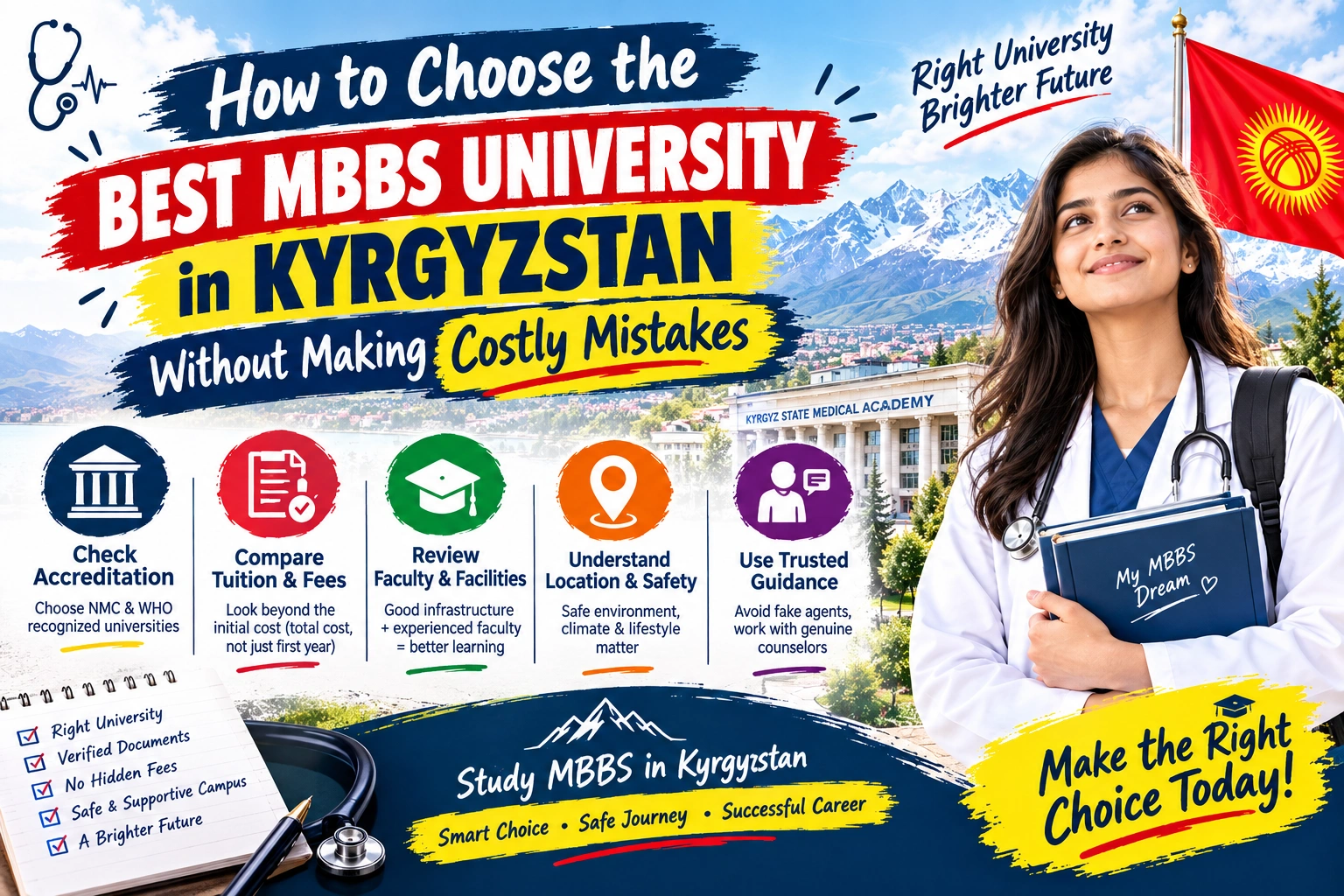
Most critically, applicants must carefully screen for formal institutions accredited by India’s NMC to avoid enrolling in unqualified organizations and encountering preventable problems.
Cross-University Student Experience Analysis
All information collated in this study is extracted from authentic reviews by Indian medical students who pursued their studies in Kyrgyzstan.
First, this study identifies five cross-institutional common study-abroad challenges that apply to all surveyed universities.
1. Language Barriers
Local universities deliver all classroom lectures in English, but once students enter clinical rotations in their upper academic years, they must communicate with local patients and residents, which requires mastery of basic Russian or Kyrgyz.
2. Adapting to the Cold Climate
Most of these students come from warm regions of India, so they must adjust to Kyrgyzstan’s harsh winter during their first year abroad.
3. Overcrowding in Some Universities
Overenrollment at some low-tuition universities squeezes out space for personalized academic support and undermines learning quality.
4. Risks Related to Education Agents
Students who partnered with unvetted, unqualified agents often encountered issues including opaque fee structures and unfulfilled promises, while students who applied directly to universities or worked with compliant consultants had far smoother study experiences.
5. Homesickness During the Initial Months
Even though most host universities have well-established, large communities of Indian international students, the majority still experience homesickness during their first few months abroad, and this feeling gradually eases as they adapt to their academic workload and build connections with peers.
Institution-Specific Student Feedback
On top of this common challenge analysis, this study collates institution-specific feedback from six local medical universities, which are presented uniformly across two dimensions:
Widely praised strengths
Unique institutional challenges
The universities covered are:
KSMA
KRSU
Osh State Medical University
International Medical School
Jalalabad State Medical University
Asian Medical Institute
How to Evaluate Student Reviews Before Choosing a University
This paper targets all groups of study-abroad applicants planning to apply for the MBBS in Kyrgyzstan, and outlines 5 practical guidelines for rationally screening student evaluations of overseas universities.
Practical Guidelines
Identifying common patterns across multiple sets of reviews.
Remaining wary of unsubstantiated reviews on agency official websites that lack independent verification.
Contacting currently enrolled students through alumni groups.
Cross-verifying university information via the host institution and the NMC.
Balancing positive and negative feedback.
This set of methods can help applicants establish reasonable expectations in advance.
Eligibility Criteria
The eligibility criteria for this program are as follows:
Completion of coursework in physics, chemistry, biology and English during the 10+2 stage.
An overall score of at least 50% for general category applicants and 45% for reserved category applicants.
A minimum age of 17 years at enrollment.
Possession of a qualifying score on the NEET-UG.
Applicants to the English-medium program are not required to submit IELTS or TOEFL scores.
Admission Process and Tuition Fee Information
For Indian candidates planning to pursue an MBBS in Kyrgyzstan, we have collated a complete set of application procedures and tuition fee information.
Applicants must complete 8 core steps spanning from university shortlisting to the official start of courses, and only candidates holding NEET-UG eligibility who apply to institutions accredited by the National Medical Commission (NMC) and the World Health Organization (WHO) are eligible to apply.
To mitigate risks:
Tuition fees must be paid directly into the host university’s official account.
Applicants should contact currently enrolled students to gather relevant information before submitting their applications.
We have additionally aggregated information on 6 leading medical universities that retain their original English names, with their annual tuition fee ranges marked in both US dollars and Indian rupees.
All costs related to Kyrgyzstan’s MBBS programs compiled in this paper are estimated values.
Indian students intending to apply must contact their target institution directly before making any payments, to confirm accurate tuition fees denominated in Indian rupees and avoid disputes.
Core Factors That Influence University Selection
Below is a module-by-module sorting of all core information that affects university choice decisions.
Module 1: Student Feedback
Advantages
Tuition fees are far lower than those of private medical schools in India.
Full English-medium instruction reduces the difficulty of academic transition.
The teaching staff are friendly and the student-faculty ratio is strong.
Indian food and support from the local Indian community are easily accessible.
Students can access early and continuous clinical practice opportunities.
Disadvantages
There are language barriers to communicating with local patients in the early stage of the clinical phase.
The adaptation period for Kyrgyzstan’s harsh winters is long.
A small number of institutions face overcrowded campuses or dormitories.
Students must avoid unregulated agents to prevent tuition fee disputes.
Temporary homesickness often occurs in the months before starting the study abroad program.
Module 2: Top-Reputed Medical Universities
The second module is the list of top-reputed institutions, totaling 6 schools recognized by India’s National Medical Commission (NMC):
KSMA
KRSU
Osh State Medical University
ISM
JASU
AMI
Students must finalize their university choice based on their own personal needs.
Module 3: Career Opportunities After Graduation
For Indian graduates who complete the standard 6-year program including an internship, this paper sorts out 4 mainstream development directions:
Taking the FMGE/NEXT exam to practice medicine in India.
Applying for MD/MS postgraduate study at domestic or international institutions.
Obtaining international medical practice licenses such as USMLE or PLAB.
Staying in Kyrgyzstan or working at public or private hospitals around the world.
The author of this paper adds that for all graduates from NMC-accredited institutions, continuous effort during their studies, especially in the clinical phase, has a greater impact on the pass rate of various medical licensing exams than the institution itself.
It is recommended that students make a comprehensive decision that combines student feedback and overall study abroad costs.
Module 4: Frequently Asked Questions (FAQ)
The fourth module is the frequently asked questions (FAQ) section, which responds to 5 questions in sequence:
Whether the overall evaluation of the institutions is positive.
Which institution receives the best feedback from Indian students.
Whether studying for an MBBS in Kyrgyzstan is recommended.
What the biggest challenge of studying abroad is.
Whether reviews on consulting websites can be trusted.
The response to the last question has not yet been finalized.
Final Recommendations
Applicants planning to pursue an MBBS degree in Kyrgyzstan should take note that most institutional content published on mainstream study-abroad consulting websites has been filtered and embellished, so it is essential to cross-verify student assessments via alumni groups and independent social communities.
During the application period, two core questions must be clarified.
How to Obtain Authentic Student Feedback
Applicants may reach out to current enrollees or recent graduates through alumni networks and exclusive forums for overseas MBBS students.
Do Student Reviews Affect FMGE/NEXT Performance?
The two factors are only indirectly correlated:
Graduates from medical schools with long-term positive evaluations of their clinical resources and teaching faculty are better prepared for these exams.
The six local medical schools including KSMA share common positive assessments:
Manageable costs.
Smooth English-medium instruction.
Sufficient teaching staff.
They also share common drawbacks:
Difficulties adapting to the local language.
Difficulties adapting to the local climate.
It is recommended that applicants integrate student assessments with official qualification verification through the WDOMS, the NMC, and direct communication with university administrations when formulating their application decisions.