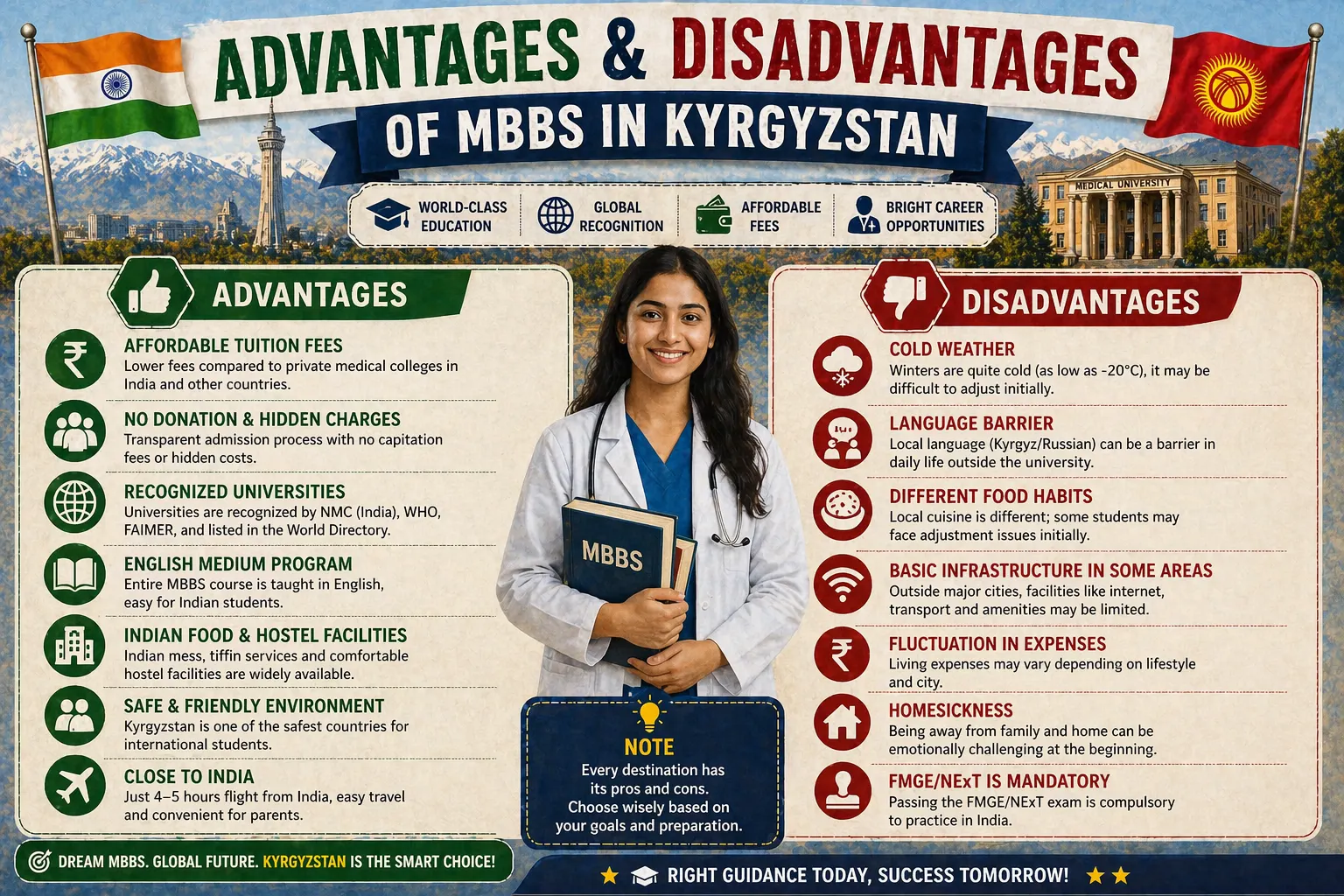
However, every study destination has its pros and cons. To identify the both sides of a coin before seeking admission in such universities which are NMC (National Medical Commission) approved, WHO (World Health Organization) and WDOMS (World medical colleges directory).
Advantages of MBBS in Kyrgyzstan
Low Tuition Fees and Cost of Living
Affordable living in Kyrgyzstan is one of the greatest benefits of studying there.
Tuition fee is very lower than private colleges in India
Cost of living is budget-friendly
Without donations or capitation fees
That means that it is affordable for middle-class families.
NMC, WHO, and WDOMS Recognition
Here are the most important medical universities of Kyrgyzstan:
Approved by NMC
Listed under WHO
Included in WDOMS
This ensures:
Degree validity in India
Eligibility for FMGE/NExT
Opportunity for international medical exams USMLE and PLAB
Simple Admission Process
The admission process is straightforward.
No entrance exam (apart from NEET qualified)
Minimal documentation
High acceptance rate
It allows students to get admission without cutthroat competition.
English Medium Education
And MBBS offered in English by most universities.
No language barrier in academics
Easier understanding of medical subjects
Suitable for international students
Availability of Indian Food
Students find Indian food at an accessible reach.
Indian mess in hostels
Restaurants serving Indian food in cities such as Bishkek
Option for self-cooking
This helps students adjust comfortably.
Good Student Environment
A large Indian student community
Safe and student-friendly environment
Cultural familiarity
Early Clinical Exposure
Most of the institutes offer training from the early days.
Hospital tie-ups
Basic clinical exposure
Hands-on learning opportunities
Disadvantages of MBBS in Kyrgyzstan
FMGE/NExT Passing Rate
The FMGE/NExT exam is one of the toughest challenges among these.
Passing rate is relatively low
Students need extra self-study
Coaching may be required
The above tactics will only work at the scale of touchpoints that is possible with individual effort.
Language Barrier in Daily Life
Although classes are in English:
Patients speak local languages (Kyrgyz/Russian)
Website: Stockholm2019.eu To develop guidelines for effective communication in clinical practice. Communication of healthcare must be improved, especially between different health care providers.
More local language interaction for studentsippy classroom.
Limited Global Ranking
To begin with, universities are globally not in high ranks
More domestic exposure relative to great nations
This could impact the chances in hyper-compete ecosystems.
Harsh Weather Conditions
Kyrgyzstan experiences cold winters.
Temperature can drop below zero
It can be a challenge for Indian students to adjust.
Self-Discipline Required
In some universities not very strict academic environment
Have students maintain concentration and discipline
If not taken proper care of, it may impact the learning process.
Not enough practical exposure in few universities
Not all universities provide equal clinical exposure.
Some have limited patient flow
Practical exposure may vary
Key to success is choosing the right university.
Final Conclusion
For affordable medical education, MBBS in Kyrgyzstan is a great option as the universities are NMC approved and listed under WHO and WDOMS. It has advantages such as fewer prices, easy admission, and availability of Indian food. You can also explore options like MBBS in Bangladesh.
However, then there is the FMGE/NExT preparation, language, and self-discipline to consider.
Accurate advice with the right university and regular study efforts can help students establish a successful medical career after MBBS in Kyrgyzstan.