Parents usually ask the safety question before asking about anatomy laboratories, hospital exposure, or even tuition. Fair enough. Their child may be living thousands of kilometres away, sharing a hostel room, learning a new language, and handling emergencies without family nearby.So, is MBBS in Kyrgyzstan safe for Indian students? The balanced answer is that many international students study and manage daily life there without serious incidents, particularly in established university areas of Bishkek and Osh. Still, no city or campus is risk-free. Students should examine hostel security, neighbourhood, transport, political gatherings, local laws, border restrictions, and the university’s emergency response before admission. Safe enough with preparation. Not safe enough for carelessness.
What Is the Current Safety Situation?
Kyrgyzstan isn’t generally under a countrywide “do not travel” warning from major foreign authorities. Current official advisories commonly recommend ordinary or increased caution, while giving stronger warnings about demonstrations and certain border areas. The US travel advisory for Kyrgyzstan advises increased caution within 30 kilometres of the Tajikistan border and recommends avoiding protests and demonstrations. Other official advisories similarly tell visitors to avoid large gatherings because peaceful events can change quickly. For medical students, this means university areas in Bishkek or Osh should not be judged in the same way as remote border zones. Most students spend their time between the hostel, campus, hospital, supermarket, and nearby restaurants. Ordinary routine. Ordinary precautions.
What Happened in Bishkek in May 2024?
This event shouldn’t be hidden, especially in an article about safety. In May 2024, mob violence and attacks involving foreign residents and students occurred in Bishkek. The unrest caused understandable fear among South Asian student communities, and foreign embassies issued safety advice. The Indian Embassy advised students to remain indoors during the immediate disturbance and stay in contact with the embassy. The situation later stabilised, but the incident showed that tensions can emerge suddenly and that international students need reliable university and embassy communication. It would be misleading to describe one episode as the daily condition of the entire country. It would be equally misleading to pretend it never happened.
Students should ask prospective universities what steps they took during that period:
Did they communicate with international students quickly?
Was hostel security strengthened?
Were emergency helplines active?
Did staff arrange food, transport, or medical assistance?
Were parents given verified updates?
Has the emergency plan been revised since then?
A university’s response during a difficult event tells you more than a general promise of “24-hour security.”
Safety in Bishkek
Bishkek is the capital and the country’s largest university centre. It offers hospitals, restaurants, shopping areas, public transport, international services, and a sizable foreign student community. More facilities. More activity too. Common urban risks include petty theft, overcharging, road accidents, poorly lit streets, disputes around nightlife areas, and occasional demonstrations. Students should avoid isolated places late at night, use established taxi apps, and keep phones and wallets secure in crowded markets or public transport. Bishkek’s size makes location important. A hostel beside the campus and a hostel on the distant edge of the city may offer very different daily experiences. Ask about walking routes, street lighting, late-evening transport, nearby pharmacies, and the distance to teaching hospitals. For students considering MBBS in Kyrgyzstan, Bishkek can offer greater convenience and university choice, but a capital-city setting requires the same street awareness expected in Delhi, Mumbai, Bengaluru, or any other busy city.
Safety in Osh
Osh is smaller and often feels less hectic than Bishkek. It has established educational institutions, local markets, hospitals, and international medical students. Daily living costs may also be lower. A quieter city doesn’t mean students can ignore safety. Late-night travel, unregistered taxis, document theft, rental disputes, and unfamiliar neighbourhoods remain possible. Osh is also closer to the Fergana Valley and southern border regions, so students should pay attention to official travel guidance before making trips outside the city. Within the normal university routine, many students live between hostels, academic buildings, and teaching hospitals. The main safety checks remain practical: secure accommodation, reliable transport, recognised university status, and access to emergency support. Students should not travel toward sensitive border areas casually just because a place looks nearby on a map. Borders in Central Asia can involve checkpoints, restricted roads, and changing local conditions.
Campus Security: What Families Should Inspect
Here’s where a video call can be more useful than a brochure. Ask the university to show the campus entrance, hostel gate, security desk, corridors, and surrounding street. Campus safety can include controlled entry, guards, CCTV in common areas, student identity cards, visitor registers, wardens, and separate hostel arrangements for male and female students. The quality of these systems differs by institution and building.
Parents should ask:
Is security present overnight?
Are visitors recorded?
Does the hostel have CCTV in common areas?
Is there a resident warden?
Are emergency exits usable?
How quickly can an ambulance reach the hostel?
Is transport available for late hospital duties?
Who contacts families during an emergency?
Does the university have an English-speaking helpline?
Are female students housed separately?
Don’t accept “campus is completely safe.” Ask how.
Women’s Safety and Hostel Arrangements
A practical safety discussion must include female students separately. Many medical universities provide women’s hostels, gender-separated floors, controlled visitor access, or curfew arrangements. Exact facilities vary. Female students should check whether the hostel has a woman warden, secure entry, working corridor lighting, emergency contacts, and reliable transport to clinical postings. Ask current female students about the route between the hostel and hospital, especially during winter when daylight hours are shorter. Normal precautions include travelling in groups after dark, sharing ride details, avoiding isolated shortcuts, and using registered transport. Students should also know the university procedure for reporting harassment without being forced to approach an informal agent. Honestly, a strict curfew alone doesn’t prove good security. Responsible management, lighting, transport, and complaint handling matter more.
Public Transport and Road Safety
Traffic may create a more frequent daily risk than street crime. Students use buses, minibuses, and taxis to reach campuses and hospitals, sometimes during busy morning hours. Use recognised taxi services rather than entering an unmarked vehicle. Check the registration number, share the trip with a friend, and avoid accepting extra passengers where that feels unsafe. Wearing a seat belt may sound basic, but road habits vary. Public transport is inexpensive, often costing students roughly USD 10–25 per month. The cheapest accommodation shouldn’t be selected if it requires several transfers or a long walk through an isolated area. Clinical students may attend different hospitals across the city. Ask whether the university arranges transport for early-morning or late hospital postings. This is especially relevant during winter.
Hostel Safety and Shared Living
I’ve noticed that most hostel problems aren’t criminal. They involve missing belongings, unlocked doors, unknown visitors, unsafe cooking appliances, or arguments between roommates. Keep valuables in a lockable drawer or suitcase. Don’t leave passports, cash, bank cards, or original certificates openly inside a shared room. Store digital copies in secure online storage and give another set to the family. Check fire extinguishers, emergency exits, smoke alarms where available, kitchen rules, heating equipment, and electrical sockets. Overloaded extension boards and unauthorised heaters create genuine danger during winter. Students beginning MBBS in Kyrgyzstan should also agree on basic roommate rules: lock the room, don’t share entry cards, report lost keys, and ask before inviting guests. Simple habits prevent many problems.
Scams and Unofficial Payments
International students can become targets for rental scams, fake job offers, unofficial currency exchange, inflated transport charges, and people claiming they can “fix” university or visa problems. Pay tuition through the university’s official bank account or a properly verified authorised channel. Request receipts for hostel fees, immigration registration, visa extensions, and insurance. Avoid handing over a passport to an unknown representative. If the university international office needs the original for registration, obtain a receipt and ask when it will be returned. Students should exchange currency through lawful channels and avoid carrying large amounts of cash. A second bank card stored separately can help if the primary card is lost or blocked. Urgency is a common scam tactic. “Pay now.” “Don’t tell the university.” “Final chance.” Step back.
Political Gatherings and Demonstrations
Demonstrations can occur in Bishkek and other parts of Kyrgyzstan. Foreign students should avoid them, even if the gathering initially appears peaceful or unrelated to international communities. Don’t stop to record close-up videos. Don’t join political discussions with strangers. Move away from crowds, follow local-authority instructions, and monitor messages from the university and embassy. Official travel advice consistently recommends avoiding demonstrations and large public gatherings. That isn’t panic. It’s sensible behaviour for a foreign student whose purpose in the country is education. If roads or transport services are disrupted, contact the university before attempting an unfamiliar route.
Border Areas and Student Travel
Kyrgyzstan is known for mountains, lakes, and outdoor travel. Weekend trips can be one of the best parts of student life, but remote travel requires planning. Certain border zones—particularly areas near Tajikistan—may be subject to stronger cautions, checkpoints, or changing access conditions. Students should check current official advice before travelling outside established routes.
For any overnight trip:
Inform a roommate or friend.
Share the destination and return time.
Use a recognised operator.
Carry identification and insurance details.
Check weather conditions.
Avoid unofficial border crossings.
Don’t trek alone in remote areas.
Maintain phone power and local connectivity.
Beautiful place. Weak mobile signal. Plan for both.
Health, Insurance and Emergency Care
Safety isn’t only about crime. Illness, winter falls, food reactions, respiratory infections, and road accidents are more realistic concerns for most students. Medical insurance should cover emergencies, hospitalisation, and other essential treatment under local conditions. Students should understand where claims are accepted and whether payment is cashless or reimbursement-based. The World Health Organization provides international health guidance, but it doesn’t replace a local insurance policy. Keep copies of prescriptions, vaccination records, allergy information, and regular medicine details. Save the university clinic, ambulance, hostel warden, insurer, and embassy numbers. Do this before an emergency. Searching through an old WhatsApp group while unwell isn’t ideal.
Register With the Indian Embassy
The Embassy of India in Bishkek provides student registration facilities, advisories, and contact information for Indian nationals. Students should register after arrival and keep official contact details saved. Embassy registration can help authorities communicate during civil unrest, natural disasters, document loss, or other emergencies. It doesn’t replace university support or personal precautions, but it adds an important official contact. Students should also consider registering on the Government of India’s MADAD portal where applicable. Parents should know the university international office number, hostel address, and emergency contact—not only the consultant’s phone number in India. One contact is not an emergency plan.
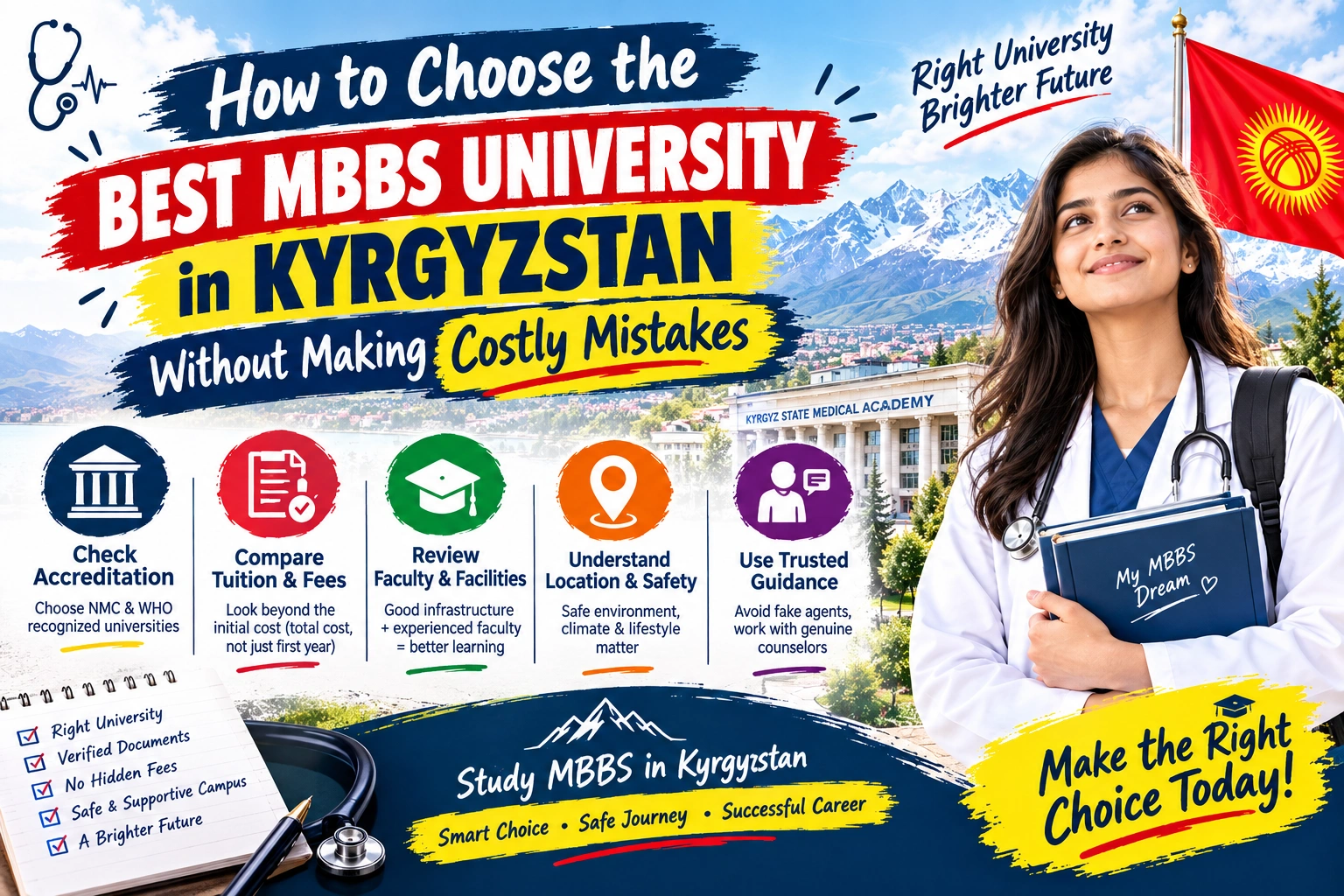
University Recognition Is Part of Safety
This may sound like a different issue, but academic safety matters too. Losing years in an unsuitable programme can be more damaging than an ordinary hostel problem. Indian students should check the course against regulations issued by the National Medical Commission. Programme duration, internship, required subjects, clinical training, teaching language, and local licensing eligibility need verification before admission. A listing in the World Directory of Medical Schools provides directory information. WDOMS states that inclusion doesn’t itself mean recognition, accreditation, or endorsement. Students pursuing MBBS in Kyrgyzstan should avoid the expression “NMC-approved university” as a complete guarantee. Check the actual programme. A legally operating institution can still offer a course structure that requires closer examination under Indian rules.
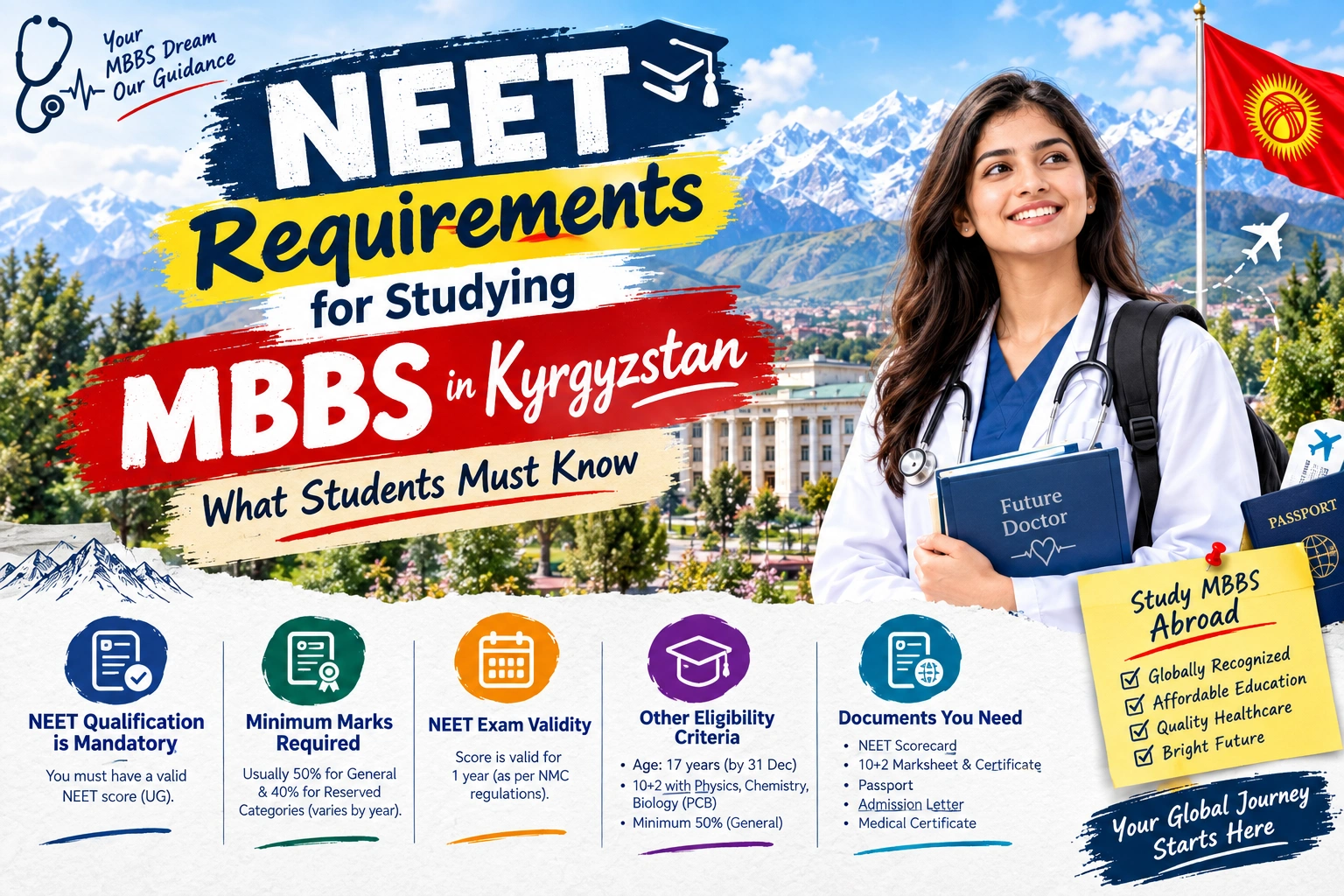
NEET and Admission Safety
Indian students seeking a primary medical qualification abroad generally need to qualify NEET-UG under the applicable framework. For 2026, the reported minimum qualifying score was 213 for General and EWS candidates and 177 for OBC, SC, and ST candidates. PwBD applicants should check their exact category range officially. Use the NEET portal to confirm the scorecard and qualifying status. Don’t pay a non-refundable foreign admission fee based on an estimated result.
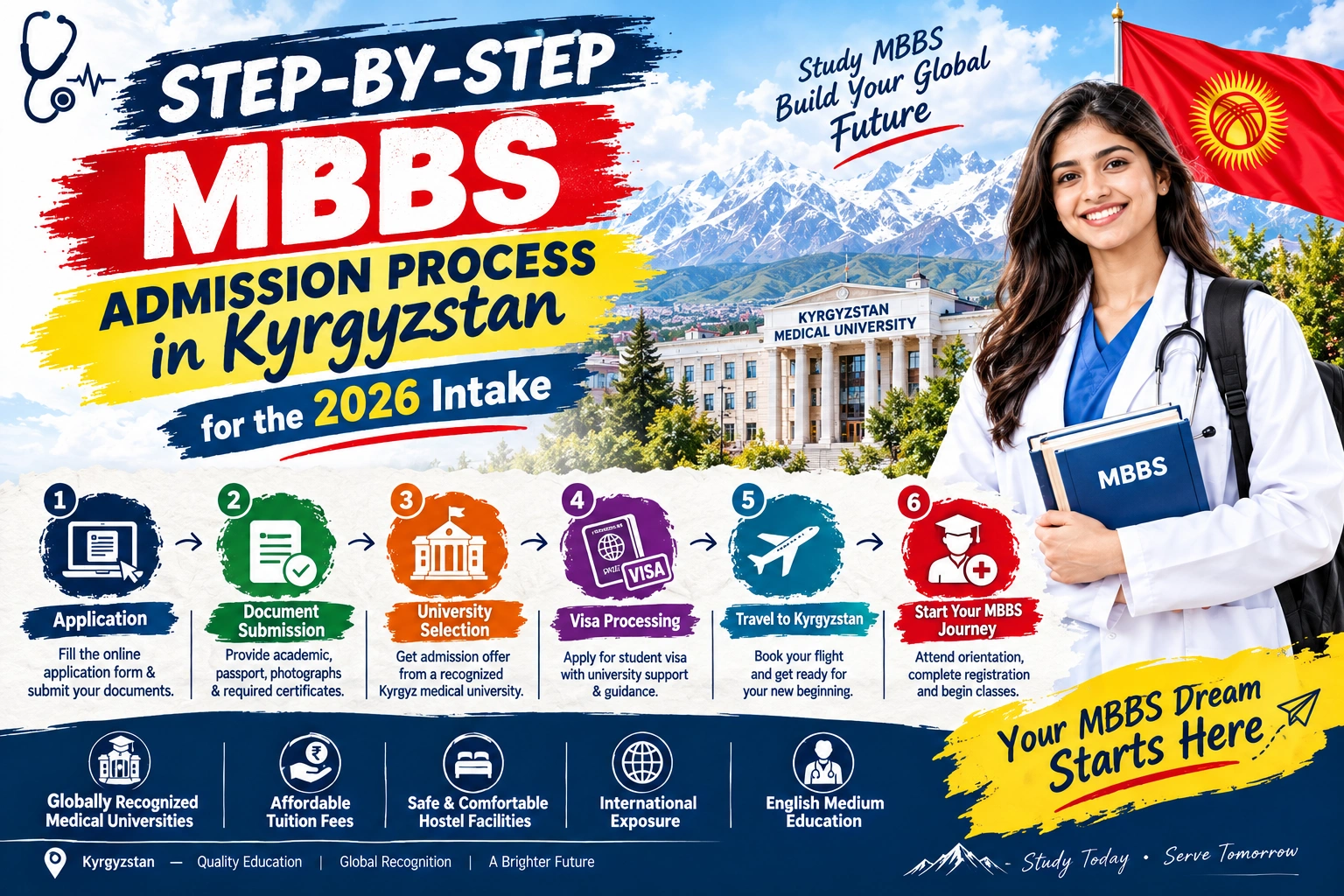
A safe admission file should include:
Verified university offer
NEET qualification
Class 12 eligibility
Official fee schedule
Written refund terms
Confirmed course duration
Internship details
Student visa process
Hostel allocation
Insurance
Safety begins before the flight.
Costs of Choosing Safer Accommodation
A secure hostel may cost slightly more than the cheapest available room. That difference can be worthwhile if it provides controlled entry, reliable heating, an on-site warden, and easy campus access. University hostel fees commonly range from approximately USD 500 to USD 1,200 annually. Private accommodation may cost USD 120–300 per student each month, depending on the city and location. Families should compare security, transport, heating, and registration support—not rent alone. A remote apartment saving USD 30 monthly may require daily late-evening travel through an unfamiliar area. Cheap rent. Expensive inconvenience.
A Practical Safety Checklist
Before leaving India, save both digital and printed copies of the passport, visa, admission letter, insurance, fee receipts, NEET scorecard, and emergency contacts.
After arrival:
Register with the university and embassy.
Learn the hostel exit routes.
Save local emergency numbers.
Use registered transport.
Avoid demonstrations.
Stay away from restricted border areas.
Carry limited cash.
Learn basic Russian or Kyrgyz phrases.
Report harassment or threats promptly.
Keep family informed during travel.
Don’t depend entirely on classmates for safety information. Check official notices too.
Frequently Asked Questions
Is Kyrgyzstan currently safe for Indian medical students?
Many Indian and international students continue to study in Kyrgyzstan, especially in Bishkek and Osh. Students should use normal urban precautions, avoid demonstrations, follow official advice, and stay away from sensitive border areas.
Was there violence against foreign students in Bishkek?
Yes. Mob violence involving foreign residents and students occurred in May 2024. Embassies issued safety advice during the disturbance. Students should ask universities how their emergency systems have changed since that event.
Are university hostels secure?
Many hostels provide guards, controlled entry, wardens, or CCTV, but standards differ. Families should inspect the exact hostel assigned to international students.
Is Osh safer than Bishkek?
Osh is smaller and may feel quieter, while Bishkek has more services and a larger international community. Neither city is risk-free. Hostel location and student behaviour matter greatly.
Is Kyrgyzstan safe for female students?
Female students study at Kyrgyz medical institutions, but they should verify women’s hostel arrangements, security, transport, wardens, and complaint procedures before admission.
What should students do during unrest?
Remain inside secure accommodation where advised, avoid crowds, follow university and embassy updates, keep phones charged, and contact family with verified information.
Conclusion
Kyrgyzstan shouldn’t be described as completely safe. No country should. Nor should one past incident be used to present every medical campus as permanently dangerous. The better question is whether the university has secure accommodation, reliable communication, organised transport, responsible management, and an actual emergency plan. Then comes student behaviour—avoiding crowds, protecting documents, checking travel advice, and reporting problems early. Before selecting MBBS in Kyrgyzstan, investigate the exact campus, hostel, neighbourhood, hospital routes, and support system. Speak with current male and female students. Ask about May 2024. A trustworthy university shouldn’t avoid the question. Safety isn’t a slogan. It is a set of systems and habits, repeated every day.