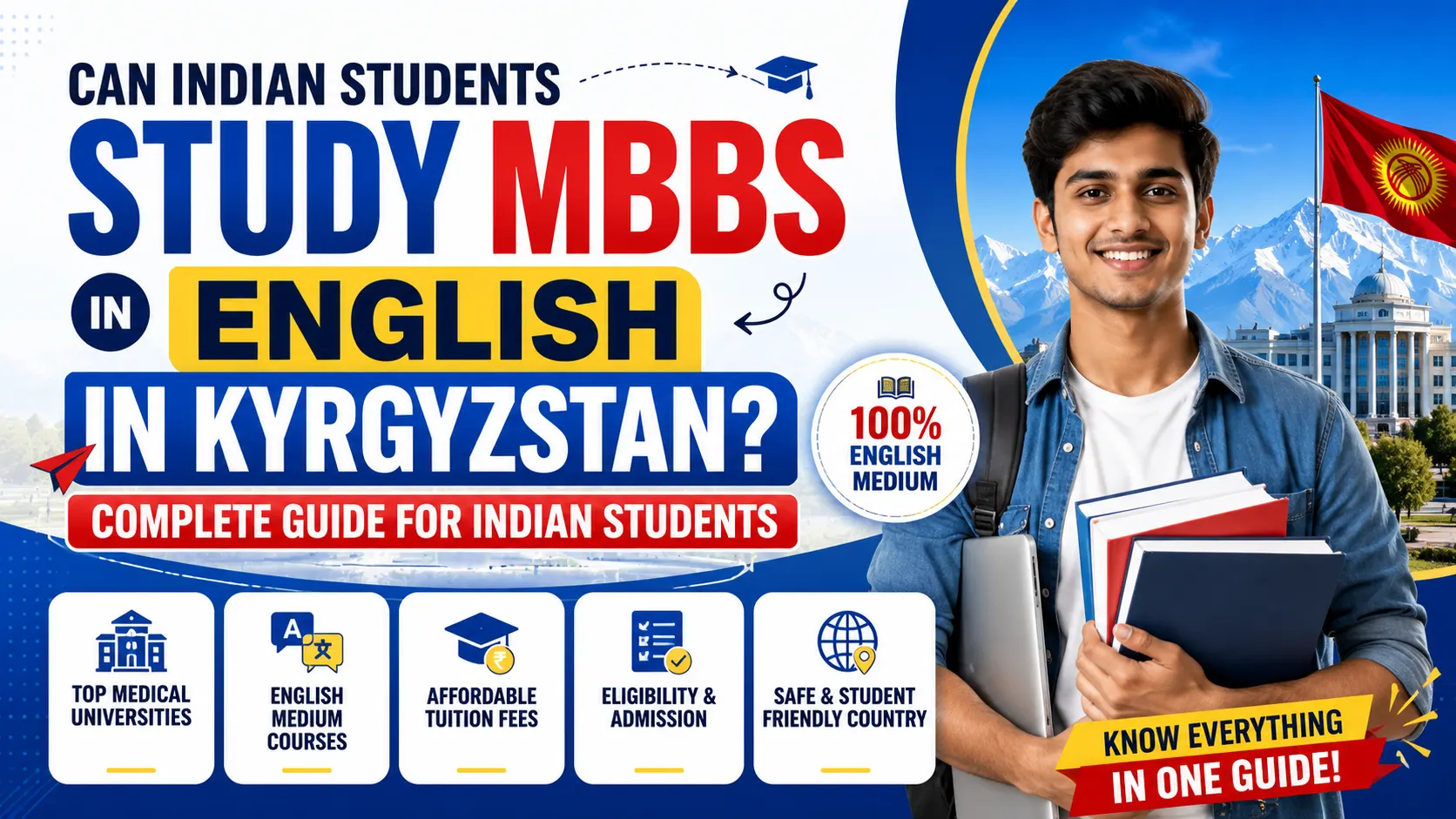
Are you an Indian student planning to pursue an overseas medical degree, wondering if you can enroll in an English-taught MBBS in Kyrgyzstan? This is in fact the core concern of the vast majority of Indian medical students studying abroad: none want to struggle to follow lectures delivered in a non-native language while spending six years studying complex specialized content such as anatomy and pharmacology. It is precisely because Kyrgyzstan hosts English-medium medical programs that meet international medical education standards that it has become a popular study destination for medical students from India and other countries. The subsequent sections of this guide will comprehensively cover full-dimensional information including application eligibility, admission requirements, study abroad costs, program advantages, and related career paths.
Quick Answer
First, here is the core quick answer: Most medical schools in Kyrgyzstan that meet the requirements of India's National Medical Commission (NMC) and are listed on the World Directory of Medical Schools (WDOMS) do not mandate that students learn Russian or Kyrgyz during their academic phase. Only basic local language proficiency will benefit your clinical work and daily life.
Why English-Medium Programs Matter
Choosing a study abroad country to pursue an MBBS requires far more than only focusing on costs. Language barriers can cause significant negative impacts on students' academic performance and even learning confidence in core subjects such as biochemistry, pathology, and clinical medicine. For this reason, English-taught programs have always been the first choice for Indian families. To accommodate the large number of international students from India, neighboring Central Asian countries, and Africa, medical schools in Kyrgyzstan have set up dedicated English-taught classes and exclusive departments, adopting English for the entire process from lectures, textbook development, and clinical training to assessments. This fully complies with NMC's mandatory requirement that any overseas medical degree recognized for Indian students must be delivered in English.
Eligibility Requirements
To apply for such programs, you must first meet the eligibility requirements: you must have passed India's National Eligibility cum Entrance Test (Undergraduate) (NEET-UG), and earned qualifying grades in the three high school subjects of physics, chemistry, and biology (PCB). The initial application process is divided into two steps: first, submit a full set of application documents including academic certificates and identity materials; second, wait for the institution's preliminary review and notification of subsequent assessments.
Application Process
If you are an Indian student planning to travel to Kyrgyzstan to pursue an English-medium MBBS degree, this application guide sorts out all key information for your application and enrollment, addressing the core questions that matter most to you. Regarding the application process, the steps outlined in this article are: submit your academic documents, NEET score report with a valid score, and passport copy; receive an official invitation letter from the host university to confirm your seat in the English-medium program; apply for a Kyrgyzstani student visa; and complete formal enrollment after arriving in Kyrgyzstan.
An important reminder: some Kyrgyzstani universities offer parallel Russian-taught programs, so you must email the university in advance to confirm that your assigned intake is for the English-medium program, to avoid enrolling in the wrong study track.
Cost of English-Medium MBBS in Kyrgyzstan
Regarding expenses, this article first corrects a common misunderstanding among Indian students that "English-medium programs charge far higher tuition fees than other programs." The total cost (including all tuition and accommodation fees) for Indian students enrolled in Kyrgyzstan's English-medium MBBS programs ranges from 1.5 million to 2.5 million Indian rupees. When applying, you must request an official detailed fee list to check for any hidden extra charges for English-medium courses.
Why Local Language Skills Still Matter
In response to the frequent question "why do I need to learn Russian or Kyrgyz if the program is taught in English?", the core uses of these local languages include communicating with patients during clinical internships, coordinating with local authorities for daily needs, building connections with hospital medical staff, and easing cultural shock. Most universities offer supplementary local language courses for international students, alongside their core medical training.
Core Strengths of English-Medium Programs
The five core strengths of this program are: no language barriers for attending lectures and reading academic literature, as most global mainstream medical literature is published in English, enabling smooth knowledge acquisition; India's national physician screening exams, the FMGE/NExT, are administered in English, which reduces preparation difficulty; and you can easily build connections with international students from other English-speaking countries.
Challenges to Prepare For Studying MBBS in English in Kyrgyzstan
The four types of challenges you need to prepare for in advance are: you still need to use local languages for clinical communication; the quality of English-speaking teaching faculty varies widely across universities, so you must conduct your own assessment of this; relying solely on English throughout your study will cause you to lose opportunities to practice the local languages; and the reliability of English-medium programs at small, newly established universities is far lower than that of long-established leading institutions.
Top Universities Offering English-Medium MBBS
The five eligible universities compiled in this article are: Kyrgyz State Medical Academy (KSMA), a long-established institution with an independent English-medium faculty; International School of Medicine (ISM), which has a mature English-medium curriculum and is highly popular among Indian students; Osh State Medical University, whose English-medium MBBS program has seen a steady expansion in its international student population; Asian Medical Institute, which offers low-tuition English-medium medical courses; and International Higher School of Medicine (IHSM), whose English-medium clinical courses prioritize teaching quality.
Finally, this article reminds all applicants that you must verify two core qualifications: the official English-medium instruction accreditation of your target program, and whether that program is registered on the World Directory of Medical Schools (WDOMS) and the official website of India's National Medical Commission (NMC).
Career Prospects After English-Medium MBBS
If you are an Indian student planning to apply to pursue an undergraduate medical degree in Kyrgyzstan, completing the local English-taught MBBS program will significantly boost your professional career prospects. The factors supporting this core advantage include the following: The Foreign Medical Graduate Examination (FMGE), the licensing exam for Indian international medical graduates, will soon be renamed the National Exit Test (NExT); all Indian medical advancement and licensing exams, including this one, are drafted entirely in English; English proficiency meets the needs of reading global medical research literature and conducting doctor-patient communication both in India and abroad; after passing the relevant exam and registering with India's National Medical Commission (NMC) or any of India's state medical councils, you will enjoy exactly the same rights to practice medicine and pursue further education as doctors who earned their medical degrees within India.
English-Taught vs Mixed Russian-English Programs
To help you compare and select the right program, we have compiled a clear comparison table that presents the core differences between two types of programs—fully English-taught programs and mixed Russian-English-taught programs—assessed across five key indicators: language of instruction, NMC compliance, adaptability for Indian students, alignment with FMGE/NExT exam preparation, and availability of additional language support.
Frequently Asked Questions
Next, we will answer one by one the six most frequently asked questions raised by applicants: The vast majority of officially accredited universities offer fully English-taught programs; universities provide specialized supporting courses to address any language barriers that may arise during clinical internships; fully English-taught programs are better aligned with the study pace for licensing exam preparation; a NEET-UG score is a mandatory requirement for all Indian student applicants; English-taught programs do not charge any extra tuition premium; the four English-taught universities with currently outstanding reputations are Kyrgyzstan State Medical Academy, International School of Medicine, Osh State Medical University, and Asian Medical Institute.
Conclusion
Finally, we remind all applicants that while pursuing your medical dreams, you must conduct advanced research to match your personal background with a suitable program, to ensure a smooth application process. Applicants to overseas English-taught medical programs must first confirm the English-language instruction arrangement with their target university, then verify the program's accreditation with NMC and WDOMS. Only after completing these two steps can they finish the optimal preparation process for their study abroad application