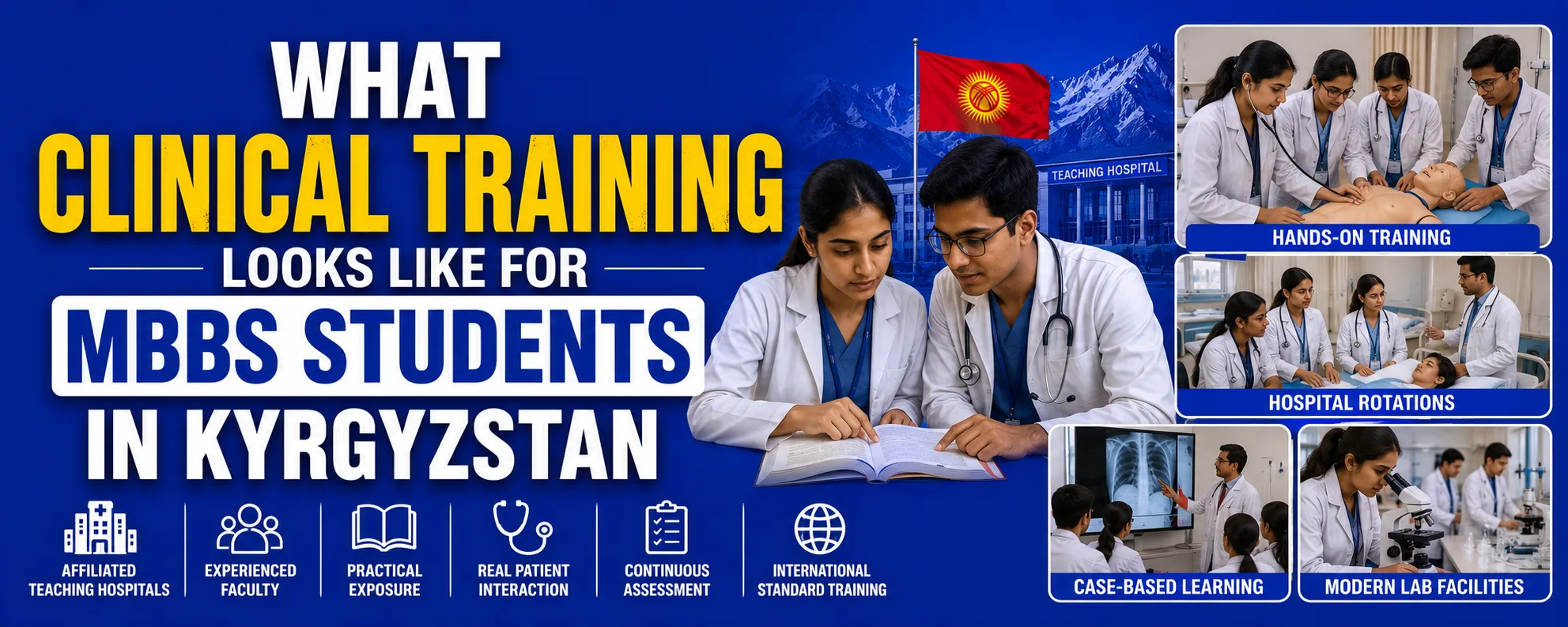
Clinical training is a core component of medical education worldwide. In-class theoretical teaching lays the foundational framework of professional knowledge for medical students, while hands-on clinical training is the key node that enables them to complete the transition from theoretical learners to qualified clinicians. As a popular study-abroad destination for Indian medical applicants, Kyrgyzstan’s MBBS program has four core advantages for international students: low application barriers, affordable tuition, wide recognition of its academic degrees, and an internationally aligned teaching system. It has long attracted large numbers of cross-border students pursuing a medical education.
This paper comprehensively sorts out the full-cycle clinical training system for MBBS in Kyrgyzstan’s MBBS students, from their first year of enrollment through clinical internship and all subsequent stages, to present the complete training logic for prospective study-abroad students.
Structure of the MBBS Clinical Training Framework
Local medical universities generally adopt an overall six-year training framework, split into five consecutive training modules. The core structure follows the model of "five years of integrated academic and clinical learning + one year of mandatory clinical internship", and its training specifications meet the general standards of international medical education.
In the pre-clinical stage, universities arrange a two-year foundational training period. Its core courses cover major basic medical subjects including anatomy and physiology, supported by resources such as standardized teaching atlases and practical training models, to help students build a solid knowledge bridge to transition from basic studies to clinical training.
Currently, multiple local medical universities have allocated special funds to upgrade their on-campus laboratories and clinical simulation centers, to further improve the quality of practical teaching in the pre-clinical stage and strengthen the early competency foundation of medical students.
Early Clinical Exposure and Structured Clinical Training
In traditional medical education, most medical students only gain access to real patients when they reach their upper-level university years. The early-clinical, phased clinical training model rolled out by multiple medical universities across Kyrgyzstan breaks this convention.
The full model arranges five core modules along the timeline of a medical student’s academic career, with all systemic details supported by local institutional case studies, presented as specific and traceable content with no vague, unsubstantiated arguments.
Early Clinical Exposure Module
The first module is early clinical exposure, implemented by the International Higher Medical College through its on-campus simulation center and affiliated hospitals. It includes five categories of activities such as hospital visits, ward round observation, and community healthcare initiatives, and works to foster professional confidence and clinical awareness starting from the initial stage of a student’s medical career.
Structured Clinical Training Module
Next is the structured clinical training module, launched in the third year of study and implemented by institutions including Osh State Medical University. Targeted at students pursuing MBBS degrees, this module facilitates their transition from purely theoretical learning to patient-centered education.
Students rotate through eight core departments including internal medicine, general surgery, and pediatrics, to master five clinical skills such as medical history collection and physical examination.
Affiliated Teaching Hospital Network Module
The third module is the affiliated teaching hospital network module. The partner institutions of all participating universities cover five types of medical entities, including public hospitals, specialized medical centers, and children’s hospitals.
The International Medical University also provides additional rotation opportunities at top-tier hospitals both within and outside Kyrgyzstan, solving the problem of disconnect between theory and practice.
Internal Medicine and Surgery Rotations
Internal Medicine Rotation
The core internal medicine rotation module requires students to learn to manage seven common diseases including diabetes, hypertension, and respiratory illnesses, participate in four learning activities such as observation of clinical consultations and case discussions, to develop systematic clinical reasoning skills.
Surgery Rotation
The core surgery rotation module arranges for students to observe five types of surgeries including general surgery procedures and emergency operations, learn four core content areas such as aseptic technique and surgical workflows, and clearly defines the learning boundary for lower-year medical students that they may only conduct observations, and do not perform surgeries independently.
Core Clinical Training Modules
The core medical training system for medical students enrolled in Kyrgyzstan’s MBBS program sets up 8 core training modules. Each module clearly defines its learning content and competency development goals, and aligns with the localization adaptation requirements for international medical students.
Pediatrics Training
The first module is pediatrics training, which covers 5 core dimensions: child development, pediatric diseases, immunization programs, nutritional management, and neonatal care. Students are required to master specialized communication and clinical approaches, and understand the unique characteristics of pediatric diagnosis and treatment through clinical clerkships.
Obstetrics and Gynecology Rotation
The subsequent obstetrics and gynecology rotation covers 5 core areas: prenatal care, labor and delivery procedures, gynecological surgery, family planning services, and reproductive health management. This rotation is rated by most students as the most dynamic and educationally valuable clinical rotation track.
Mental Health and Psychosocial Well-Being Training
Mental health and psychosocial well-being training includes 5 learning areas: depression, anxiety disorders, schizophrenia, substance use disorders, and behavioral health issues. This training develops students’ ability to conduct psychiatric assessments and communicate effectively with patients.
Emergency Medicine Practice
Emergency medicine practice covers 5 core clinical scenarios: management of trauma cases, cardiac emergencies, respiratory distress, acute infections, and injured accident patients. This module hones students’ capacity to make rapid clinical decisions and collaborate in teams under pressure.
Clinical Skills Laboratory
The clinical skills laboratory adopts simulation-based teaching, where students practice 5 core procedures: blood pressure measurement, intravenous injection, cardiopulmonary resuscitation, suturing, and patient physical examination. This setup provides a safe practice space before students engage in real patient consultations.
Doctor-Patient Communication Training
Doctor-patient communication training focuses on building 4 core competencies: professional communication, empathy, ethical decision-making, and patient counseling.
The program uses English as the medium of instruction for all academic teaching. International students are required to complete basic Russian or Kyrgyz courses, and intensive local language learning is mandatory during the clinical stage to ensure the effectiveness of medical diagnosis and treatment.
Clinical Case Discussion Module
The clinical case discussion module trains students’ critical thinking through 5 core dimensions including symptoms and diagnosis, uses case-based teaching to simulate real decision-making scenarios.
Community and Public Medicine Module
The final module, the community and public medicine module, only has its framework introduced and is not expanded on.
Community Healthcare and Research Opportunities
Kyrgyzstan’s MBBS programs are centered on clinical training, and hold strong appeal for Indian students planning to pursue studies in the country.
Community Healthcare Participation Module
This paper breaks down their core components in line with the progression logic of clinical training: first, the community healthcare participation module that lays foundational cognitive groundwork, which includes four types of activities:
Rural health camps
Vaccination programs
Health promotion campaigns
Community surveys
This module helps medical students build basic understanding of preventive medicine and population health management.
Clinical Research Opportunity Module
The second component is the clinical-stage research opportunity module that supports academic growth, covering four channels:
Clinical research
Public health projects
Medical conferences
Academic publications
These opportunities can train students’ analytical skills and boost their competitiveness when applying for further study.
Internship Training and Global Licensing Pathways
In line with Kyrgyzstan’s domestic medical education regulations, most 6-year medical programs include a 1-year mandatory internship.
Internship rotations cover six departments:
Internal medicine
Surgery
Pediatrics
Obstetrics and gynecology
Emergency medicine
Community health
This helps students accumulate hands-on experience in patient care and meet the requirements for professional medical practice.
Clinical training also supports preparation for the world’s mainstream medical licensing exams, covering four major pathways:
India’s National Medical Commission (NMC)
World Directory of Medical Schools (WDOMS)
United States Medical Licensing Examination (USMLE)
United Kingdom’s General Medical Council (GMC)
Recently, the NMC issued a clarification requiring foreign medical graduates to complete sufficient in-person clinical training and onsite medical education, which highlights the core value of clinical competence.
Challenges Faced by International Students
The programs also face four types of challenges:
Language barriers
Cultural differences
Climate adaptation
Academic pressure
Most of these can be overcome by most students through consistent effort.
Why Indian Students Choose Kyrgyzstan for MBBS
The seven core attractions of these programs for Indian students are:
Low tuition fees
Full English-language instruction
Early exposure to clinical practice
Hospital-based teaching
Modern simulation laboratories
Internationally recognized degrees
Accessible global licensing pathways
The entire training system integrates classroom learning, laboratory education, hospital rotations, simulation training, and internship experience, forming a highly structured and mature model for cultivating medical students.
Conclusion
This paper analyzes Kyrgyzstan’s MBBS study-abroad programs: medical students gradually accumulate the knowledge, skills, and confidence required to practice medicine, starting from early engagement in patient interactions and progressing to participate in complex clinical rotations and internships.
Local medical universities provide abundant practical learning opportunities through their affiliated teaching hospitals, modern simulation centers, clinical case discussions, and precepted nursing training. While minor challenges related to language adaptation and cultural adjustment do exist, the country’s high-quality clinical training remains the core reason that thousands of international students choose to study medicine in Kyrgyzstan.
It is a high-quality option for aspiring medical practitioners who seek a cost-effective, international path to build a career in medicine.
For students planning their medical education journey, it is also important to stay updated with official information from the National Medical Commission (NMC), verify university recognition through the World Directory of Medical Schools (WDOMS), review global public health standards published by the World Health Organization (WHO), understand eligibility requirements related to NEET-UG, and explore professional admission guidance through MBBS in Kyrgyzstan.