
Introduction
Choosing which medical university to attend is one of the most critical life decisions for every medical school applicant. For a large number of Indian medical applicants, the core barrier standing in the way of their pursuit of a medical career is that they cannot secure the scarce seats at government-run medical colleges, yet cannot afford the exorbitant tuition fees of private medical schools. For this reason, MBBS programs in Kyrgyzstan have become a widely popular alternative for Indian students in recent years.
Over the past decade, thousands of Indian students have traveled to Kyrgyzstan to study medicine. The core draws of these programs include affordable tuition, globally recognized university accreditation, English-medium instruction, and abundant opportunities to practice medicine internationally.
Why MBBS in Kyrgyzstan Has Become Popular
What is more, the training provided by Kyrgyzstani medical schools meets global medical education standards, and these institutions offer bridging programs tailored specifically for international students to lower the threshold for adaptation.
The track record of large numbers of past graduates who have successfully launched their medical careers has further boosted the reputation and popularity of these programs.
Despite the rising popularity of this study abroad pathway, Indian students and their parents still hold many widespread misconceptions about it. Conflicting information available online has left them confused on core dimensions including:
University recognition
Degree validity
Tuition structures
Career prospects
Living conditions
These misconceptions mainly stem from two sources:
Outdated materials
Misinterpretations of foreign medical regulatory rules
Making major life decisions based on incorrect information only generates unnecessary anxiety, so it is essential to clarify the line between facts and misunderstandings and present the real situation of studying medicine in Kyrgyzstan.
Misconception 1: MBBS Degree from Kyrgyzstan is Invalid in India
The first and most prevalent misconception to dispel is the claim that “an MBBS degree from Kyrgyzstan is invalid in India.”
Per the regulations of India’s official medical governing body the National Medical Commission (NMC) and the World Directory of Medical Schools (WDOMS), the world’s authoritative roster of medical universities, this degree is fully valid in India as long as graduates complete their studies at a qualified, recognized institution and abide by all regulatory requirements.
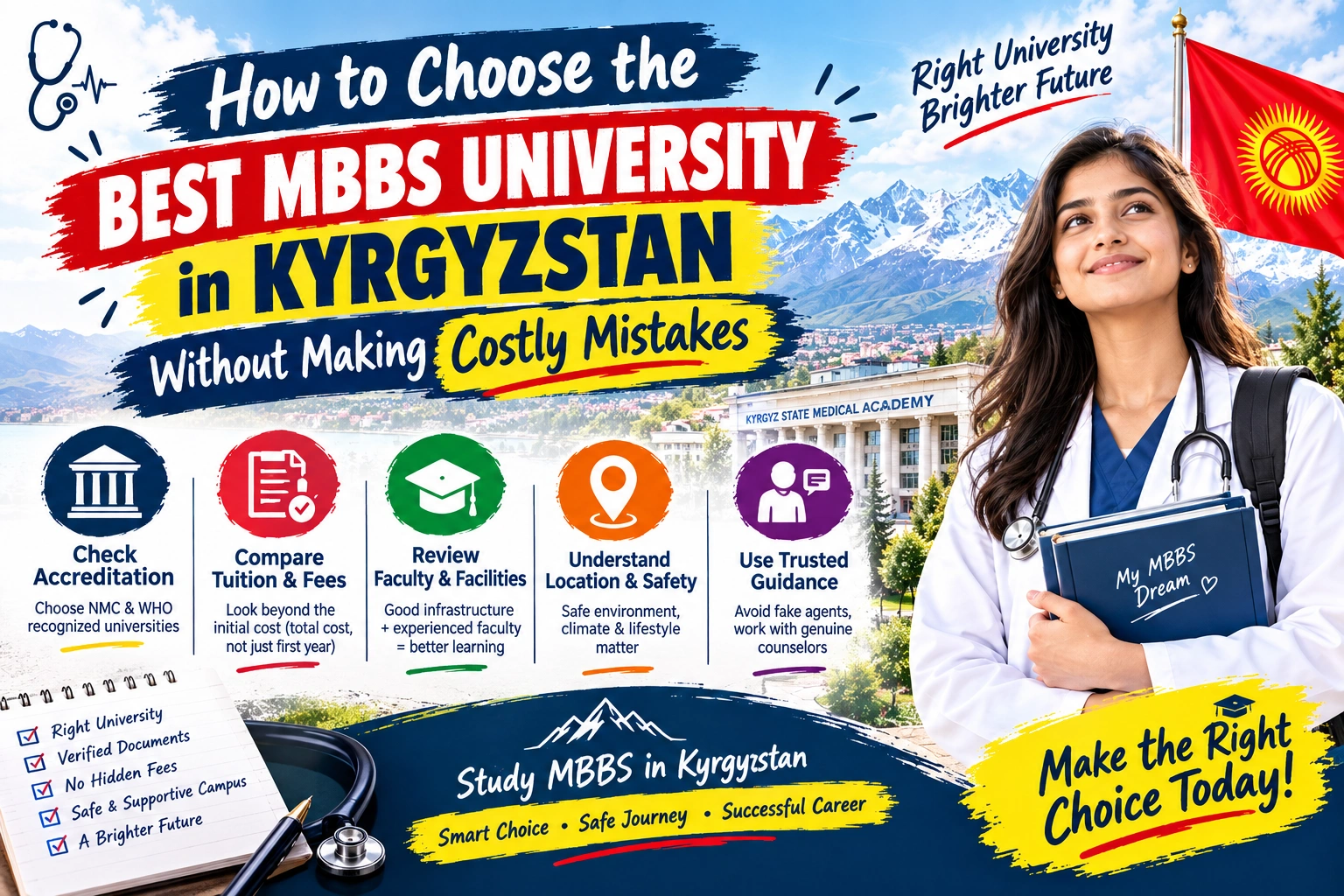
Students must also meet four mandatory criteria when selecting a school.
To date, large numbers of graduates from accredited Kyrgyzstani medical schools have successfully completed India’s medical license registration process and launched their medical careers.
Misconception 2: Only Students with Weak Academics Study MBBS Abroad
Many Indian students and their parents planning to apply for overseas MBBS programs first hold a common misconception: that all students who travel to Kyrgyzstan to study medicine are those with subpar academic performance.
This assumption is completely unfounded.
Indian students choose to pursue medical degrees abroad for five core reasons:
Insufficient supply of domestic medical school seats in India
Exorbitant tuition fees at India’s private medical colleges
Interest in international education systems
Desire to build global professional perspectives
Practical financial considerations for their households
Many Indian medical students admitted to local Kyrgyzstani institutions actually have outstanding academic records.
Ultimately, academic achievement depends on individual effort, not the country where a university is located.
Misconception 3: Medical Education Quality in Kyrgyzstan is Low
The claim that “Kyrgyzstan has low-quality medical education” is another common misconception.
Legitimate local institutions offer six core guarantees:
Modern medical curricula aligned with industry standards
Sufficient clinical training opportunities
Fully qualified teaching staff
Well-resourced laboratory facilities
Stably partnered affiliated hospitals
Full-cycle support services for international students
We advise applicants not to generalize based on national stereotypes and to evaluate each institution’s qualifications individually.
Education quality depends on an institution’s own operating standards, faculty professionalism, and access to clinical resources, not the country in which it is based.
Misconception 4: Clinical Practice Opportunities are Limited
Indian students studying for an MBBS in Kyrgyzstan can participate in five major categories of clinical activities:
Cross-departmental hospital rotations
Clinical observation shadowing
Direct patient interaction
Multidisciplinary case discussions
Basic medical skills training
Students who take the initiative to engage deeply in these activities often develop strong clinical diagnostic and patient management capabilities.
Misconception 5: MBBS in Kyrgyzstan is Extremely Expensive
Analysis of the six most frequent search terms Indian students use to research Kyrgyzstan MBBS tuition shows that local program costs hold a significant cost advantage compared to private medical colleges in India and other mainstream international study destinations.
Applicants should calculate their total full-cycle expenditure, including:
Accommodation
Daily living costs
Round-trip travel fees
This helps avoid misjudging the true cost of study.
Misconception 6: Language Barrier is a Major Problem
Many first-time international students believe one must master the local language before enrolling to study medicine in Kyrgyzstan.
In fact, the vast majority of accredited local medical schools deliver their entire MBBS program in English.
Students only need to master basic daily conversational language to adapt to life in the country, so it is recommended to spend just 1–2 months learning foundational Russian or Kyrgyz rather than investing excessive time before enrollment.
Misconception 7: Career Opportunities are Limited After Graduation
Graduates can pursue six career tracks:
Practicing medicine
Enrolling in postgraduate studies
Entering a clinical specialty
Working in scientific research
Taking on healthcare management roles
Working in international healthcare
Students should clarify their own goals and start preparation as early as their third year of study.
Misconception 8: All Medical Universities Have the Same Quality
Medical schools in Kyrgyzstan differ significantly across six core dimensions:
Faculty quality
Clinical resources
Infrastructure
Academic standards
Student support services
Research opportunities
Students must compare these factors one by one when selecting a school.
Misconception 9: Every Degree Automatically Allows Practice in India
Students must verify that the university meets four eligibility requirements:
NMC compliance
Listing in WDOMS
Valid academic accreditation
Official regulatory approval
This check must be completed before submitting any applications.
Misconception 10: FMGE and NExT Preparation Can Be Delayed
The belief that there is enough time to prepare for the FMGE and NExT exams is incorrect.
Most applicants who fail these exams lose out due to insufficient preparation timelines, so it is recommended to start building foundational knowledge in the second year of enrollment.
Misconception 11: Student Housing Conditions are Poor
Compliant universities almost all offer up-to-standard living facilities including:
Qualified dormitories
Stable internet
Commuting services
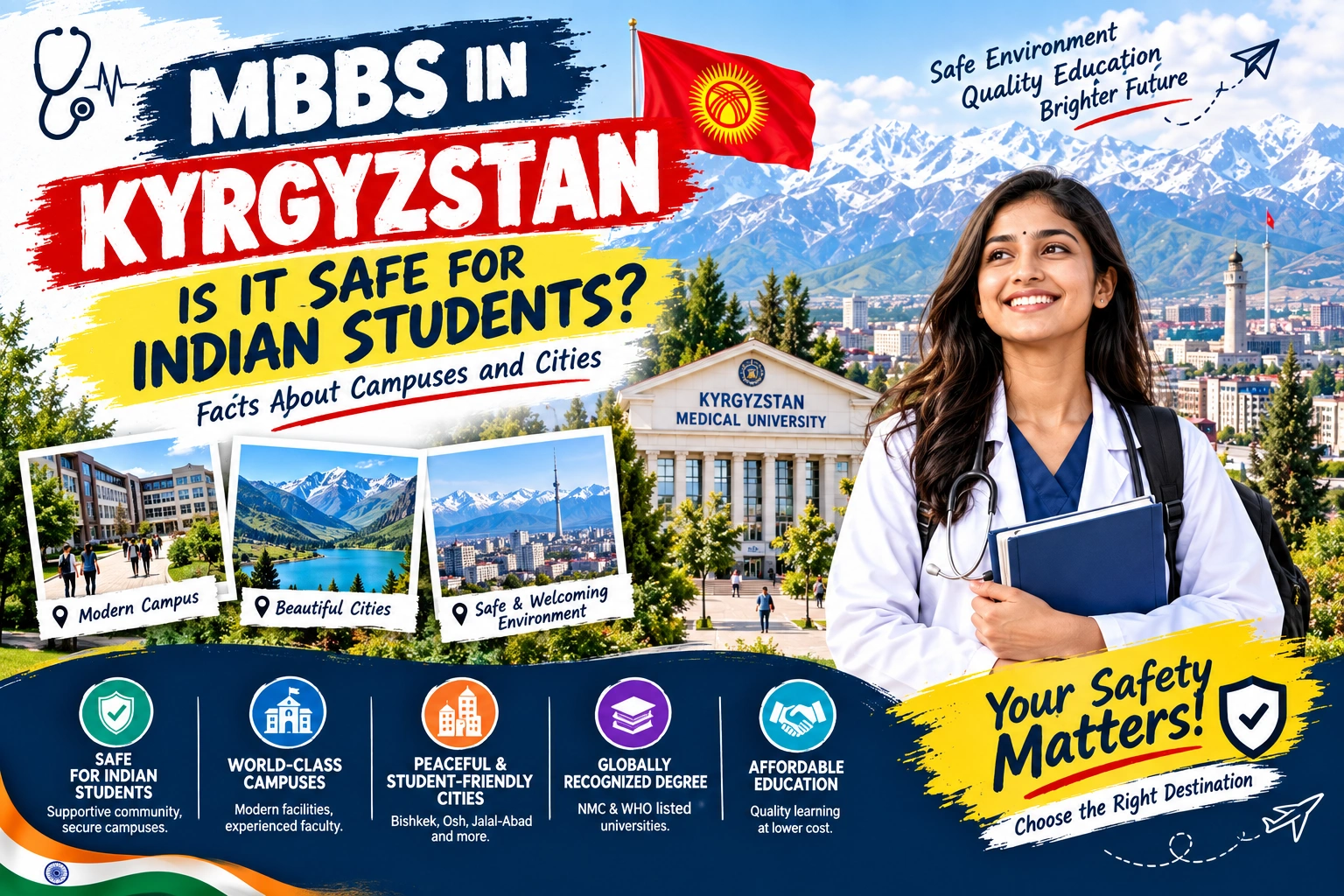
Currently, the vast majority of international students studying in Kyrgyzstan can successfully adapt to the local pace of life and study and gain valuable transnational growth experiences.
Application Process and Important Compliance Requirements
For Indian students planning to pursue an MBBS degree in Kyrgyzstan, there exist numerous easily fallen-for cognitive misconceptions in the areas of application, certification, school selection, and cost planning.
The application process is not overly complex. Applicants only need to follow a standard 6-step application process to submit materials and verify the authenticity of all submitted information.
The priority order of medical certifications must also be understood correctly. NMC compliance and inclusion in WDOMS have far higher priority than WHO certification.
Each type of certification serves its own bounded purpose, and mixing up their priority order can harm future eligibility to practice medicine.
Choosing the Right Medical University in Kyrgyzstan
Many students hold one-sided opinions about Kyrgyzstan’s two mainstream medical schools, International School of Medicine Kyrgyzstan and JAIU Kyrgyzstan.
Students must conduct evaluations based on objective dimensions including:
Institutional operation qualifications
Faculty-student ratio
Clinical internship resources
They must not let unverified information influence their school selection decisions.
Understanding the Complete Cost of Studying MBBS Abroad
Many students calculate their expenses only based on tuition fees, but the total cost of studying medicine in Kyrgyzstan includes eight specific expense categories.
Focusing solely on tuition can easily lead to misjudgment of the overall investment required.
A special reminder is that neglecting NEET eligibility can directly impact your eligibility to obtain a medical practice license after returning to your home country.
Doctor Salary and Long-Term Career Growth After MBBS
Many medical students planning to pursue an MBBS in Kyrgyzstan often search for local doctors’ salaries to assess their career prospects.
A doctor’s actual income is determined by five core dimensions:
Country of practice
Years of professional experience
Medical specialty
Healthcare sector of employment
Personal career choices
Medical education is a long-term professional investment, and students must never focus only on starting salaries.
Conclusion
Today, the popularity of studying for an MBBS in Kyrgyzstan continues to rise, and various misinformation and rumors have emerged alongside this trend.
These misconceptions stem from:
Outdated information
Incomplete understanding of regulatory requirements
False assumptions about international education
Accredited, compliant institutions such as the International Medical School of Kyrgyzstan offer affordable medical education, clinical training opportunities, global exposure, and formal career development pathways.
Indian applicants should verify the following five core matters before enrolling:
Their chosen institution meets NMC compliance requirements.
The university is listed in WDOMS.
They retain their NEET eligibility.
They clearly understand the complete tuition fee structure.
They assess the institution’s educational quality.
Only by conducting fact-based research can students complete their studies smoothly and qualify to practice medicine in India or anywhere else in the world in the future.