
Introduction
The study abroad program appeals to many aspiring medical students for its affordability. Every year, thousands of Indians travel abroad for medical studies. While many of them go on to have successful careers, some students express regret about their decisions. By understanding these testimonials, we can determine if the trip is worth it.
This guide is about the potential pitfalls of foreign medical studies. This guide is not intended to dissuade or scare students away from traveling abroad for medical school. The aim is to help you avoid the specific, documented mistakes that students made when they traveled abroad for MBBS, which resulted in student regret. To allow prospective students to make a fully informed decision, reasons for student regret will be outlined, along with eligibility, admission process, fees, top universities, and career scope.
View our infographic: The Quick Answer
What causes student regret when studying MBBS abroad? The most common reasons students regret studying abroad for MBBS include recognizing the unrecognized universities, being mislead by crooked agents, not understanding the total cost of studies and living expenses, struggling with language in clinical training, being unprepared to take the FMGE/NExT licensing exam, homesickness, and culture shock. Most of these issues arise when students choose a university that is listed with the NMC, WHO, and conducts their own research instead of putting their trust in the agents.
Reason #1: Unrecognized University
Choosing an unrecognized university remains one of the most damaging mistakes of this collection.
Every year, students find out a few years into their course that their university is not registered with the National Medical Commission of India or not in the World Directory of Medical Schools. Without this approval, the students will not be able to take the licensing exam in India.
Here's how to avoid this: Always check the status of the university on the NMC site. Also, check for the university on WDOMS yourself. Do not depend on agents or university brochures, as some recognition status might be old and they might be lying.
Most Common Verification Errors
Mistake
consequences
Correct approach
Believing on agent provided screenshots
Finest can be edited or outdated.
View WDOMS and NMC as they are
Assuming
“WHO-recognzed” without checking
WHO does neither rank nor give approval to universities , the listing is in WDOMS.
Type the name of the university in WDOMS.
Taking the the
university sites
for WDOMS compliance.
Lied about
Faculties assignments
and missed crucial
details about their internship terms
Compare NMC and university claims.
Reasons 2: Trusting dishonest agents and their false claims
Dishonest agents do not care about the students as they will promise “no NEET” or “guarantee Admission” with low fees to take convince the parents to make fast payments
result: Some students will find out they have a
fake admission letter or they paid to a personal account instead of the university.
Avoid: Treat all claims of “apply now, seats filling fast” as a red flag, do not pay unless you confirm the funds will be sent to the official university account and not a personal account. Also, ask for direct contact with the admissions office.
Reason 3: Miscalculating the Total Cost of Studying Abroad
Some students only consider tuition costs, forgetting visa expenses, hostel costs, health insurance, currency fluctuations, and coaching for licensing exams. Financial stress significantly impacts students, some as early as halfway through a course; this stress also has a negative effect on a student's academic performance.
Although Kyrgyzstan's MBBS program has one of the lowest tuition costs, students should consider the cost of the entire 6 years, not just the first year.
Consider the following costs-
Cost Component
Approximate Annual Cost
Tuition
$3,200 – $5,600
Hostels and Food
$1,800 – $3,000
Health Insurance, Visa
$150 – $300
FMGE/NExT Coaching (final years)
₹15,000 – ₹50,000
A currency buffer of 10-15% along with a full course duration budget eliminates one more regret.
Reason 4: Language Barrier in Clinical Training
Most students have no issue with English lectures, but the patients encountered in clinical training speak the local language. Students who fail to learn basic conversational Kyrgyz or Russian significantly struggle in the clinical years and also lack confidence in the FMGE/NExT exam.
How to avoid it- Learn basic medical phrases and pick an Indian MBBS university that has a medical training course with a language support system.
Reason 5: FMGE/NExT Take a Difficult Exam to Practice in India
Foreign medical graduates have been experiencing national pass rates of less than 30%. The exam syllabus comprises community and forensic medicine, among other subjects, found in the overseas curricula in varying degrees. Graduates who do not prepare for the FMGE/NExT examinations after their graduation are often at an extremely high level of disadvantage.
What you must do to avoid it: Embark on an FMGE/NExT preparatory course during the later years of the MBBS rather than after you arrive in India. Also, select a medical college that has a history of producing graduates with reasonable passing rates in the licensing examinations.
Eligibility Criteria for MBBS in Kyrgyzstan
To avoid regret that stems from the confusion around eligibility, this is what is clearly required:
More than 50% marks in PCB (Physics, Chemistry, Biology combined) in Grade 12 (40% for SC/ST/OBC categories).
Passing Grade 12 from a recognized board.
A validated, qualifying score for the NEET UG, which is a must as per NMC.
The minimum age is 17 years by 31st December of the year of admission.
A passport with adequate validity for the duration of the course.
Admission Process for MBBS in Kyrgyzstan
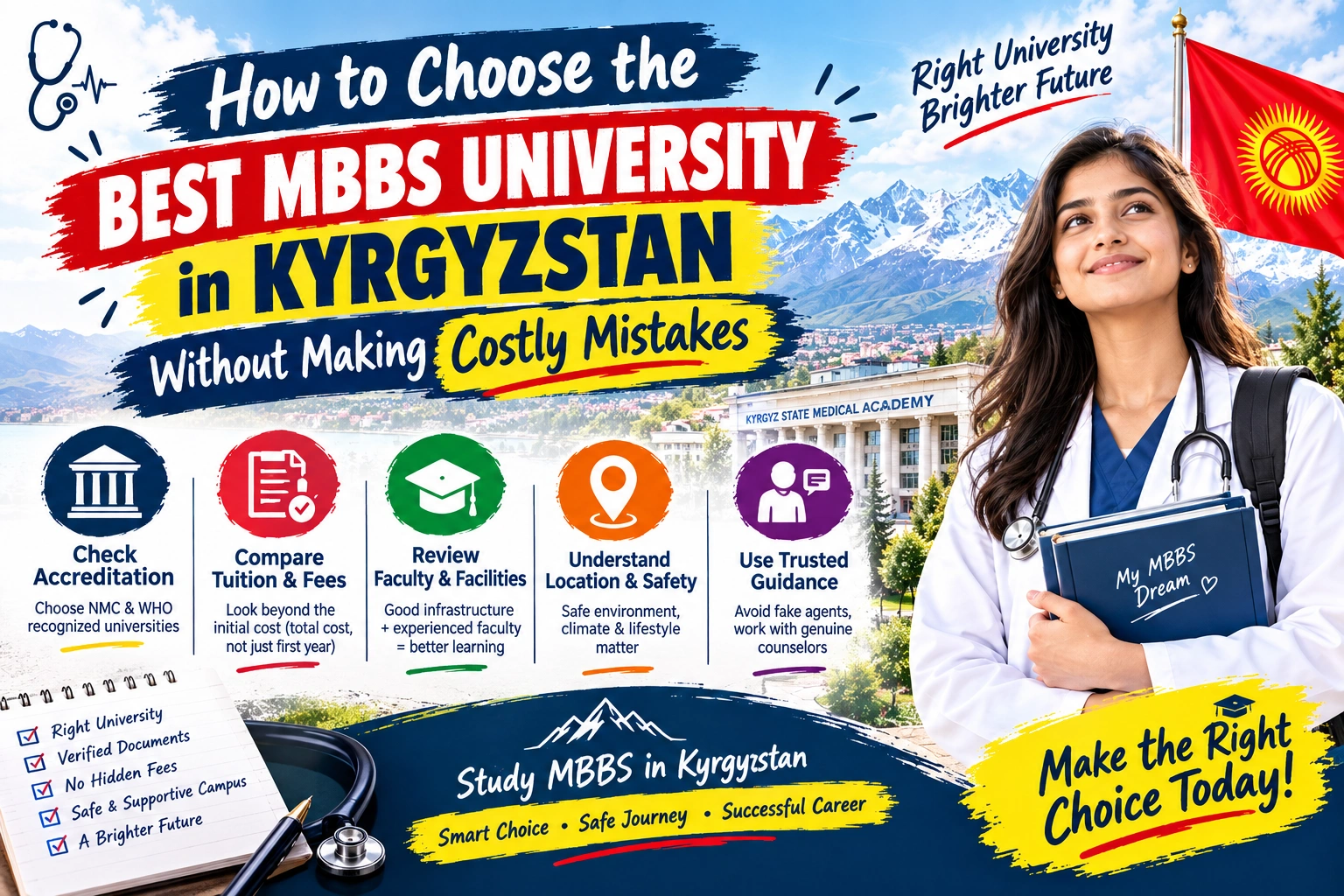
Choose from universities that are NMC approved and WHO WDOMS listed.
Confirm that you have qualified NEET and prepare the required educational documents.
Directly apply to the university or through a verified, registered educational representative.
Officially receive the admission or invitation letter from the university.
Apply for a Kyrgyz student visa.
Pay the university's first-year fee, which should be paid to the official account of the university (not to an individual).
Travel to Kyrgyzstan, complete the required local registrations and start your studies.
The Right Way to Pursue MBBS in Kyrgyzstan
Tuition is lower in comparison to the private medical colleges in India.
The medium of instruction is English.
No donation required at NMC-approved universities
Established Indian peer support communities
Clinical exposure starts from third year in most universities
Students Must Weigh the Following Disadvantages
Cold winters and cultural adjustment can be difficult in the beginning
Clinical rotations mainly consists of patient interaction in Russian or Kyrgyz
FMGE/NExT preparation is complex and requires a lot of self-study from the students, irrespective of the university
Choosing a university of lesser-known or unverified name can jeopardize your future licensing
Homesickness is common for newly arrived students in the first few months when studying abroad
Top Universities for MBBS in Kyrgyzstan
University/Subcontinent/Country
Considered For
Kyrgyz State Medical Academy (KSMA)
Bishkek
First & largest medical school in the country; has biggest hospital network in country
Kyrgyz Russian Slavic University (KRSU)
Bishkek
Historically has better FMGE results
International School of Medicine (ISM)
Bishkek
High volume of foreign students
Osh State University
Osh
Less expensive & good visibility in the region
Jalal-Abad State University (JASU)
Jalal-Abad
Good connections to clinics for internships
Asian Medical Institute (ASMI)
Kant
Good cultural diversity with foreign students
Cross Check the Current NMC Recognition and WDOMS Before Selection
Career Scope After MBBS in Kyrgyzstan
Graduates can sit for FMGE/NExT to practice in India and are eligible for post-graduation & licensing in other countries including USA (USMLE), UK (PLAB) & Australia.
Practice or Residency Opportunities for MBBS Graduates
The pathways of your MBBS career rely on your active participation, your university, and your licensing exam prep, more than where you choose to practice medicine. For this reason, you should avoid the pitfalls mentioned above.
Frequently Asked Questions (FAQs)
Q1. Do many MBBS students who study abroad feel like they made a mistake?
Not often. Many students successfully graduate and regret the decision for reasons like choosing a non-recognized university, being scammed by agents, or not planning finances, and not for studying abroad in itself.
Q2. How do I check if a Kyrgyz university is associated with the NMC?
To see if a Kyrgyz university is associated with the NMC, look for the university on the NMC official website and check the WDOMS. Do not rely on the documents provided by your agents.
Q3. Do I have to clear the NEET to study MBBS in Kyrgyzstan?
NEET is mandatory for Indian students for MBBS in Kyrgyzstan, as per the NMC guidelines, irrespective of the university they join.
Q4. What do students wish they had spent more on when studying abroad?
Students often forget to budget for coaching for the NMC exams, insurance, visas, and accommodation. These can easily add an additional USD 40,000 to a student’s budget over six years.
Q5. Do language barriers affect students’ careers as doctors?
Faced barrier language can be an issue when building your confidence during clinical rotations, but is manageable if you choose a university with a language support program and learn the language before you arrive.
Q6. What is the best way to guarantee success with study of MBBS in Kyrgyzstan?
Plan your finances.
When students NMC verify recognition status, choose NMC approved universities, budget for the future, and begin preparations for licensure in advance, Kyrgyzstan remains among the most cost-effective countries that provide a medical degree that is validated by the rest of the world.
Conclusion
Most of the time, where there is regret after the journey of MBBS, there is an absence of verification, timing, and most importantly, a lack of trust in agents who are not authentic. The best part is that the majority of these regrets are avoidable.
If you are contemplating an MBBS in Kyrgyzstan, NMC recognition verification should be a priority, create a budget for your entire six years of study, and begin preparations for the licensure exam with time to spare. If you do all these things, you will significantly improve your chances of not regretting your decision.
This is a piece of writing that contains facts. For your protection, always confirm a university's recognition status with the NMC and the World Health Organization before making any admissions or payments.