Introduction
For Indian students, getting an MBBS degree from Kyrgyzstan is a way for them to get a medical degree and understand the science of medicine through books and classes. However, the practice of medicine requires more skills like communication, resilience, flexibility, and confidence. The reality is that many students who excel academically and become toppers practice with clinical confidence and other skills that many of them lack.
This guide attempts to highlight the practical aspects and the so-called invisible skills that you are likely to need to be an excellent candidate for the medical profession.
Free Snippet: Skills To Develop
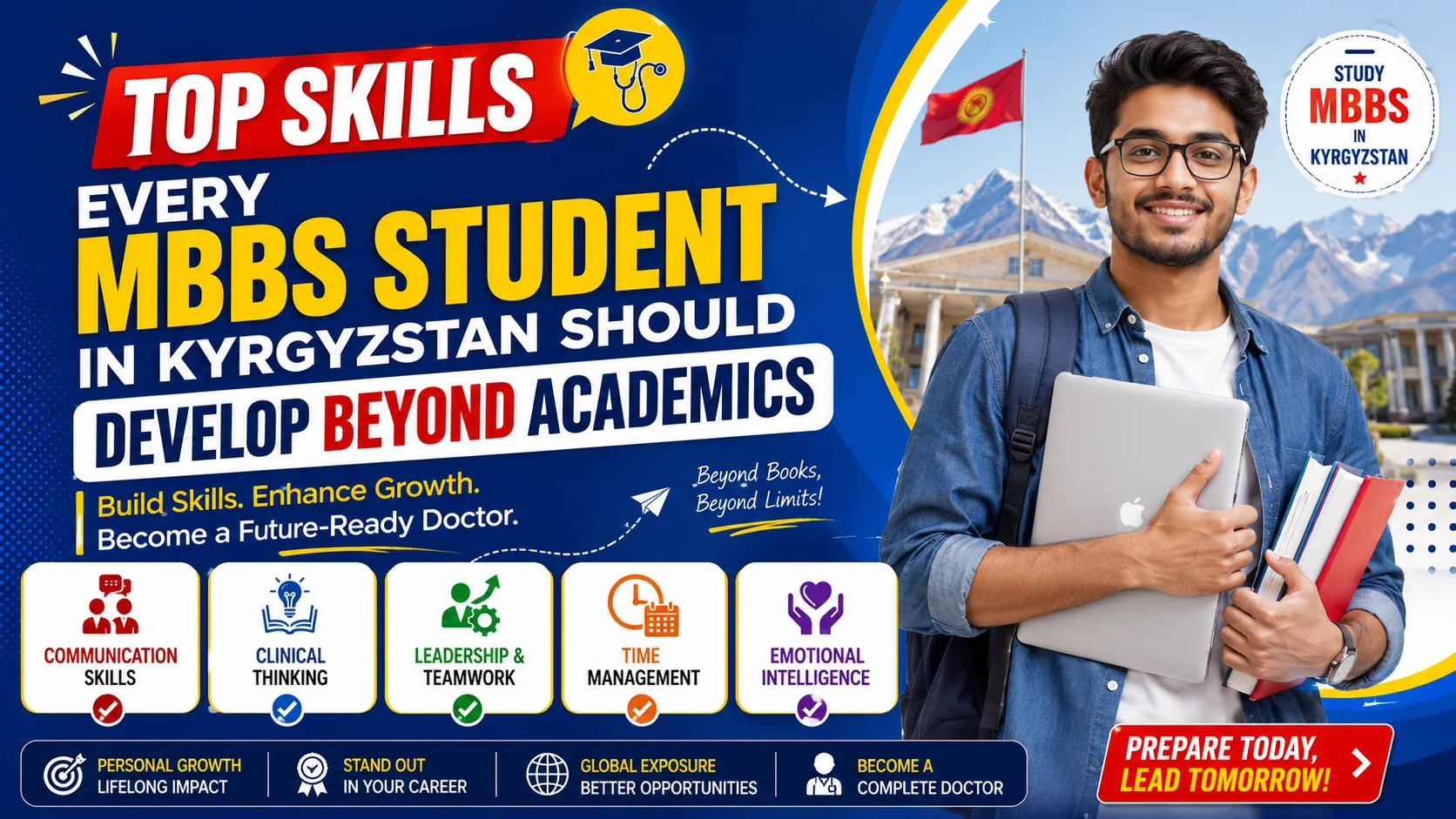
What should MBBS students in Kyrgyzstan focus on to develop beyond academics?
MBBS students in Kyrgyzstan should develop communication and language skills, clinical observation and bedside manner, time management, emotional resilience, digital and telemedicine skills, basic research and documentation skills, and cultural adaptability. These skills affect clinical practice, readiness for the FMGE/NExT, and a successful medical career.
Importance of Non Academic Skills for MBBS Students
Making a living is not the main goal of practicing medicine. Good doctors understand the art and science of the profession. As you commence with clinical postings and internships, you will have daily interactions with patients and various members of the medical team as well as other international students. mbbs in kyrgyzstan is a great option as the multicultural environment makes mastering communication skills, a new language, and a foreign health care system of paramount importance.
Essential Eligibility Requirements Recap Before You Start
Before diving into the skill-building that will determine your success as a physician, it is important to keep in mind medical school admissions criteria, as they lay the foundational steps of your medical career as follows:
Entering CriteriaRequirementQualifying Exam10+2 with Physics, Chemistry, Biology (PCB)Minimum Marks50% aggregate (45% for reserved categories)Entrance ExamValid NEET-UG scoreAge LimitMinimum 17 yearsMedium of InstructionEnglishCourse Duration5 to 6 years, including internship
Essential Skills for Every MBBS Student
1. Communication and Language skills
Due to the need to establish relationships and earn the trust of patients, communication skills are the most important of all medical skills and the most important to practicing good medicine. Although class instruction for kyrgyzstan mbbs is in English, hospital postings may benefit from the ability to say a few basic words in the local language, Russian or Kyrgyz, since most of the local patients, as well as a good number of the hospital staff, will be more comfortable and will appreciate your speaking to them in their native language.
2. Clinical Observation and Bedside Manner
The application of your medical knowledge to clinical medicine at the bedside will be dictated more by your powers of observation than by the knowledge itself. The development of good observation skills to note pertinent signs and symptoms, as well as the body language of the patient, will benefit you in the early stages of your clinical years and as a student in the years to come.
3. Time Management and Discipline
The kyrgyzstan mbbs course will prove to be an arduous undertaking. Establishing the habits of good time management and self-discipline throughout this course will yield great benefits and dividends for the balance of your career. This includes establishing a study schedule in advance and adhering strictly to the study schedule, employing spaced repetition for learning, and memorizing clinical subjects, such as anatomy and pharmacology. This will even diminish the tendency to cram and study at the last minute.
4. Emotional Resilience and Stress Management
The combination of homesickness and the burden of academic pressure is difficult enough to bear. Add the burden of caring for a patient and the pressure that accompanies it, and you have a recipe for disaster.
Building healthy coping skills such as workout routines, participating in support groups, and engaging in frank discussions with family members helps stave off the burnout that many medical students experience worldwide.
5. Fundamental Research and Documentation Skills
Knowing the fundamentals of research, such as the ability to read research papers, write case reports, and keep detailed patient notes, helps with the preparation of your exams and your future postgraduate studies. These skills will be increasingly relevant in the competency-based medical education frameworks that the National Medical Commission advocates.
6. Digital and Telemedicine Literacy
Today's medical practice is increasingly reliant on digital medicine, from electronic health records to remote consultations and AI-assisted diagnostics. Gaining even a basic understanding of digital health will be a considerable advantage in the early stages of your career.
7. Cultural Flexibility
While studying abroad, you will adjust to a different climate, food, customs and social behaviors. Students studying abroad in Kyrgyzstan will have a more fruitful and less stressful student life when they immerse themselves in the local culture.
8. Financial Management
Living on monthly budgets for food, living, and personal expenses helps you learn responsibility. Understanding Kyrgyzstan mbbs fees in Indian Rupees and budgeting for the semester in advance will reduce the financial strain on your family.
Overview of Admission Requirements
If you have yet to apply, the following is a brief outline of the admission requirements.
You must have a qualifying score on the NEET-UG exam.
Select a university listed with NMC and WDOMS.
Upload your documents to receive an invitation.
Obtain a student visa for Kyrgyzstan.
Travel and complete enrollment formalities
Benefits of Building These Skills Early
Easier adjustment during clinical postings and internships
Improved performance during FMGE/NExT preparation
Better patient relationship and diagnosis
Less anxiety and better performance
Greater chances of getting a job and opportunities for higher studies
Disadvantages of Not Developing Decent Soft Skills
Patients will be difficult to communicate with during clinical rotations
Great chance of burnout and poor academic performance
Inability to adjust well resulting in a high chance of dropout or transfer request
Inability to effectively present cases and document them during internships
Poor confidence during practical examinations on a medical subject
Leading Universities Promoting Holistic Development of Students
Some of the universities in Kyrgyzstan that offer good formal education and good systems of support to students are:
Osh State Medical University
Kyrgyz State Medical Academy
International School of Medicine (ISM)
Jalal-Abad State Medical University
Asian Medical Institute
Always check the current recognition status of each university in the WDOMS official directory before making a decision about your admission.
Future Career: Benefits of These Skills in the Long Run
After finishing your MBBS, you would have to pass the FMGE (which will soon become the NExT) in order to register with the NMC or a State Medical Council. Doctors who, during their MBBS, developed good communication skills, resilience and good documentation skills are likely to have a better chance of being able to:
Answer the FMGE/NExT clinical exams confidently
Adapt to internships and residency programs easily
Establish a good relationship with patients in Indian hospitals easily
Develop good habits that will help in pursuing higher studies in their area of speciality.
Skill Development at a Particular Stage of MBBS
Year of StudyFocus AreaSkill Recommended to BuildYear 1–2Foundation subjectsTime management and basic language skillsYear 3–4Begin clinical exposureEach stagePreparation for internshipEmotional resilience, digital skillsInternship yearReal patient careBedside manner, financial skills, flexibility
FAQs
Q1. Are soft skills important for MBBS students? Does academic performance play a bigger role?
Academic performance contributes to knowledge. However, communication skills, resilience, and being adaptive are vital for your clinical practice, your dealing with patients, and your career in the long run.
Q2. Do I have to learn Russian or Kyrgyz to study MBBS in Kyrgyzstan?
No, because the medium of instruction is English. However, learning basic Russian or Kyrgyz for daily communication will improve your clinical postings.
Q3. What are the best methods for managing stress during MBBS abroad?
It is important to keep an active lifestyle, have a study routine, keep in regular contact with your family, and spend time with a support network of fellow students.
Q4. Is it mandatory to qualify for the NEET-UG exam to study MBBS in Kyrgyzstan?
Q5. How does this skill set help while preparing for the FMGE or NExT exam?
These skills help with the documentation and observation aspects of the exam, as well as
Yes, qualifying for the NEET-UG is mandatory for all Indian students who wish to study MBBS in Kyrgyzstan or any other foreign country, as per the NMC regulations.
the clinical skills required while preparing for FMGE/NExT exam.
Q6. How important is financial planning during MBBS abroad?
If you know the fee structure and plan your expenses, financial stress will be reduced, and you will be able to focus on your clinical skills and college studies.
Conclusion
Becoming a good doctor involves a lot more than just passing exams.
A successful medical professional not only possesses excellent academic performance but also has strong communication skills, emotional resilience, digital literacy, and cultural adaptability. MBBS students in Kyrgyzstan will benefit greatly from developing these skills during their studies to provide a stronger foundation for their medical career in India and enhance their experience during the clinical years.