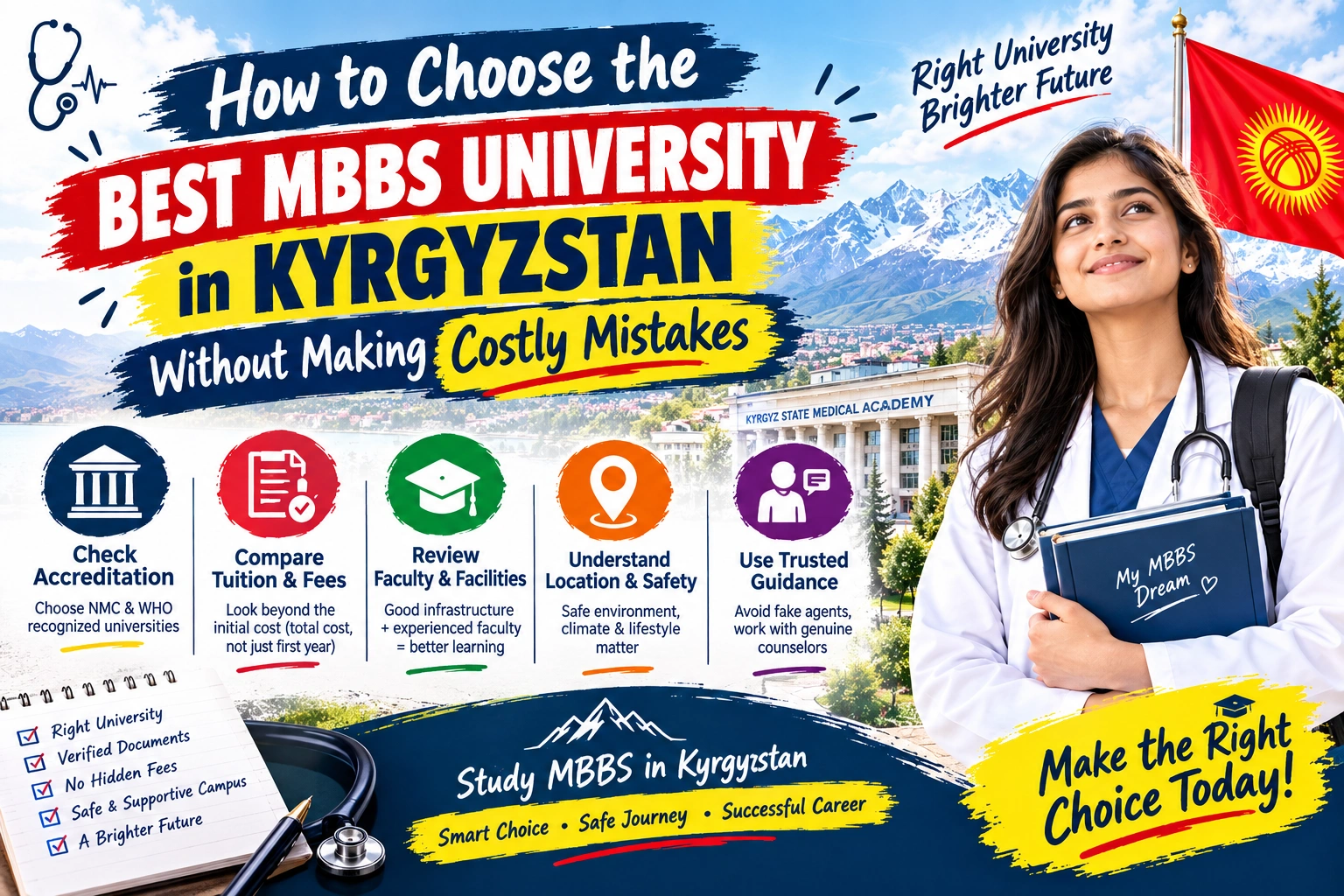

An early decision for any student interested in pursuing an MBBS in Kyrgyzstan concerns selecting between government or private medical universities. Government and private medical universities are recognized by international medical organizations and have produced many doctors. They do not, however, offer the same experience. Differences between types of universities can be seen in the campus culture, relationships that the university has with hospitals, and the speed with which universities modify their facilities to assist international students, among others.
In this article, we will examine the distinctions between government and private medical universities in Kyrgyzstan, the competitive advantages of each, and how to choose based on your personal priorities and not on their name recognition.
Featured Snippet: Quick Answer
What is the main difference between government and private medical universities in Kyrgyzstan? Kyrgyz State Medical Academy and Osh State University, both government medical universities, have established a long academic history and established relationships with public hospitals, resulting in lower fees. Private medical universities, like the International School of Medicine or the Bishkek International Medical Institute, may have newer facilities, smaller class sizes, and English-medium instruction from day one (and charge marginally higher fees). Both types of medical universities can be recognized by WDOMS and endorsed by India's National Medical Commission, hence, the recognition status should be verified on a case-by-case basis rather than assumed by ownership type.
Importance of Understanding the Difference
Your choice of mbbs kyrgyzstan for your studies is only the beginning of your decision-making process. Upon this choice, some government and private universities appeal to different sets of students. One has a lot of traditional legacy, while the other has modernization and flexible systems. Recognizing this allows you to avoid making a decision applying the same standard when making a comparison between two highly dissimilar institutions.
Eligibility Criteria: Both Government and Private Institutions are the Same
When it comes to eligibility criteria, the criteria are the same regardless of whether the institution is government or private.
Age: Must be a minimum of 17 years of age by 31 December of the year of admission.
Education: Must have completed 10+2 in the subjects of Physics, Chemistry, and Biology, with an aggregate of at least 50% (40% for reserved categories).
NEET: Must have a valid and qualifying score of the National Eligibility cum Entrance Test (NEET) in order to practice in India.
Medical fitness certificate: Must have a medical fitness certificate.
Since when it comes to eligibility there are no differences between government and private institutions regarding mbbs admission kyrgyzstan, you should look at the differences when making comparisons: the cost, infrastructure, and outcomes.
Government Medical Universities In Kyrgyzstan
Kyrgyzstan's Ministry of Education and Science funds government-run Kyrgyzstan medical universities, and due to this, they have the longest history of operation in the country. Those universities, for example, Kyrgyz State Medical Academy and Osh State University, are from the era of the Soviet Union and have decades of experience in teaching local and international students.
Strengths of Government Universities
An institutional record more extensive than private universities with a better-alumni network
A greater number of public hospital collaborations and therefore a greater breadth of clinical exposure
Average tuition is lower than many private medical institutes. Strong name recognition in India. Trade-offs of Government Medical Universities
Renovation cycles are longer at Government Medical Universities resulting in some having aged infrastructure.
Some have larger class sizes.
Some administrative processes are not as efficient as in smaller private medical universities.
Private Medical Universities in Kyrgyzstan
Private medical universities have been built since the early 2000s with a focus on international (especially Indian) students. Examples are: International School of Medicine, International Higher School of Medicine, Bishkek International Medical Institute.
Benefits of Private Medical Universities
Private medical universities have modern, purpose built infrastructure.
Private medical universities have more modern teaching support with the ability to have instruction in English.
Smaller class sizes result in better and more personalized education.
Private Medical Universities have better support for international students because they cater to their needs and construct their reputation based on their enrollment.
Trade-offs of Private Medical Universities
There is a shorter history of private medical universities and as such fewer alumni.
Private Medical Universities have less stable fees.
Government Medical Universities affiliations with hospitals may be older and private medical universities need to have good reputations with their teaching hospitals.
Similarities: Government vs Private
The processes of admission to university are quite similar with the Government Medical Universities having a slower admission process.
Step 1: Shortlist and Verify Recognition
You need to check if the school is listed in WDOMS regardless if it is a government school or private. The fact that it is private or government does not mean recognition is guaranteed.
Step 2: Submit Application
You will need to submit mark sheets, passport copy, photographs and the NEET admit card. This is pretty much the same across any Kyrgyzstan mbbs college, government or private.
Step 3: Receive Offer Letter
Government universities may take slightly longer because of a larger administrative workload, but offer letters are issued by Private universities in a timely manner.
Step 4: Visa Processing
The invitation letter is to be submitted and the duration of processing is usually the same for both types of universities, 2 – 4 weeks.
Step 5: Travel and Enrolment
Both types of universities that offer study mbbs abroad in kyrgyzstan will have classes starting in September and will require students to complete a scheduled orientation first.
Course Duration: No Real Difference
There is no difference in the course duration whether you go to a government university or a private one. The mbbs duration in kyrgyzstan is standardised in that all programs run for five years of academic study followed by a one year internship. This is not a meaningful consideration in the government versus private decision.
Fee Comparison: Government vs Private
Category | Government Universities | Private Universities |
Average Annual Tuition | ₹2.2 – 3.8 lakh | ₹3 – 4.5 lakh |
Hostel/Accommodation | ₹60,000 – 1 lakh | ₹70,000 – 1.2 lakh |
Overall Total (Full Course) | ₹18 – 28 lakh | ₹22 – 32 lakh |
Fee Revision Frequency | Generally stable | Can vary more often |
Across both categories, the Kyrgyzstan mbbs fees in Indian rupees remain well below most private Indian medical colleges. To get the exact mbbs in kyrgyzstan fees in indian rupees for your targeted university, ask for a written schedule, rather than relying on averages.
When comparing the mbbs in kyrgyzstan fee structure for Government and Private options, ask if the tuition is fixed for all five years. Also check the Kyrgyzstan medical college fees which cover hostel and insurance, as in some Private Universities, these are included differently than in Government Universities.
Benefits of Government Universities
Time-tested prestige: Decades of alumni and a well-known name among Indian families.
Comprehensive clinical exposure: Hospital collaborations spanning multiple decades.
Efficiency: The mbbs in Kyrgyzstan at government universities are most often the least expensive.
Tuition consistency: Less frequent upward revisions in contrast to several Private Universities.
Benefits of Private Universities
Better and newer design: Labs, classrooms, and simulators.
First-class International design: Curricula built specifically for International students.
Education: Smaller class sizes in several universities.
Comparable Value: The cost of MBBS in Kyrgyzstan remains significantly less than the private fees of Indian institutions, even if there is a slight increase in the price.
Things to Weigh on Both Sides
Government Universities: Less responsive and slower offices and large class sizes may serve as a disadvantage to students preferring responsive and small universities.
Private Universities: They tend to have a more volatile cost structure and a shorter operational history, rendering more limited data regarding the results of the graduates.
For Both: Recognition status can only be verified with WDOMS and the National Medical Commission and cannot be assumed based on the public or private nature of the university.
For Both: No university, either government or private, will permit automatic practice in India without passing the FMGE or NExT licensing exam.
Top Universities: A Government vs Private Comparison
University | Type | City | Established |
Kyrgyz State Medical Academy | Government | Bishkek | 1939 |
Osh State University, Medical Faculty | Government | Osh | 1939/1993 |
Jalal-Abad State University | Government | Jalalabad | 1993 |
Kyrgyz-Russian Slavic University | Government | Bishkek | 1993 |
International School of Medicine | Private | Bishkek | 2003 |
International Higher School of Medicine | Private | Bishkek | 2003 |
Asian Medical Institute | Private | Kant | 2003 |
Bishkek International Medical Institute | Private | Bishkek | 2019 |
Whatever Kyrgyzstan Medical college you prefer, ensure you obtain the most current data on hospital associations and recent licensing exam passage rates to assist you in making the most informed decision.
Career Scope: Does Ownership Type Affect Outcomes?
Generally, no. Career scope is more dependent on individual university quality and exam preparation rather than whether the institution is government or private.
Practice in India: Clear FMGE or NExT and register with the NMC or the respective State Medical Council. It does not matter which type of university you studied in.
Practice in Kyrgyzstan or other CIS countries: Needs more local licensing which is accessible for graduates of both categories.
Postgraduate studies: Qualifications from government or private universities which are WHO recognized and WDOMS listed qualify you to pursue your postgraduate studies in India and other countries.
International licensing: USMLE, PLAB and other exams remain available to both graduates, as long as the university is recognized.
Frequently Asked Questions
Would a government medical university always be better than a private one in Kyrgyzstan? No. Government universities usually have historical and public hospital associations; however, private universities may offer modern infrastructure and smaller classrooms.
Are private universities less recognized than government ones? Not necessarily. Recognition is based on WDOMS listing and NMC recognition, which many private universities have, just as government ones do — always verify individually.
What is the total MBBS fees in Kyrgyzstan for government universities? Government universities are usually at the lower end of the mbbs fees in kyrgyzstan, usually between ₹18 lakh and ₹28 lakh for the complete course.
Q4. Compared to public universities, do you think private universities provide a better English-language instruction? Many private universities were established as English-medium institutions and these have the advantage of being more experienced at providing English-Medium instruction. However, some public universities have improved their English-Medium offerings.
Q5. How much does studying MBBS in Kyrgyzstan's private universities cost? The cost for studying MBBS at private universities in Kyrgyzstan is between ₹22 to ₹32 lakh, depending on the university.
Q6. Do private and government universities have different FMGE/NExT pass rates? FMGE/NExT pass rates do not tend to vary much by university ownership (private vs government), but rather by the university and the students' level of preparedness. Hence, it is better to look at a university's recent results instead of relying on ownership type.
Q7. Which of the two has better clinical exposure? Government universities have the advantage of partnerships with public hospitals that have been in place for decades. This gives them an advantage for clinical exposure. However, some of the newer private universities have established good partnerships with hospitals. Both need to be evaluated on a case-by-case basis.
Conclusion
Both government and private medical universities in Kyrgyzstan have their pros and cons, so neither can be designated the 'better' option. For example, if you prefer established networks and long-standing institutions, you may prefer the government option of the Kyrgyz State Medical Academy. Alternatively, if you prefer modern facilities and a school built with the international student in mind, you may prefer the International School of Medicine. Whatever the case may be, consider the recognition status, ask for a clear fee schedule, and investigate the hospital links before finalizing the MBBS in Kyrgyzstan.