
How to Choose the Best Medical University in Kyrgyzstan After NEET?
Introduction
Choosing to study at a medical university in Kyrgyzstan is an important decision for Indian students looking to pursue medical education abroad. While the country may be attractive because of its educational opportunities and relatively affordable costs, there is much more research to do before selecting a university.
You should look into the legality and accreditation of the university, the medical course offered, the language of teaching, clinical training, internship arrangements and whether graduates can meet the requirements for medical registration in India.
Below, we have outlined how Indian students can compare medical universities in Kyrgyzstan and make a well-informed admission decision for the 2026–27 academic year.
1. Check the University's Legal Status and Accreditation
Firstly, you should check whether the university is legally authorised to operate and offer medical education in Kyrgyzstan.
It is important to note that there have been changes to the accreditation system for medical education in Kyrgyzstan. Just because a university is popular among Indian students does not mean it is currently legally accredited.
You should confirm:
Whether the university is legally established.
Whether it is authorised to teach a General Medicine programme.
Whether its current accreditation is valid.
Whether it can admit international medical students.
Whether it can legally award the medical qualification.
Whether its accreditation covers the specific course and duration you are joining.
Ask the university to provide its latest accreditation certificate and verify the information with the relevant authorities in Kyrgyzstan.
On 8 June 2026, the Embassy of India in Bishkek released advice about the state accreditation process and the status of medical institutions. Students should pay attention to the validity period of accreditation and ensure they select a university with the appropriate status.
As accreditation can change, always check the latest updates from the Embassy before making an admission decision.
Read the Embassy of India advice on studying medicine in Kyrgyzstan.
You can also explore MBBS in Kyrgyzstan for more information about medical universities and admission opportunities.
2. Understand the NMC Rules
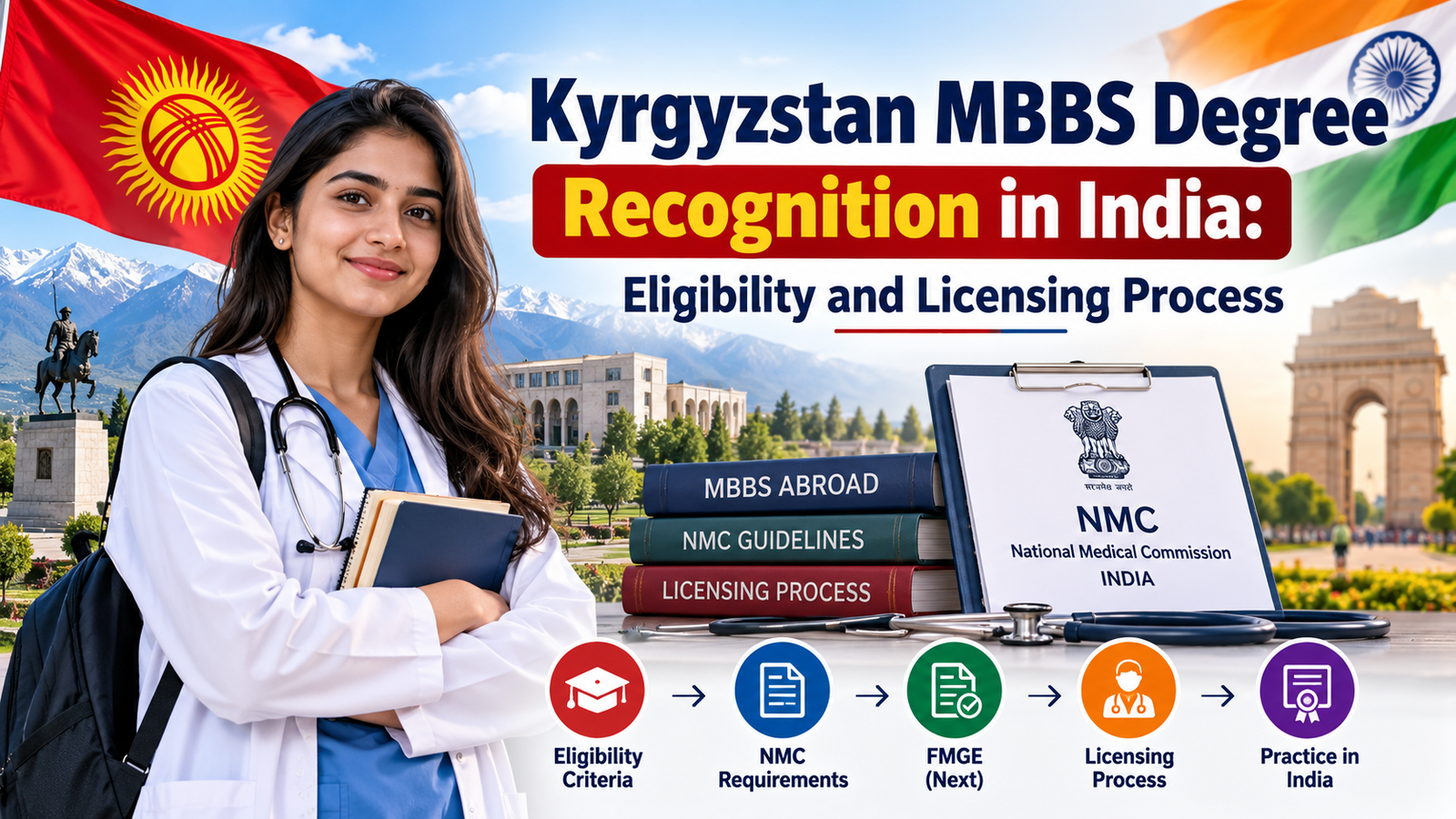
A key point for Indian students is that the complete medical course undertaken overseas should meet the relevant National Medical Commission (NMC) requirements.
The Foreign Medical Graduate Licentiate (FMGL) Regulations, 2021 outline the conditions foreign medical graduates must fulfil to become eligible for registration to practise medicine in India.
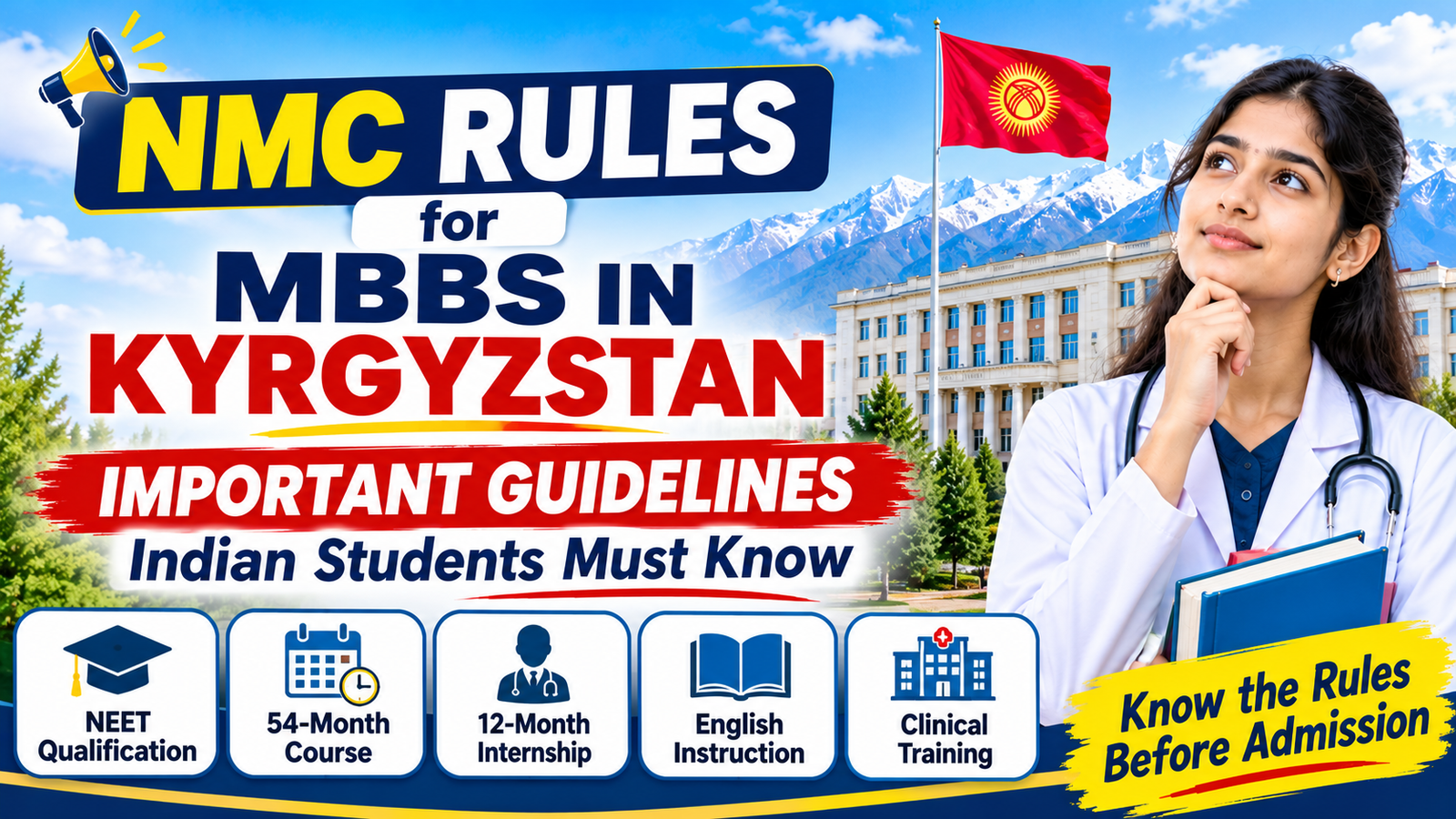
Important requirements include:
Minimum 54 months of medical education.
English as the medium of instruction.
Relevant theoretical, practical and clinical subjects.
A 12-month internship at the same foreign medical institution.
Clinical training and internship arrangements in line with the regulations.
Eligibility for registration or a licence to practise in the country where the degree is awarded.
Completion of the applicable licensing examination and supervised internship requirements in India.
Do not take an agent's statements at face value or assume that a university is NMC-approved simply because they claim it is.
The NMC does not officially approve a general list of foreign medical universities. You should independently examine the course and ensure it meets the applicable regulations.
Review the official NMC website and its published FMGL Regulations, 2021 before taking admission.
3. Check the Course Duration
One of the first things you should examine is the duration of the medical course.
As per the FMGL Regulations, the foreign medical education programme should include a minimum of 54 months of medical education, along with the required 12-month internship.
Some universities advertise a six-year General Medicine course. However, you should not take this information at face value. Ask for the official course structure and check:
How many months of academic study are included?
How many semesters or academic years are there?
How long is the theoretical education?
How much time is allocated to practical and laboratory sessions?
How long are the clinical rotations?
How long is the internship, and where will it take place?
What are the examination and graduation requirements?
Ensure that the course you are joining is the same programme outlined in the university's official documents.
Having a clear academic calendar will help you understand what you will study during each year.
4. Check Whether the Course Is Taught in English
A key factor for Indian students is the medium of instruction. The applicable NMC regulations require the foreign medical degree to be obtained through an English-medium programme.
Some universities advertise English-taught courses. However, you should confirm how teaching is actually conducted.
Check whether:
Medical lectures are taught in English.
Classroom lessons are conducted in English.
Theory subjects are taught in English.
Laboratory sessions are conducted in English.
Practical sessions are conducted in English.
Clinical teaching is provided in English.
Internal assessments and examinations are conducted in English.
Also ask whether the university has qualified English-speaking teaching staff in its key medical departments.
It is useful to know some basic Kyrgyz or Russian because you may need to communicate with patients and medical staff during clinical rotations. However, the medical course itself must meet the English-medium instruction requirement.
If possible, speak to current Indian students to understand how teaching is conducted in practice.
5. Compare the Medical Course and Curriculum
A medical degree requires a strong foundation in basic sciences, clinical subjects and practical training.
Ask the university for its complete medical course outline and check whether it covers the relevant subjects, including:
Anatomy
Physiology
Biochemistry
Pathology
Pharmacology
Microbiology
Forensic Medicine
Community Medicine
General Medicine
General Surgery
Obstetrics and Gynaecology
Paediatrics
Psychiatry
Orthopaedics
Ophthalmology
Otorhinolaryngology
Dermatology
Anaesthesia
Emergency Services and related subjects
Ensure that the programme has an appropriate balance between theoretical teaching, laboratory work and clinical training.
Ask how students are assessed, whether practical examinations are conducted and how academic progress is monitored.
Having a detailed course curriculum will help you understand whether the programme provides the academic foundation required for medical education.
6. Check the Teaching Hospitals and Clinical Facilities
Clinical training is an essential part of medical education. Students need opportunities to observe patients, understand medical conditions and learn how doctors make clinical decisions.
Before deciding on a university, find out which hospitals are used for clinical training.
Important questions include:
Does the university have its own teaching hospital?
Which hospitals are affiliated with the university?
Are the hospitals currently operational?
Which clinical departments are available?
When do students begin hospital training?
How frequently do students attend clinical rotations?
Are students supervised by qualified doctors and teaching staff?
Do students receive practical exposure in laboratories and clinical departments?
Do not rely only on photographs of hospitals displayed on the university website. Ask for specific information about clinical rotations and the actual training arrangements.
If possible, ask whether you can visit the hospital or speak to students who are currently attending clinical postings.
The quality of clinical facilities and teaching can have a significant impact on the medical education you receive.
7. Check the Internship Arrangements
Another important consideration is the internship.
Under the FMGL Regulations, students covered by these rules must complete the required 12-month internship at the same foreign medical institution where they obtain their primary medical qualification.
Before paying any fees, ask:
Is the complete 12-month internship included?
Where will the internship take place?
Is it arranged by the same foreign medical institution?
Which hospitals and clinical departments are involved?
Will the internship be supervised?
What official certificate will students receive after completion?
Ensure that you receive these details in writing.
You should also understand that completing an internship in Kyrgyzstan does not automatically remove the applicable supervised internship requirement in India. You may still need to qualify the required examination and complete the relevant supervised internship under Indian regulations.
Do not choose a university based on promises that you will not have to complete the licensing process in India because of your foreign internship.
8. Compare the Full Cost of Studying
While Kyrgyzstan may be considered an affordable option for Indian students, you should not automatically choose the university with the lowest tuition fees.
Ask each university for a complete breakdown of the fees for the entire medical programme.
Expense | What to check |
Tuition fees | How much per year? What is the total course cost? |
Hostel | What type of room is available? What facilities are included? How much per year? |
Food | Are meal plans available? How much will food cost separately? |
Registration | What are the admission and university registration charges? |
Medical insurance | How much does it cost annually? |
Visa and residence | What are the visa extension and residence-related charges? |
Books and equipment | How much will medical books and study materials cost? |
Other costs | Are there additional examination, laboratory or administrative fees? |
Travel | How much will flights and local transportation cost? |
Ask whether tuition fees can increase in later academic years. Confirm the currency in which fees are charged and understand the applicable exchange-rate arrangements.
The Embassy of India in Bishkek advises students to ensure that tuition fees, accommodation, food and other expenses are clearly mentioned year by year in the agreement.
Compare the estimated total cost of the complete course rather than looking only at the first-year admission fee.
9. Research the University's Reputation
You should research the university's academic background and reputation before making a final decision.
Look for information about:
How long the university has been operating.
Its medical education background.
Academic departments and teaching staff.
Research and academic activities.
Teaching hospital facilities.
Support for international students.
Feedback from current students.
Graduation and documentation procedures.
You can check whether the medical school is listed in the World Directory of Medical Schools (WDOMS).
However, a WDOMS listing does not automatically mean that the university or its programme complies with NMC regulations or that graduates will be eligible for medical registration in India.
You can also visit the World Health Organization (WHO) for general health information and international health resources.
Always use official regulatory sources to confirm the university's legal status and academic standing.
10. Speak to Current Indian Students
Speaking to students who are currently studying at a university can help you understand what everyday academic life is like.
Although an admission consultant may explain the course and facilities, it can be helpful to speak directly with current students.
Try to speak to students from different academic years and ask:
Are lectures regularly conducted in English?
Are teachers available to explain difficult subjects?
Are laboratory facilities accessible?
How are clinical rotations organised?
Are hospital postings conducted regularly?
Is the hostel suitable for Indian students?
Are there any additional costs?
Is academic support available?
Are there delays in examinations or documentation?
Do not rely on one positive or negative review. Compare different experiences and look for common issues.
If possible, speak to graduates who have completed the course. Ask about their experience with degree documentation, internship certificates and the medical registration process.
11. Check the Quality of the Hostel
Medical education is a long-term commitment, so it is important to have suitable accommodation and student support.
Indian students moving to Kyrgyzstan should understand the living conditions before selecting a university.
Check:
Does the university provide hostel accommodation?
How many students share each room?
Is heating available during winter?
Is hot water available?
Is there a kitchen?
Is internet access provided?
Are laundry facilities available?
How far is the hostel from the university?
Are the accommodation facilities secure and supervised?
Food is also an important factor. Check whether Indian food is available nearby and whether students can prepare their own meals.
Kyrgyzstan can experience very cold winters, so it is important to understand the heating facilities and the clothing you may need.
Having a comfortable living environment can help you focus on your medical education.
12. Verify the Education Consultant
Many students use education consultants to understand available university options and the admission process. However, you and your parents should independently check the consultant before paying any money.
The Embassy of India in Bishkek has highlighted concerns involving students being misled, university fees not being paid and contractual problems with educational consultants.
Before signing any agreement:
Ensure the consultant is officially registered in India.
Ask for its Corporate Identification Number (CIN), Tax Deduction and Collection Account Number (TAN) and Permanent Account Number (PAN), where applicable.
Check its office address and contact details.
Confirm the official admission process with the university.
Read the complete agreement.
Ensure that all fees are clearly itemised.
Understand the refund and cancellation policies.
Obtain official receipts for all payments.
Where possible, make payments through documented and traceable methods approved by the university.
The Embassy also advises students to travel to Kyrgyzstan on the correct student visa.
13. Check NEET Requirements
Qualifying for NEET is an important step for Indian students who want to study medicine abroad.
Indian citizens and OCI candidates wishing to study undergraduate medicine abroad must meet the relevant NEET requirements.
Before applying, check:
Are you NEET-qualified?
Are you eligible under the current admission rules?
What subjects and grades are required in Class 12?
Do you have a valid passport and identity documents?
Are your academic certificates and mark sheets ready?
What are the university-specific admission requirements?
What visa and medical documentation is required?
Keep your NEET scorecard and other admission documents safe throughout the application process.
You can find examination updates and official information on the NEET website.
Do not be misled into thinking you do not need to qualify NEET as an Indian student who wants to practise medicine in India after completing a foreign medical degree.
14. Make a Final University Comparison
After shortlisting two or three universities, compare them using the same selection criteria.
A simple comparison table can help you organise your research:
Criteria | University A | University B | University C |
Current accreditation | Check | Check | Check |
Course duration | Check | Check | Check |
English-medium teaching | Check | Check | Check |
Medical curriculum | Compare | Compare | Compare |
Clinical facilities | Compare | Compare | Compare |
Internship arrangements | Check | Check | Check |
Full course cost | Calculate | Calculate | Calculate |
Hostel facilities | Compare | Compare | Compare |
Student feedback | Research | Research | Research |
Written admission agreement | Obtain | Obtain | Obtain |
Do not finalise your admission until you have confirmed the important details using official documents.
A cheaper university may not offer the same academic facilities, clinical opportunities or student support as another institution.
Your decision should be based on verified information and your long-term medical career goals.
Conclusion
Choosing the best medical university in Kyrgyzstan after NEET requires careful planning and research. You should look beyond admission advertisements and check whether the university is legally authorised, currently accredited and offers a medical course that meets the applicable requirements.
For Indian students, compliance with the relevant NMC regulations is particularly important. Simply obtaining a foreign medical degree does not guarantee that you can practise in India. You must fulfil the applicable academic, internship, examination and registration requirements.
Before paying any fees, make sure you have the official course structure, current accreditation documents, complete fee agreement and internship details. Speak to current students, verify the education consultant and review the latest Embassy of India advice.
A well-researched decision can help you avoid unnecessary academic and financial difficulties and make your medical education journey more informed.
For more information about universities, admission procedures and medical education opportunities, visit MBBS in Kyrgyzstan. Always verify important regulatory information through official sources such as the NMC, WDOMS, WHO and NEET websites.