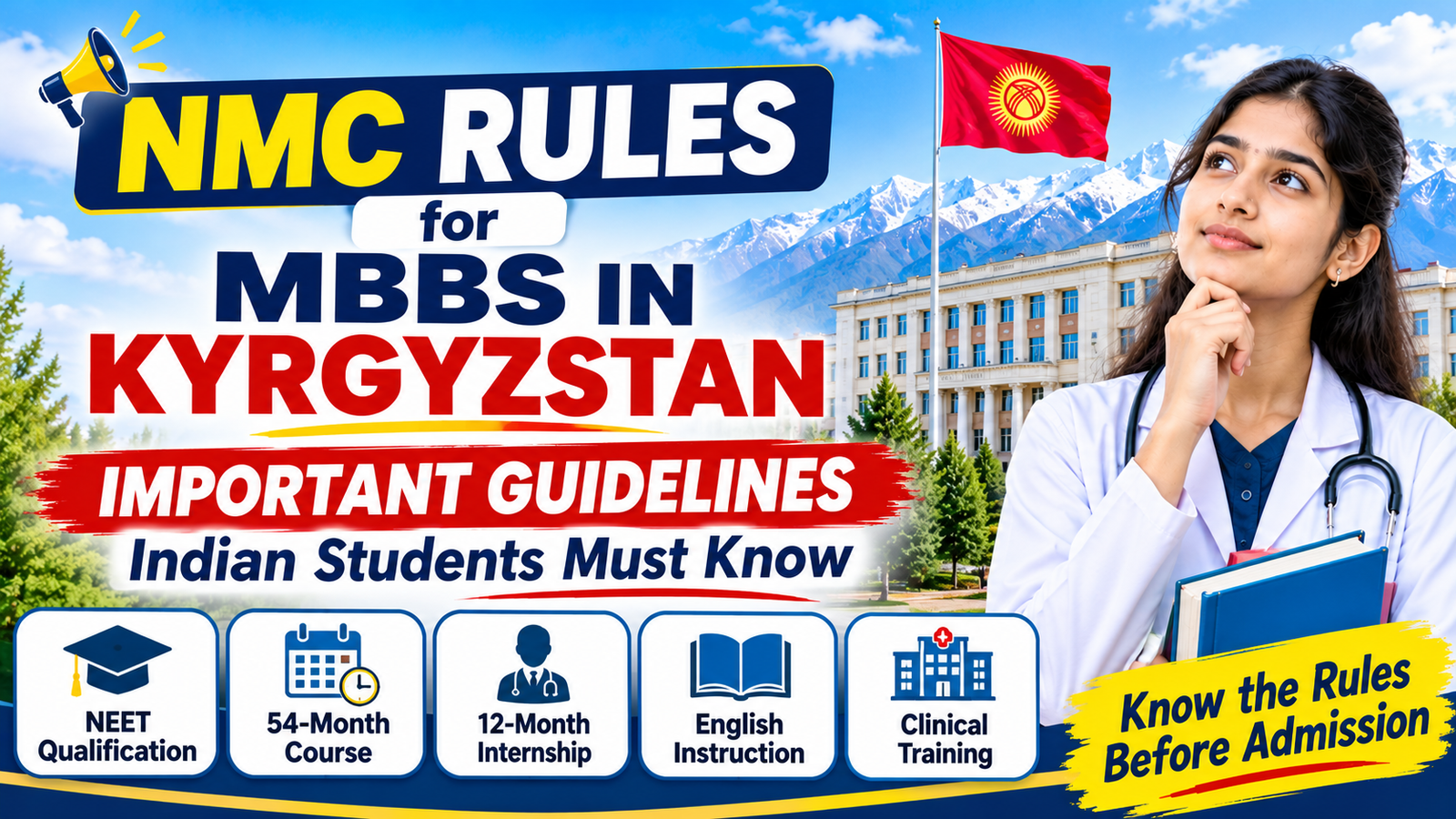
NMC Rules for MBBS in Kyrgyzstan: Important Guidelines Indian Students Must Know
1. Understanding NMC Rules for MBBS in Kyrgyzstan
It is vital for students who wish to enrol in a medical university in Kyrgyzstan to ensure that the university offers a valid medical course that meets the applicable requirements of the National Medical Commission (NMC).
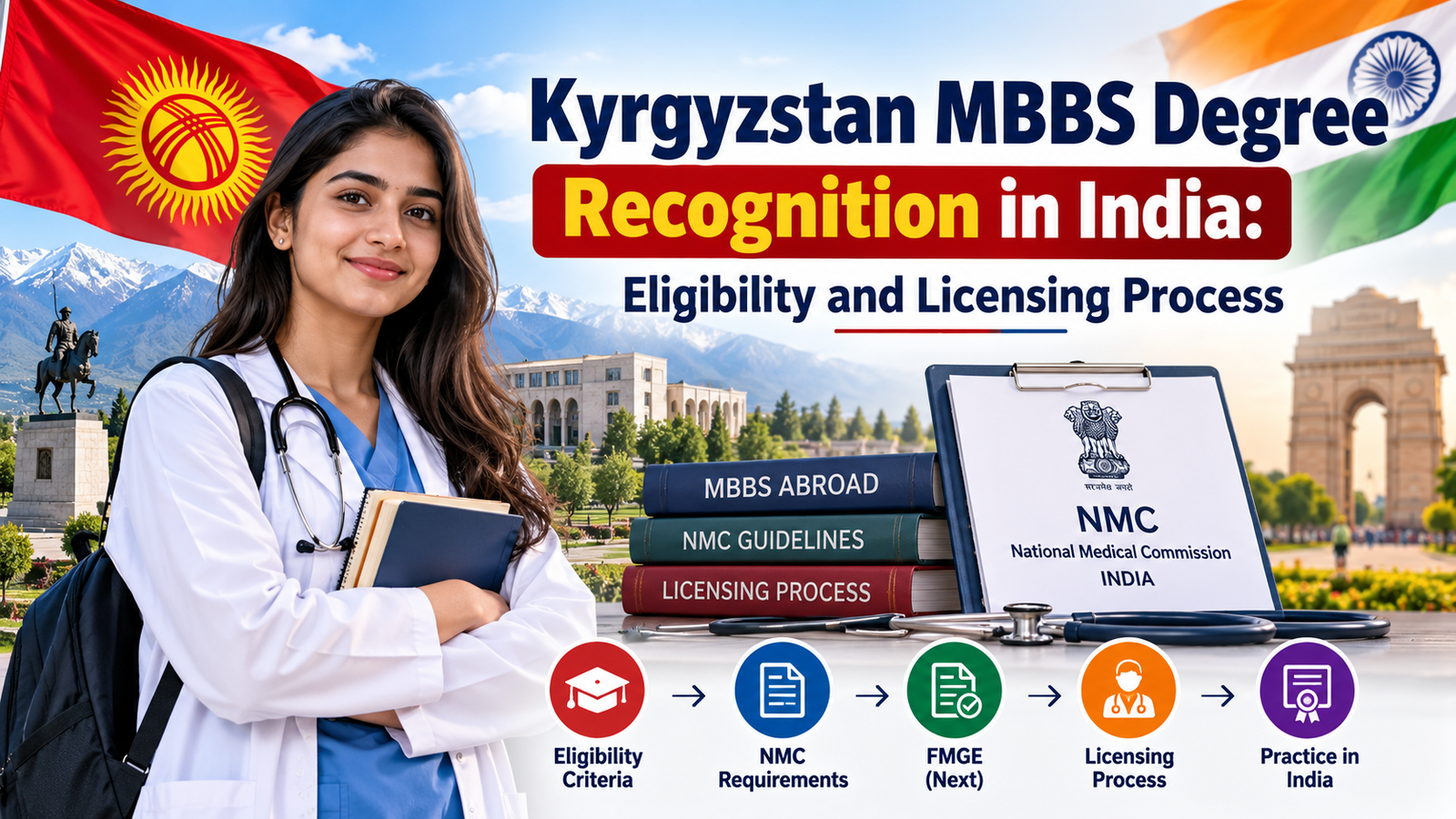
The Foreign Medical Graduate Licentiate (FMGL) Regulations, 2021, outline important conditions for Indian students who complete their medical education outside India and wish to practise medicine in India.
These regulations aim to ensure that foreign medical education meets the required academic and clinical standards. Important requirements include:
Minimum duration of medical education.
Language of instruction.
Subjects to be studied.
Practical and clinical training.
Internship requirements.
Registration or licence eligibility in the country where the degree is awarded.
Required examinations and supervised internship in India.
Students planning to study medicine in Kyrgyzstan should read the official NMC website and understand the applicable regulations before taking admission.
You can also explore MBBS in Kyrgyzstan to learn more about medical education opportunities, universities and admission-related information.
2. Minimum 54-Month Medical Course
One of the key points of the FMGL Regulations is the minimum duration of foreign medical education.
A student must undertake medical education for a minimum period of 54 months, in addition to the required internship.
Before enrolling in a medical university, ask for a copy of its official academic calendar and complete course breakdown. Make sure the programme provides the required duration of theoretical, practical and clinical training.
Do not rely only on advertisements describing a programme as a six-year MBBS or international medical degree. Check the actual academic duration, course structure and training arrangements.
If the course is shorter than the prescribed duration or does not meet the applicable requirements, you may face difficulties when applying for registration in India.
3. 12-Month Internship at the Same Foreign Institution
Another important requirement under the NMC guidelines is the internship.
A foreign medical graduate must complete a minimum of 12 months of internship at the same foreign medical institution where the primary medical qualification is obtained.
When considering medical universities in Kyrgyzstan, make sure you understand their internship arrangements.
Ask the university:
Is the internship for the complete 12-month period?
Will the internship take place at the same foreign medical institution?
Which hospitals and departments will be used for training?
Will students receive supervised practical experience?
Will the university provide official documents confirming internship completion?
Do not assume that an internship offered by a different hospital, university or country will automatically be acceptable.
Ensure that the internship is officially recorded, properly supervised and consistent with the applicable NMC requirements.
4. English Language as the Medium of Instruction
Many Indian students choose Kyrgyzstan because some universities offer medical programmes in English.
However, students must verify the actual medium of instruction before taking admission. The FMGL Regulations require the foreign medical degree to be obtained through a programme taught in English.
Confirm that:
Lectures are conducted in English.
Medical theory subjects are taught in English.
Practical sessions are conducted in English.
Clinical teaching is provided in English.
Assessments and examinations are conducted in English.
The overall medical programme follows the required English-medium instruction.
Although learning basic Kyrgyz or Russian can help students communicate with patients and medical staff during hospital rotations, this should not be confused with the requirement that the medical course itself must be taught in English.
5. Required Medical Subjects
The NMC requires foreign medical education to provide academic and clinical training that meets the applicable standards for medical graduates in India.
The FMGL Regulations specify the required subjects in Schedule I. Students should carefully review the complete curriculum before joining a university.
Important subjects include:
Anatomy
Physiology
Biochemistry
Pathology
Pharmacology
Microbiology
Forensic Medicine
Community Medicine
General Medicine
General Surgery
Obstetrics and Gynaecology
Paediatrics
Psychiatry
Orthopaedics
Ophthalmology
Otorhinolaryngology
Dermatology
Anaesthesia
Emergency and Casualty Services
Laboratory Services and Relevant Specialities
The university should provide a detailed syllabus showing the theoretical, practical and clinical training included in the programme.
You can ask for a copy of the official curriculum before paying admission fees. Keeping a copy of the syllabus for future reference is also a good idea.
Students can consult the World Health Organization (WHO) for general information about global health and medical education-related topics.
6. Clinical Training in Kyrgyzstan
Medical education should not be limited to classroom lectures and examinations. Students need practical experience to understand how diseases are diagnosed, treated and managed.
Make sure the medical course includes properly planned clinical training. Ask the university about its associated hospitals, clinical departments, laboratories and qualified teaching staff.
Important questions to ask include:
Which hospitals are affiliated with the university?
Which clinical departments will students use?
When does hospital training begin, and how long does it continue?
Will students receive supervised patient interaction?
What practical and laboratory facilities are available?
Will faculty members supervise students during clinical placements?
The FMGL Regulations also require the course, training and internship or clerkship to be completed outside India at the same foreign medical institution throughout the programme.
Do not split your medical training and internship between multiple countries.
Be cautious about arrangements that promise to complete part of your medical course in India or another country. Such arrangements could create serious problems when applying for registration in India.
7. Complete the Medical Course Within the Prescribed Timeframe
The FMGL Regulations state that the total time taken to complete the foreign medical graduation course must be within 10 years from the date of joining the course.
This is important for students who experience academic delays, examination failures, retakes or interruptions in their studies.
Before admission, understand the university's examination rules, attendance requirements and policies for repeating subjects.
Ask the university:
What happens if a student fails a subject?
Are supplementary examinations available?
What happens if a student has academic backlogs?
What happens if there is a break in studies?
How is the internship scheduled?
What happens if the final degree is delayed?
Keeping academic records organised throughout your studies can help prevent documentation problems in the future.
8. Eligibility to Practise Medicine in Kyrgyzstan
Another important requirement is that foreign medical graduates must meet the applicable professional registration or licence eligibility conditions in the country where the medical degree is awarded.
The qualification and registration must meet the requirements set out in the FMGL Regulations. This includes having the required level of eligibility to practise medicine, comparable to that provided to citizens of the country.
For Indian students, it is important to understand how professional recognition and licensing work in Kyrgyzstan.
Ask the university for written information about:
The legal status of the medical institution.
The authority responsible for regulating medical practice.
Whether graduates with this degree can obtain local professional registration.
Whether additional licensing requirements apply to Indian graduates.
Which documents will be provided after completing the programme.
Do not assume that receiving a degree from a university automatically makes you eligible for professional registration in Kyrgyzstan.
9. NEET Qualification for Indian Students
Indian students who wish to complete an MBBS or equivalent medical qualification abroad should understand the NEET requirements.
Qualifying NEET is compulsory for Indian citizens and Overseas Citizens of India (OCI) candidates seeking undergraduate medical education abroad under the applicable rules.
The NEET result serves as the eligibility qualification for this purpose, provided the candidate also fulfils the relevant admission requirements.
Before taking admission, make sure that:
You understand the current NEET eligibility requirements.
You have qualified the NEET examination.
Your NEET scorecard and admission documents are safely maintained.
Your admission year and medical course fall under the applicable regulations.
Never trust agents who claim that Indian students can ignore NEET and still obtain registration in India after completing a foreign medical degree.
For official examination information, visit the NEET website.
10. Further Internship in India
Students should understand that completing an internship in Kyrgyzstan does not automatically remove the requirement for a further supervised internship in India.
Under the FMGL Regulations, foreign medical graduates must complete a minimum of 12 months of supervised internship in India, subject to the applicable regulatory process.
The NMC issued a public notice on 21 September 2022 stating that foreign medical graduates required to complete an internship in India must do so at medical colleges or institutions approved to provide compulsory rotating medical internship. The allocation is handled by the concerned State Medical Council under the applicable process.
Therefore, students should plan for this additional internship requirement.
Keep the following documents safely:
Foreign internship completion certificate.
Clinical placement records.
Final medical degree.
Academic transcripts.
Other relevant university documents.
For updated information, refer to the National Medical Commission.
11. Pass the Required Screening or Licensing Examination
After completing their foreign medical qualification, Indian students must fulfil the applicable examination requirements before obtaining registration to practise medicine in India.
The NMC's current framework requires Indian and OCI candidates to qualify the Foreign Medical Graduate Examination (FMGE), administered by the National Board of Examinations in Medical Sciences (NBEMS), subject to the rules applicable to their qualification and admission year.
After qualifying the required examination, graduates must complete the applicable registration and internship process with the relevant State Medical Council.
The regulations also refer to the National Exit Test (NExT) or another examination mandated by the Commission. Students should therefore remain informed about the examination and licensing requirements in force when they graduate.
Passing the examination is important, but it does not remove the other requirements relating to course duration, English-medium education, curriculum, clinical training and internship.
12. Is Every Medical University in Kyrgyzstan Approved by the NMC?
This is one of the most common questions asked by students and parents.
The NMC has clarified that it does not approve a general list of foreign medical institutions or universities offering courses equivalent to MBBS in India. Students are advised to obtain information directly from the university about the course, fees, duration and internship arrangements.
Therefore, do not automatically assume that a university is NMC-approved simply because an admission agent or promotional website makes that claim.
Before taking admission, verify that:
The university is legally authorised to conduct the medical programme in Kyrgyzstan.
The course meets the applicable FMGL requirements.
The programme is taught in English.
The university provides the required academic and clinical training.
The internship arrangements meet the relevant requirements.
Graduates can fulfil the local professional registration requirements.
You can also check the World Directory of Medical Schools (WDOMS) to find information about a medical school.
However, a WDOMS listing does not automatically guarantee that the medical school or its programme complies with NMC requirements. Students must independently verify all applicable conditions.
13. Indian Embassy Advice for Kyrgyzstan
Apart from the NMC regulations, students should read the guidance provided by the Indian Embassy in Bishkek.
The Embassy's advice dated 23 April 2026 highlights important points to consider before selecting a medical university. These include:
University infrastructure and facilities.
Availability of English-speaking teaching staff.
Written fee agreements.
Credibility of educational consultants.
Appropriate student visa arrangements.
Proper research into the university and its admission process.
Students should thoroughly examine the university and admission arrangements before making financial commitments.
Reading official guidance from the Embassy, along with information from the WHO, WDOMS and NMC, can help students make more informed decisions.
14. Important Documents to Keep
Keeping academic and admission documents organised throughout your course can make the future registration process easier.
Students should preserve the following documents:
NEET scorecard.
University admission letter.
Signed admission agreement and fee agreement.
Passport and visa documents.
University registration documents.
Official course curriculum.
Academic transcripts and mark sheets.
Attendance and clinical placement records.
Internship completion certificate.
Final medical degree.
Evidence of local professional registration or eligibility, as applicable.
Keep copies of fee receipts and official correspondence from the university. These documents may be useful if questions arise about your course structure, academic history or clinical training.
Conclusion
Studying MBBS in Kyrgyzstan can be an option for Indian students who wish to complete their medical education abroad. However, it is important to research the university carefully before taking admission.
The most important consideration should not simply be tuition fees or how popular a university is among international students. Students must check whether the complete medical programme meets the applicable NMC requirements.
Make sure you understand the minimum 54-month medical course, the additional 12-month internship at the same foreign institution, English as the medium of instruction, required medical subjects, clinical training and local professional registration requirements. You should also understand the further supervised internship and licensing examination requirements in India.
The NMC does not guarantee registration simply because a student graduates from a university in Kyrgyzstan. It is the student's responsibility to verify that the course meets the applicable requirements.
Reading official documents, contacting the university directly and reviewing Indian Embassy guidance can help you make a more informed decision.
For more information about universities, admission procedures and medical education opportunities, visit MBBS in Kyrgyzstan and always verify important regulatory details through the NMC and other official sources.