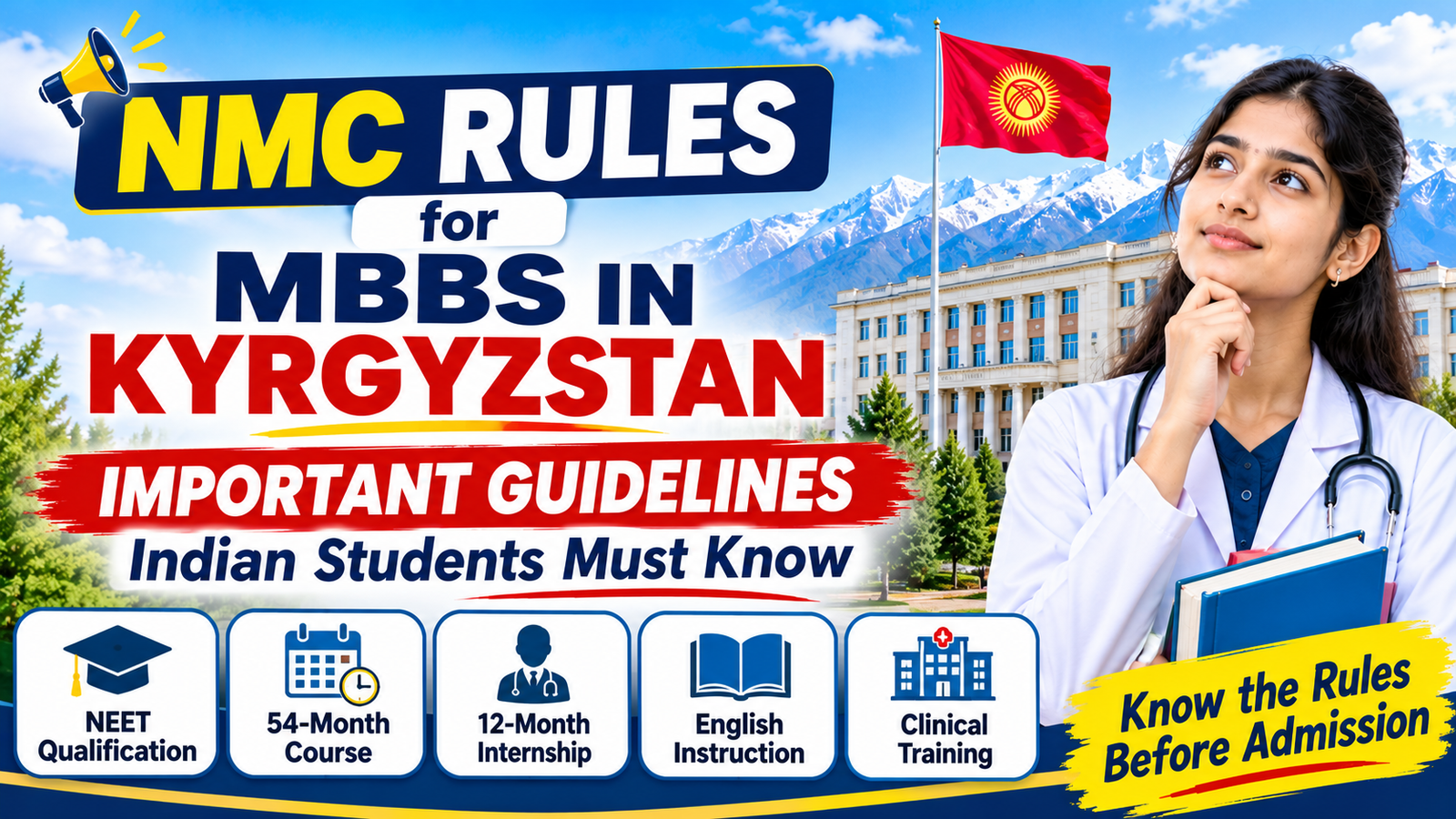
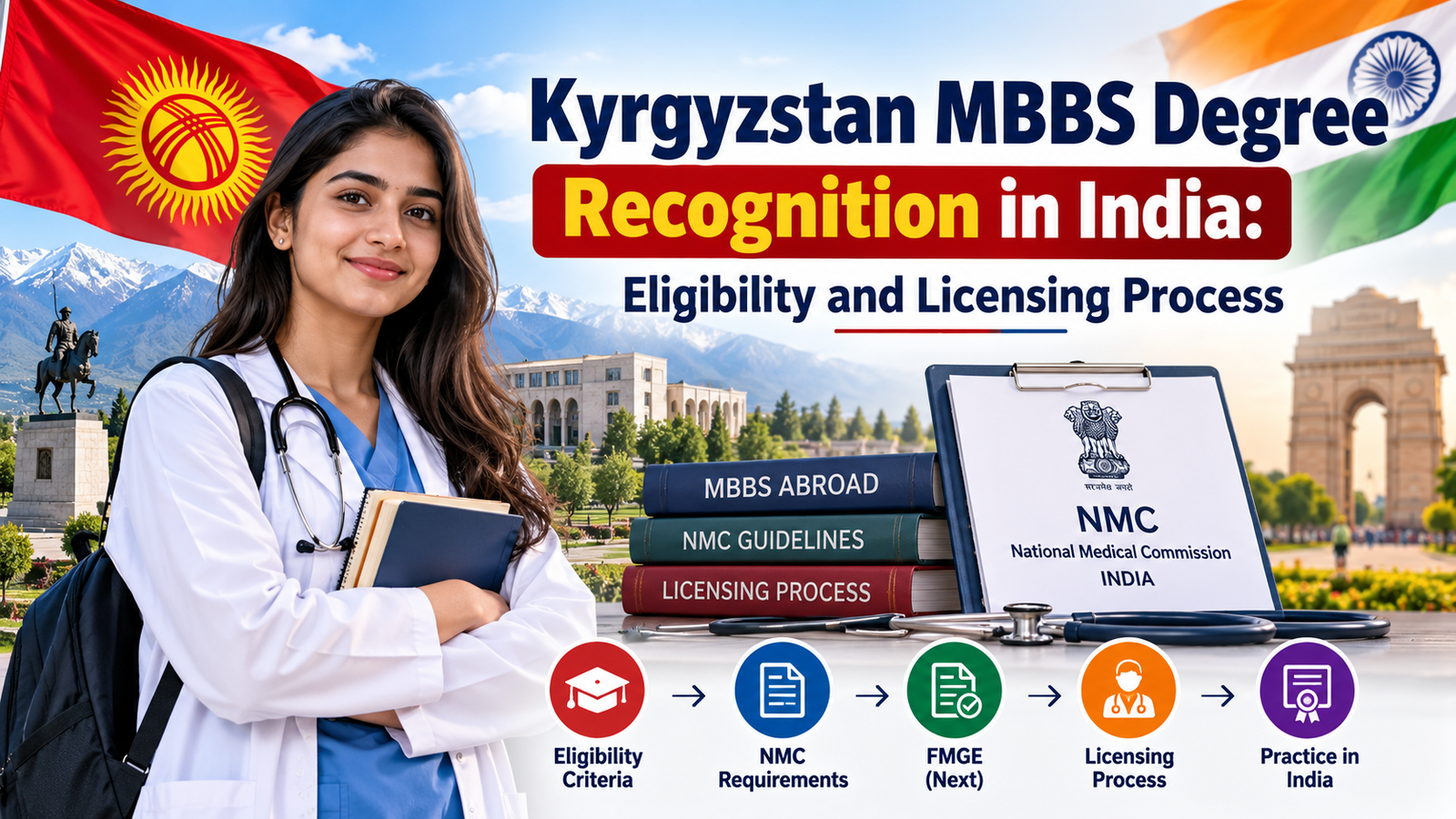
MBBS in Kyrgyzstan is now an option for many Indian students seeking international medical education. Some reasons students consider studying MBBS in Kyrgyzstan include affordable tuition fees, a global learning environment and English-medium medical courses offered by selected universities.
However, completing an MBBS degree from a foreign university will not automatically make a student eligible to practise in India. Those wanting to return to India after completing their medical education should understand the requirements for getting their degree recognised. These include eligibility criteria, licensing examinations and registration procedures established by the National Medical Commission (NMC).
Requirements for Getting an MBBS Degree from Kyrgyzstan Recognised in India
There are several requirements for obtaining medical registration in India after completing MBBS in Kyrgyzstan. These include:
University accreditation and legal recognition.
Medical course duration.
English as the medium of instruction.
Required clinical training.
Internship completion.
Eligibility for medical registration in the country awarding the qualification.
Compliance with Indian licensing and registration requirements.
Indian students should be aware of the Foreign Medical Graduate Licentiate (FMGL) Regulations, 2021. These regulations establish key requirements for Indian citizens and eligible candidates wishing to obtain primary medical qualifications outside India.
This guide explains how students can pursue medical registration in India after completing MBBS in Kyrgyzstan, what to check before applying, how the licensing process works and which documents may be required.
1. Is My MBBS Degree from Kyrgyzstan Recognised in India?
An MBBS-equivalent medical qualification from Kyrgyzstan may make a graduate eligible to begin the medical registration process in India, provided the graduate and qualification satisfy all applicable NMC requirements.
However, students should understand the difference between obtaining a foreign medical degree and becoming eligible for medical registration in India.
Just because a university offers a General Medicine course does not mean that every graduate will automatically be eligible to practise in India.
Students should ensure:
The university awarding the qualification is legally recognised.
The course meets applicable NMC requirements.
The course duration satisfies the prescribed requirements.
The entire programme meets the English-medium requirement.
Clinical training and internship requirements are fulfilled.
The graduate meets Indian licensing examination and registration requirements.
The National Medical Commission is the primary authority responsible for regulating medical education and registration requirements in India.
Students can visit the National Medical Commission (NMC) for official information and regulatory updates.
2. NMC Requirements for Indian Students Studying MBBS in Kyrgyzstan
The Foreign Medical Graduate Licentiate (FMGL) Regulations, 2021 are important for Indian students planning to obtain medical qualifications abroad.
Students should understand the following requirements before selecting a university.
2.1 Minimum Course Duration
The foreign medical programme must meet the prescribed minimum duration of 54 months of academic medical education.
Students should carefully examine the university's official curriculum, academic calendar and course structure.
Even if a university advertises a five-year course, students should verify that the actual academic programme satisfies the applicable requirements.
2.2 English as the Medium of Instruction
The entire medical programme must satisfy the English-medium requirement under the applicable regulations.
Students should ensure that:
Classroom teaching is conducted in English.
Medical subjects are taught in English.
University examinations are conducted in English.
Academic assessments are in English.
Clinical training and education satisfy the applicable requirements.
It can still be beneficial to learn basic Russian or Kyrgyz because patients in local hospitals may communicate in these languages.
2.3 Required Medical Subjects
The medical programme must cover the prescribed medical subjects and clinical training requirements.
Students should ensure their university offers:
Anatomy.
Physiology.
Biochemistry.
Pathology.
Microbiology.
Pharmacology.
Forensic Medicine.
Community Medicine.
General Medicine.
General Surgery.
Obstetrics and Gynaecology.
Paediatrics.
Other required clinical and medical subjects.
2.4 Internship Requirements
An internship is an essential part of medical education and affects eligibility for medical registration.
Students must complete the prescribed supervised internship requirements, including the applicable 12-month internship in India.
They should also ensure that they meet the requirements concerning internship and clinical training in the country awarding their foreign medical qualification.
Students should obtain written confirmation of the complete internship structure and maintain official internship completion records.
2.5 Eligibility to Register in the Foreign Country
Another important requirement is ensuring that graduates are eligible for registration as medical practitioners in the country where they obtained their medical qualification, in accordance with applicable Indian regulations.
Students should understand and fulfil the relevant licensing and registration requirements in Kyrgyzstan.
3. NEET Requirements: Is NEET Required for MBBS in Kyrgyzstan?
Yes. Indian citizens and Overseas Citizens of India (OCI) intending to obtain an undergraduate medical qualification abroad must qualify NEET-UG under the applicable eligibility requirements.
NEET is an important requirement for students planning to return to India after completing their medical education.
Why Is NEET Important?
Meeting the NEET requirements helps establish eligibility to pursue medical education abroad under Indian regulations. It is also important for foreign medical graduates seeking medical registration in India.
Students should remember:
Qualifying NEET does not guarantee admission to a university in Kyrgyzstan.
Qualifying NEET does not automatically guarantee recognition of a foreign medical degree.
Students must satisfy the applicable academic eligibility requirements.
NEET results have a prescribed validity period for foreign medical education purposes.
For the 2026–27 admission session, students should check the latest examination information and eligibility requirements through the official NEET website.
4. How Does the Medical Licensing Process Work in India After Completing MBBS in Kyrgyzstan?
After completing medical education in Kyrgyzstan, Indian students must fulfil the applicable licensing and registration requirements before practising medicine in India.
The process involves several important stages.
4.1 Complete the Foreign Medical Degree
Students must successfully complete their General Medicine programme.
Before graduation, they should ensure that they have:
Completed the prescribed course duration.
Passed all university examinations.
Studied the required medical subjects.
Completed the required practical and clinical training.
Fulfilled the applicable internship requirements.
Students should maintain copies of academic transcripts, clinical training records and internship certificates.
4.2 Receive the Medical Degree and Supporting Documents
After successfully completing the programme, students should collect their final degree and other necessary documents from the university.
These may include:
Final medical degree certificate.
Academic transcripts.
Course completion certificate.
Internship completion certificate.
Clinical rotation records.
University registration documents.
Passport and visa records.
Apostille Requirements: Degrees and certificates awarded by universities in Kyrgyzstan must be apostilled by the Ministry of Education of the Kyrgyz Republic before submission to Indian authorities for registration purposes, as advised by the Indian Embassy in Bishkek. Students should confirm the latest document authentication procedure before applying.
4.3 Qualify the FMGE Screening Test
The Foreign Medical Graduate Examination (FMGE) is the screening examination for eligible Indian and OCI foreign medical graduates seeking registration in India under the currently applicable process.
It is administered by the National Board of Examinations in Medical Sciences (NBEMS).
The FMGE assesses the medical knowledge of candidates who have obtained their primary medical qualifications outside India.
Students should prepare thoroughly for subjects such as:
Anatomy.
Physiology.
Biochemistry.
Pathology.
Pharmacology.
Microbiology.
Forensic Medicine.
Community Medicine.
Medicine.
Surgery.
Paediatrics.
Obstetrics and Gynaecology.
Other prescribed clinical subjects.
Candidates must satisfy the examination eligibility conditions and pass the examination.
Official examination information is available through the NBEMS FMGE portal.
4.4 Apply for Provisional Registration and Complete the Required Internship
After qualifying FMGE, eligible candidates must approach the relevant State Medical Council for provisional registration and completion of the Compulsory Rotating Medical Internship (CRMI), as applicable.
The FMGL framework specifies a minimum 12-month supervised internship in India after applying to the Commission.
It is important to understand that the foreign internship requirement is different from the supervised internship in India. Under the applicable FMGL requirements, students must also complete the prescribed internship in the same foreign medical institution.
4.5 Apply for Permanent Medical Registration
After fulfilling the applicable examination and internship requirements, graduates can apply to the concerned State Medical Council for permanent registration.
The registration authority will review their qualifications and supporting documents.
Once permanent registration is granted, graduates can practise medicine in India in accordance with applicable medical regulations.
5. What Documents Are Required for Medical Registration in India?
Indian students returning from Kyrgyzstan should maintain all their academic and personal documents throughout their medical education.
The following documents may be required during the examination and registration process.
Document | Purpose |
NEET scorecard | Proof of NEET qualification |
Class 10 certificate | Date of birth and academic history |
Class 12 marksheet | Proof of educational eligibility |
Passport | Identity and travel history |
Student visa | Evidence of overseas study |
Admission letter | University admission details |
Medical degree | Proof of medical qualification |
Academic transcripts | Details of subjects and examinations |
Internship certificate | Proof of internship completion |
Clinical training records | Evidence of practical training |
Apostilled documents | Authentication of foreign certificates |
FMGE pass certificate | Proof of screening examination qualification |
Provisional registration | Required for applicable internship procedures |
Exact documentation requirements may vary depending on the examination and State Medical Council instructions.
6. Is FMGE Required for Indian Students Completing MBBS in Kyrgyzstan?
Yes. Under the currently applicable foreign medical graduate registration process, eligible Indian and OCI graduates must pass FMGE before proceeding with the applicable registration and internship requirements.
The NMC's foreign qualification guidance identifies FMGE as the screening examination for foreign undergraduate medical graduates.
Difference Between NEET-UG and FMGE
NEET-UG | FMGE |
Pre-admission eligibility examination | Post-graduation screening examination |
Conducted by NTA | Conducted by NBEMS |
Required for applicable foreign medical admission eligibility | Required under the current foreign graduate registration process |
Taken before starting medical education | Taken after obtaining the foreign medical qualification |
The National Exit Test (NExT) is also part of India's evolving medical licensing framework. Students should follow official NMC notifications regarding future changes instead of assuming that any proposed examination has already replaced FMGE.
7. Will My Kyrgyzstan Medical Degree Be Recognised in India If It Is Listed on WDOMS?
No. This is one of the most important points Indian students should understand before applying.
The World Directory of Medical Schools (WDOMS) provides information about medical schools around the world. It helps students verify institutional information, but a listing does not automatically mean that a university is recognised or approved by NMC.
Students should understand the difference between:
WDOMS Listing
Provides information about medical schools and their institutional details.
Accreditation in Kyrgyzstan
Establishes whether an institution satisfies the applicable accreditation requirements in Kyrgyzstan.
NMC Compliance
Determines whether the foreign medical qualification and training satisfy the applicable Indian regulations.
Licensing in India
Requires graduates to complete the prescribed examination, internship and medical registration requirements.
Students can verify medical school information through the World Directory of Medical Schools.
The World Health Organization (WHO) is an important international health organisation, but it does not individually approve foreign medical colleges for medical registration in India.
8. How to Choose an NMC-Compliant Medical University in Kyrgyzstan
Choosing the correct medical university is essential for Indian students planning to return to India after graduation.
Before applying, students should research the following factors.
8.1 Check Current University Accreditation
Ensure that the university has the required accreditation under Kyrgyzstan's applicable regulations.
The Indian Embassy in Bishkek has issued advisories regarding changes in medical university accreditation. Students should always consult the latest advisory before admission.
8.2 Verify the Complete Course Duration
Ask the university for an official academic calendar showing the entire course duration, including academic teaching, practical training and clinical rotations.
8.3 Understand the Internship Structure
Request written confirmation about:
Foreign internship duration.
Internship at the same awarding institution.
Hospital affiliations.
Clinical departments.
Internship completion documentation.
8.4 Confirm English-Medium Education
Ensure that the entire medical programme satisfies the applicable English-medium requirements.
8.5 Verify the Degree-Awarding Institution
Sometimes the university name and campus name may be different. Students should confirm which institution will award their final medical qualification.
8.6 Avoid Unverified Admission Claims
Do not believe claims such as:
Guaranteed NMC recognition.
Guaranteed FMGE clearance.
Automatic medical registration.
Guaranteed eligibility to practise in India.
A genuine admission guidance service should explain the applicable requirements transparently.
Students can explore MBBS in Kyrgyzstan to learn more about medical universities, eligibility, course structures and medical education opportunities.
9. Common Mistakes to Avoid
Some students experience difficulties during the medical registration process because they fail to verify important details before admission.
Here are common mistakes to avoid:
Not Qualifying NEET: Students may overlook the requirement to qualify NEET before pursuing foreign medical education.
Choosing an Unverified University: Only consider institutions after checking their legal status and applicable accreditation.
Ignoring Internship Requirements: Understand both foreign and Indian internship requirements.
Not Checking Course Duration: The medical programme must meet the prescribed minimum duration.
Relying Only on WDOMS: A directory listing does not automatically establish eligibility for medical registration in India.
Losing Academic Documents: Maintain transcripts, attendance records and clinical training certificates.
Ignoring Apostille Requirements: Foreign degrees and certificates may need authentication.
Assuming FMGE Is Not Required: Eligible foreign medical graduates must satisfy the applicable screening examination requirements.
10. Frequently Asked Questions (FAQs)
Q1. Is an MBBS Degree from Kyrgyzstan Valid in India?
A medical qualification from Kyrgyzstan may be used to pursue medical registration in India if the university, course structure, duration, internship and other requirements satisfy applicable NMC regulations. Graduation alone does not guarantee eligibility for registration.
Q2. Is FMGE Required After Completing MBBS in Kyrgyzstan?
Yes. Under the currently applicable process, eligible Indian and OCI foreign medical graduates must pass FMGE before proceeding with the required registration and internship procedures.
Q3. Is NEET Required for MBBS in Kyrgyzstan?
Yes. Indian citizens and OCI candidates intending to obtain an undergraduate medical qualification abroad must qualify NEET-UG under the applicable regulations.
Q4. How Long Is the MBBS Course in Kyrgyzstan for Indian Students?
The FMGL Regulations prescribe a minimum of 54 months of medical education and a minimum 12-month internship in the same foreign medical institution. Students must also fulfil the applicable supervised internship requirements in India.
Q5. Can I Practise Immediately After Completing MBBS in Kyrgyzstan?
No. Students cannot automatically practise after obtaining their foreign medical degree. They must complete the applicable licensing examination, internship and registration requirements.
Q6. Does WDOMS Listing Guarantee NMC Recognition?
No. WDOMS listing provides information about medical schools but does not automatically establish NMC recognition or eligibility for medical registration in India.
Q7. Is an Internship in Kyrgyzstan Enough to Practise in India?
No. Students must satisfy the prescribed foreign internship requirements as well as the applicable supervised internship requirement in India.
Q8. Which Authority Conducts FMGE?
The National Board of Examinations in Medical Sciences (NBEMS) conducts FMGE for eligible foreign medical graduates.
Conclusion
A medical degree from Kyrgyzstan can provide Indian students with an opportunity to pursue medical education abroad. However, students planning to practise in India must understand the recognition and licensing requirements before choosing a university. The FMGL Regulations, 2021 establish important conditions concerning course duration, English-medium instruction, medical subjects, foreign internship and supervised internship in India. Students must also qualify NEET before admission and follow the applicable FMGE and medical registration process after graduation. Before taking admission for the 2026–27 academic session, students should verify the university's current accreditation, degree-awarding authority, academic programme and internship arrangements. The most important advice for Indian students is to check NMC compliance before paying university fees rather than waiting until graduation to discover problems with medical registration eligibility.