
Introduction
Choosing a suitable medical university is one of the most critical decisions in every medical student’s academic career, and this holds especially true for Indian medical students planning to pursue an MBBS degree in Kyrgyzstan. Competition for domestic medical seats in India has remained extremely high year after year, while tuition fees at private Indian medical colleges far outstrip the financial capacity of ordinary families. Studying medicine abroad has long become a mainstream choice for a growing number of Indian students, and Kyrgyzstan’s MBBS programs have emerged as a popular option in recent years: these programs charge low tuition, the qualifications of Kyrgyzstan’s core medical universities are recognized by all major global medical education systems, and dedicated English-taught tracks are specially offered to international students.
The scale of international students attracted to these programs expands year on year, with thousands of Indian students submitting admission applications annually, hoping to access high-quality medical education at a reasonable cost. Yet many applicants fall into the same core pitfall when selecting a school: they treat tuition level as the sole standard for choosing a university, ignoring core factors that directly determine academic success, such as teaching quality, institutional accreditation status, clinical practice opportunities, campus infrastructure, faculty qualifications, and future career development prospects.
A medical degree is a long-term investment that requires massive input of time, energy, and money, so applicants must make informed and rational choices. This guide is launched specifically to help these applicants screen for suitable Kyrgyzstani medical universities and avoid common mistakes in the application process.
Why MBBS Programs in Kyrgyzstan Are Popular Among Indian Students
Over the past decade, MBBS programs in Kyrgyzstan have become one of the top choices for Indian medical students pursuing overseas study. Beyond cost advantages, their English-language instruction, modern teaching methods, and sufficient clinical training opportunities allow these programs to balance educational costs and training quality.
However, not all medical universities in Kyrgyzstan share the same level of academic standing, so a comprehensive qualification assessment must be completed before selecting a school.
University Accreditation and Recognition Requirements
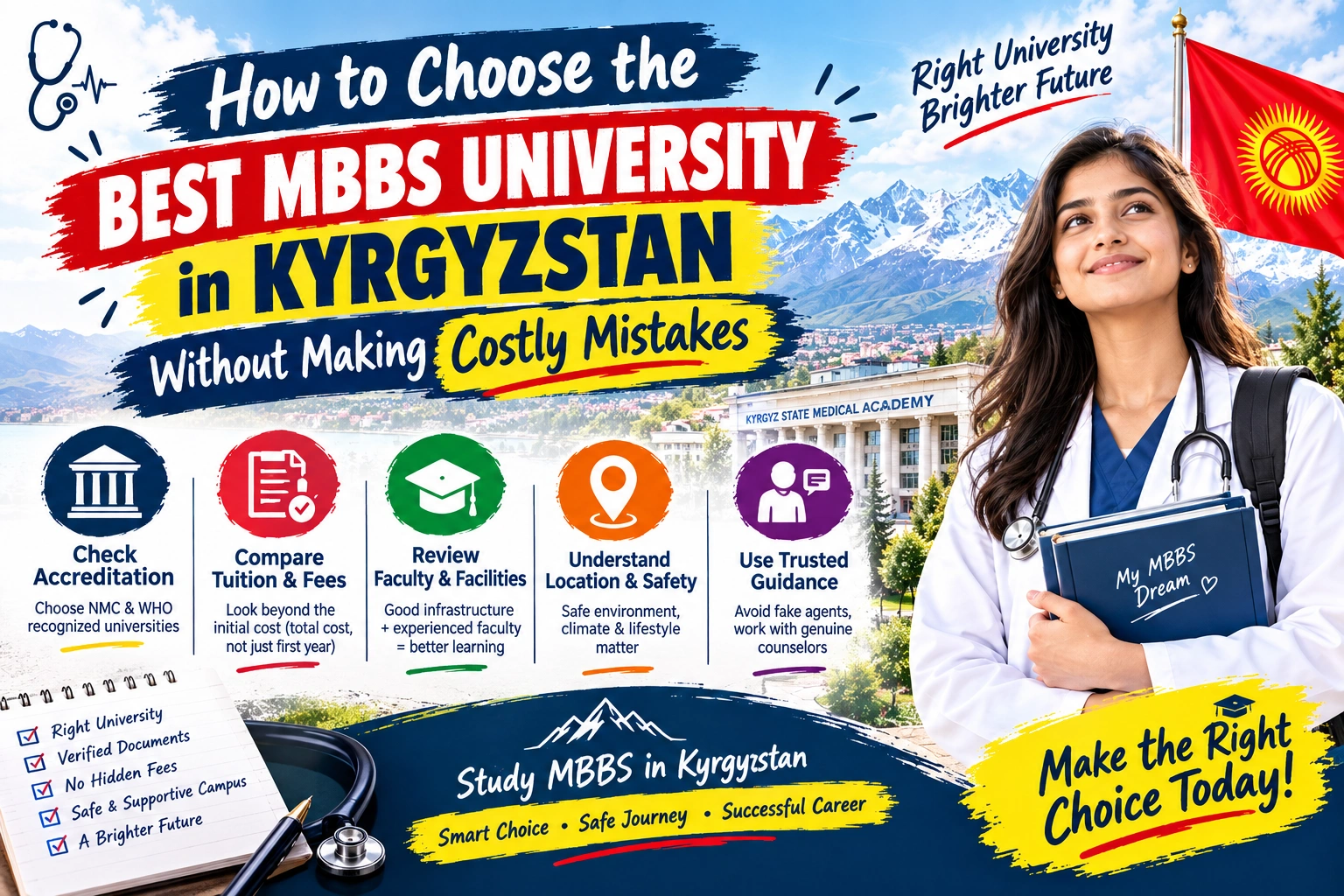
The first core dimension of school selection we will introduce is a university’s official accreditation and qualifications: accreditation status directly determines graduates’ career opportunities, eligibility to apply for a medical practice license, and the range of available postgraduate education programs.
Students planning to return to India to practice medicine after graduation must ensure that the university and program they apply for fully meet the current requirements of India’s National Medical Commission (NMC).
If you are an Indian international student planning to pursue an MBBS degree in Kyrgyzstan, you must first identify a core risk before selecting a school: if your chosen institution has not passed the compliance verification of India’s National Medical Commission (NMC), your future application to register for a medical practice license will be directly blocked.
Six Core Dimensions for Evaluating Medical Universities
1. Verify WDOMS Listing
Before enrolling, you must verify whether the institution is included in the World Directory of Medical Schools (WDOMS). Eligibility for inclusion in this authoritative international database means the institution has earned both official recognition from its home country and international acceptance.
2. Understand WHO Recognition Correctly
Clarify a common misconception that many students mistakenly fall into: many Indian students habitually search for medical schools with WHO certification, but the World Health Organization (WHO) does not directly certify medical schools.
Most people incorrectly equate WDOMS listing with international recognition, so the core rule for school selection is to prioritize institutions that meet both NMC compliance and WDOMS listing and never rely only on marketing claims.
3. Evaluate Academic Quality Beyond Advertising
Many institutions only promote their good facilities and low tuition fees; you must proactively look into five core academic indicators:
Structured medical curricula
Qualified teaching staff
Modern teaching methods
Clinical integration
Student support systems
Academic excellence is the core factor that determines your future development, and you must verify these details through the institution’s official website, official documents, and independent information sources.
4. Assess Clinical Training Opportunities
Clinical exposure is the core foundation of medical education. For Indian international students studying in Kyrgyzstan, you must evaluate the quality and scope of your chosen institution’s clinical training, with a key focus on verifying five practical training components:
Hospital rotations
Patient interaction
Case discussions
Bedside teaching
Diagnostic training
Institutions that have in-depth partnerships with hospitals can provide more sufficient practical opportunities.
5. Confirm MBBS Course Duration
The MBBS program at most local compliant institutions lasts 6 years, including complete academic coursework and clinical training. You must verify that the program meets current regulatory requirements and allocates sufficient clinical hours.
6. Compare Fees and Overall Value
We will later elaborate in detail on tuition fee comparisons across different institutions to help you finalize your school-selection plan.
Understanding MBBS Fees in Kyrgyzstan for Indian Students
If you are an international student planning to apply for the MBBS program in Kyrgyzstan, especially an Indian student belonging to the core applicant pool, you have most likely searched for a series of popular keywords related to MBBS fees in Kyrgyzstan for Indian students.
Many students only fixate on the stated tuition fee when comparing charges of different institutions, which is a very common evaluation pitfall.
You need to calculate the full educational cost that covers:
Tuition
Accommodation
Meal expenses
Insurance
Transportation
Administrative fees
Study materials
Some institutions with slightly higher tuition fees often deliver better academic outcomes and career opportunities, so school selection must balance both cost affordability and cost-effectiveness.
Faculty, Student Support, and Infrastructure Assessment
When selecting a school, you must also verify the actionable items across four core evaluation dimensions.
Faculty Qualifications and Teaching Standards
You need to check the credentials, teaching experience, clinical competence, and research engagement of the teaching staff. High-quality faculty can provide career guidance and academic support to facilitate your development.
Student Support Services
You must confirm whether the institution offers services such as:
New student orientation
Academic advising
Dedicated assistance for international students
Infrastructure and Learning Resources
You need to assess the institution’s supporting facilities including laboratories, simulation centers, and digital learning resources, which underpin both theoretical and practical learning.
Evaluating International School of Medicine and JAIU Kyrgyzstan
Many international students search for relevant information about the International School of Medicine in Kyrgyzstan. When evaluating this or any other institution, you must base your assessment on objective criteria and never make judgments solely based on an institution’s level of popularity.
When applying to JAIU Kyrgyzstan and similar institutions, you must adopt a unified comprehensive assessment standard and avoid the mistake of choosing a school based solely on rankings or advertising.
Long-Term Career Planning After MBBS
Your core assessment dimensions must cover academic quality, faculty expertise, clinical internship opportunities, regulatory compliance, and graduate outcomes; only a comprehensive assessment can align with your personal and long-term career goals.
When selecting a school, you must move beyond the short-term mindset that only focuses on admission and graduation and incorporate five career paths into your consideration:
Practicing medicine
Pursuing postgraduate studies
Conducting research
Practicing medicine internationally
Obtaining general professional qualifications
As an Indian student coming to Kyrgyzstan to complete an MBBS, you must meet NEET eligibility requirements, which are a core prerequisite to practice medicine in your home country.
Common Mistakes to Avoid While Choosing an MBBS University
You must correct the common mistake of choosing a school based solely on low tuition. Affordability of tuition is a secondary consideration, while educational quality is the core priority.
Many students are concerned about physician salaries in Kyrgyzstan, but starting salaries have far less impact on long-term success than the quality of training you receive at medical school.
The five core factors that truly determine your career development are:
Professional competence
Clinical skills
Practice qualifications
Postgraduate education
Continuous learning
Final Checklist Before Applying for MBBS in Kyrgyzstan
For Indian medical students planning to pursue an MBBS degree in Kyrgyzstan, choosing the right medical university is the core top priority of the entire study abroad application process.
Many applicants fall into 7 types of avoidable school-selection pitfalls:
Ignoring institutional accreditation
Choosing a school solely based on cost
Failing to research clinical resources
Neglecting student support services
Taking admission advertisements at face value
Failing to verify NMC compliance
Not confirming WDOMS listing
We have compiled a list of officially recognized medical schools in Kyrgyzstan, including the International School of Medicine Kyrgyzstan and JAIU Kyrgyzstan.
Before applying, every student should complete four mandatory research tasks:
Conduct a comprehensive background check of the target institution
Sort out its full-cycle cost structure
Verify eligibility requirements set by NMC, WDOMS, and NEET
Focus on the institution’s actual educational quality
A correct school-selection decision will lay a solid core foundation for your long-term medical career development.