If you are preparing to travel to Kyrgyzstan to pursue an MBBS degree, as an international student or a student’s parent, you have most likely encountered difficulties at the school selection stage.
Currently, more than 30 medical universities in Kyrgyzstan operate normally, and the factors that must be weighed when choosing a school are numerous and complex.
Many people make hasty decisions based solely on a single study abroad agent’s recommendation, or only fixate on the lowest available tuition.
If you choose the wrong school, you will not only waste several years of time and a large sum of money, but you may also receive a degree that is not officially recognized by Indian authorities, permanently losing your qualification to practice medicine in your home country.
To help you avoid these risks, this guide has developed a feasible, step-by-step school selection framework.
This framework helps you clearly distinguish between core factors that truly impact your decision, and overhyped irrelevant conditions, so you can complete your school selection process clearly and confidently.
Quick School Selection Checklist
We have also prepared a curated set of quick answers for readers with busy schedules, which lists the core school selection screening criteria:
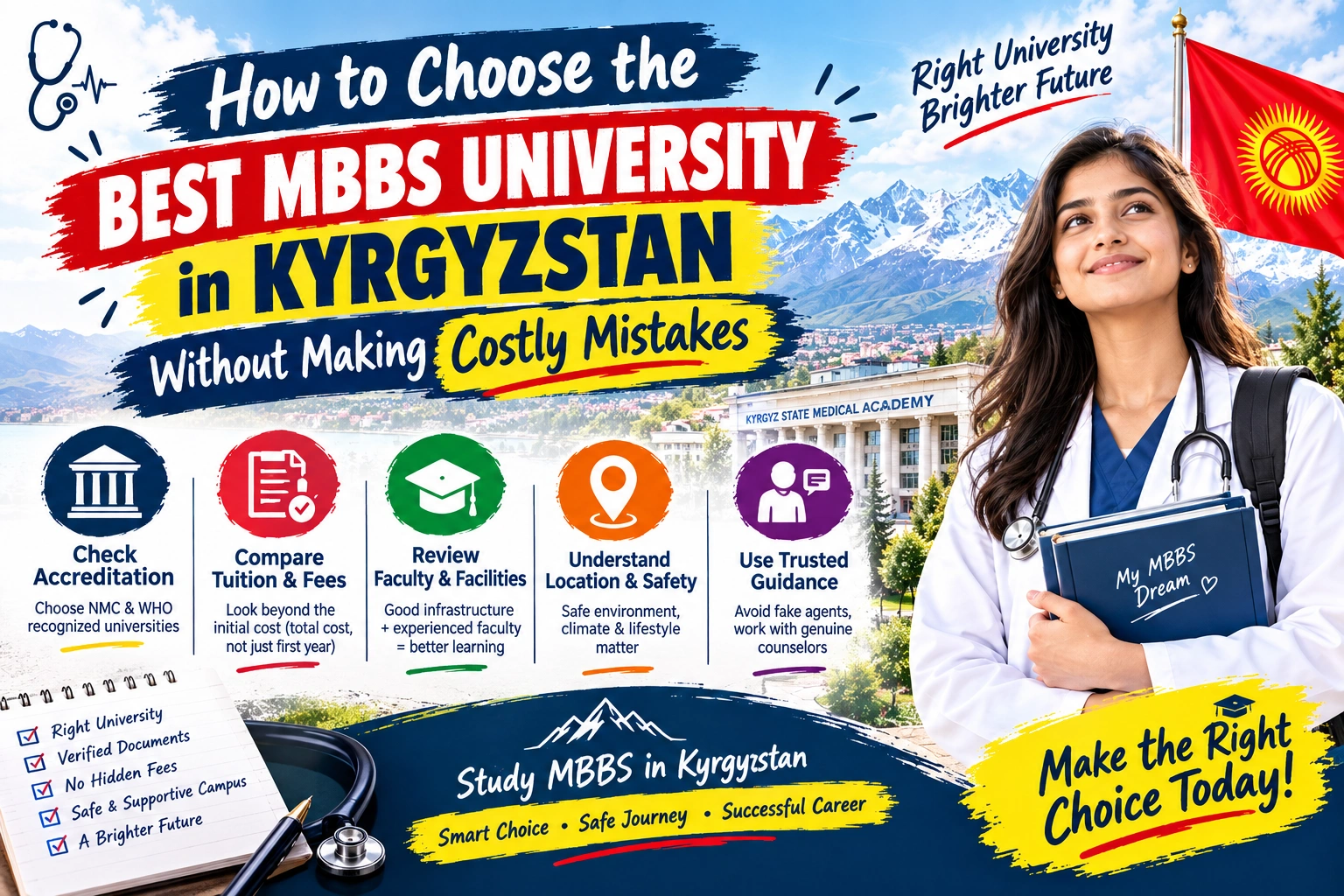
First, verify that the school holds approval from the National Medical Commission (NMC) of India, and is listed in the World Health Organization’s World Directory of Medical Schools (WHO WDOMS).
Second, compare the total cost of studying abroad, including accommodation and living expenses.
Third, check the school’s clinical training resources and its partner hospital network.
Fourth, look up the school’s pass rates for the FMGE and NEXT exams.
Fifth, confirm that the school uses English as the sole language of instruction.
Step-by-Step School Selection Framework
Next, we will elaborate on the detailed step-by-step school selection framework.
Step 1: Verify NMC and WHO Recognition
Step One prioritizes verification of the dual NMC and WHO certifications, which directly eliminates all schools that would disqualify you from practicing medicine in India.
Step 2: Check the University's Accreditation History
Step Two requires checking the school’s certification history, which is regularly audited by the Ministry of Health of Kyrgyzstan.
Prioritize schools that have passed audits stably for many years.
Avoid schools that only barely meet the minimum standards.
Step 3: Compare the Total Cost
Step Three asks you to proactively request a full breakdown of all costs, including additional expenses such as:
Accommodation
Meals
Insurance
Only compare actual total expenditure rather than the isolated tuition figure.
Step 4: Evaluate Clinical Training
Step Four requires you to confirm with full clarity:
The school’s partner hospital resources.
The timing of early clinical exposure.
The class size for clinical rotations.
Clinical training is far more important than non-core factors such as a school’s campus appearance.
We will explain the detailed requirements for Step Five in the following section.
Complete Verification Process Before Applying
For candidates planning to pursue a medical degree overseas, you may complete the school selection verification process for your target medical school following the steps below.
All stages of this process are designed to address the unique pain points of studying medicine abroad, avoiding the blind spots common in generic application guidance.
Verify the Language of Instruction
First, confirm the compliance of the language of instruction.
Many overseas institutions advertise full English-taught programs, but language support for the clinical phase varies widely.
You must:
Obtain a written certificate confirming that all teaching activities, including internships, are conducted in English.
Simultaneously verify that the institution is listed in the World Directory of Medical Schools (WDOMS).
Confirm that it meets the relevant requirements of India’s National Medical Commission (NMC).
Compare FMGE/NEXT Results
Next, compare the pass rates of the FMGE/NEXT medical licensing examination among graduates of your shortlisted institutions, to measure the quality of the institutions’ academic and clinical training.
Research the City
Then, research the livability of the city where the institution is located, to adapt to the six-year long program duration required for medical majors.
For example:
Bishkek has complete supporting facilities.
Osh offers a quiet environment and lower living costs.
Jalal-Abad also provides a peaceful atmosphere with affordable living expenses.
Choose according to your own needs.
Contact Current Students
After that, proactively contact current students or alumni of the institution to obtain authentic first-hand information about the study experience.
Never rely solely on the institution’s official marketing content.
Verify the Admission Channel
Finally, verify the compliance of your application channel.
Confirm that any education agent you work with holds official authorization from the institution.
Strictly prohibit paying the full sum of fees to an agent’s private account.
Route all fees exclusively through the institution’s official payment channel.
A standardized school selection comparison table is attached at the end of this paragraph, which organizes 7 core dimensions into a three-column framework of:
Verification factor
Key verification points
Why this item matters
Forming a clear, actionable logical system.
Top Best MBBS Colleges in Kyrgyzstan for Indian Students for Indian Students
Building on the screening framework established in the preceding section, we have curated a list of 6 candidate medical schools in Kyrgyzstan that are common top choices for Indian students applying to the country’s MBBS program.
Kyrgyz State Medical Academy (KSMA)
Long academic history.
Robust medical collaboration resources.
Kyrgyz-Russian Slavic University (KRSU)
Standardized curriculum.
Excellent performance on the FMGE exam.
Osh State Medical University
Affordable tuition.
The small-city setting allows for personalized attention.
International School of Medicine (ISM)
Modern campus exclusively for international students.
Jalal-Abad State Medical University (JASU)
High cost-effectiveness.
Tight-knit community atmosphere.
Asian Medical Institute (AMI)
Strong focus on practical hands-on training.
One of the lowest-cost options available.
Eligibility Criteria
All applicants must meet the following requirements to apply:
Completion of 10+2 education with completed coursework in physics, chemistry, biology, and English.
A minimum overall score of 50% for general category applicants and 45% for applicants from India’s reserved categories.
A minimum age of 17 years at enrollment.
A valid qualifying score on the NEET-UG.
No IELTS or TOEFL scores are required for the English-taught program.
MBBS Admission Process
If you have selected your target medical school in Kyrgyzstan, you may complete your application by following a coherent 8-step process.
It is essential to initiate this process 3–4 months in advance to avoid missing the enrollment deadline.
Tuition Fee Overview
Below is an overview of the annual tuition fees of 6 popular higher education institutions, including:
Kyrgyz-Russian Slavic University
International School of Medicine (ISM)
Other leading institutions
Tuition fees are denominated in two currencies:
US dollars
Indian rupees
All listed institutions:
Meet the eligibility requirements of India’s NEET-UG.
Hold accreditations from India’s National Medical Commission (NMC).
Hold accreditations from the World Health Organization (WHO).
Comply with the exclusive application rules designed for Indian medical students.
Important Cost Information
All cost-related data cited in this passage are approximate reference values.
All Indian students planning to pursue an undergraduate Bachelor of Medicine and Bachelor of Surgery (MBBS) degree in Kyrgyzstan must verify the exact value of the tuition fee converted to Indian Rupees directly with their target institution before paying any fees.
Benefits of Following This Framework
Next, we outline the core logic of this structured school selection decision-making process.
Following this process will:
Grant you 5 core application advantages.
Help you match with a suitable institution.
Deliver long-term positive benefits for your career development after graduation.
Skipping any steps arbitrarily will expose you to 5 distinct, clear risks.
Career Opportunities After Graduation
The MBBS in Kyrgyzstan lasts 6 years and includes an internship period.
Target institutions must meet the accreditation requirements of India’s National Medical Commission (NMC) and the World Health Organization (WHO).
Only after meeting this requirement will you be eligible to take:
India’s Foreign Medical Graduate Examination (FMGE/NEXT).
USMLE.
PLAB.
A mandatory application requirement is that applicants must obtain a passing score on the NEET-UG exam.
The total cost for the full program ranges from approximately 2.5 million to 3.5 million Indian Rupees.
Frequently Asked Questions (FAQs)
Finally, we have compiled 7 high-frequency core questions raised by Indian international students, and provided clear, actionable answers for each one by one.
What are the core factors for selecting a school?
Can low tuition be set as the top priority when choosing a school?
How can I verify an institution’s NMC accreditation?
Is it necessary to contact current Indian students enrolled at the institution to confirm information?
What is the total budget required for the full program?
Is it possible to transfer to another school after enrolling?
Is a NEET score a mandatory application requirement?
All answers point to clear operational pathways, to help you eliminate core concerns throughout the entire application process.
Conclusion
You do not need to struggle with selecting an institution to pursue your MBBS in Kyrgyzstan.
The structured screening method proposed in this paper will help you complete the selection process.
You only need to sequentially verify core evaluation dimensions such as institutional compliance requirements, refer to the list of six major local medical schools, and finalize your ultimate choice using core decision benchmarks.
Sufficient preliminary research will lay a solid foundation for your subsequent academic and career development.