Is NEET Mandatory for MBBS
in Kyrgyzstan in 2026?
If you are an Indian student planning to pursue an MBBS in Kyrgyzstan in 2026, or an Indian parent mapping out a medical career path for your child, you have almost certainly noticed the growing overall trend in recent years: more and more Indian students aspiring to work in medicine choose to pursue their Bachelor of Medicine and Bachelor of Surgery (MBBS) overseas.
Among the many international study destinations, Kyrgyzstan stands out as a popular choice among Indian medical students, thanks to four core competitive strengths.
However, no matter how much advance preparation they complete, nearly all students and parents planning to study medicine in Kyrgyzstan ask the same core, most anxiety-fueled question:
Is NEET qualification mandatory to pursue an MBBS in Kyrgyzstan?
We can offer a clear, definitive answer here:
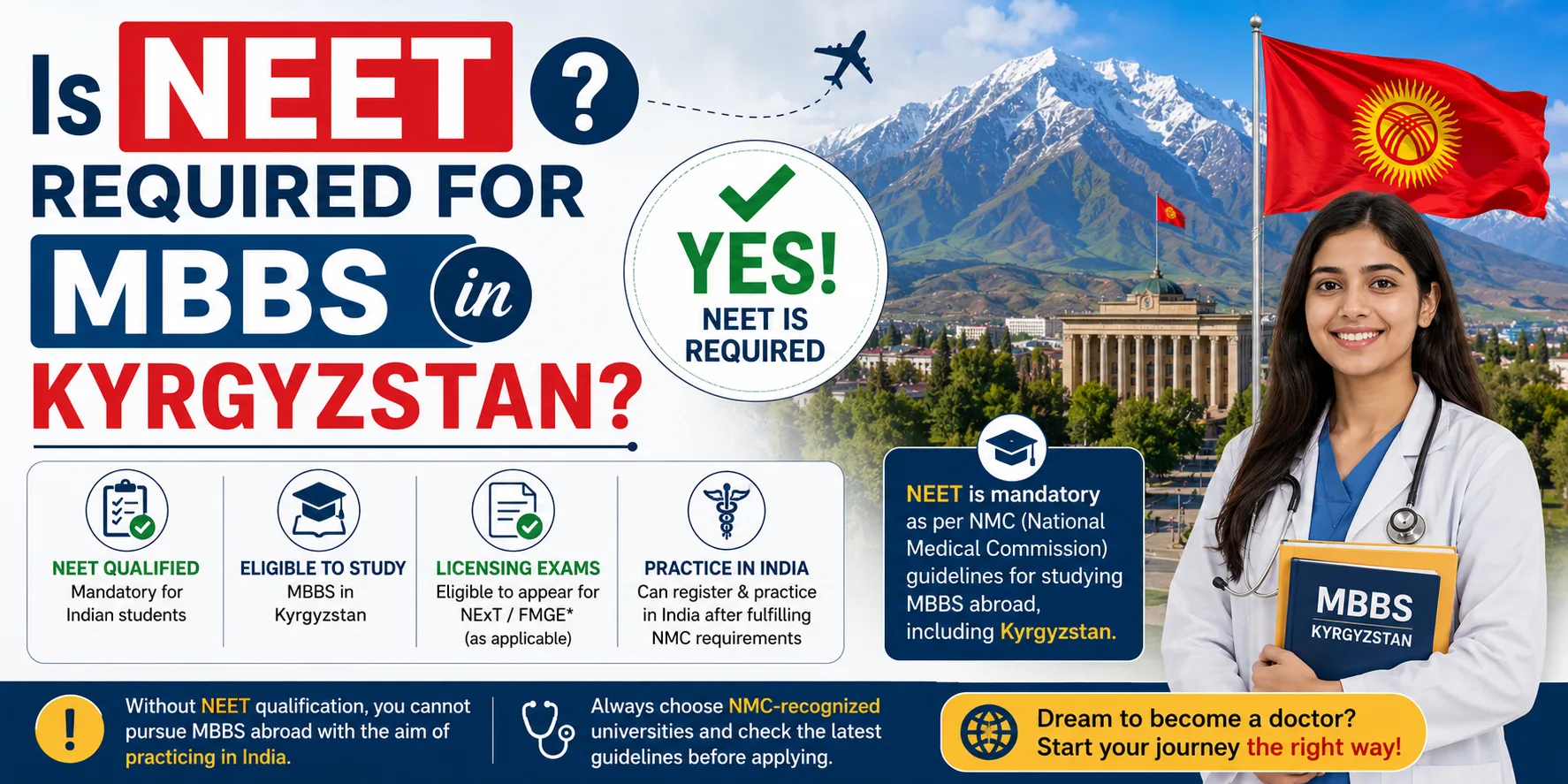
Yes, NEET is a non-negotiable requirement for studying medicine in Kyrgyzstan.
This rule is not set independently by local Kyrgyz universities; it originates from a unified regulation that formally took effect in 2018, issued by India’s National Medical Commission (NMC) and the Indian government.
Many students fall into a common misconception: that as long as they receive an admission letter from a local Kyrgyz university, they can return to India to practice medicine directly after graduation.
This is entirely incorrect: university admission eligibility and eligibility to practice medicine in India are two completely separate assessment standards.
Consequences of Not Qualifying NEET
If you fail to meet the rigid NEET requirement, you will face four severe consequences:
You will not comply with the NMC’s unified regulations.
You will be barred from taking medical licensing exams including the Foreign Medical Graduate Examination (FMGE) and National Exit Test (NExT).
Your earned medical degree will not be recognized by Indian official authorities.
Ultimately, you will be unable to complete practice registration with India’s health departments.
What This Guide Covers
In the following sections of this guide, we will sort through all core information item by item, including:
Specific requirements for NEET
Eligibility criteria to apply for medical studies in Kyrgyzstan
Full admission process
NMC compliance regulations
Advantages of studying medicine in Kyrgyzstan
Domestic and international career opportunities after graduation
Frequently asked questions
NEET Requirement for Indian Students
Indian students who wish to pursue an MBBS degree overseas must first pass the NEET exam, a mandatory pre-requirement set by India's National Medical Commission.
This standard cannot be bypassed by any application for overseas medical study.
Advantages of MBBS in Kyrgyzstan
As a popular destination for Indian medical applicants in recent years, Kyrgyzstan's MBBS programs have six core advantages:
Total tuition fees are only 150,000 to 350,000 rupees.
All programs are taught entirely in English.
Programs comply with NMC guidelines.
Academic credentials are listed in international medical directories.
No donation fees are required.
Affordable overall cost compared with Indian private medical colleges.
This directly addresses the core pain points of India's domestic private medical colleges, where tuition often reaches millions of rupees and applicants must additionally pay high donation fees.
Eligibility Criteria for MBBS in Kyrgyzstan
Programs require applicants to have completed all Grade 12 courses in:
Physics
Chemistry
Biology (PCB)
Minimum Academic Requirements
General category applicants must achieve a combined PCB score of at least 50%.
Reserved category applicants must score at least 40%.
Age Requirement
All applicants must be at least 17 years old in the year they enroll.
NEET Score Requirement
Many applicants mistakenly believe that a high score or specific ranking is required to submit an application.
In fact, only reaching the NEET qualifying cutoff is sufficient.
Furthermore, NEET scores are valid for 3 years for overseas study applications.
Applicants should always verify the latest official regulations issued by the NMC.
Application Process Overview
This section lists the complete first three steps of the application requirements, while the fourth step is pending supplementation.
School Selection
The school selection step requires verification of five core dimensions.
Documentation
The five core categories of materials required for the application are detailed one by one.
All information is closely aligned with the actual needs of Indian applicants.
Final Stages of the Application Process
If you are planning to travel to Kyrgyzstan to pursue a Bachelor of Medicine and Bachelor of Surgery (MBBS) degree and have advanced to the final three steps of the application process, these include:
Submitting final application verification materials
Paying the host university’s seat reservation fee
Scheduling a pre-visa audit
NMC Regulatory Module
The first module places all mandatory regulatory requirements set by India’s National Medical Commission upfront for priority review.
These requirements include:
The target university must be included in the recognized overseas medical school listings.
You must meet the qualifying cutoff of NEET.
The overseas medical program must include 1 year of full-time clinical internship.
These requirements are essential before appearing for licensing examinations after returning to India.
University Assessment Module
All listed Kyrgyzstani universities should be reviewed based on:
Accreditation status
Admission availability
English-medium instruction coverage
Cost Module
The latest expense data indicates:
Annual tuition: US$2,200–3,600
Annual accommodation: Around US$650
The overall cost of studying abroad is approximately 30% of the cost of attending a private medical college in India.
Advantages of Studying MBBS in Kyrgyzstan
The Advantages Module highlights the following benefits:
Lower admission competition than Indian government colleges
Fast application process
English-medium education
Affordable tuition
Internationally recognized degrees
Challenges Students Should Prepare For
The Challenges Module highlights several areas requiring preparation.
Language Barrier
The widespread use of Russian may create communication challenges during clinical internships.
Clinical Exposure Differences
Some lesser-known universities may have limited clinical internship resources.
Cultural Adaptation
Students may require additional time to adjust to the local culture and climate.
Career Opportunities After Graduation
After graduation, students can pursue several career pathways.
Medical Practice in India
Students must comply with NMC regulations and clear:
FMGE
NExT
International Licensing Pathways
Students may prepare for:
USMLE (United States)
PLAB (United Kingdom)
Higher Education Opportunities
Students may also pursue:
MD
MS
Other postgraduate medical programs
School Selection Criteria
The guide recommends evaluating Kyrgyzstan medical universities based on eight measurable dimensions:
NMC-compliant qualification status
International accreditation standing
Clinical training opportunities
Internship system quality
Faculty qualifications
Feedback from Indian students
FMGE/NExT performance trends
Infrastructure and laboratory facilities
Frequently Asked Questions
Is NEET Mandatory?
Yes. NEET is mandatory for Indian students planning to return and practice medicine in India.
Is a High NEET Score Necessary?
No. Most Kyrgyz medical universities only require a qualifying NEET score.
Can Graduates Practice in India?
Yes, provided they meet all NMC regulations and licensing requirements.
Is Kyrgyzstan Safe for Indian Students?
A large number of Indian students complete their studies in Kyrgyzstan every year. Following university regulations and local laws is generally sufficient to maintain personal safety.
Are Degrees Internationally Recognized?
Most medical schools are listed in international medical directories and hold globally recognized credentials. Students should independently verify accreditation through WDOMS and WHO resources.
Conclusion
MBBS in Kyrgyzstan remains one of the most affordable and accessible overseas medical education options for Indian students.
Its major strengths include:
Low tuition fees
Affordable living costs
English-medium instruction
International recognition
Simplified admission process
Before selecting any university, students should carefully verify institutional recognition through NMC, WDOMS, and WHO databases, assess the quality of clinical training, and ensure complete compliance with all Indian regulatory requirements.
When pursued in full compliance with applicable regulations, MBBS in Kyrgyzstan can provide a practical and effective pathway toward a successful medical career.