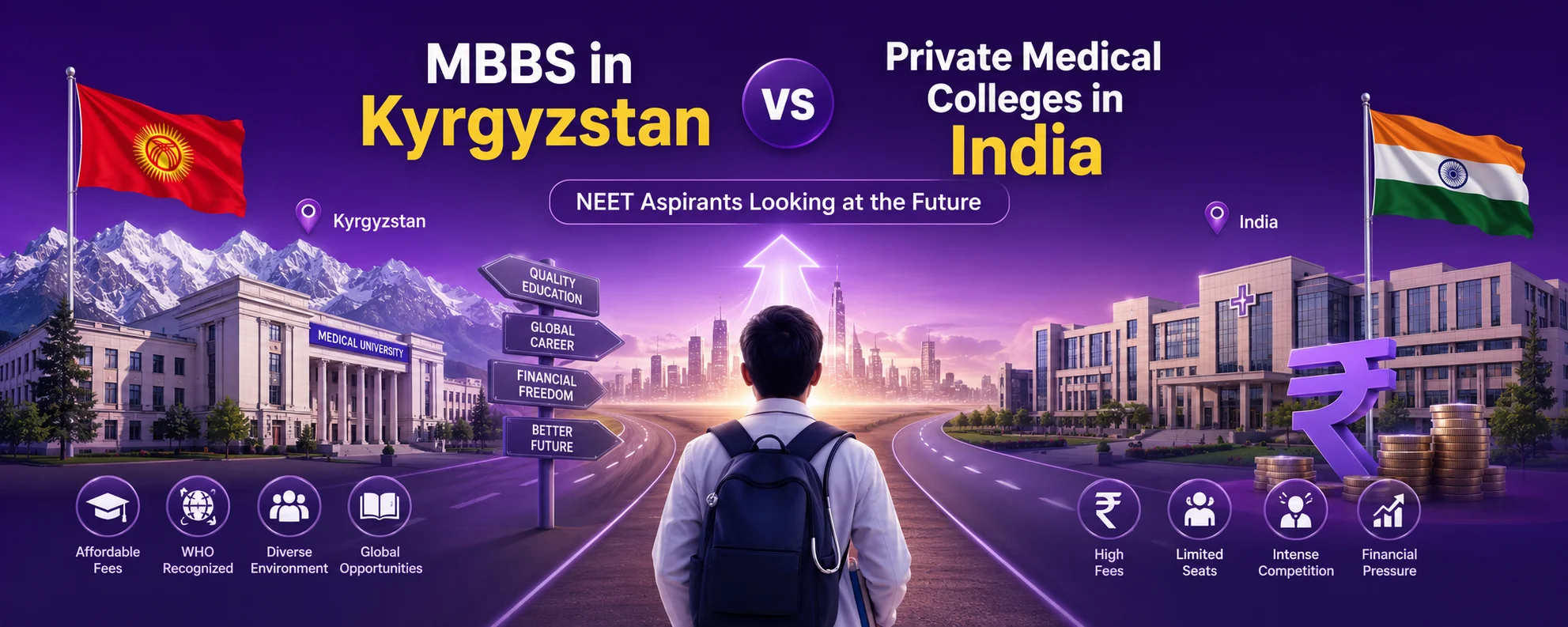
Each year, a significant number of Indian students qualifying for NEET struggle with the same problem: a lack of affordable MBBS opportunities. Due to a lack of government medical seats, medical education has become increasingly competitive. This leads students to choose between costly private medical institutions in India and medical institutions in foreign countries such as Kyrgyzstan.
In the last decade, Kyrgyzstan has become one of the most favored locations for Indian medical students. The combination of affordable tuition, globally acknowledged universities, a focus on English, and a burgeoning community of Indian students have been instrumental in the growth of this region. Meanwhile, private medical colleges in India continue to have a steady number of admissions as students prefer staying within the Indian healthcare system.
This comparison provides a thorough breakdown of the two options mentioned for students and parents.
The Current Medical Admissions Scenario in India
The first obstacle aspiring doctors face is qualifying for NEET. The number of students enrolling to take NEET to secure MBBS seats continues to grow. Government medical colleges have affordable education, but students need exceptionally high NEET scores to qualify for an MBBS seat.
Unable to get a government MBBS seat, students are left to pursue education in private medical colleges. These private colleges are self-financed institutions providing medical education; however, the cost is a considerable financial burden. Families in these cases spend decades of their savings or take out educational loans for this degree.
Many students are now seriously considering international options like MBBS in Kyrgyzstan after encountering affordability problems in India.
Cost Comparison: The Most Important Factor
Cost is usually the most influential factor when choosing a medical college.
Private Medical Colleges in India
All the expenses related to MBBS in an Indian private medical college usually include:
Tuition
Hostel Charges
Lab Fees
Exam Fees
Miscellaneous Fees
In the majority of medical colleges in India, the entire MBBS program could cost anywhere between ₹60,00,000 to ₹1,50,00,000 (or even beyond). This cost makes medical education a dream for middle-class families in India.
MBBS in Kyrgyzstan
In Kyrgyzstan, students become doctors with a much lower investment than in India. Students pay much lower tuition to receive a good education.
The total commonly consists of:
Education
Hostel
Student Services
Healthcare
Considering all travel expenses and personal expenses, the total outlay is significantly less compared to private colleges in India.
Studying MBBS in Kyrgyzstan is one of the best value-for-money options in the world.
Admission Procedure: Simplicity vs Competition
Admission in Private Medical Colleges
The admission process consists of:
NEET
State/National Counseling
Seat Allotment
Fee Payment
There is a lot of competition and students are left in the dark until the last rounds of counseling.
Admission in Kyrgyzstan
The admission procedure for Kyrgyzstan universities is much simpler.
Most students need the items below for a medical college application:
NEET
Transcripts
Passport
Application
The majority of medical colleges do not have their own entrance exams. This makes applying for medical studies abroad easier.
Learning Conditions and Academic Style
Learning medicine is more than earning a ticket to practice. It is about gaining the knowledge and skills needed to save lives.
Indian Private Medical Colleges
Indian private medical colleges have:
Better Laboratories
Simulation Labs
Better Classrooms
Better Faculty
Sadly, the quality of education may be inconsistent. Students need to evaluate the quality of faculty, supporting medical college hospitals, and academic output before choosing to enroll.
Medical Colleges in Kyrgyzstan
Many medical colleges in Kyrgyzstan have improved their teaching infrastructure to accommodate international medical students.
Students have access to:
Learning in English
Modern Teaching Methods
Teaching Staff from Various Countries
eLearning Medical Resources
Many colleges are listed in the World Directory of Medical Schools (WDOMS), giving students the opportunity to verify the global status of the medical college.
Clinical Training: The Pillar of Medical Education
Clinical training is the most important element of medical teaching.
Indian Private Medical Colleges
Studying in India, students have exposure to:
A Variety of Patients
A Range of Diseases
High-Capacity Hospitals
Community Health Services
Students develop a strong understanding of Indian medical services by the end of their studies.
Kyrgyzstan Medical Universities
Medical universities in Kyrgyzstan also offer clinical education in teaching hospitals.
Students receive exposure to:
Internal Medicine
General Surgery
Pediatrics
Obstetrics and Gynecology
Emergency Medicine
When choosing a university, it is important to consider institutions where extensive clinical training is a priority and institutions that comply with the policies of the National Medical Commission (NMC).
Student Life and Cultural Experience
Staying in India
Studying in India allows students to remain close to family and familiar surroundings.
The benefits include:
No Language Issues
Familiar Eating Habits
Cultural Familiarity
Less Travel
For a majority of students, family provides the needed emotional support and remains in close proximity during medical schooling.
Studying in Kyrgyzstan
Living in a foreign country provides a new experience and helps develop:
Independence
Adaptability
Effective Inter-Cultural Communication
A Broader Outlook
Most major medical universities in Kyrgyzstan have a good representation of Indian students. Food, celebrations, and cultural clubs help freshers adjust to the new environment.
Students often return with greater confidence, exposure, and a broader perspective that helps them in their careers.
Recognition and Future Licensing
One of the main concerns of students and parents is the recognition of MBBS degrees earned abroad.
While choosing a university, students must confirm that:
The University complies with NMC regulations
The University is listed in the World Directory of Medical Schools (WDOMS)
The University provides adequate Clinical Training
The University meets eligibility criteria for Foreign Medical Graduates
Students must also be aware of the policies provided by the World Health Organization (WHO) and other global medical education authorities.
Promotional materials should not be the sole basis for assuming recognition. Prior to admission, confirmation through official channels is the only reliable method.
Financial Freedom After Graduation
One thing that people often forget about in a field as intensive as medicine is the financial pressure felt after graduation.
Graduates from expensive private institutions may carry a notable amount of debt. This can impact career choices, specialization plans, and professional decisions during the early years after graduation.
Students from Kyrgyzstan often find educational costs more manageable and may therefore have greater flexibility regarding:
Further Studies
Specialization Choices
International Career Opportunities
Research Pathways
Technology and Modern Medical Education
Medical education is changing rapidly.
Students today should be learning about:
Digital Diagnostics
Telehealth
Evidence-Based Medicine
AI in Healthcare
Research
Several institutions in Kyrgyzstan have developed curricula that include simulation-based learning, internet-supported education, and interactive teaching methods.
Similarly, leading private institutions in India have developed a strong commitment to the use of technology in medical education.
Students should assess the facilities available and not rely solely on institutional reputation.
Which Students Most Benefit from Kyrgyzstan?
Kyrgyzstan may be a great fit for students:
Wanting Affordable Medical Education
Who Have Qualified in NEET but Missed Government Seats
Seeking International Exposure
Willing to Adjust to a New Environment
Wanting to Reduce the Financial Burden on Their Families
The country offers a good balance of affordability and educational quality.
Who Benefits Most from India's Private Medical Colleges?
Private medical colleges in India may primarily benefit students who:
Prefer to Study Within India
Can Afford the Higher Cost
Wish to Stay Close to Family
Want Immediate Integration into India's Healthcare System
Have Secured Admission to a Reputed Medical College with Strong Clinical Exposure
Choosing the best option depends on individual circumstances, preferences, and financial considerations.
Conclusion
There is no single correct answer when comparing MBBS in Kyrgyzstan with private medical colleges in India. Both options have advantages and limitations.Private medical colleges in India offer local clinical exposure and direct integration into the Indian healthcare system. However, these benefits often come with a substantial financial burden. MBBS in Kyrgyzstan, on the other hand, provides a more affordable pathway to medical education while offering international exposure, modern infrastructure, and an increasingly supportive environment for Indian students.When students select universities that comply with NMC guidelines, are listed in WDOMS, and maintain internationally recognized educational standards, Kyrgyzstan can be considered a practical and valuable option for pursuing medical education.A careful evaluation of costs, recognition, clinical training, student life, and long-term career goals will help students make an informed decision and build a successful medical career.