Introduction
If you are an Indian medical student who failed to secure an admission quota for a domestic public medical college in India, cannot afford the steep tuition fees of private medical colleges in your home country, and are searching globally for reliable overseas MBBS study options in Kyrgyzstan, then Kyrgyzstan’s medical study abroad programs are absolutely a high-value-for-money choice you cannot miss.
Kyrgyzstan’s MBBS programs boast solid medical education quality, their awarded degrees are recognized by leading international authorities, all instruction is delivered fully in English, which perfectly matches Indian students’ language foundation, and the overall cost of studying there is far lower than that of mainstream medical study-abroad destinations such as Europe, the United States, and Singapore.
What underpins this strong cost-effectiveness is Kyrgyzstan’s low local university operation and living costs, as well as long-term support policies for international medical students implemented by local higher education institutions.
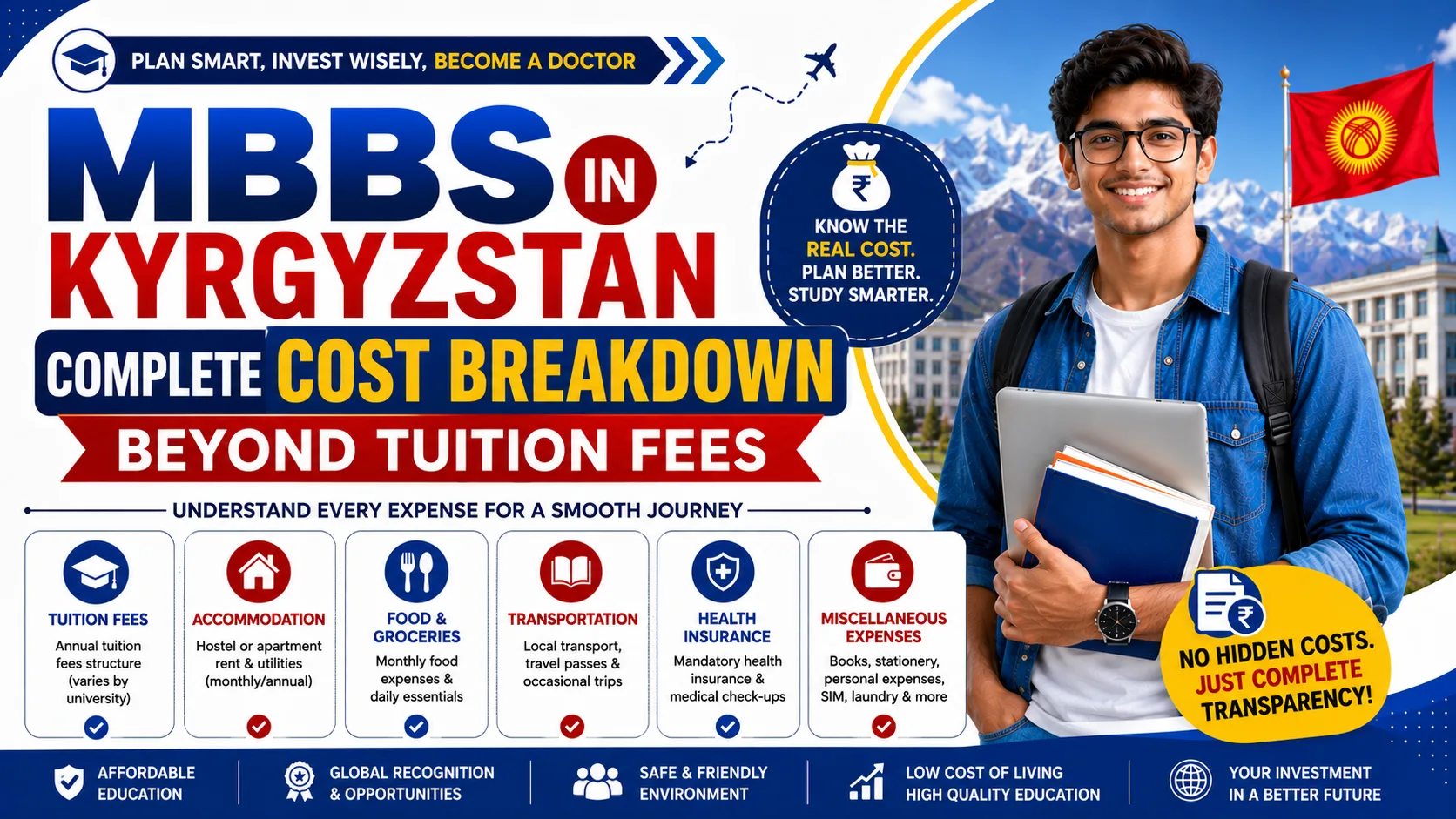
Understanding the Complete Cost of MBBS in Kyrgyzstan
Recently, we sorted out 10 sets of high-frequency keywords that Indian students use when searching for information related to MBBS studies in Kyrgyzstan, and the vast majority of these keywords center on tuition fees.
This shows that most Indian students planning to study medicine in Kyrgyzstan have fallen into the same common cognitive pitfall: they only focus on the surface tuition fees published by universities, and completely overlook a range of additional costs that must be included in the budget, such as:
Accommodation
Meals
Visa processing
Cross-border travel
Medical insurance
Entry health screenings
Study materials
Daily personal expenses
In fact, tuition fees themselves vary significantly across different Kyrgyz universities, and there are six core influencing factors:
University reputation
Infrastructure level
Reserve of clinical training resources
Quality of the teaching faculty
Support services for international students
The geographic location of the university
In the follow-up content of this guide, we will fully break down all hidden costs beyond basic tuition, to help students and their families avoid unplanned unexpected expenses, and make sufficiently rational, informed choices when selecting a university.
Full Financial Planning for MBBS Students in Kyrgyzstan
This gap in cost awareness, which is overlooked by most study-abroad families, is exactly the core issue that this guide prioritizes clarifying.
For Indian international students planning to travel to Kyrgyzstan to pursue a Bachelor of Medicine, Bachelor of Surgery (MBBS), a complete financial plan for overseas study must incorporate all potential additional costs. It is never acceptable to take only the base tuition fee as the core of one’s budget.
We have sorted out a full-cycle list of 10 expense categories that covers tuition, accommodation, and meal costs.
If any unplanned cost is omitted, it may trigger a financial crisis during the study period.
Therefore, to assess the total cost of pursuing an MBBS in Kyrgyzstan, one must adopt a fully comprehensive perspective and never generalize from incomplete information.
Five Major Non-Tuition Expenses During MBBS
Accommodation Costs
First is accommodation costs, whose core requirement is compliance with the host university’s unified on-campus residency policy.
Specific components include:
Accommodation deposit
Utilities fees (electricity, water, and internet)
Variables impacting costs include the location of the on-campus dormitory and whether a student chooses to share a room.
The cost-control recommendation is to prioritize applying for the university’s unified on-campus dormitories and avoid off-campus housing with inflated prices.
Meal and Daily Living Expenses
Second is meal and living expenses, whose core requirement is to cover three daily meals and a small number of emergency purchases.
Specific components include:
Grocery spending
Costs of dining out
Variables impacting costs include the area where one consumes goods and services and personal eating habits.
Local consumer prices in Kyrgyzstan are over 60% lower than those in Western countries.
The cost-control recommendation is to dine at the university canteen, which can greatly reduce daily expenses.
Travel Expenses
Third is round-trip travel expenses, whose core requirement is to cover at least two round-trip trips between India and Kyrgyzstan during the study period.
Specific components include:
Airfare
Accommodation and meal costs during transit
Variables impacting costs are the timing of ticket booking and the choice of airline.
The recommendation is to book round-trip air tickets six months in advance and stay clear of travel peaks during public holidays.
Visa and Immigration Fees
Fourth is visa and immigration fees, whose core requirement is to cover all official charges for legal residency throughout the full study period.
Specific components include:
Visa application fees
Visa-on-arrival registration fees
The variable impacting costs is whether the application channel is compliant.
The recommendation is to submit applications through the university’s unified channel to avoid additional charges from third-party agents.
Medical Insurance and Health Expenses
The last is medical insurance and health expenses, whose core requirement is to cover basic medical diagnosis and treatment needs during the study period.
Specific components include:
Mandatory medical insurance premiums
Routine physical examination fees
The variable impacting costs is the coverage scope of the insurance plan.
The cost-control recommendation is to choose the medical insurance product that the university cooperates with, whose premium is far lower than that of an international health insurance plan purchased independently.
Additional Expenses During the Six-Year MBBS Course
For all international students planning to study in Kyrgyzstan to pursue the Bachelor of Medicine and Bachelor of Surgery (MBBS) program, completing full-cycle financial planning is a core prerequisite for successfully finishing their studies.
The financial needs for the entire study abroad period are divided into six core dimensions:
Educational Materials and Academic Expenses
Professional textbooks
Reference materials
Laboratory manuals
Supporting clinical equipment
Professional digital resources
Internet and Communication Expenses
This category covers:
Mobile phone services
Home internet subscriptions
International calls
Local network fees in Kyrgyzstan are affordable and widely accessible.
Local Transportation Expenses
This includes:
Daily public transit
Ride-hailing
Intercity travel
Clinical rotation commuting
It is recommended to prioritize accommodation near campus to reduce transportation costs.
Personal Living Expenses
This covers:
Clothing purchases
Leisure and entertainment
Fitness costs
Personal care
These expenses are highly individualized, so a reasonable budget must be prepared in advance.
Emergency Financial Planning
A dedicated emergency fund must be reserved for situations such as:
Sudden illness
Interrupted travel
Urgent family matters
Exchange rate fluctuations
Full-Cycle Cost Calculation
The MBBS programs at most accredited universities in Kyrgyzstan follow a six-year academic system that includes complete academic education and clinical training.
Applicants must calculate the total cost of the full cycle and avoid considering only single-year expenses.
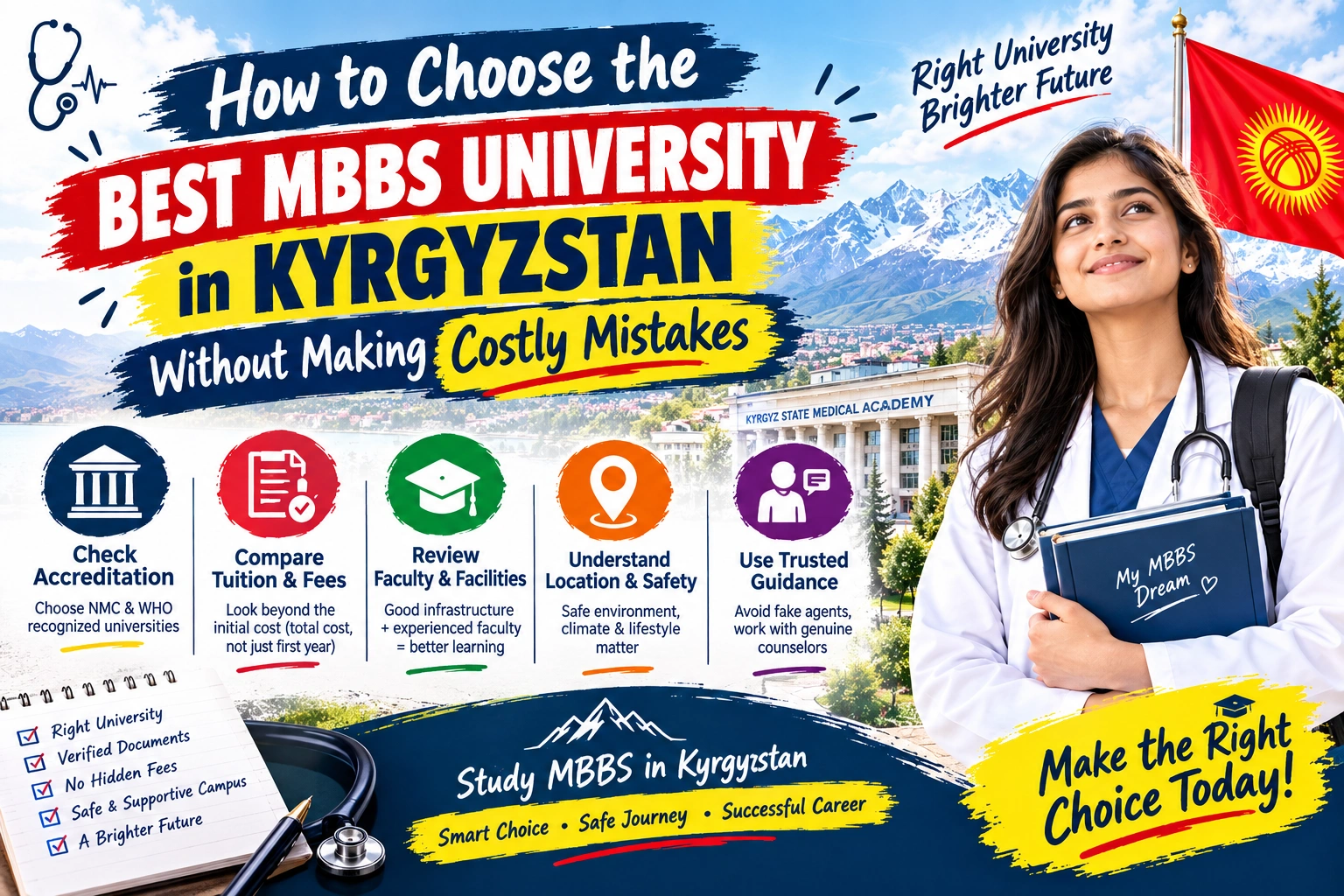
How to Select the Right Medical University in Kyrgyzstan
When selecting a university, you must avoid the mistake of choosing a school solely based on its tuition fees.
Instead, you should comprehensively evaluate the overall value of the institution and make a reasonable decision that fits your personal circumstances.
The first set of criteria includes seven hard indicators for university screening:
Clinical resources
Academic quality
Faculty experience
Infrastructure
Hospital partnership ties
Student support services
Accreditation status
Taking two target medical schools in Kyrgyzstan—International School of Medicine Kyrgyzstan and Kyrgyzstan’s JAIU University—as examples, this paper breaks down a full cost accounting checklist.
NMC, NEET, and WDOMS Compliance for Indian Students
For Indian students, three core conditions must be met:
A common misconception must be clarified: WHO accreditation has a far lower practical priority than these three conditions.
There are also seven easily overlooked hidden costs that must be included in calculations:
University registration fees
Exam fees
Document authentication fees
Translation fees
Residence permit renewal fees
Medical examination fees
Graduation document fees
Long-Term Return on Investment After MBBS in Kyrgyzstan
The low overall cost of MBBS programs in Kyrgyzstan drives up their return on investment, and students must also incorporate six core pillars supporting long-term career success:
Academic performance
Clinical skills
Professional practice qualification
Postgraduate education
Career planning
For Indian students and their parents who plan to pursue a Bachelor of Medicine and Bachelor of Surgery (MBBS) in Kyrgyzstan, this pathway is a high-quality, cost-effective option for building a career in medicine.
However, many families commonly fall into a cognitive misperception: they only focus on explicit tuition fees and overlook various hidden costs.
Only by fully grasping all details of the full cost of studying abroad and relevant compliance requirements can they make informed study-abroad decisions.
They must address the following core matters one by one:
Calculate the full cost of studying abroad that covers all direct and indirect expenses.
Verify the compliance qualifications of their target institution.
Maintain valid eligibility for India’s National Eligibility cum Entrance Test (NEET).
Develop a systematic strategic financial plan as early as possible.