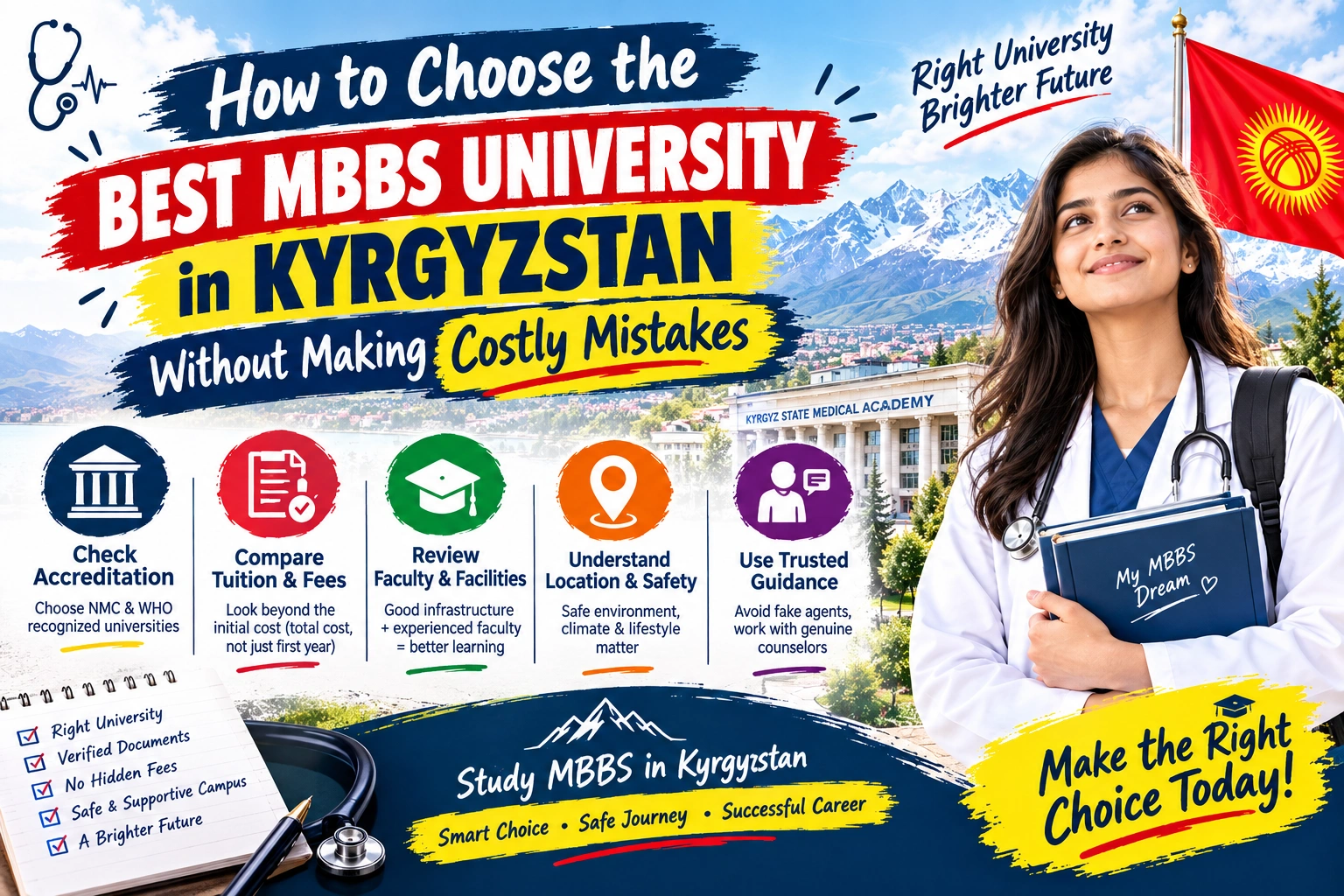

The vast majority of students planning to apply for MBBS in Kyrgyzstan initially only set three core screening criteria for university selection:
Tuition fees
University rankings
Qualification accreditations
They often only think to prioritize clinical internship resources at a late stage of the university selection process.
In fact, clinical internship resources should receive the same level of attention as tuition fees and rankings when choosing a school, as they are the core factor that truly shapes the practical value of a student’s medical degree.
Clinical internship refers to opportunities to engage in hands-on contact with patients, accumulate compliant training hours at hospitals, and access diverse case studies during coursework.
It directly determines a graduate’s level of preparation to enter the medical workforce.
The quality of clinical internship resources varies drastically across Kyrgyzstan’s medical universities, and these gaps stem primarily from three core differences between schools:
Their pool of cooperative hospital partnerships.
Class sizes.
Teaching models.
To meet the needs of readers seeking quick university selection references, I first put forward the core conclusion:
The first-tier medical universities in Kyrgyzstan with the strongest clinical internship resources are the Kyrgyz State Medical Academy (KSMA) and the Kyrgyz-Russian Slavic University (KRSU).
The core advantage of these two schools is their long-term, stable cooperation with major public teaching hospitals in the capital, Bishkek.
Osh State Medical University is also able to provide solid clinical training for its students, thanks to its stable partnerships with core regional hospitals.
If you wish to independently assess whether a university’s clinical resources match your needs, you should focus on verifying three core indicators:
The qualification level of the university’s affiliated cooperative hospitals.
The volume of patients those hospitals receive.
Their department rotation system.
The core value of clinical internship lies in turning classroom theory into actionable practical skills.
High-quality clinical training brings four clear benefits to students pursuing an MBBS in Kyrgyzstan:
It enhances personal confidence and practical abilities during the internship period.
Improves performance in professional licensing exams such as FMGE/NEXT.
Lays a solid ability foundation for postgraduate further study.
Speeds up graduates’ adaptation to real hospital work environments.
I must emphasize that a degree from a university that only holds elite accreditation but has weak clinical training has extremely low practical value.
To accurately assess the quality of a university’s clinical training, you must break down the evaluation along four dimensions:
Hospital partnership qualifications.
Student-teacher ratio.
Rotation system.
Internship quality control.
For example, the student-teacher ratio is directly linked to the amount of individual hands-on practice opportunities a student can access during rotations, and every dimension follows a clear, actionable assessment logic.
Clinical Training Comparison of Top Medical Universities
This review covers the detailed allocation of clinical internship resources at 6 medical universities across Kyrgyzstan, and the unique circumstances of each institution are introduced one by one below.
Kyrgyz State Medical Academy (KSMA)
Kyrgyzstan State Medical Academy (KSMA), located in the capital Bishkek, is the oldest medical higher education institution in the country.
It has maintained decades of stable cooperative ties with multiple public hospitals in Bishkek, and has built a mature, comprehensive clinical training network.
Kyrgyz-Russian Slavic University (KRSU)
Kyrgyz-Russian Slavic University (KRSU) operates under a joint Kyrgyz-Russian education model, with a standardized clinical rotation system, and its students consistently earn excellent scores on the FMGE medical licensing examination.
Osh State Medical University
Osh State Medical University, situated in the southern city of Osh, carries out its cooperation programs relying on local regional hospitals, and uses small-class instruction to provide students with personalized clinical mentorship.
Jalal-Abad State Medical University (JASU)
Jalal-Abad State Medical University (JASU) partners with the local regional hospital in Jalal-Abad; with a smaller operational scale than peer institutions in Bishkek, it can foster a close-knit hands-on learning environment for its students.
International School of Medicine (ISM)
The International School of Medicine (ISM) focuses on training international students, and its current clinical cooperation network remains in continuous expansion.
Asian Medical Institute (AMI)
The Asian Medical Institute (AMI) collaborates with regional hospitals surrounding Bishkek, including the hospital in Kant, and has long emphasized that in-class theoretical learning must be deeply integrated with clinical practical training.
A structured comparative summary table is attached at the end of this section, which sets four core dimension columns:
Institution name.
Nature of cooperating hospitals.
Class size during clinical years.
Core strengths.
All information in the table corresponds one-to-one with the preceding descriptions of each university, and can clearly present the differences in clinical internship resources across all institutions.
Admission and Eligibility
Before submitting your application to medical schools in Kyrgyzstan, we have compiled two core categories of application reference information to help you reduce the information screening costs associated with your overseas study application.
During the school selection stage, you must place equal priority on verifying clinical training quality and comparing tuition fees.
When assessing clinical quality, you need to check 5 items as required by the checklist.
Do not rely on vague generalized promotional content, and must confirm core details including:
The university’s directly affiliated teaching hospitals.
The length of clinical rotations for upper-year students.
Other key information.
For MBBS program admission, there are also 5 mandatory eligibility requirements, covering:
Academic background.
Score requirements.
Age limits.
A passing NEET score.
The language rule for English-taught programs that exempts applicants from submitting IELTS or TOEFL scores.
Admission Process
For Indian candidates applying to pursue an MBBS in Kyrgyzstan, we have compiled an 8-step linear admission process:
First, screen universities accredited by the NMC and WHO with strong clinical reputations.
Confirm NEET-UG eligibility.
Submit the application and academic materials.
Receive the official admission offer letter.
Process a student visa.
Pay tuition fees directly to the university’s official account.
Travel to Kyrgyzstan to complete local registration.
Start academic studies after participating in new student orientation.
Special Reminder
Candidates must verify a university’s cooperating hospital resources during the application stage, and must not wait to confirm this information only after enrolling.
In addition, we have attached the annual tuition breakdowns for 6 local medical universities that focus on clinical training, with costs listed in both US dollars and Indian rupees for reference.
Tuition Fees and Cost Warning
To all Indian international students planning to pursue an undergraduate medical degree (MBBS) in Bishkek and other locations in Kyrgyzstan, we first issue a critical reminder to pay close attention to the cost risks of studying abroad.
Before submitting your applications, you must verify:
The full breakdown of total tuition fees.
All clinical-related additional fees with your intended universities.
The official clinical training accreditation of these institutions.
To avoid problems such as hidden charges or non-compliant institutional qualifications.
Advantages and Disadvantages
Next, we break down the core study-abroad related information.
First, we outline:
5 core advantages of programs with strong clinical exposure.
As well as:
4 common drawbacks of programs with weak clinical exposure.
Currently, there are 4 top local clinical training universities that meet diverse student needs:
KSMA.
KRSU.
Osh State Medical University.
JASU.
Each university’s clinical training scenarios align with different study goals.
For example:
Students focusing on taking U.S. or European medical licensing exams should prioritize universities connected to overseas hospital training resources.
Students who plan to return to India to take the FMGE or NEXT exams can choose universities that arrange their training to align with the syllabus of India’s national medical licensing exams.
Career Opportunities
Clinical training affects your career trajectory across 4 core dimensions:
The pass rates of various licensing exams including FMGE/NEXT, USMLE, and PLAB.
The priority you receive in hospital recruitment after returning to India.
Your application competitiveness for overseas postgraduate study.
Your initial competency to practice independently.
Our core university selection principle is that when choosing a school, the quality of its clinical training must be weighted as equally important as the total cost of your study abroad program.
Frequently Asked Questions
Finally, we have compiled and answered the 6 most frequently asked questions from students, covering core decision-making uncertainties such as:
The key dimensions for university qualification verification.
The advantages and disadvantages of universities of different scales.
This resource aims to eliminate all information gaps you may have before applying, and help you smoothly advance your study abroad application process.
Conclusion
For Indian applicants planning to pursue an MBBS in Kyrgyzstan, we provide the following supplementary clarification:
The total cost of the six-year program is 2.5 to 3.5 million Indian Rupees, which covers tuition, accommodation, and living expenses, and clinical training is also included in standard tuition fees.
Many people often raise the question:
Do Private Universities Have Weaker Clinical Internship Resources Than Public Universities?
In fact, some private universities have proactively built hospital partnership networks, while the cooperative systems of long-established public universities are more mature.
The core school-selection factor that is most easily overlooked is clinical exposure.
KSMA and KRSU have extensive hospital partnerships and structured training.
Osh State and JASU offer personalized small-group clinical experiences.
When choosing a school, you must not rely solely on rankings.
You need to research:
Hospital partnerships.
Rotation structures.
Internship quality.
As a solid clinical foundation directly determines the confidence and competence of graduates in their future medical practice.