Introduction
Kyrgyzstan has become one of the most popular destinations for Indian students who wish to pursue an MBBS abroad. This is due to the fact that it offers relatively low cost medical education, modern infrastructure, allied health and medical education infrastructure, and ample exposure to clinical practice. While the cost of education and ranking of universities is of utmost importance, one of the most important components of medical education is internship and clinical training.
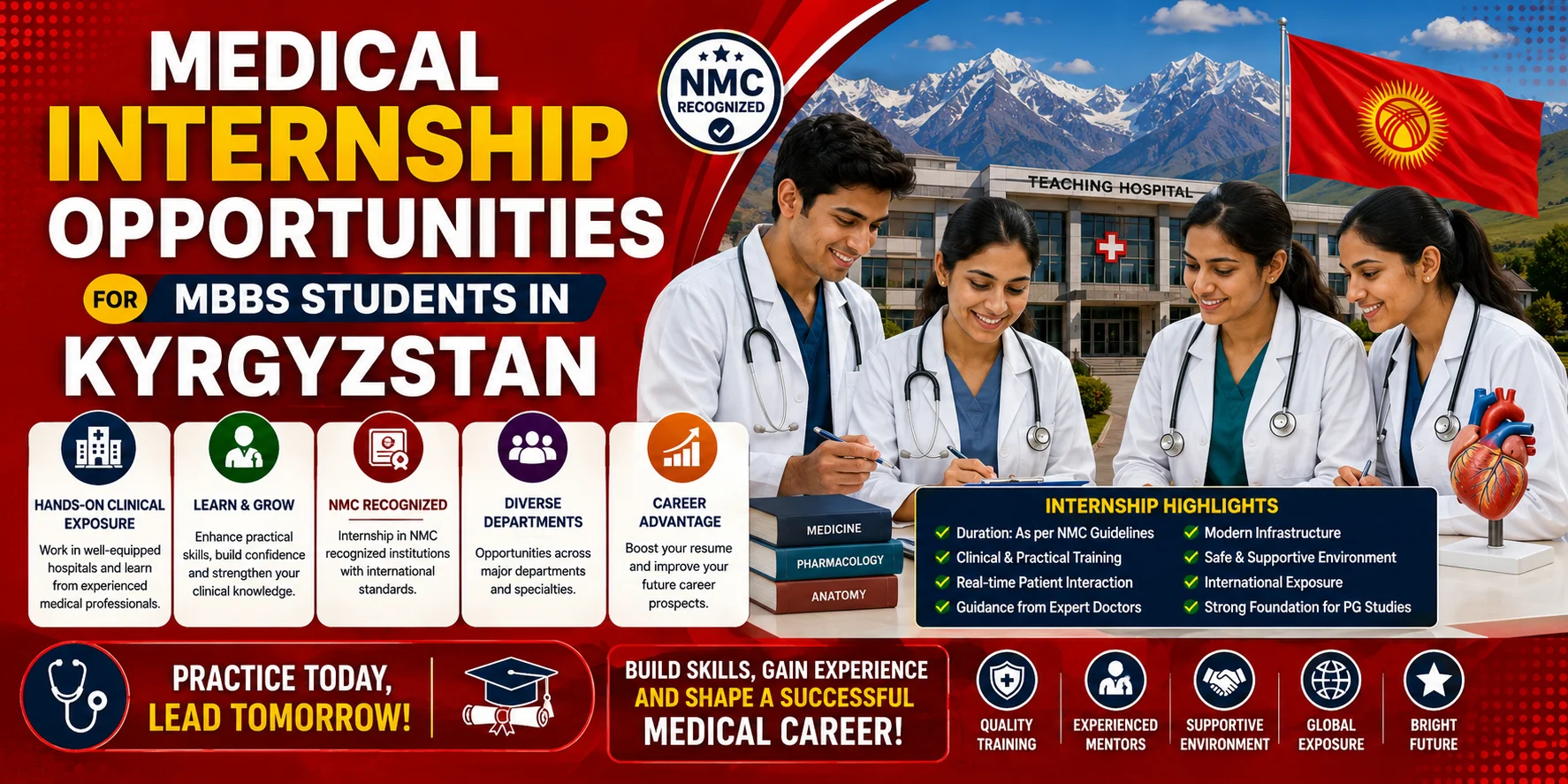
Medical internships are an important part of medical education. This is where students first begin to bridge the gap between theory and practice in the care of patients. Students have the opportunity to bring the knowledge and skills that they have learned in the classroom and apply it to a clinical setting. This is done under the supervision of practicing medical professionals. It is important for students who wish to pursue an MBBS in Kyrgyzstan to know about the internship opportunities, as clinical exposure will greatly affect your chances of getting a good job in the future.
Many students who are interested in information about the admission process for MBBS in Kyrgyzstan, Kyrgyzstan MBBS colleges for Indian students and the MBBS fees in Kyrgyzstan tend to overlook the importance of internship training. However, the quality of clinical practice during medical education will have a lasting impact on one’s professional practice, self-confidence, and professional competence.
The purpose of this comprehensive guide is to offer insights into the internship opportunities for students who are studying in Kyrgyzstan medical colleges, the structure of clinical training and placement, and the importance of practical training and professional exposure in the development and growth of medical professionals.
Understanding the Importance of Medical Internships
Medical education goes beyond theory and encompasses a vital component of practical education. While practical training aids in and supports the development of the skills requisite to effectively diagnose and treat patients, theory is the backbone of medical education.
Internships help students to:
Watch how doctors work.
Assist with care given to patients.
Work on making better and faster clinical decisions.
Learn to communicate better.
Understand how things are done in the hospitals.
Know the systems healthcare operates in.
Understanding the importance of internships in the medical field is vital for students looking to do their MBBS in Kyrgyzstan. Internships are almost the last step to getting an experience that is a prerequisite to starting a career in medicine. Clinical training is a great way to garner the confidence and experience to deal with the healthcare system, patients, and most importantly work in a healthcare team.
Why Kyrgyzstan is a Great Option for MBBS with Clinical Exposure
The rise in popularity for studying MBBS in Kyrgyzstan stems from a focus on learning beyond the classroom.
The medical universities in Kyrgyzstan have built relationships with teaching hospitals and healthcare centers, allowing students to undergo clinical training during their studies.
In contrast to the wholly theoretical programs, many medical colleges in Kyrgyzstan provide students with early exposure to the hospitals. This enables students to build their confidence in clinical work as they progress through their studies.
The students gain exposure to:
General Medicine
Surgery
Pediatrics
Gynecology
Emergency Medicine
Internal Medicine
Community Healthcare
All of the above assists students in preparation for the medical licensing and practice.
Clinical Training During MBBS in Kyrgyzstan
Typically, clinical training for the MBBS in Kyrgyzstan begins after students have completed the introductory years of the program that are focused on the basic medical sciences.
The early years of the program are comprised of studies in:
Anatomy
Physiology
Biochemistry
Histology
Pathology
Pharmacology
As students advance in the program, they are placed in clinical departments to begin their first interactions with patients and other healthcare practitioners.
This system of progressing through the program ensures that students are adequately prepared and have theoretical knowledge prior to beginning clinical training.
Numerous Kyrgyzstan MBBS programs utilize a combination of teaching strategies to ensure students learn important concepts and develop useful skills.
MBBS Duration in Kyrgyzstan and Internship Structure
When many students think about studying abroad to receive their MBBS, one of the first things they want to know is, “How long is the MBBS program in Kyrgyzstan?”
The MBBS program in Kyrgyzstan is made up of both the academic portion and the clinical portion. The students participate in a variety of interactive learning sessions, participate in site visits, and complete clinical rotations.
When considering:
MBBS duration in Kyrgyzstan
MBBS course duration in Kyrgyzstan
MBBS in Kyrgyzstan duration
Kyrgyzstan MBBS duration
Students are encouraged to look at the MBBS portion of the programs to see how practical training is integrated in the programs.
Teaching Hospitals Associated with Medical Universities
Access to teaching hospitals strongly impacts the quality of the internship.
The top Kyrgyzstan medical colleges for Indian students have affiliations with government hospitals, specialized hospitals, and regional medical centers.
These hospitals help students:
Watch and participate in patient encounters.
Participate in ward rounds.
Participate in clinical talk rounds.
Practice clinical skills.
The relationships with hospitals help the students develop skills to participate in the medical field.
The strength of hospitals often plays a role in which cuts are chosen by students applying to Kyrgyzstan MBBS schools.
Internship Opportunities at Kyrgyzstan International School of Medicine
International School of Medicine Kyrgyzstan is one of the popular schools, especially for Indian students.
ISIM focuses on practical skills to complement classroom learning.
Students become familiar with clinical practice by way of patient contact in our partner hospitals. Clinical practice covers contact with:
Internal Medicine
Surgery
Pediatrics
Obstetrics and Gynecology
Emergency Medicine
These services help students develop the skills and competencies necessary to complement theoretical studies.
Clinical Learning Opportunities at JAIU Kyrgyzstan
Another medical institution that many international applicants are interested in is JAIU Kyrgyzstan.
Medical students at least have access to clinical training and teaching practice at this institution.
The university focuses on learning through teaching and uses clinical practice to enhance diagnostic and patient management skills.
For students who are comparing a number of medical colleges in Kyrgyzstan, the clinical opportunities on offer are just as important as the cost of tuition.
Benefits of Early Hospital Exposure
Among the many advantages that an Indian student pursuing an MBBS in Kyrgyzstan has is the availability of early clinical exposure.
Early clinical exposure leads to a number of important life skills:
Confidence
Understanding patient care
Communication skills
Clinical judgment
Knowledge of the workings of a hospital
Students who have early clinical exposure have a better chance of adapting to the clinical practice of medicine as compared to students who lack early clinical exposure.
Early clinical exposure helps integrate the theoretical components of the practice of medicine.
Learning from Diverse Medical Cases
The teaching hospitals in Kyrgyzstan are well equipped to provide students the opportunity to learn about a variety of medical conditions.
Learning about a variety of cases improves the following:
Clinical judgment
Diagnosis and management of patients
Knowledge of the course of a disease and its treatment
Advanced thinking
The exposure that students of medicine have is unparalleled.
A key part of medical education is learning how to manage clinical variety, because once students begin working, this is something they will regularly encounter. Learning with real patients is the best way to improve one’s clinical skills.
Significance of NMC Compliance in Clinical Education
For Indian students, taking the NMC (National Medical Commission) into account is a priority when choosing a medical school. Medical education has to meet specific standards, and clinical education is a key component in this. Students need to check:
the way the school will partner with hospitals,
the way practical training will be organized,
opportunities for clinical rotations and
arrangements for internships.
Schools that provide students with clinical training are often better able to assist students in realizing their professional aspirations.
Due to their relevance to the NMC, students need to thoroughly assess opportunities before they apply for internships.
Recognition by WHO and WDOMS and Clinical Training
Recognition is still an important part of choosing a medical school. Students interested in MBBS programs in Kyrgyzstan need to check if the medical schools are listed with the WDOMS, and if the schools are compliant with the standards of medical education.
Having recognition is important for legitimating the medical degree, and it is a reflection that the medical school is committed to providing quality education.
There are several Kyrgyzstan medical schools that are recognized, and they are modifying their Clinical Training programs in ways that meet or exceed their expectations.
Key Skills that are the Result of Practical Training
There are numerous skills that medical students develop during their training, some of which are:
Interviewing patients
Performing clinical exams and observations
Having an understanding of work-related procedures
Having an understanding of medical notes
Working in a medical team
Having an understanding of basic medical procedures
All of the skills listed above are fundamental to the practice of medicine.
For students who pursue their MBBS in Kyrgyzstan, having this practical clinical training is essential for developing the practice of medicine.
The Importance of NEET in Career Preparation
While most students are busy learning the ins and outs of the admission process, planning for their future careers is of equal importance.
Indian students hoping to pursue MBBS in Kyrgyzstan need to understand how NEET affects their future educational and professional endeavors.
Future planning helps students to make informed decisions, such as:
The university they will attend
The training they will undergo
The exams they will take
The careers they will pursue
The best way for students to make the most of their medical training is to plan early.
The Impact of Internships on Career Opportunities
Clinical training has a major impact on employability upon graduation.
Employers in the health field are looking for graduates with:
Developed clinical skills
Many experiences
Confidence and
Communication skills
Those students who take full advantage of their internship opportunities are the most prepared for the medical duties they will have in the future.
Internships and Future Opportunities
When students are comparing the costs of pursuing their MBBS in Kyrgyzstan, they should pay attention to the quality of the clinical education included in the medical school.
Many students pay attention to:
The fees for the MBBS in Kyrgyzstan
The fees for Kyrgyzstan medical colleges
The fees for Kyrgyzstan MBBS in Indian Rupees
The MBBS in Kyrgyzstan for Indian students
However, the value of physical training often exceeds the cost of the tuition.
A school that offers the best clinical training may have a higher tuition and offer better training than a school with lower tuition.
Looking at the Total Price of Studying MBBS in Kyrgyzstan
The overall cost for pursuing MBBS in Kyrgyzstan goes beyond the tuition.
Students should pay attention to:
The cost of clinical education
Training and support services
The costs of living and studying
Opportunities for clinical training
The fee structure of MBBS in Kyrgyzstan should be looked at with the educational standards.
Choosing a university in Kyrgyzstan because of the low medical fees may not be the best long-term choice.
Future Doctor Salary and Clinical Training
One of the things students looking into studying abroad for medicine are interested in are the Kyrgyzstan doctors' salary and future earnings.
Salary will differ based on field of interest, where you work, how long you've worked, and your qualifications, but strong clinical skills are also important for the success of your career.
Students that have substantial practical training are more likely to succeed in their careers and be ready for the more demanding aspects of medicine.
The Value of Clinical Exposure
Healthcare continues to grow increasingly complicated. Because of this, doctors need to be able to combine their theoretical education with practical skills, effective communication, and clinical reasoning.
This is why the Medical schools in Kyrgyzstan focus on strengthening their internships.
Practical education is crucial for the preparation of future doctors.
Students that commit to furthering their clinical education are the ones that gain invaluable experiences that cannot be found in a book.
Conclusion
Practical training is what defines the competence and the confidence of the future doctors.
Students that are pursuing their MBBS in Kyrgyzstan for Indians are the ones that receive the most benefit from having built in clinical exposure, partnerships with hospitals, and organized instruction from healthcare professionals.
Medical schools in Kyrgyzstan, including the International School of Medicine Kyrgyzstan and JAIU Kyrgyzstan, are continually improving their internship and clinical training programs to better align with international standards.
When looking for the best universities in Kyrgyzstan for MBBS, students cannot consider only the MBBS in Kyrgyzstan fees. Students should analyze the quality of the clinical education, the ties to teaching hospitals, internship placements, and other factors such as WHO recognition, WDOMS recognition, and NMC and NEET requirements.
Quality internship placements help students learn and practice the skills they need to become successful doctors. The MBBS programs in Kyrgyzstan that provide quality clinical training will prepare graduates to meet the challenges of an evolving global health care system and help them succeed in their professional practice and make a real contribution to the health care system.