A student scores 190 in NEET-UG 2026 and receives an admission offer from a medical university in Kyrgyzstan. The university is ready. The family is ready. But is the student eligible under Indian rules? For an unreserved applicant in 2026, no—the reported minimum qualifying score is 213. That one detail changes the entire admission decision. Indian students planning MBBS in Kyrgyzstan need to understand that foreign university admission and Indian regulatory eligibility are separate. A Kyrgyz institution may offer a seat based on Class 12 marks, while India’s rules can still require NEET qualification for students intending to return and seek medical registration. Let’s make the distinction clear.
Is NEET Compulsory for MBBS in Kyrgyzstan?
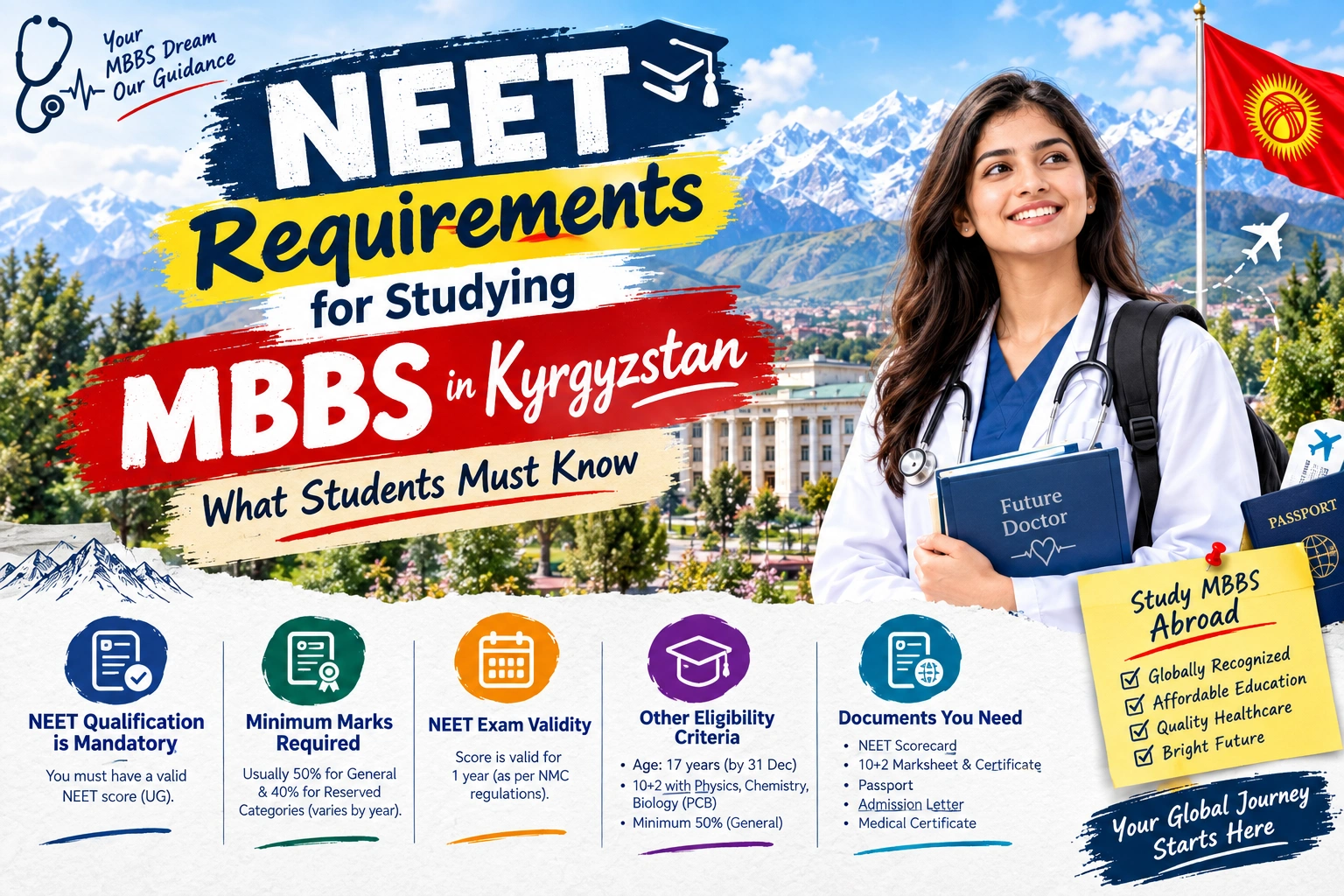
Yes, Indian citizens and Overseas Citizens of India who plan to obtain a primary medical qualification abroad generally need to qualify NEET-UG under the applicable regulatory framework. The foreign university may not always demand a high NEET score for its own admission decision. Some institutions primarily assess Class 12 science marks, passport details, and an interview. But that doesn’t remove the Indian requirement. Students should use the official NEET portal to download the information bulletin, scorecard, result notice, and qualifying criteria. Don’t rely on an admission agent saying, “The university doesn’t ask for NEET.” The university’s checklist is only one part of the story. NEET matters because it is connected with the Indian student’s eligibility to pursue foreign medical education and later enter the registration process in India.
NEET-UG 2026 Qualifying Cutoff
The 2026 qualifying cutoff rose considerably compared with the previous examination cycle. According to the cutoff information released with the result, the minimum qualifying score for the General and EWS categories was 213, while the minimum for OBC, SC, and ST candidates was 177.
Category | Required percentile | NEET-UG 2026 score range |
General/Unreserved | 50th percentile | 715–213 |
EWS | 50th percentile | 715–213 |
OBC | 40th percentile | 212–177 |
SC | 40th percentile | 212–177 |
ST | 40th percentile | 212–177 |
PwBD categories | As officially prescribed | Verify from the NTA result notice |
The lower number in each score range is the relevant minimum qualifying mark. A General-category student with 212 marks, for example, would fall below the stated 2026 qualifying cutoff. PwBD candidates should check their exact category-specific range from the official NTA result document rather than using a general table copied across admission websites. This part is simple. Your scorecard should clearly indicate whether you qualified.
Qualifying NEET Is Different From Getting an Indian Medical Seat
Here’s where many parents get confused. A student with 250 marks may qualify NEET in 2026 but won’t ordinarily secure a government MBBS seat in India through regular competition. The admission cutoff for a government college can be far higher than the basic qualifying mark. Foreign medical admission doesn’t generally require a 600-plus NEET score merely because the course is medicine. For MBBS in Kyrgyzstan, the student usually needs to satisfy the officially declared qualifying standard, the university’s eligibility conditions, and all requirements applicable to foreign medical graduates.
Think of the difference this way:
NEET qualifying cutoff: Establishes basic qualification under the examination rules.
Indian college admission cutoff: Depends on rank, category, state, quota, college, and counselling round.
Foreign university requirement: Depends on its own academic and admission policy.
NMC compliance: Depends on the student and the complete foreign medical programme.
Four checks. Not one.
Class 12 Eligibility Still Applies
NEET qualification doesn’t correct weak or ineligible Class 12 subjects. Indian applicants generally need Physics, Chemistry, Biology or Biotechnology, and English from a recognised board. Under the commonly applicable framework, General-category students require at least 50% aggregate marks in PCB. Eligible SC, ST, and OBC applicants generally require 40%, while PwBD requirements may vary. The applicant should ordinarily be at least 17 years old by December 31 of the admission year. Individual universities may set higher PCB requirements or examine subject-wise marks. A student can qualify NEET and still face an academic eligibility problem if the required subjects or marks are missing. Check both before paying.
How Long Is the NEET Result Valid for Foreign Admission?
NEET results have generally been treated as valid for three years from the date of result declaration for students pursuing medical education abroad, including any pre-medical or language programme followed by the medical course. Students should still verify the current position through the National Medical Commission and their 2026 NEET documents before admission. Why does this matter? A student may qualify NEET, take a gap year, and apply abroad later. The score may remain usable within the permitted period, but the student shouldn’t assume unlimited validity. Keep the original scorecard, application number, admit card, and result notice. Screenshots alone aren’t ideal. Download the official PDF.
Can a Student Take Admission Without NEET?
A Kyrgyz university might process an international application without using NEET as its own entrance examination. That doesn’t make the route safe for an Indian student planning to return. Taking admission without the required NEET qualification may affect the student’s future eligibility for the Indian licensing and registration process. A representative promising that the issue can be “managed after graduation” is offering a very risky assumption. Honestly, this is not the place for creative interpretation.
If you haven’t qualified NEET:
Don’t make a non-refundable university payment.
Don’t rely solely on the foreign university’s admission criteria.
Check the NMC rules applicable to your case.
Consider appearing for the next NEET examination.
Obtain advice from an authorised regulatory source if your situation is unusual.
A foreign admission letter cannot replace Indian eligibility.
Does Kyrgyzstan Conduct a Separate Medical Entrance Exam?
Many Kyrgyz medical universities assess international applicants through Class 12 records, passport documents, and an interview. Some may conduct an internal English or basic science assessment. There usually isn’t one common national medical entrance examination for all Indian applicants comparable to NEET. Admission policies vary by institution, so students should ask whether the 2026 intake requires an online interview, biology test, English assessment, or document-based screening. Universities commonly researched by Indian students include Kyrgyz State Medical Academy, Kyrgyz Russian Slavic University, Osh State University, and International Higher School of Medicine. The exact requirements, programme language, fee, and duration should be confirmed directly. Easy university admission doesn’t mean easy medical education. Anatomy arrives either way.
NEET Qualification Doesn’t Guarantee NMC Compliance
This is the most important distinction in the article. A student may qualify NEET and still select a foreign programme that doesn’t meet Indian regulations. Before choosing MBBS in Kyrgyzstan, examine the Foreign Medical Graduate Licentiate Regulations and later NMC clarifications. Students need to verify areas such as:
Duration of medical education
Required subjects
English-medium instruction
Physical clinical training
Internship duration and location
Institution awarding the qualification
Eligibility for a medical licence in Kyrgyzstan
Programme structures may be advertised as five years, five-plus-one years, or six years. Don’t accept a verbal explanation. Request a semester-wise curriculum and internship rule from the university. NEET gets you past one eligibility gate. The medical programme must still pass several others.
Recognition Claims Students Should Check
A medical school appearing in the World Directory of Medical Schools is a useful directory check. WDOMS states that inclusion doesn’t itself mean recognition, accreditation, or endorsement. The World Health Organization also doesn’t issue an individual university approval that automatically guarantees registration in India. The phrase “WHO approved” is often used loosely in admission marketing.
Indian students should independently verify:
The university’s legal status in Kyrgyzstan
Accreditation of the specific medical programme
WDOMS directory information
Internship and clinical training
Local registration eligibility
Compliance with current NMC regulations
A student can qualify NEET, join a WDOMS-listed institution, and still encounter problems if the actual programme structure is unsuitable. That’s why every level needs checking.
When Should Students Apply for the 2026 Intake?
Applications for the main autumn intake commonly begin between May and August, although some universities continue accepting students into September. Exact dates differ. Since the 2026 NEET result and qualifying cutoff have been released, qualified students can proceed with university comparison and document verification. Still, don’t choose in a hurry merely because someone says seats are disappearing.
The normal timeline may look like this:
Stage | Typical period |
NEET result and eligibility check | After official result |
University research | June–August |
Application and interview | June–September |
Offer and fee payment | July–September |
Invitation and visa | August–October |
Travel and reporting | According to university calendar |
Late intake can create problems with attendance, visa processing, and hostel allocation. Ask for the official academic start date.
Documents Needed Along With the NEET Scorecard
The scorecard is important, but it isn’t the whole file. Applicants commonly need:
Passport
Class 10 marksheet and certificate
Class 12 marksheet and certificate
NEET-UG 2026 scorecard
NEET admit card, where requested
Passport-size photographs
Medical fitness certificate
HIV test report, if prescribed
Birth certificate
University application form
Police clearance, where required
Parent or sponsor documents
Check that names and dates match. A middle name missing from the NEET scorecard or a different spelling in the passport can create verification questions. Don’t edit documents yourself. Use the authorised correction or affidavit procedure where necessary.
Approximate Fees After NEET Qualification
Qualifying NEET doesn’t result in a scholarship automatically. The student must still plan the complete course budget. Tuition for MBBS in Kyrgyzstan may broadly range from USD 3,000 to USD 5,500 annually. Hostel fees may fall around USD 500–1,200 per year, while food and daily living expenses can cost approximately USD 130–300 per month.
Expense | Approximate range |
Tuition per year | USD 3,000–5,500 |
Hostel per year | USD 500–1,200 |
Monthly living costs | USD 130–300 |
Insurance and registration | Varies |
Visa and extension | Varies |
Flights | Depends on route and season |
A broad total programme estimate may reach ₹20–32 lakh or more. University, city, exchange rates, mess, travel, and personal spending affect the final amount. NEET score usually doesn’t change the university tuition. Some institutions may advertise merit concessions, but these should be confirmed in an official scholarship letter.
What Happens After Graduation?
Qualifying NEET before admission is only the beginning of the Indian regulatory journey. Eligible foreign medical graduates must satisfy NMC requirements and complete the licensing or screening process in force when they return. FMGE remains relevant in 2026. NExT regulations have been notified, although implementation developments should be followed through official announcements.
Students should begin exam-oriented preparation during the course:
Years 1–2: strengthen anatomy, physiology, and biochemistry.
Year 3: connect pathology, pharmacology, and microbiology.
Clinical years: practise case-based questions and images.
Final phase: revise all subjects and attempt full tests.
Internship: connect real patients with diagnosis and management.
NEET qualification opens the foreign-study route. It doesn’t guarantee FMGE or NExT success. Daily study does that part.
Common NEET-Related Mistakes
I’ve seen the same misunderstandings repeat:
Assuming “appeared in NEET” means “qualified NEET”
Using an old year’s cutoff
Confusing percentile with percentage
Believing foreign admission removes the NEET requirement
Paying before checking the scorecard status
Losing access to the registered email
Treating NEET qualification as proof of university compliance
Ignoring Class 12 PCB eligibility
Assuming the result remains valid forever
Check the word “qualified” on the official record. Don’t calculate eligibility from a social-media post.
Advantages and Limitations of the NEET Route
The main benefit is clarity. A qualified student can focus on comparing suitable foreign medical programmes without uncertainty over this basic Indian condition. The limitation is that NEET qualification alone says nothing about the quality of a Kyrgyz university. It doesn’t assess the institution’s hospitals, faculty, batch size, internship, or English-medium teaching. Students choosing MBBS in Kyrgyzstan still need detailed university research. The exam qualifies the student. It doesn’t approve of the college.
Frequently Asked Questions
What is the NEET-UG 2026 cutoff for foreign MBBS admission?
The minimum reported qualifying score is 213 for General and EWS candidates and 177 for OBC, SC, and ST candidates. PwBD applicants should verify their category-specific cutoff from the official NTA result notice.
Is merely appearing in NEET enough?
No. Indian applicants generally need to qualify the examination under the applicable criteria. Appearing without achieving the required percentile doesn’t establish qualification.
Can I use an older NEET score?
NEET results have generally been valid for three years for foreign medical admission. Confirm that your score falls within the permitted period and check current NMC directions.
Do I need NEET counselling for admission in Kyrgyzstan?
Foreign university admission is usually processed separately from Indian state or MCC seat counselling. Students still need the NEET qualification and must follow the foreign university’s admission procedure.
Does a higher NEET score reduce the university fee?
Usually not. Some universities may provide a genuine merit concession, but students should demand written scholarship terms rather than relying on verbal promises.
Can I practise in India after studying in Kyrgyzstan?
Eligible graduates may pursue the Indian licensing and registration pathway if their admission, programme, internship, degree, and clinical training meet NMC requirements.
Conclusion
For Indian students, NEET is the first filter—not the final approval. In 2026, General and EWS applicants need at least 213 marks under the declared qualifying range, while OBC, SC, and ST candidates need at least 177. Category-specific official records should always be checked. After that, examine the university. Course duration. Internship. Hospitals. Local licence eligibility. Fees. Every piece. Before confirming MBBS in Kyrgyzstan, match your NEET status and Class 12 eligibility with the complete NMC-related programme requirements. A qualifying score gets the conversation started. Careful university selection decides whether that conversation leads somewhere useful.