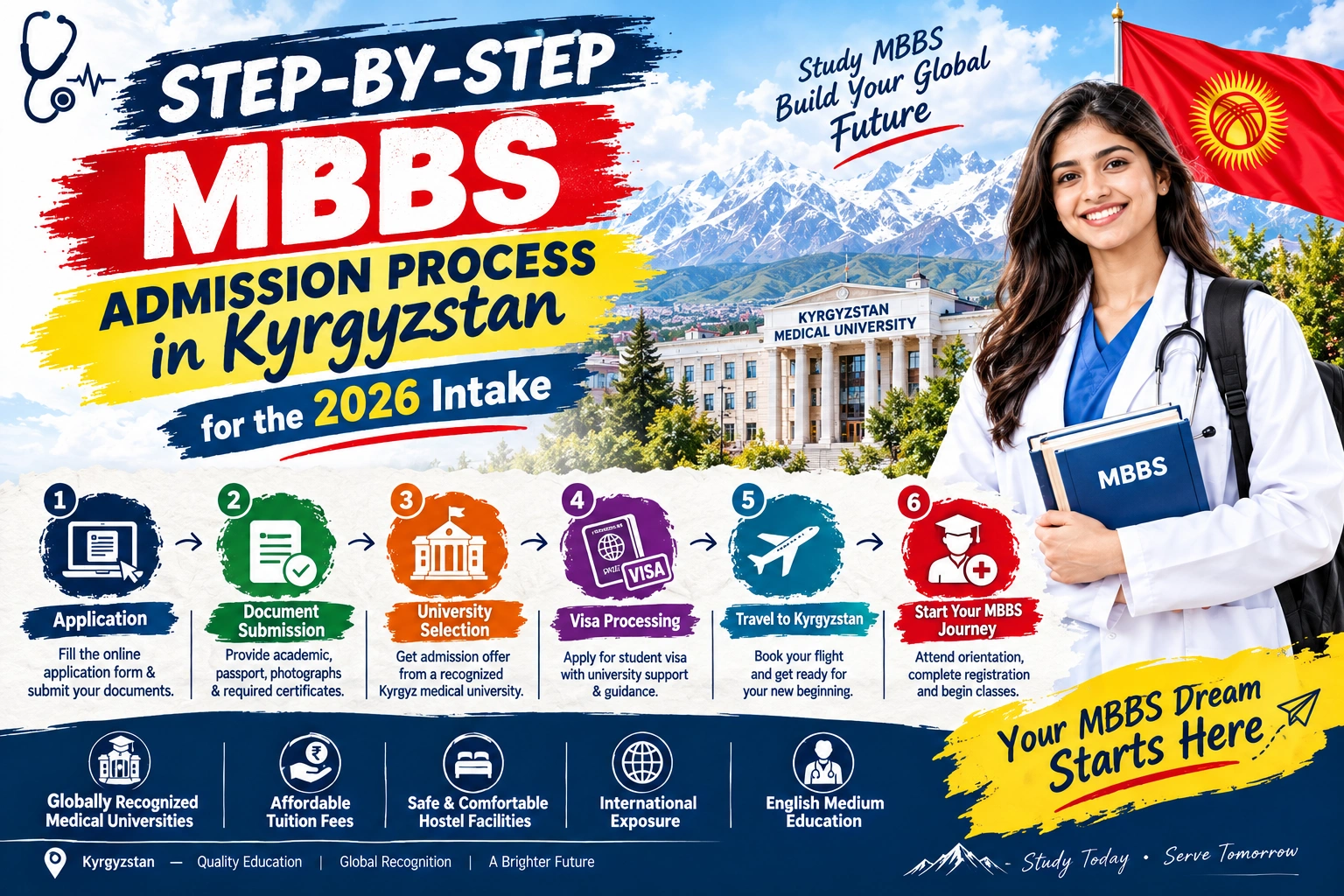
The admission message often sounds urgent: documents today, payment tomorrow, seat confirmed by evening. Convenient. Maybe too convenient. Applying for MBBS in Kyrgyzstan isn’t usually complicated, but the decision behind the application needs serious checking. A student must qualify academically, meet the NEET requirement, select a suitable medical programme, verify its duration and internship, submit genuine documents, pay through an authorised channel, secure the correct student visa, and complete registration after arrival. One skipped check can create years of trouble. So, slow down a little.
Step 1: Check the Basic Eligibility Criteria
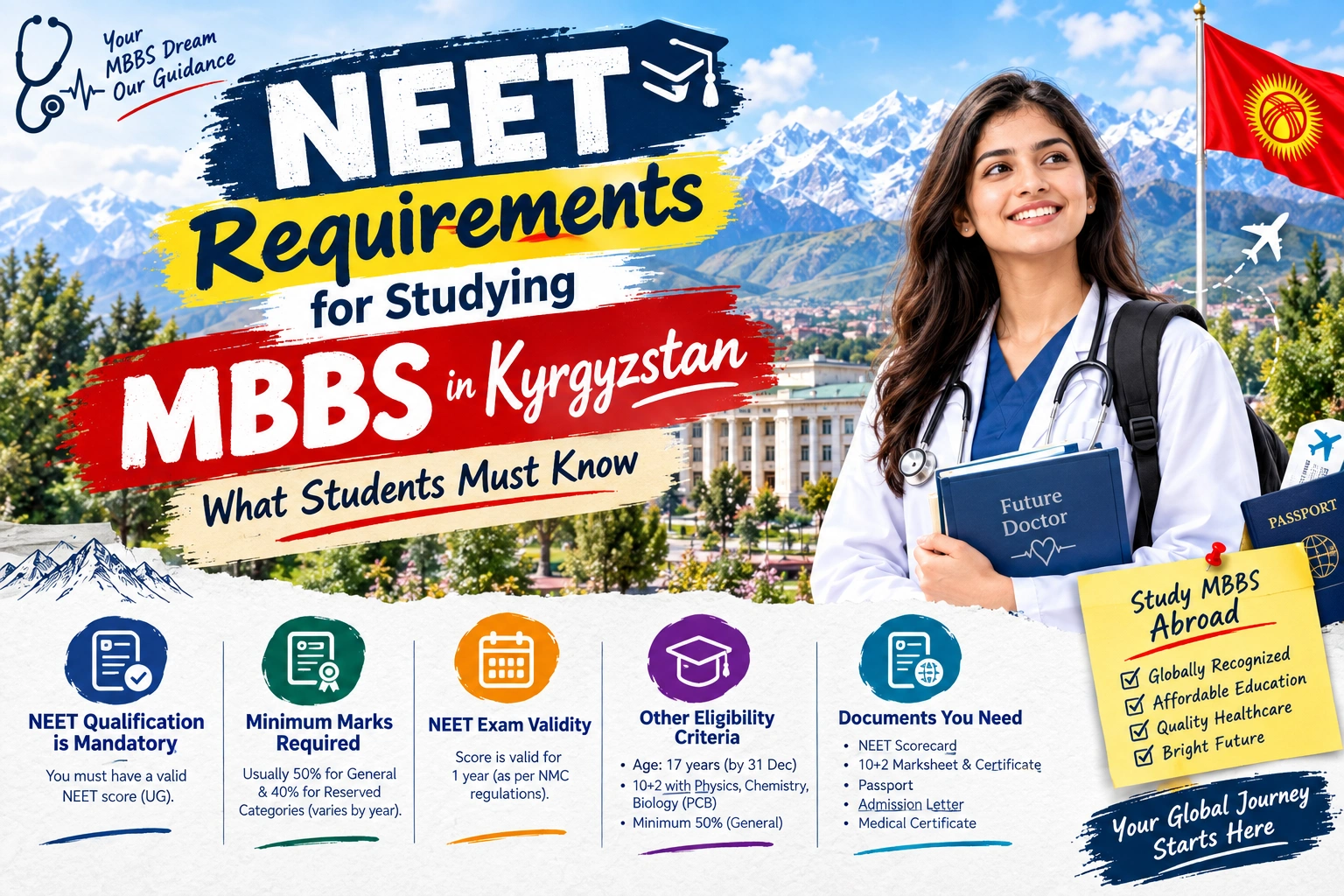
Can you apply immediately after Class 12? Usually, yes, if you have studied Physics, Chemistry, Biology or Biotechnology, and English from a recognised board. Under the commonly applicable eligibility framework, general-category Indian applicants require at least 50% aggregate marks in PCB. Eligible reserved-category candidates generally need 40%, while the requirements for PwD students may differ. Individual universities can also set higher academic expectations. The applicant should ordinarily be at least 17 years old by December 31 of the admission year. There is generally no upper age restriction imposed by the foreign university in the same way students sometimes expect, but Indian and university regulations applicable to the 2026 intake should still be checked. Some medical institutions may conduct an online interview or basic assessment. It can cover English communication, school-level science, and the student’s reason for choosing medicine. Nothing terrifying. Still, prepare.
Step 2: Qualify NEET-UG 2026
Here’s the non-negotiable part for most Indian applicants. Students seeking a primary medical qualification abroad and planning to pursue registration in India generally need to qualify NEET-UG under the applicable rules. The category-wise qualifying marks change every year. Use the official NEET website for the 2026 result, cutoff, bulletin, and related notices. Don’t use a previous year’s score as a permanent benchmark. A student doesn’t ordinarily need the extremely high marks required for admission to a popular Indian government medical college merely to apply abroad. The relevant starting point is the officially declared qualifying requirement, followed by all other foreign medical education conditions.
Keep these documents:
NEET application confirmation
Admit card
Scorecard
Result document
Registered email address
Application number and login records
Save them in more than one place. Six years later, one old PDF can become surprisingly urgent.
Step 3: Shortlist Universities Carefully
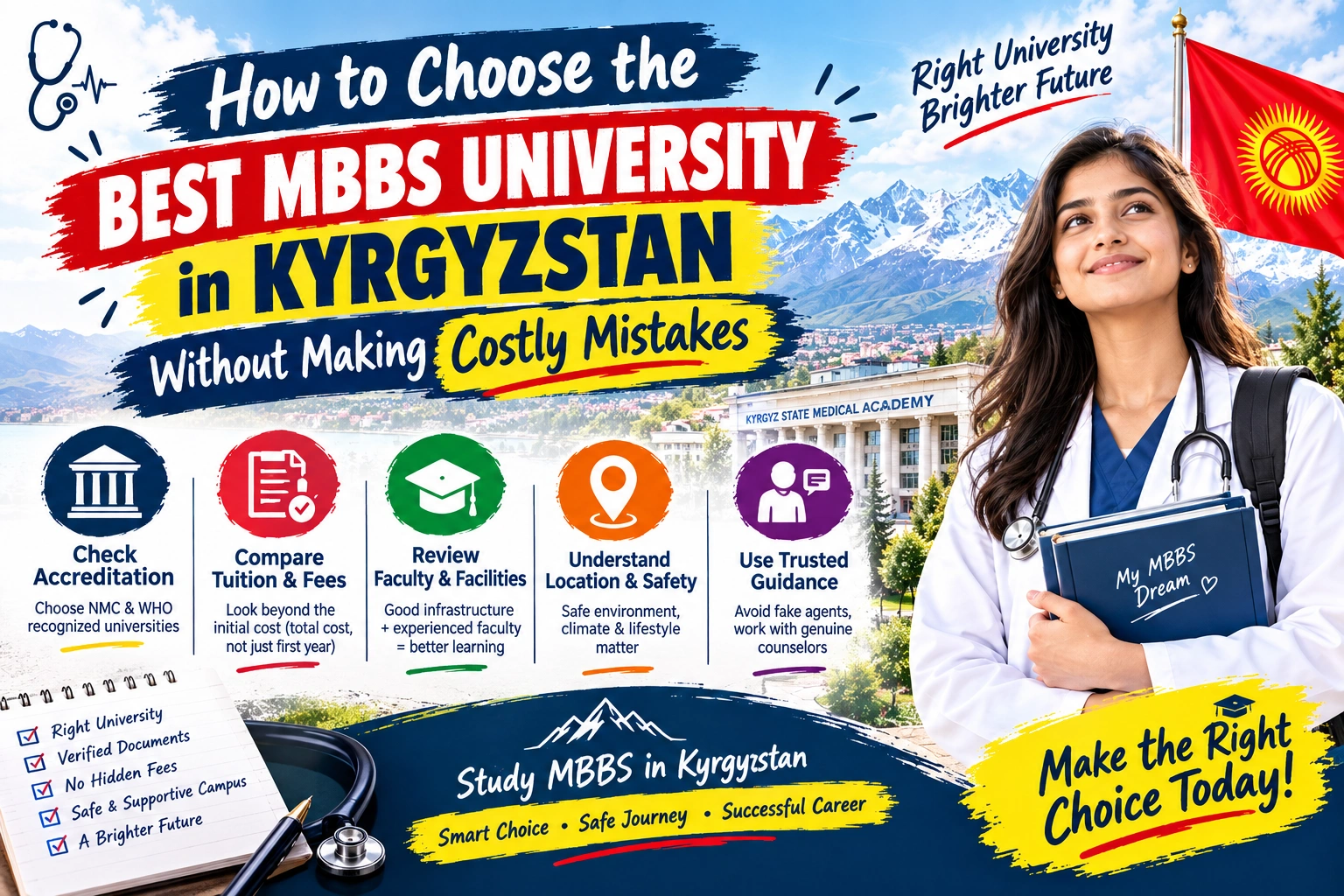
A low tuition fee is useful information. It is not a complete university review. Institutions commonly researched by students include Kyrgyz State Medical Academy, Kyrgyz Russian Slavic University, Osh State University, International Higher School of Medicine, and other public or private medical institutions in Bishkek, Osh, and nearby cities.
Students considering MBBS in Kyrgyzstan should compare universities on the following factors:
Selection factor | What to verify |
Legal status | Recognition by the relevant Kyrgyz authority |
Programme | General Medicine degree and exact awarding institution |
Duration | Academic study plus internship |
Language | English in lectures, examinations, and clinical teaching |
Hospitals | Names and frequency of clinical postings |
Batch size | Students per lecture and clinical group |
Local licence | Eligibility to pursue registration in Kyrgyzstan |
Fees | Full programme cost and annual increases |
Speak with students in the fourth, fifth, or final year. First-year students can describe admission and hostel life. They can’t properly evaluate internships or advanced clinical rotations yet.
Step 4: Check NMC-Related Course Requirements
Honestly, this is the stage families most often rush. The National Medical Commission publishes regulations and clarifications concerning foreign medical graduates. Indian applicants should check requirements related to academic duration, compulsory subjects, English-medium instruction, clinical training, internship, and eligibility to obtain a medical licence in the country where the degree is awarded. NMC doesn’t provide a simple permanent list that guarantees every course at every foreign institution. A phrase such as “NMC-approved university” shouldn’t end your investigation.
Ask the university for written confirmation of:
Total academic duration in months
Complete subject list
Internship length and location
Affiliated teaching hospitals
Medium of instruction
Degree title
Local registration eligibility
Whether any transfer is required
A five-year course may appear attractive because it costs less. If it doesn’t satisfy the requirements applicable to the student, that saving means nothing.
Step 5: Verify WDOMS and Local Accreditation
A medical school’s appearance in the World Directory of Medical Schools is a useful verification point. WDOMS itself states, however, that listing doesn’t constitute recognition, accreditation, or endorsement. Likewise, the World Health Organization works on international public health; it doesn’t issue an individual university approval that automatically guarantees Indian registration.
Students should verify:
The institution’s legal authority to operate
Accreditation of the specific medical programme
WDOMS directory information
Local licensing rights after graduation
Compatibility with current Indian regulations
One logo cannot answer all five questions. A brochure might suggest otherwise, but no.
Step 6: Confirm the Programme Duration and Internship
Medical programmes in Kyrgyzstan may be advertised as five years, five-plus-one years, or six years. Don’t calculate the duration from a consultancy poster. Request the official curriculum and academic calendar. It should show the number of semesters, teaching months, clinical rotations, examination periods, and internship arrangements. Before applying for MBBS in Kyrgyzstan, ask whether the internship is included in the fee package and whether it is completed at the same institution or its approved teaching hospitals. Confirm that the programme makes the graduate eligible to pursue a licence in Kyrgyzstan. If the representative says, “Internship will be arranged later,” ask for the university rule. No written rule? Keep looking.
Step 7: Calculate the Complete Cost
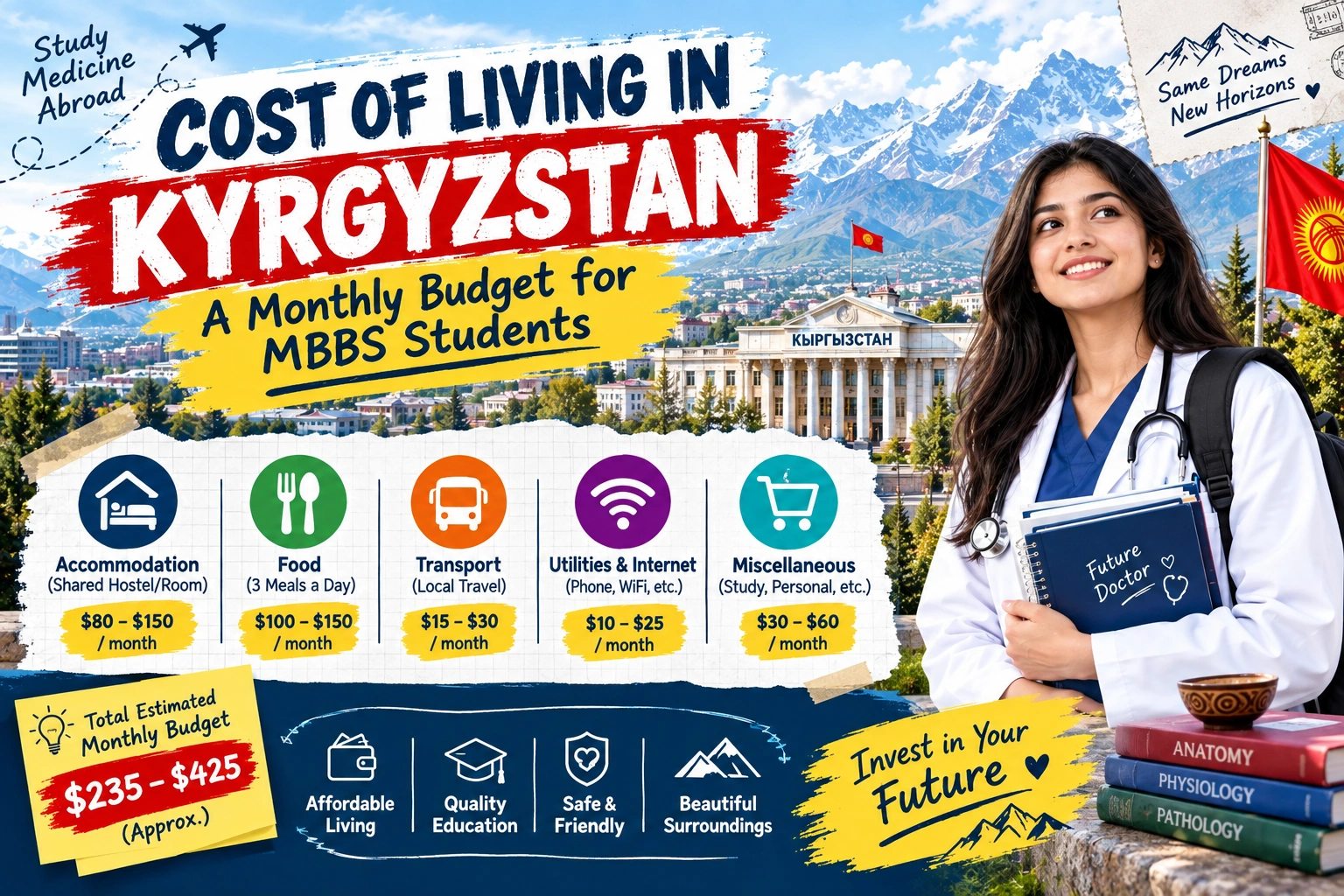
Fees are affordable. Often genuinely affordable. But not every quotation includes the same things. Annual tuition at many Kyrgyz medical institutions may broadly range from USD 3,000 to USD 5,500. Hostel charges can fall around USD 500–1,200 annually, while food and ordinary living expenses may cost roughly USD 130–300 per month.
Expense | Approximate range |
Annual tuition | USD 3,000–5,500 |
Hostel per year | USD 500–1,200 |
Food and living per month | USD 130–300 |
Insurance and medical tests | Varies |
Visa and annual extension | Varies |
Flights | Depends on route and season |
Books and initial setup | USD 200–500 approximately |
A complete programme budget may reach approximately ₹20–32 lakh or more, depending on the university, city, exchange rate, accommodation, travel, and lifestyle.
Check whether the quoted package includes:
Application charges
Invitation processing
Student visa
Annual visa extension
University registration
Medical insurance
Hostel deposit
Indian mess
Examination fees
Airport pickup
Consultancy services
Ask for an itemised fee sheet. “Total package” can hide a lot.
Step 8: Prepare the Application Documents
Now comes the paperwork. Universities commonly accept scanned copies during the initial stage and verify originals later.
Applicants may need:
Valid passport
Class 10 certificate and marksheet
Class 12 certificate and marksheet
NEET-UG scorecard
Passport-size photographs
Birth certificate, where requested
Medical fitness certificate
HIV test report, if required
Police clearance certificate, where applicable
Completed university application form
Parent or sponsor details
Bank or financial documents, if requested
Some documents may require notarisation, apostille, legalisation, or certified translation. Requirements vary by university and visa route, so obtain a personalised checklist. Check spelling carefully. Names, dates of birth, passport details, and academic records should match. “Md” in one record and “Mohammad” in another may lead to questions.
Step 9: Submit the University Application
The main application cycle commonly begins during spring or early summer for the autumn intake. Many institutions accept applications between May and August, with some continuing into September. The exact 2026 deadline depends on the university. Earlier applications leave more time for invitation approval, visa processing, hostel allocation, and document corrections. Late admission can work, but the margin becomes tight.
The university usually:
Reviews the academic documents.
Check passport details.
Conducts an interview, where applicable.
Requests missing or corrected papers.
Issues a provisional offer letter.
Asks for an initial payment.
Starts the invitation process.
Use clear scans. A blurred photograph of a folded marksheet isn’t a professional application.
Step 10: Verify the Offer Letter
I always recommend reading the offer letter slowly. The excitement can wait five minutes. Check the applicant’s name, passport number, course, academic session, university, teaching language, duration, annual tuition, reporting date, and refund policy. Confirm the letter using the university’s official email address or international admissions office. A provisional offer may depend on document verification, NEET qualification, fee payment, or successful interview. It isn’t always equivalent to final enrolment. Look for vague phrases such as “course details subject to later confirmation.” Medical programme details shouldn’t remain uncertain after payment.
Step 11: Make the Initial Payment Safely
Pay only into the university’s official bank account or a properly verified authorised channel. Ask for an invoice showing the student’s name, purpose of payment, amount, currency, and beneficiary. Avoid transferring large amounts into a personal savings account. If an authorised representative collects a payment, verify the arrangement with the university and obtain a formal receipt.
Keep:
Fee invoice
Bank transfer confirmation
SWIFT receipt, where applicable
University acknowledgement
Signed service agreement
Refund policy
Full six-year advance payment is rarely a sensible choice unless the university formally requires it and every detail has been independently checked. Cash without a receipt? Never.
Step 12: Receive the Invitation Letter
After admission acceptance and the required payment, the university usually initiates the official invitation or visa-support process. The invitation should contain the student’s full name, passport number, university details, and purpose of travel. Match every character with the passport. One incorrect digit can hold up the visa. Invitation processing may take days or several weeks, depending on the institution, government procedure, document accuracy, and intake-season workload. Don’t book a non-refundable ticket based on an estimated invitation date. Wait for the actual document.
Step 13: Apply for the Student Visa
Kyrgyzstan’s official visa information identifies the Student Visa, type “S,” for study purposes, with initial validity that may be up to 90 calendar days. Long-term students generally need extension or additional immigration formalities after arrival through the appropriate process. The exact application route and document list depend on nationality and current rules. Verify the 2026 procedure through Kyrgyzstan’s official visa portal, embassy or consular authority, and the university.
Commonly requested visa papers may include:
Passport
Application form
Photograph
University invitation
Admission letter
Fee receipt
Medical documents
Insurance
Proof of funds
Accommodation details
After approval, check the visa category, passport number, validity, number of entries, and travel dates. A tourist visa is not a substitute for the correct student status. Don’t let anyone convince you otherwise.
Step 14: Arrange Hostel, Insurance and Travel
The academic seat is confirmed. Now ordinary life needs organising. Ask for current hostel photographs or a live video. Check room occupancy, annual charges, security deposit, heating, Wi-Fi, kitchen, laundry, security, and distance from academic buildings and teaching hospitals. Purchase suitable travel and health insurance according to current university and immigration requirements. Pack original documents in cabin baggage, not checked luggage.
Students should carry:
Passport and visa
Admission and invitation letters
Original academic records
NEET scorecard
Fee receipts
Insurance policy
Medical reports
Hostel confirmation
University contact numbers
Winter clothing can take considerable baggage space. Check airline allowance before buying the cheapest ticket.
Step 15: Complete Registration After Arrival
Landing at Manas or Osh airport isn’t the final step. Students generally need to report to the university, submit original documents, complete medical checks, confirm fees, register at the hostel, and handle immigration formalities. The initial student visa may require extension after arrival. The university’s international office often assists, but students remain responsible for keeping their legal status valid.
Attend orientation. It may cover:
Attendance requirements
Examination rules
Hostel regulations
Visa extension
Emergency contacts
Local laws
Medical insurance
Clinical training
Language classes
Keep copies of every registration and visa-extension document. You’ll need an organised file from day one.
FMGE, NExT and Long-Term Planning
Admission is only the opening chapter. Indian graduates of foreign medical institutions must meet the licensing and registration conditions in force when they return. FMGE remains relevant for eligible foreign medical graduates in 2026. NExT regulations have also been notified, though implementation developments should be followed through official NMC announcements. A student entering a six-year programme now shouldn’t rely on predictions about the examination that will apply at graduation. Students pursuing MBBS in Kyrgyzstan should begin light MCQ practice during the early years, connect pathology and pharmacology with clinical subjects, and move toward structured revision during the later course. Preserve the curriculum, marksheets, attendance, clinical logs, internship papers, visa records, and fee receipts. Good preparation includes good documentation.
Common Admission Mistakes
Some mistakes happen because students are careless. Others happen because they are rushed.
Avoid:
Choosing only by tuition fee
Accepting “NMC approved” without checking the programme
Ignoring internship details
Paying into an unverified personal account
Applying through several agents simultaneously
Booking flights before visa approval
Submitting mismatched documents
Assuming WDOMS listing guarantees registration
Selecting a five-year course without compliance checks
Ignoring local-language requirements
The cheapest application can become the most expensive correction.
Frequently Asked Questions
When should students apply for the 2026 intake?
Applications commonly begin between May and August for autumn classes, though some universities may accept later files. Exact deadlines must be confirmed directly.
Is NEET compulsory for Indian students?
Indian students seeking a foreign medical qualification and planning to pursue registration in India generally need to qualify NEET under applicable regulations.
Is there an entrance examination?
Many universities assess applicants through academic records and an interview. Some may conduct an English or science assessment. Check the institution’s current policy.
What is the approximate total cost?
A broad programme estimate may range from ₹20 lakh to ₹32 lakh or more. Tuition, hostel, food, flights, visa extensions, and exchange rates affect the final amount.
Is a WDOMS-listed university automatically valid in India?
No. WDOMS listing doesn’t guarantee accreditation, NMC compliance, or registration eligibility. The specific programme and internship must meet applicable requirements.
Which visa do students need?
The official student visa category is type “S.” Initial validity and extension procedures should be confirmed through official Kyrgyz authorities and the university before travel.
Conclusion
The admission process is manageable: verify eligibility, qualify NEET, select the right programme, prepare documents, confirm the offer, pay safely, obtain the invitation, secure the student visa, and complete registration. Simple sequence. Serious details. Before applying for MBBS in Kyrgyzstan in 2026, compare universities on programme duration, internship, clinical hospitals, teaching language, local licence eligibility, full fees, and current NMC conditions. Admission may take a few weeks. The degree will take years. Give the first decision the attention those years deserve.