Introduction
Medical education has evolved. Lecturing and textbooks are a thing of the past. AI, simulation technologies, and learning digitally are the future of doctor training, while medical universities in Kyrgyzstan are making the adjustments. For Indian students eager to pursue an MBBS in Kyrgyzstan, there are now advanced learning classrooms, immersive clinical practice, and the educational technologies to prepare future doctors for the profession.
How AI and Digital Medicine are Reshaping Medical Education in Kyrgyzstan is one of the many things covered in this article. It also includes Medical Education in Kyrgyzstan-with respect to eligibility, admissions, and tuition- as well as the pros, cons, top universities, and job opportunities.
Featured Snippet: Quick Answer
How is AI evolving medical education in Kyrgyzstan?
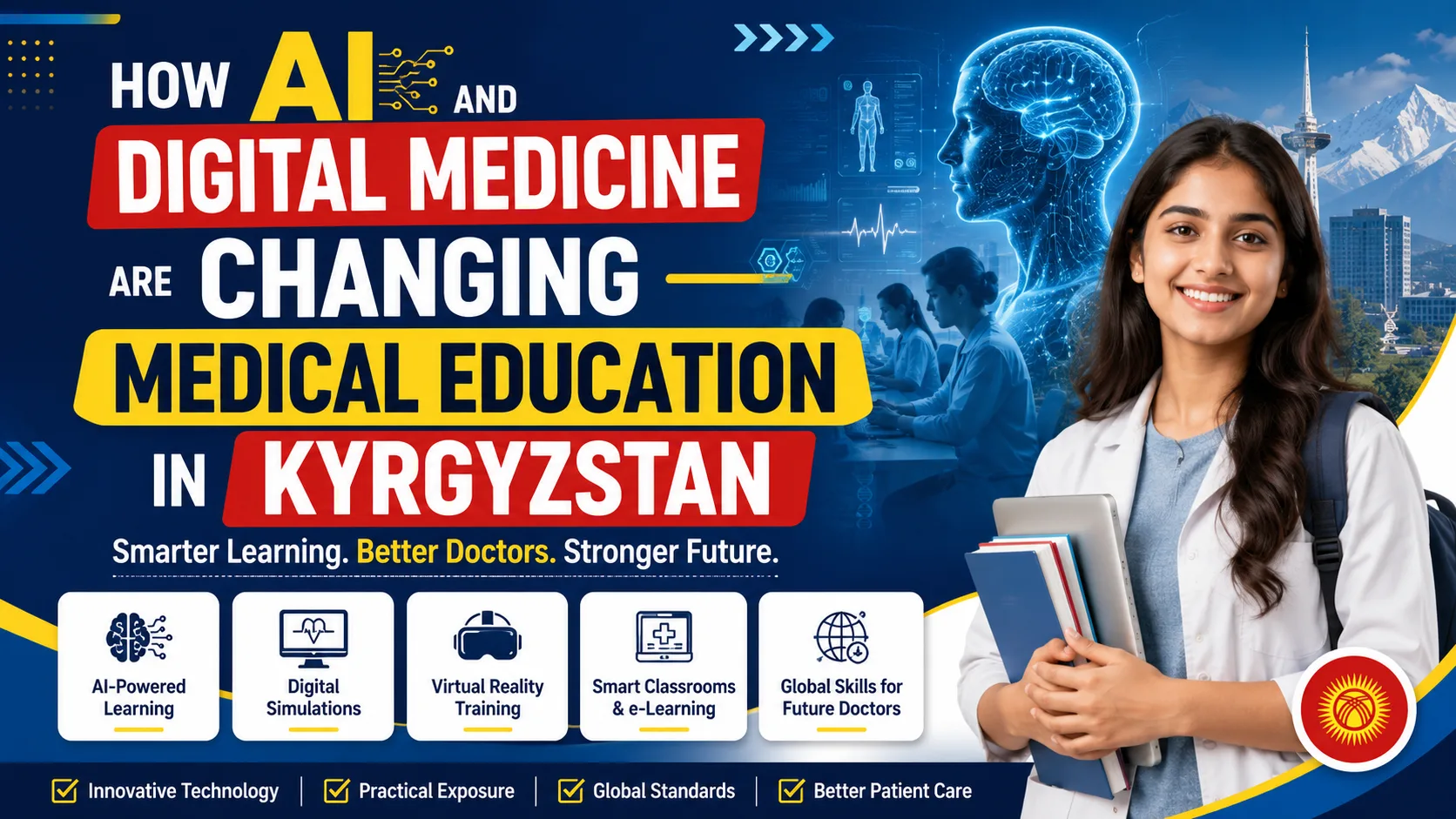
AI and Digital Medicine are advancing medical education in Kyrgyzstan through the implementation of high tech simulation labs, 3D anatomage tables and smart classrooms, telemedicine, and case based digital learning. These technologies allow students the opportunity to virtually practice clinical skills prior to engaging with real patients and ultimately improves clinical confidence, as well as, the accuracy of medical diagnosis. Furthermore, these innovations allow educational institutes to keep the medical curriculum at par with evolving global standards.
The Digital Shift in Global Medical Education
When it comes to medical schools, the technologies available are the greatest aids in narrowing the gap between the classroom and real-life clinical practice. The World Health Organization (WHO), as well as, a number of other global health agencies, have all placed an emphasis on the need for digital health literacy because the practice of health care in this modern age relies heavily on data and diagnostics, as well as, the remote monitoring of patients.
Several medical universities in Kyrgyzstan are beginning to adopt global medical practices to attract increasingly competitive international students. Numerous medical universities in Kyrgyzstan have been recognized by the National Medical Commission (NMC).
Earnings Criteria for MBBS Admission in Kyrgyzstan
This section outlines some of the minimum criteria for admission to MBBS programs in Kyrgyzstan.
Necessities
Requirements | Details |
Eligible Exam | 10+2 level exam with Physics, Chemistry, and Biology |
Minimum Required Marks | Aggregate total of 50%; 45% for reserved categories |
Entrance Exam | Eligible score in NEET-UG is mandatory |
Age Requirements | Minimum age: 17 years |
Medium of Instruction | English |
Course Length | 5–6 years (may include internship) |
AI and Digital Tools in Classroom: Transforming Education
Simulation-Based Clinical Training
Several universities that offer MBBS in Kyrgyzstan now have the ability to train students in the use of CPR and in the response to emergencies, through the use of simulation labs. The first time that a medical student will be able to participate in training that is clinical in nature will be with the use of a patient that is an actual human.
3D Anatomage Tables
Universities now have the option of using virtual dissection tables that may be used to teach students anatomy of the human body through a dissection that is less actual and that is more interactive.
Case-Based Digital Learning (CBL)
Digital learning modules based on cases provide students with the opportunity to learn in a more holistic manner, as they will be presented with actual case scenarios and problems that require them to plan and complete clinical activities that are of a higher order than that of a mere recall of facts in a clinical setting that is not less.
Smart Classrooms and E-Learning Platforms
Software and hardware that includes projectors, animations in three dimensions, and modules that have recorded lectures, allow students to learn concepts and to practice clinical skills that are of a higher order. This is of great benefit for many of the students that travel from overseas and are in a new and unfamiliar academic system.
AI-Assisted Diagnostic Learning
Some schools are adopting AI diagnostic training tools that teach students how machine learning assists with radiology and pathology and the detection of early-stage diseases. This skill will aid students in training in hospitals that utilize modern technology.
Telemedicine Exposure
Due to the popularity of telemedicine, having early access to remote consultation tools during MBBS Kyrgyzstan training will help students adapt to a mixed telephonic and in-person healthcare delivery system.
Admission Process for MBBS in Kyrgyzstan
Qualify NEET-UG.
Select a university with strong digital infrastructure that is compliant with the NMC and listed on WDOMS.
Submit your documents to receive the official invitation letter.
Apply for the Kyrgyzstan student visa.
Travel and complete the enrollment process.
Fees for MBBS in Kyrgyzstan
To compare universities, it's important to understand Kyrgyzstan MBBS fees in Indian Rupees. Costs for infrastructure, technology, and other investments vary significantly. On average, the full course costs ₹15–25 lakhs and covers all tuition and accommodation. Some universities with advanced learning tools may charge higher tuition, but the benefits will justify the expense.
Benefits of AI and Digital Medicine Integration
Students will gain confidence from simulated interactions with patients.
Engage with 3D models of anatomy.
Develop digitally via case studies in learning.
Have assisted practice in a field of medicine that is rapidly evolving.
Students can adjust study practices to the recorded lectures and e-learning modules.
Telemedicine Preparation Has Advantages and Challenges
First, universities do not have the same capabilities for adopting tools that aid in digitizing teaching. The level of digital tools infrastructure varies across universities.
Second, reliance on simulation tools can diminish students' exposure to real patients, if not controlled.
Third, costs may increase due to added technology fees in some universities.
Fourth, most digital tools cannot substitute core classroom learning. Students need to learn through textbooks to develop a strong foundation.
Lastly, internet connectivity in certain regions may affect the ability to access online learning modules.
The Following Universities Are Some of the Best Examples of Digitized Medical Education in Kyrgyzstan
Kyrgyz State Medical Academy (KSMA). Established in 1939, KSMA contributes to the digitization of medical education through modern laboratories and simulation rooms, as well as providing an extensive digital library, while preserving its historic academic legacy.
International School of Medicine (ISM). KSMA integrates smart classrooms with case-based learning.
Osh State Medical University. Combines traditional clinical teaching with developing infrastructure for simulation.
Asian Medical Institute. Offers modern facilities while focusing on affordable, technology-enhanced education.
International Higher School of Medicine (IHSM). Provides modern facilities along with technology-assisted clinical training.
Always verify the current status of a university's technological infrastructure as well as its recognition in the WDOMS official directory prior to application.
Digital Skills for Future Doctors: Career Scope and Importance
Post MBBS, graduates have to clear FMGE (and transition to NExT) for registration with NMC or any State Medical Council to practice in India. Doctors trained with simulation, digital diagnostics, and telemedicine tools find it easier to:
What are the benefits of working with AI and Digital Learning tools?
Complete the practical licensing exams and case work confidently.
Effectively and seamlessly navigate the systems of health management and electronic Health Records.
Choose a specialty in radiology or pathology, or other fields that have the potential for the integration of new technologies.
Keep abreast of current trends and emerging technologies in global health care.
Comparison of Traditional and Technology Integrated Learning
Element | Traditional Learning | AI and Digital Medicine Learning |
Learning Anatomy | Cadaver dissection | Cadaver dissection and 3D Anatomage tables |
Learning Clinical Skills | Direct exposure to patients | Direct exposure to patients supplemented with simulation labs |
Learning Resources | Textbooks, notes | Digital case studies, recorded lectures, e-learning |
Learning Diagnostics | Interpretation done manually | AI in diagnostic learning |
Simulated Patient Interactions | Face to face only | Face to face and virtual |
Common Queries
Q1. Is the use of AI and Digital Learning tools common in all medical schools in Kyrgyzstan?
Not all schools have the same level of investment in using tools. Some schools, for example, have invested a lot in labs for simulation and digital teaching, while others rely more on traditional teaching. As a potential student, you should research the actual tools of the school.
Q2. Does the use of digital teaching in the schools of Kyrgyzstan mean a lower level of real patient exposure?
No, if the school has a balanced teaching program. Digital tools and teaching aids, along with other means of simulation, help to prepare the student for the clinical teaching and exposure that is to be undertaken. NMC compliant courses also provide sufficient exposure to real patients.
Q3. Is the NEET-UG still required if the medical school has advanced digital teaching technologies?
Yes. All Indian students wishing to undertake the MBBS in Kyrgyzstan are required to undertake the NEET-UG irrespective of the level of digital teaching technologies in the medical school.
Q4. Do digital learning tools impact MBBS fees in Kyrgyzstan?
Fees may be higher at some universities that have state-of-the-art simulation labs and more sophisticated digital infrastructure, but this varies by university so a detailed fee structure is best obtained directly from them.
Q5. How does AI training ease FMGE or NExT?
The exposure of case-based learning and diagnostic training tools helps develop clinical reasoning skills, and this is tested in the practical and case-based components of FMGE/NExT.
Q6. Is Kyrgyzstan’s digital medical education standard internationally recognized?
Yes, as long as the university is in WDOMS and recognized by the NMC, the university’s curriculum, even the digital and/of the simulation components, is in line with the international standards of medical education.
Conclusion
Integrating AI, simulation, and digital learning tools to medical education in Kyrgyzstan makes medical education more practical and more advanced in terms of technology. This helps in making Indian students MBBS graduates from Kyrgyzstan more confident and ready for their medical career as they can select universities that maintain a sound level of conventional clinical education along with modern digital tools. The hybrid model adopted in medical education is likely to equip these doctors to respond to the newly emerging technology-based paradigms in global health demand.