Introduction
Thousands of Indian students now see obtaining their MBBS in Kyrgyzstan as a viable option to gain entry to medical programs versus attending an expensive private medical college in India. The lower cost, easy admission, and internationally recognized medical programs, make Kyrgyzstan a popular international medical education option.
One question that always concerns parents and students prior to enrollment is:
“What is the level of clinical exposure in Kyrgyzstan medical universities?”
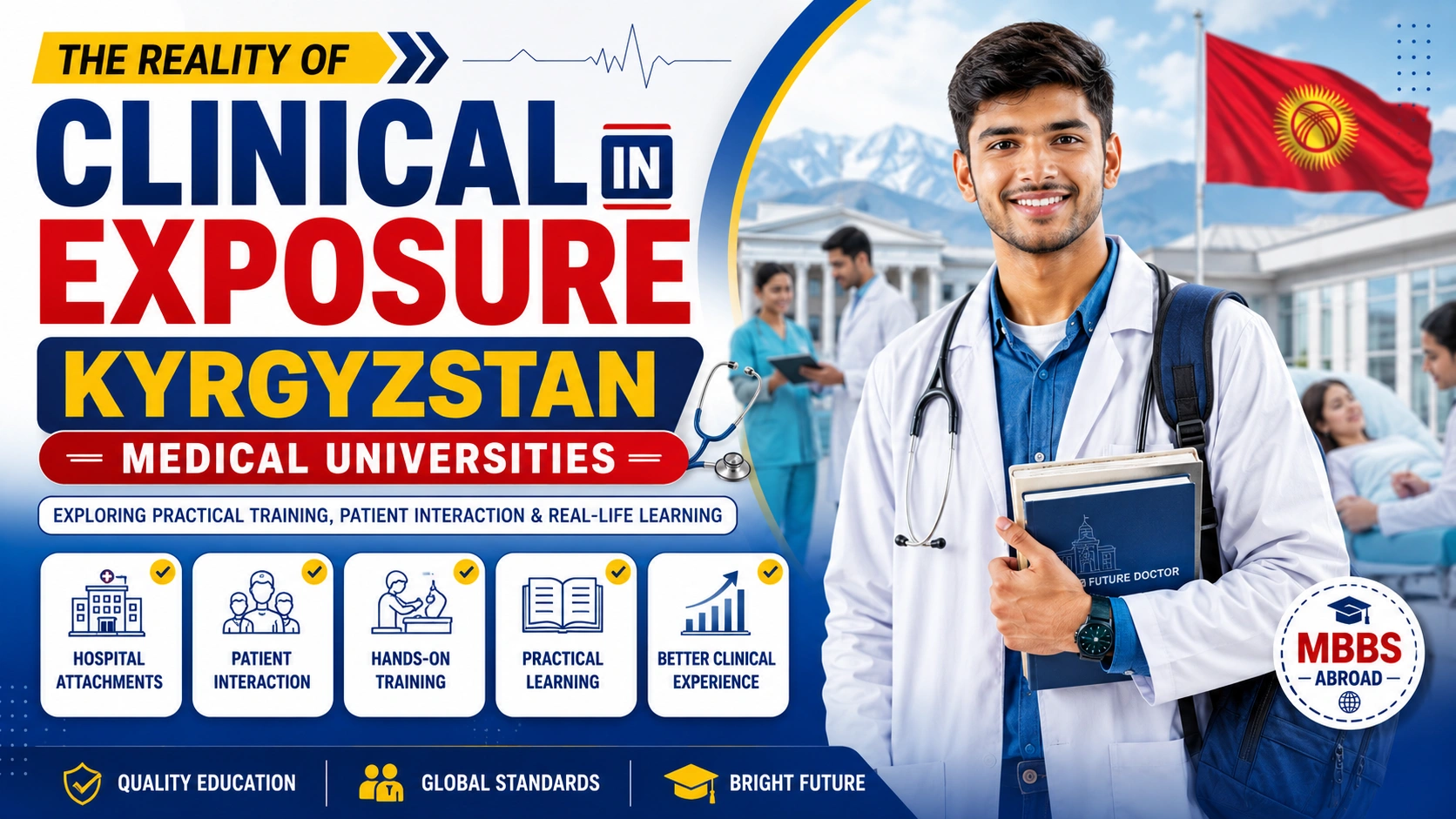
Clinical exposure is essential in the development of a medical student's practical skills and self-assurance in the delivery of real-world healthcare services. While many consultants will sell their programs based on the modernity of their campuses and lower tuition fees, it is in the student’s best interest to know the realities of the training they will receive in hospitals, their contact with patients, their internship opportunities, and learning at the bedside.
This article is intended to offer the Indian student insights that will help them understand the realities of the clinical exposure in Kyrgyzstan medical universities.
Featured Snippet: Clinical Exposure in Kyrgyzstan Medical Universities
Clinical Training in Kyrgyzstan Begins Usually from 3rd Year
Internship is of 1 Year
Patient Contact is Moderate to High in Government Hospitals
Medical Instructions are in Russian and Kyrgyz
Clinical Rotations of Medicine, Surgery, Pediatrics, and Gynecology are Common
Medical Degrees are Recognized Only from NMC compliant Universities
Practical Learning Quality Differs from University and Hospital
What is Clinical Exposure in MBBS Education?
Clinical exposure is the primary means of practical training for the medical student in a hospital and healthcare center.
This includes, but is not limited to:
Patient examinations
Bedside case discussions
Hospital rounds
Surgical observations
Participation in various diagnostic and therapeutic procedures
As well as an exposure to the practice of medicine in an emergency
Internship training
Strong clinical exposure produces competent and confident doctors.
Students considering an MBBS in Kyrgyzstan should assess their clinical training as thoroughly as they assess the tuition.
The Clinical Training Reality in Kyrgyzstan
Initial Years Are Mostly Theory
As in most countries, early training in Kyrgyzstan focuses on the following foundational medical sciences:
Anatomy
Physiology
Biochemistry
Histology
Pathology
During these years, hospital visits are usually only observational.
Students who expect to interact with patients from the very beginning should be warned that these years are dominated by lectures.
Clinical Training Usually Starts in the 3rd Year
Most universities formally start clinical training from the 3rd year onward.
Students complete rotations in:
Internal Medicine
General Surgery
Pediatrics
Obstetrics and Gynecology
Orthopedics
ENT
Psychiatry
The quality of clinical training and the extent of opportunities is directly related to the hospital's partnership with the university and the number of students assigned to that hospital.
Government Hospitals Provide Better Exposure to Patients
A major plus in Kyrgyzstan is that government hospitals have a large inflow of patients.
Medical students have the opportunities to manage cases of:
Chronic illness
Infectious diseases
Trauma
Emergencies
Surgery
This gives students a wide variety of exposure to different cases.
Is Language a Challenge?
The major challenge faced during clinical training is communication. Most patients speak in Russian or Kyrgyz. Although the professors and the international departments speak in English, interaction with patients may require knowledge of the local languages. Students who are willing to learn even a little bit of Russian usually experience a far better clinical exposure.
Are Students Allowed to Practice Medicine?
This is a case of the university, hospital, and departmental policies coupled with the supervision of the department during that particular posting as well as student competence. However, students are generally allowed to take part in the following activities:
Taking a patient’s blood pressure
Taking patient history
Performing a physical exam
Under Supervision - Basic Clinical Procedures
Independent procedures typically apply to interns and graduates.
NMC Guidelines and Clinical Training Mandates
Indian students must select universities that comply with regulations on foreign medical education. As per the National Medical Commission, students must do the following:
Meet minimum time constraints and framework of clinical training components, complete the internship, and do the entire course in one medical institution. If not, it may bar them from registering in India.
Criteria for MBBS Admission in Kyrgyzstan
Minimum Academic Qualifications
Students should have passed with a minimum of 50% marks in Physics, Chemistry, and Biology; marks of 40% are for students from the Reserved Categories.
Minimum Age Requirement
At least 17 years by the year of admission.
Mandatory Entrance Exam
Indian students should qualify NEET. Updates can be checked on the official NEET Exam website.
MBBS Admission in Kyrgyzstan
Compared to other countries, the admission process for MBBS in Kyrgyzstan is very straightforward.
Steps:
Choose a university that is NMC recognized and is listed in WDOMS.
Check the recognition for the selected university to pursue MBBS in Kyrgyzstan for Indian students and apply.
Submit the following:
Passport
NEET score
10th and 12th mark sheets
Passport size photos
Medical certificate
Receive the admission letter from the university and apply for the student visa.
Complete the travel and enrollment process after arriving in Kyrgyzstan.
Clinical Exposure: India vs Kyrgyzstan
Parameter | India Government Colleges | Kyrgyzstan Universities |
Patient Volume | Very high | Moderate to high |
Language Barrier | None | Yes |
Clinical Start Year | 2nd/3rd year | 3rd year |
Internship Opportunities | Excellent | Good |
Most Students Strongly Rely on University for Practical Skills Training
TOP MEDICAL UNIVERSITIES FOR CLINICAL TRAINING
University | Hospital affiliations | Recognition / listing |
Kyrgyz State Medical Academy | Multiple government hospitals | WHO, NMC |
Osh State University | Multiple affiliated hospitals, including Osh State University Medical Clinic and city/provincial hospitals | WHO, NMC |
Asian Medical Institute | Teaching hospitals | WHO, NMC |
Jalal-Abad State University | Public hospitals | WHO |
International School of Medicine | Urban clinical centers and affiliated hospitals | WHO, WDOMS |
CLINICAL TRAINING BY TEACHING INSTITUTIONS
STUDENTS SHOULD CHECK THE WORLD DIRECTORY OF MEDICAL SCHOOLS TO VERIFY LISTINGS.
MBBS IN KYRGYZSTAN
Kyrgyzstan has concentrated on establishing its economy mainly based on providing affordable education.
FEE STRUCTURE (IN USD)
Expense | Monthly | Annual |
Tuition | 3,500–6,500 | 42,000–78,000 |
Hostel | 500–900 | 6,000–10,800 |
Food | 800–1,000 | 9,600–12,000 |
Miscellaneous | 300–500 | 3,600–6,000 |
Total | 5,100–8,900 | 61,200–106,800 |
CLINICAL EXPOSURE IN KYRGYZSTAN
VARIED CASE MIX
Clinical training exposure cost is considerably lower than private medical colleges in India.
INTERNATIONAL ENVIRONMENT
Modern teaching facilities, including simulation labs and digital learning, are utilized by many universities.
WHO RECOGNITION
Many institutions have international recognition through WHOresources.
LANGUAGE BARRIER
THE MOST SIGNIFICANT STUDENT LIMITATION DURING HOSPITAL POSTINGS IS COMMUNICATING WITH PATIENTS.
Government hospitals have fixed placements for many students, and practical training is self-initiated.
RESTRICTED PATIENT CONTACT
GREAT CAREER OPPORTUNITIES
Clinical skills can significantly enhance students' job prospects.
Ways to Maximize Learning as a Student:
Learn Russian.
Become more active during ward rounds.
Participate in more medical workshops.
Engage in more clinical case discussions.
Utilize simulation labs.
More engaged students acquire more useful experiential learning.
Career Scope After MBBS in Kyrgyzstan
Graduates are afforded various career pathways following the completion of the program.
Medical Practice in India
After the completion of the program, students are able to perform the licensure processes to practice in India.
Postgraduate Studies
Some of the common pathways include the following countries:
India
United Kingdom
Germany
United States
Australia
Research Careers
Graduates may pursue a career in research, including, but not limited to, the following:
Biomedical research
Public health research
Research pertaining to clinical trials
Hospital Employment
Graduates can gain employment in various private and government hospitals.
Students who are considering the option of studying overseas are able to explore mbbs in Kyrgyzstan related opportunities via accredited schools.
Frequently Asked Questions
Is the clinical exposure sufficient in Kyrgyzstan for Indian students?
Yes, as long as the students select a reputed university that is strongly affiliated to a hospital.
When do the students start their clinical postings?
Most universities commence clinical postings from the 3rd year.
Is knowing the Russian language a necessity?
Russian is not an academic requirement; however, knowing Russian at a basic level will enhance communication in most hospitals.
Is NEET mandatory?
Yes, for Indian students, qualifying the NEET is mandatory.
Are degrees worldwide recognized?
A number of the universities hold recognition from WHO and WDOMS, among others.
Can the graduates practice in India?
Yes, if the graduates meet the current requirements of the NMC.
Is the internship part of the program?
Typically, most of the programs offer a one-year internship as part of the program.
Conclusion
The truth of the clinical exposure in Kyrgyzstan medical universities rests in the middle of the over optimistic assurances of the consultants and the wariness of the students.
There are some clinical training opportunities that, if offered by a university, are strongly hospital affiliated, can be quite beneficial.
Students need to recognize that practical learning is greatly affected by language barriers, differences in institutions, and personal effort.
For cost effective International medical education, MBBS in Kyrgyzstan will still be a favorable option in 2026, provided students choose a reputable university, remain active interns during their hospital postings, and start preparing early for the licensing exams.
You can attain the theoretical and practical skills necessary for a successful profession by doing thorough research and participating in your clinical training.