.webp)
Every May-June, right after NEET results drop, my phone starts buzzing with the same kind of message. "Sir meri score itni hai, kya abroad jaana chahiye?" Two months earlier, half these students hadn't even heard of Kyrgyzstan. Then a cousin mentions it, or a senior from the same coaching batch, and suddenly it's 1 AM Google searches and forwarded WhatsApp PDFs from three different agents.
I've written about MBBS admissions for consultancies for almost eight years now. Long enough to watch Kyrgyzstan go from "that random backup country" to something parents actually bring up on their own. Low fees. No donation. English-medium classes from day one. It's a decent pitch, and for a lot of families it's not really a choice between Kyrgyzstan and AIIMS — it's between Kyrgyzstan and giving up on the dream entirely.
So let's actually go through this properly. Not a copy-paste top-10 list you've seen on five other sites. Real fee ranges, what NEET actually asks for, and — this is the part nobody wants to talk about — the hidden costs and recognition traps that trip people up after they've already paid the first installment. If MBBS in Kyrgyzstan is on your shortlist, read this before you sign anything.
Why does everyone suddenly want Kyrgyzstan?
Not because it has the best medical schools on earth. Nobody's claiming that.
It's math. A full 6-year MBBS there usually lands somewhere between Rs 20 and 30 lakh, everything included. A private seat in India through management quota? Starts around Rs 50 lakh in most states and in some colleges goes past a crore. For a family running a small business or a single-income household, that gap isn't a preference. It decides whether their kid becomes a doctor or doesn't.
Then there's NEET itself. A student who scores 480 out of 720 has genuinely worked hard — that's not a bad score by any measure. But depending on category and home state, that score might still not get them a government MBBS seat in India. Kyrgyzstan doesn't demand a specific cutoff beyond just clearing NEET. That one fact is why the interest has exploded the way it has.
The top colleges, and why each one actually matters
I'm not going to give you ten identical bullet points that all say "good infrastructure, affordable fees." Some of these genuinely differ from each other in ways that matter for your daily life there.
Osh State Medical University (OSMU) is probably the most recognized name among Indian applicants right now, and for good reason. It's been taking Indian students for years, so the support system — seniors, hostel networks, even food options — is already built. Annual fee tends to sit around $3,500 to $4,500. If you want to avoid feeling isolated in your first semester, this is usually the safer pick.
Kyrgyz State Medical Academy (KSMA) sits in Bishkek, the capital. Better hospital access for clinical practicals, a bit more polish overall. Fees run slightly higher, roughly $4,000-5,000 a year. Worth it if you can afford the difference.
International School of Medicine (ISM), also in Bishkek, gets marketed aggressively — you've probably already seen its name on Instagram ads. It's popular, genuinely, with a large mixed international student base. Just don't let the glossy brochure do all your thinking for you. Verify the NMC status yourself.
Jalal-Abad State Medical Institute is smaller, and honestly that's the appeal for some students. Fewer people means faculty actually remember your name.
Asian Medical Institute in Kant, a small town near Bishkek, keeps fees low and the environment quiet. Not for someone who wants city life, but good if distractions aren't what you're looking for at 19.
Kyrgyz Russian Slavic University (KRSU) leans on a curriculum shaped partly by the Russian medical education model. A few returning students I've spoken to over the years describe it as more demanding academically than some of the newer private universities — take that as one data point, not gospel.
International Higher School of Medicine (IHSM) is newer, with noticeably modern labs, and its Indian intake has been climbing steadily.
Salymbekov University offers a fairly balanced mid-range option — decent hostels, moderate fees, nothing extreme in either direction.
Osh State University's separate Medical Faculty (not to be confused with OSMU) is less commonly chosen but functional, and worth considering if your first three picks are already full.
Naryn State University, tucked away from Bishkek, offers lower living costs and a quieter city. Not glamorous. But if your priority is budget over nightlife, it does the job.
One honest disclaimer: rankings and popularity shift a bit every year as new NMC screening data comes out and student feedback changes. Don't treat this list, or any single blog, as permanent truth. Cross-check current status on the NMC website before you finalize anything.
What NEET actually requires — cutting through the confusion
This is where a lot of parents get genuinely confused, so let me simplify it as much as I can.
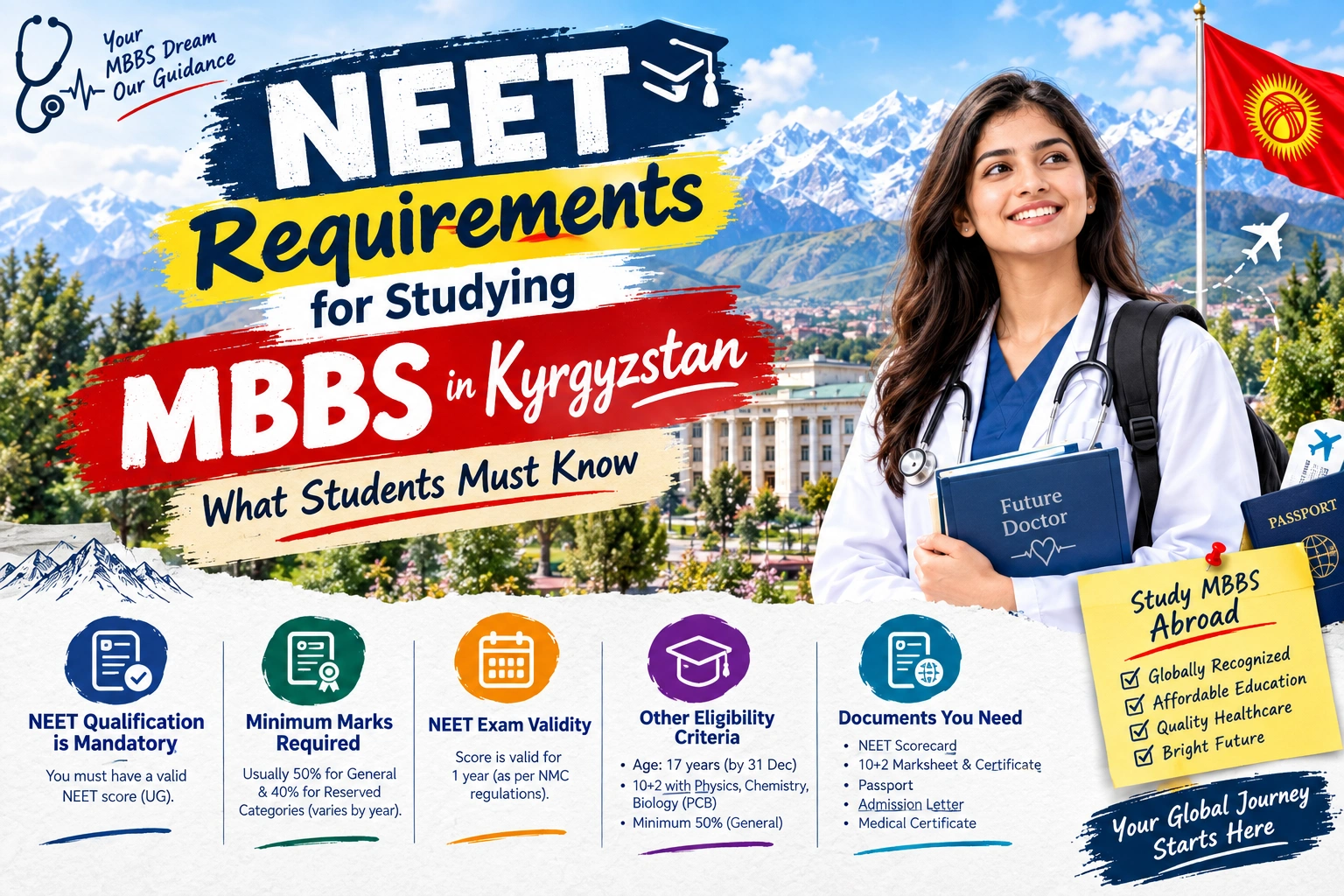
To go for MBBS in Kyrgyzstan, you need to have cleared NEET-UG within the validity window set by NMC rules. There's no separate entrance exam these universities run for Indian students. NEET is the filter, full stop.
You don't need a specific score. Just a qualifying result. Along with that — minimum age of 17 at the time of admission, and 50% aggregate in PCB at 10+2 (40% for reserved categories). That's basically it.
Go check your actual status on the NEET official portal rather than trusting whatever an agent tells you on a call. It takes two minutes and saves you from a lot of confusion later.
Passing NEET, though, does not mean you'll automatically pass the licensing exam back home. That's a separate and honestly much tougher conversation, coming up in a bit.
Fees — the actual numbers, not vague promises
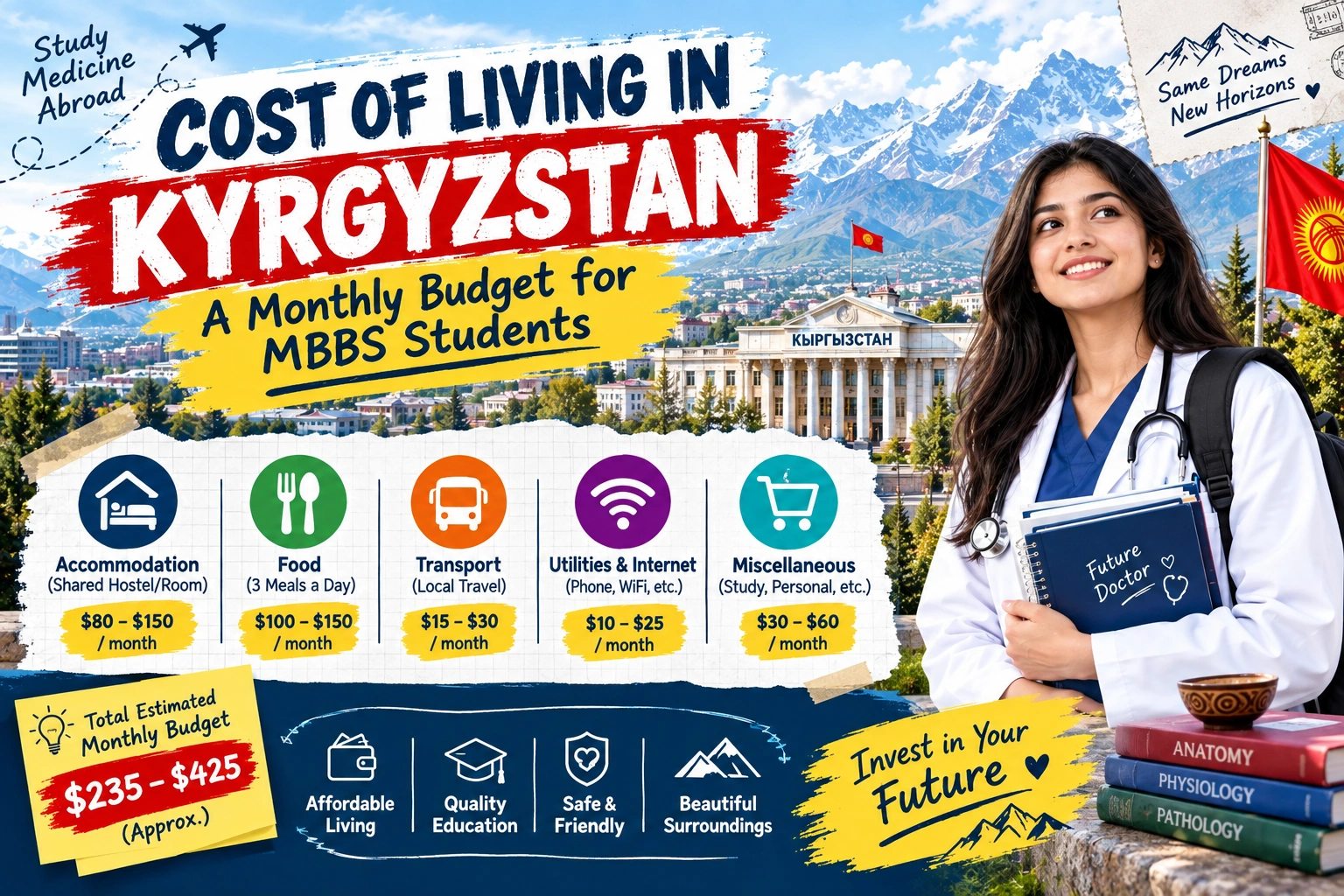
Component | Kyrgyzstan (approx/year) | Private college in India (approx/year) |
Tuition | $3,500 – $5,500 | Rs 10–25 lakh |
Hostel & living | $1,200 – $2,000 | Rs 1–3 lakh |
Total, 6 years | Rs 20–30 lakh | Rs 60 lakh to 1.5 crore |
These are approximate. Currency fluctuation and each university's own revisions mean the actual number could shift a little from year to year, so treat this table as a starting point for your own homework, not a final invoice.
Here's where students get burned, though. Some consultancies quote one clean "package" number that quietly leaves out hostel deposits, visa fees, insurance, exam charges. Ask for a full written breakdown before you transfer a single rupee. Every time. No exceptions.
How long does the course actually take?
MBBS in Kyrgyzstan generally runs 5 years of academics plus a mandatory 1-year internship — 6 years total, roughly matching the Indian MBBS structure. Some universities split the semesters a little differently, so confirm the exact breakdown for whichever college you've shortlisted.
One thing worth flagging: the internship year can sometimes be completed in India under NMC-approved hospitals, depending on the rules in force that year. These regulations get revised periodically. Don't assume last year's rule is still the current one.
Recognition — the part everyone skips and later regrets skipping
This is the section people breeze past because it's boring. It's also the most important one.
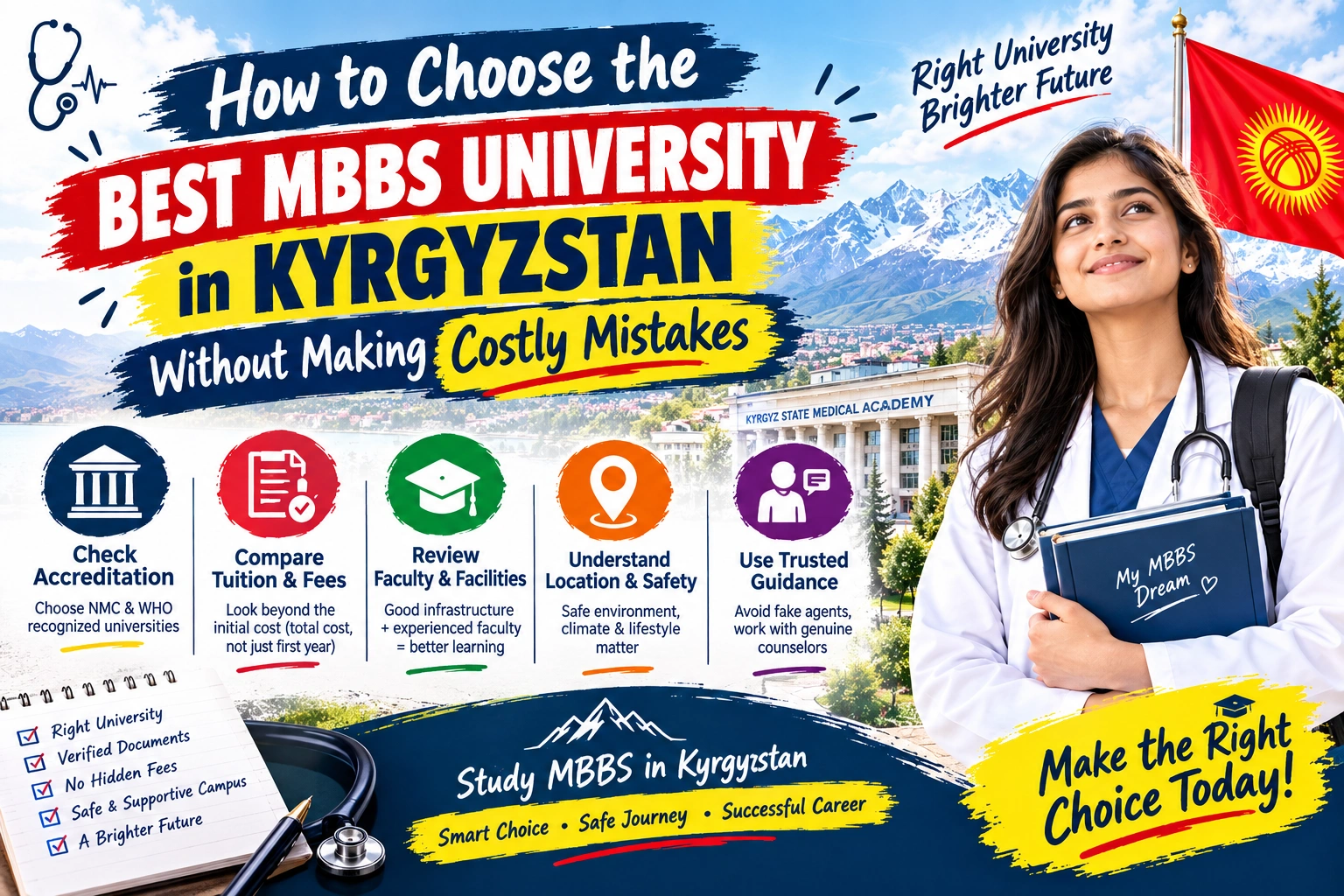
For your MBBS in Kyrgyzstan to mean anything back in India, the university has to be recognized by the National Medical Commission. Check this yourself on the NMC site. Not the college's word. Not your agent's word. Yours.
Beyond that, look at whether the university appears in the World Directory of Medical Schools (WDOMS), a listing connected to bodies affiliated with the World Health Organization. This matters if you ever think about practicing outside India too.
And after graduation, every single Indian student who studied abroad — Kyrgyzstan included — has to clear FMGE (now called NExT for newer batches) to legally practice back home. This exam has a reputation for a low pass rate. I'm not saying that to scare you off. I'm saying it because too many students find out about it in their final year instead of their first.
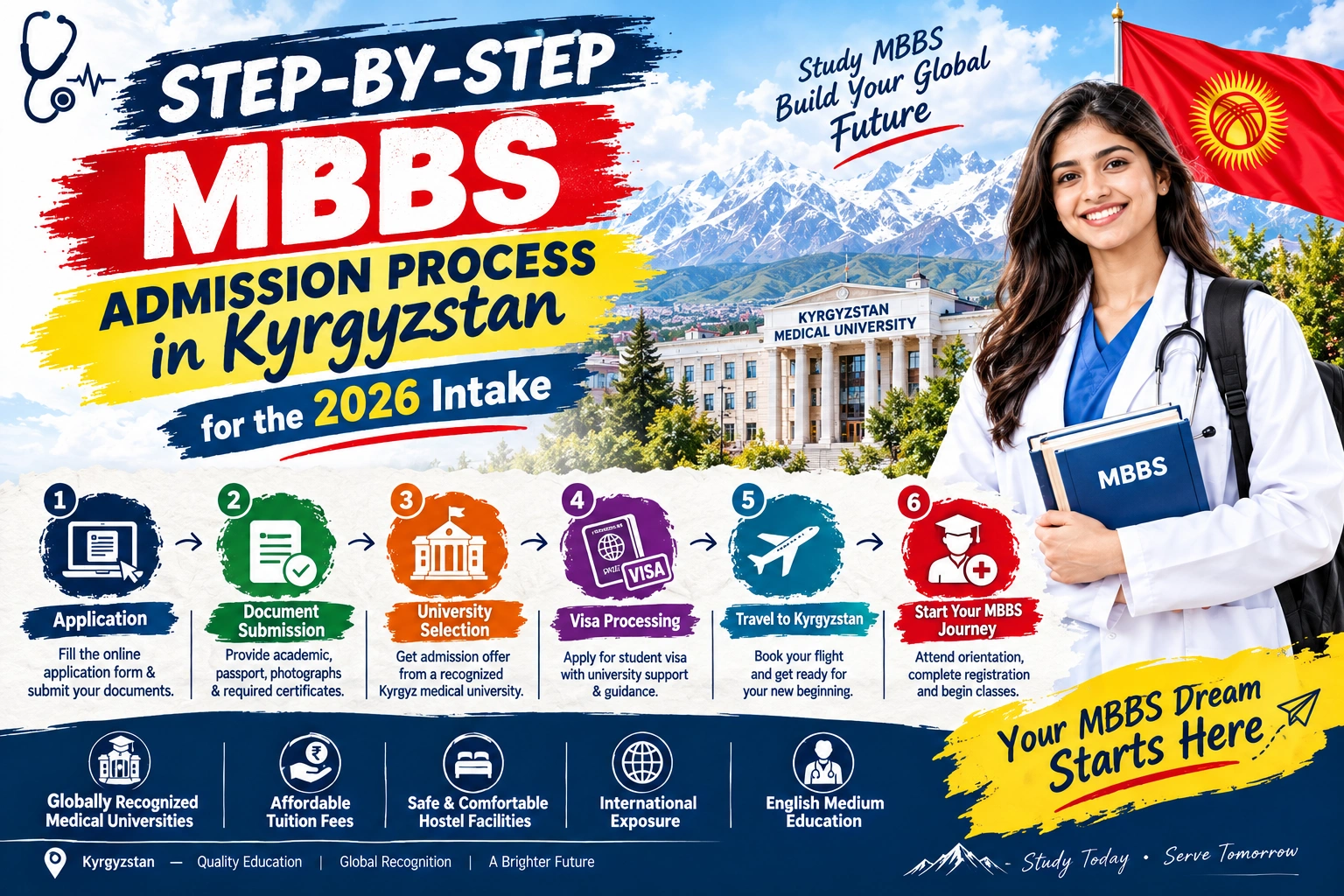
Getting admitted — the actual steps
Clear NEET-UG with a qualifying score
Shortlist NMC-recognized universities
Apply directly, or through a consultant you've actually verified — the MBBS in Kyrgyzstan is a good starting reference
Receive your admission or invitation letter
Apply for a Kyrgyz student visa
Pay the initial fee as per the official structure — get this in writing
Travel, complete local registration and medical checks on arrival
Sounds simple written out like this. In real life, visa processing and document verification can eat up anywhere from 4 to 8 weeks. Start early. June or July for a September intake, ideally.
The costs nobody mentions upfront
Flights. Round trip India-Kyrgyzstan runs somewhere around Rs 25,000-45,000 depending on the season and how many layovers you're willing to sit through.
Health insurance — sometimes bundled into the fee, sometimes billed separately. Ask specifically, don't assume.
Winter clothing, and this one catches south Indian students especially off guard. Bishkek winters drop well below freezing. Budget a few thousand rupees for proper gear in your first month, not your third.
Food. Cooking for yourself cuts your monthly spend noticeably compared to eating out every day, which a lot of first-year students don't realize until their savings run dry by month four.
An honest pros and cons, not a sales pitch
What actually works: the cost. English-medium teaching from the start. No donation culture eating into your family's savings. Reasonably safe cities, based on what students have told me over the years.
What doesn't: FMGE/NExT pass rates remain a real, industry-wide concern — not something unique to Kyrgyzstan, but not something to ignore either. The first semester hits hard — new food, new language outside class, freezing weather, all at once. And some of the smaller institutes have thinner hospital tie-ups for hands-on clinical exposure compared to bigger teaching hospitals in India.
None of this means skip it. It means walk in with your eyes open, not just your hopes up.
Questions people actually ask me
Is MBBS from Kyrgyzstan valid in India?
Yes — provided the university carries NMC recognition, and you clear FMGE/NExT once you're back. Always confirm recognition before you pay anything.
What NEET score do I need for Kyrgyzstan?
There isn't a fixed high cutoff. A qualifying score is generally enough, though the exact rules can shift slightly each admission cycle.
Total cost for the full course?
Roughly Rs 20-30 lakh across 6 years, tuition and living combined. Can vary based on which university and how you choose to live there.
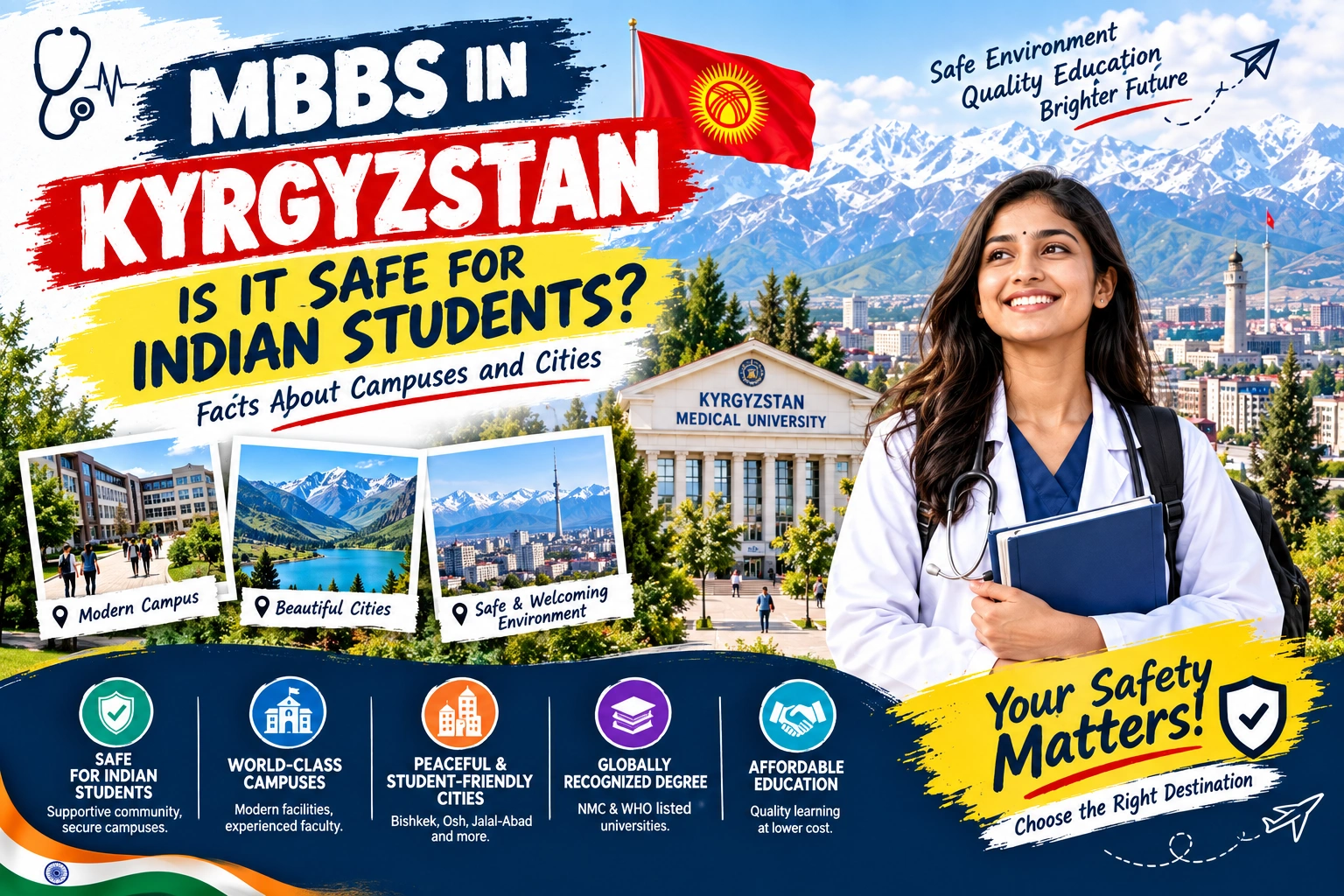
Is it actually safe for Indian students?
Mostly yes, especially in cities like Bishkek and Osh where there's already a large Indian student base. Same common-sense precautions apply as they would anywhere else in the world.
Can I take an education loan for this?
Several Indian banks do offer loans for NMC-recognized foreign medical universities. Check each bank's own approved list — it's not universal.
Bishkek or Osh?
Bishkek gives you more infrastructure and city life. Osh is quieter, a little cheaper. Depends what kind of five years you're picturing for yourself.
Conclusion
Most articles like this end by listing the ten colleges again. I'm skipping that.
What I'll say instead is something I've noticed over eight years of doing this. The students who actually do well aren't always the ones with the highest NEET scores walking in. They're the ones who treat FMGE prep as a first-year habit, not a final-semester scramble. I've watched strong NEET scorers stumble at FMGE, and I've watched average scorers clear it comfortably — purely because they studied consistently instead of cramming at the end.
If MBBS in Kyrgyzstan makes sense for your family's budget, go for it. Just go for it because the numbers genuinely work for you, not because someone's sales pitch sounded convincing on a Tuesday evening call. Talk to two or three current students from your shortlisted college first. Check NMC and WDOMS yourself. And if you want a second opinion on which college fits your NEET score and budget, MBBS in Kyrgyzstan is a decent place to start — no pressure, just information.