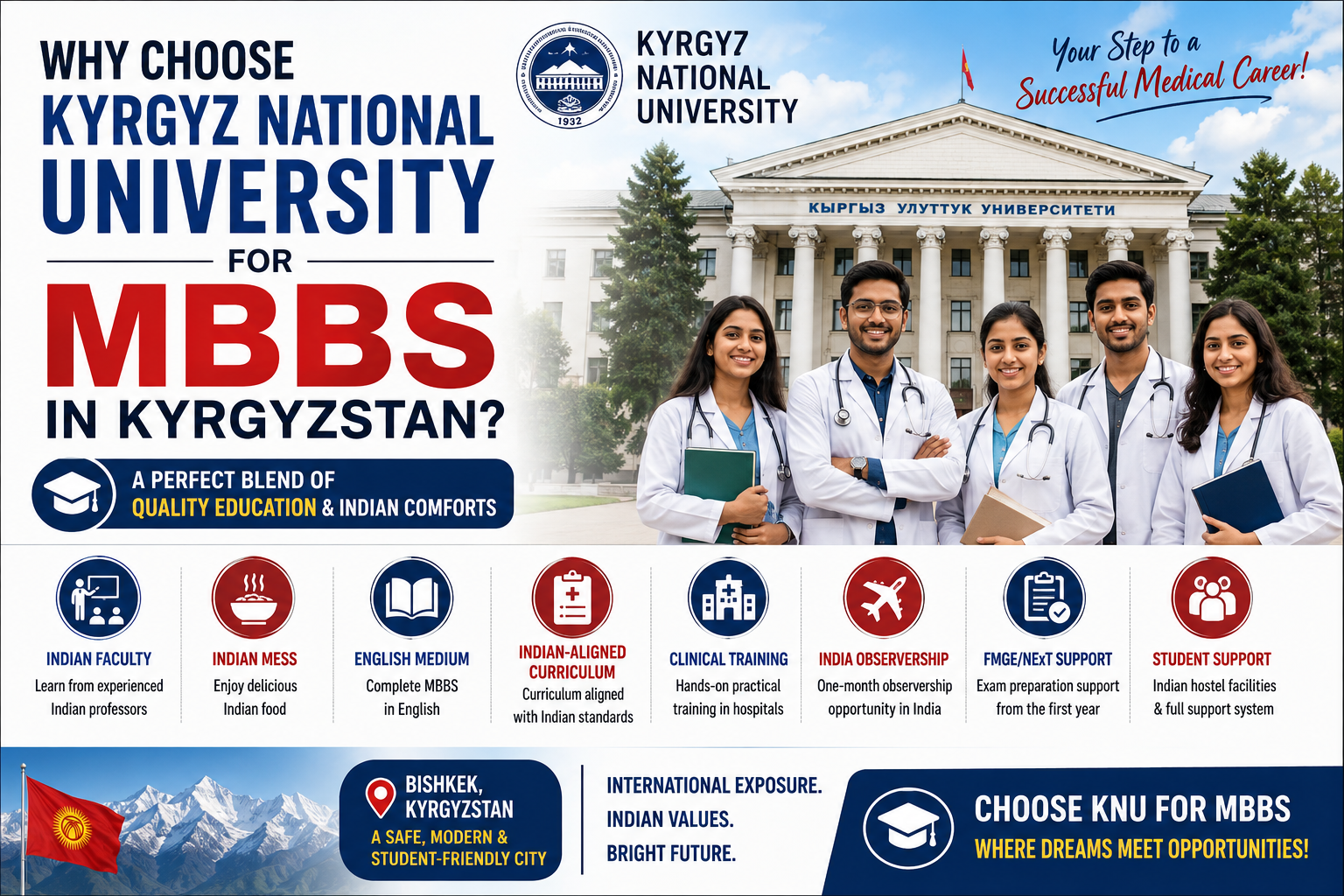
Kyrgyz National University in Bishkek (KNU), Kyrgyzstan is a good option for Indian students who are looking for a medical education that is affordable and international oriented. The university is a well-established academic institution, and the current medical education program with Yenepoya University was designed specifically for Indian students. The collaboration brings together KNU's academic infrastructure, local academic environment and Indian-oriented teaching with clinical exposure and support for students.
The availability of Indian professors, Indian food, hostel facilities, and academic support are all advantages for Indian students. The facilities available can help ease the transition of studying medicine abroad, particularly during the first few year.
Students should not choose a medical school based on advertisements or fees. They should check independently the university's status, accreditation, curriculum and internship arrangements before applying.
Why choose Kyrgyz National University to study MBBS at?
Indian students can choose KNU to study MBBS because of several factors. There are several reasons why Indian students may consider KNU for MBBS in Kyrgyzstan.
1. Indian faculty for a familiar learning experience
The KNU-Yenepoya MBBS program is known for its emphasis on Indian faculty. According to current information about the program, approximately 75% faculty members are Indian. This helps students learn medical subjects in an environment more familiar to Indian learners.
Faculty can have a big impact on an Indian student who is studying abroad. Medical education includes complex subjects like Anatomy and Physiology as well as Biochemistry, Pharmacology Pathology, Microbiology Medicine, Surgery, Microbiology. Students can benefit from learning these subjects with faculty who are familiar with the Indian system of medical education.
Students who plan to study medicine in India may find it easier to adjust academically if they follow a curriculum that is aligned with Indian standards.
2. Indian food options and familiar dishes
Students who spend six years abroad should consider the food they eat.
The KNU-Yenepoya program highlights Indian cuisine options and familiar hostel amenities to Indian students.
Students can maintain their familiar diet and adapt to the new lifestyle in Kyrgyzstan by eating Indian food. Students can have access to Indian food that is popularly eaten rather than relying solely on the local cuisine.
This is especially useful for students in their first year who are trying to adjust to a different country, climate, academic environment, and culture.
Before registering, students should confirm with the mess operator about their current menu, meal plan and charges, as well as hostel facilities. This is because these arrangements may change from intake to intake.
3. English Medium Medical Education
When choosing an MBBS institution abroad, language is a major factor.
The KNU program is marketed as an English medium MBBS. This allows Indian students to study medicine without having to finish their medical education entirely in Russian or Kyrgyz.
It is easier to understand medical terminology, textbooks, lectures and other materials if you study in English.
Students should also understand that learning local languages is still useful for clinical training. According to the programme, students will receive a foundational level of training in Russian and Kyrgyz so that they can communicate with patients.
Communication with patients is a crucial part of clinical medicine.
4. Indian-Oriented MBBS curriculum
The program's emphasis on a Indian-aligned curriculum is another reason to consider KNU.
According to programme information, curriculum is structured according to Indian MBBS syllabus. It includes basic sciences and pre-clinical topics, clinical training, and specialised medical subject.
It is helpful for Indian students to be familiar with the curriculum when preparing for licensing exams.
Students should be aware that studying a curriculum aligned with Indian standards does not guarantee that they will be eligible to practice medicine in India . Check the latest NMC regulations before applying for admission, and then again before graduating.
The Embassy of India, Bishkek, advises students to make sure that their foreign medical program complies with the FMGL Regulations. These requirements include the duration of the programme, the use of English as a medium for instruction, and the medical subjects.
5. Clinical Experience and Practical Training
Classroom learning is not enough to complete medical education. Students must be exposed to real-life clinical situations in order to learn how medicine is used.
The KNU-Yenepoya program highlights hospital exposure, clinical training and practical learning in the MBBS Programme. The programme also encourages the opportunity to observe at Yenepoya Medical College, Mangaluru.
Students can develop skills through clinical exposure, such as:
Patient communication
Clinical history taking
Physical Examination
Understanding diagnostic procedures
Observing medical and surgery procedures
Learn hospital protocols
Professional communication: Developing a professional approach
The actual clinical experience may vary depending on the department, hospital and rotation schedule. Before paying the admission fee, students should request the official rotation structure and hospital information.
6. The FMGE/NExT-Oriented Support for Academics
Students from India who are pursuing MBBS in other countries should consider their licensing options in India as early as possible.
In the KNU-Yenepoya program, preparation for FMGE/NExT is incorporated from the first years of study and not only treated as a last-year activity.
Early preparation will help students become familiar with Indian medical concepts and examination patterns.
Students should not select a university based on its high success rate in FMGE or NExT. It is not guaranteed that all students will pass the licensing exam. Studying for the exam, understanding clinical concepts, revising and preparing consistently are all essential.
7. India Observership Opportunity
The KNU-Yenepoya program offers students the chance to experience clinical observation in India.
The program currently offers a one-month observership at Yenepoya, Mangaluru every year.
Students can gain a better understanding of the Indian healthcare system while still abroad.
This course can also familiarize you with Indian hospital workflows and patient interaction, as well as clinical practices.
Students should check whether or not the observership is part of their admission package and whether or not it is mandatory or optional. They should also confirm if there are any additional expenses for travel or accommodations.
8. Enjoyable environment for Indian students
It can be difficult to move from India to another nation for six years. Students must adjust to new weather, food, languages, cultures, and academic systems.
This transition can be made easier by a support system that includes Indian faculty and students, Indian food, and familiar accommodations.
The KNU-Yenepoya program promotes Indian-oriented accommodation, Indian food, and student support.
Parents can gain confidence from this because the students are able to access a support system that is tailored around Indian medical aspirants.
International Exposure
Students from India can experience a multi-cultural academic environment when they study MBBS in Kyrgyzstan.
Students can learn from people in other countries about their cultures and perspectives on healthcare. This exposure to international cultures can enhance communication skills, adaptability, and cultural awareness.
These skills are valuable to doctors who want to pursue post-graduate training abroad or work in international healthcare environments.
10. Location in Bishkek
The Kyrgyz National University can be found in Bishkek - the capital city of Kyrgyzstan. KNU's official website identifies it as a state-owned institution, and lists the medical program in Bishkek.
Students can benefit from living in a major city by having access to essential services such as hospitals, transportation and shopping.
Bishkek, too, is a popular choice for international students. However, students should do their research before traveling to learn about the accommodation options, transportation, weather conditions in winter, costs of living and safety.
MBBS at Kyrgyz national University: Important points for Indian students
FeaturesDetails | |
University | |
Location | Bishkek (Kyrgyzstan) |
Program | General Medicine / MBBS |
The Medium | English |
Student Focus | Students from India and other countries are also eligible to apply as international students |
You can also find out more about Faculty | Indian Faculty available through the KNU-Yenepoya Programme |
Food | Indian meals / Indian meal support |
Curriculum | Curriculum aligned with Indian standards under the collaborative programme |
Clinical Training | Hospital and clinical practical exposure |
Observation | The programme currently offers observerships in India |
Prepare for Licensing | Support for FMGE/NExT-oriented Academic Support |
Entrance Requirement | Students from India should be able to meet the current NMC and University requirements |
NEET | Indian students must meet certain qualifications under the applicable rules |
What is the Kyrgyz National University like for Indian students?
Students from India who wish to study MBBS at Kyrgyzstan in an environment that supports Indian academics and lifestyle can consider the Kyrgyz National University.
Students who are worried about their ability to adjust to a foreign university will find the combination of Indian faculty and food, English-medium instruction, Indian-oriented curricula, clinical exposure, and student support attractive.
Students should also base their decisions on factual information, rather than marketing claims. As medical education is an investment that will last a lifetime, it's important to check factors like accreditation, clinical training and internship arrangements, faculty qualifications and programme structure.
Indian Students are eligible to apply for MBBS at KNU
Students from India who wish to apply for the NEET-UG should have completed their Class 12 and studied the required subjects (Physics and Chemistry), as well as meet all the age and academic requirements.
Students should check the most recent admission requirements to ensure they are eligible before applying.
The Indian student should ensure that the programme they join meets the NMC requirements for foreign medical graduates.
Why Indian students prefer KNU for MBBS
These are the main reasons:
Indian Faculty: Under the KNU-Yenepoya program, students can learn from Indian instructors.
Indian Mess Indian food can be a comforting addition to the daily life.
English Medium Classes: Students may study medical subjects in English.
Indian-Oriented curriculum: This programme promotes alignment to the Indian medical education systems.
Clinical Experience: Students are exposed to hospital-based practical training.
India Based Observership: Currently, the programme advertises observership opportunities in India at Yenepoya.
FMGE/NExT support: Exam preparation for the licensing exam is included from the very beginning of the program.
International Experience: Students are exposed to a multi-cultural environment when studying abroad.
Student Support: Indian accommodation and support facilities will help students adapt to the life in Kyrgyzstan.
Checklist Before Admission
Students and parents who are considering KNU as a MBBS program should request written confirmation from the following:
Accreditation of medical programmes currently in use.
Current NMC eligibility/compliance requirements.
Six-year academic program.
Location and duration of the internship.
Clinical Hospital Affiliates
Details about the Faculty
Hostel facilities.
Indian mess and food charges
Tuition and all non-tuition costs.
Support for visa and registration
Refunds and withdrawal policies
Students in India are subject to the following rules.
The Indian Embassy in Kyrgyzstan advises all prospective medical students that they should study in Kyrgyzstan with the correct student visa, and ensure their medical degree meets the NMC requirements.
The conclusion of the article is:
The right university to choose is crucial for Indian students who plan to study MBBS in another country. Kyrgyz National University, Kyrgyzstan provides a combination of international medical training and Indian-focused support for students through its current partnership with Yenepoya University.
Students from India can benefit from features like Indian faculty and mess, English-medium of education, Indian-aligned curricula, clinical exposure, observership opportunities, FMGE/NExT-oriented training, which make it easier to transition to medical school abroad.
MBBS abroad is not to be chosen solely on the basis that it costs less, or because of advertisements, or even claims made about its recognition. Before making a decision, students should verify independently the latest NMC requirements and accreditation of programmes, clinical training, internship structures, and costs.
Students who want to study medicine in Kyrgyzstan in a familiar academic and lifestyle environment, KNU is a good option.
Questions and Answers about MBBS at Kyrgyz National University
What is the Kyrgyz National University like for Indian students?
Students from India who are looking for a medical program in English with Indian faculty and food, academic support geared towards Indians, and international exposure should consider KNU. The KNU-Yenepoya program promotes these features.
Does KNU provide Indian faculty?
Yes. According to the current KNUYenepoya program, approximately 75% of its faculty is Indian. Before admission, students should verify the faculty structure for their specific batch.
Can I get Indian food at KNU?
The KNU-Yenepoya program promotes Indian cuisine and familiar hostel facilities to Indian students. Before joining, students should confirm current mess charges and arrangements.
Does KNU teach MBBS in English?
It is marketed as an English-medium program. The programme also states that the students are given foundational Russian and Kyrgyz languages training to communicate with patients.
Does KNU require NEET for MBBS?
Students from India should meet the NMC requirements to study medicine abroad. The current KNU-Yenepoya information on admissions also mentions NEET as a requirement.
After MBBS at KNU, can I practice medicine in India?
The graduation from a medical school abroad does not grant permission to practice medicine in India. Students must meet the NMC licensing and regulations, as well as the current examination and internship requirements. The Embassy of India recommends that students verify their compliance with FMGL regulations prior to admission.
Does KNU provide FMGE/NExT preparation?
In the KNU-Yenepoya program, FMGE/NExT is included from year one. The exact schedule of preparation and the inclusions included in your admission package should be verified by students.
Why is Indian mess important to MBBS students from Kyrgyzstan
Indian food helps students adjust to their new life and maintain familiar eating habits, while they focus on their studies. This can be especially useful during the first adjustment period.
What makes KNU unique for Indian students
The main differentiators of the KNU-Yenepoya program are Indian faculty and food, English-medium education, clinical training, India based observership, FMGE/NExT Support.