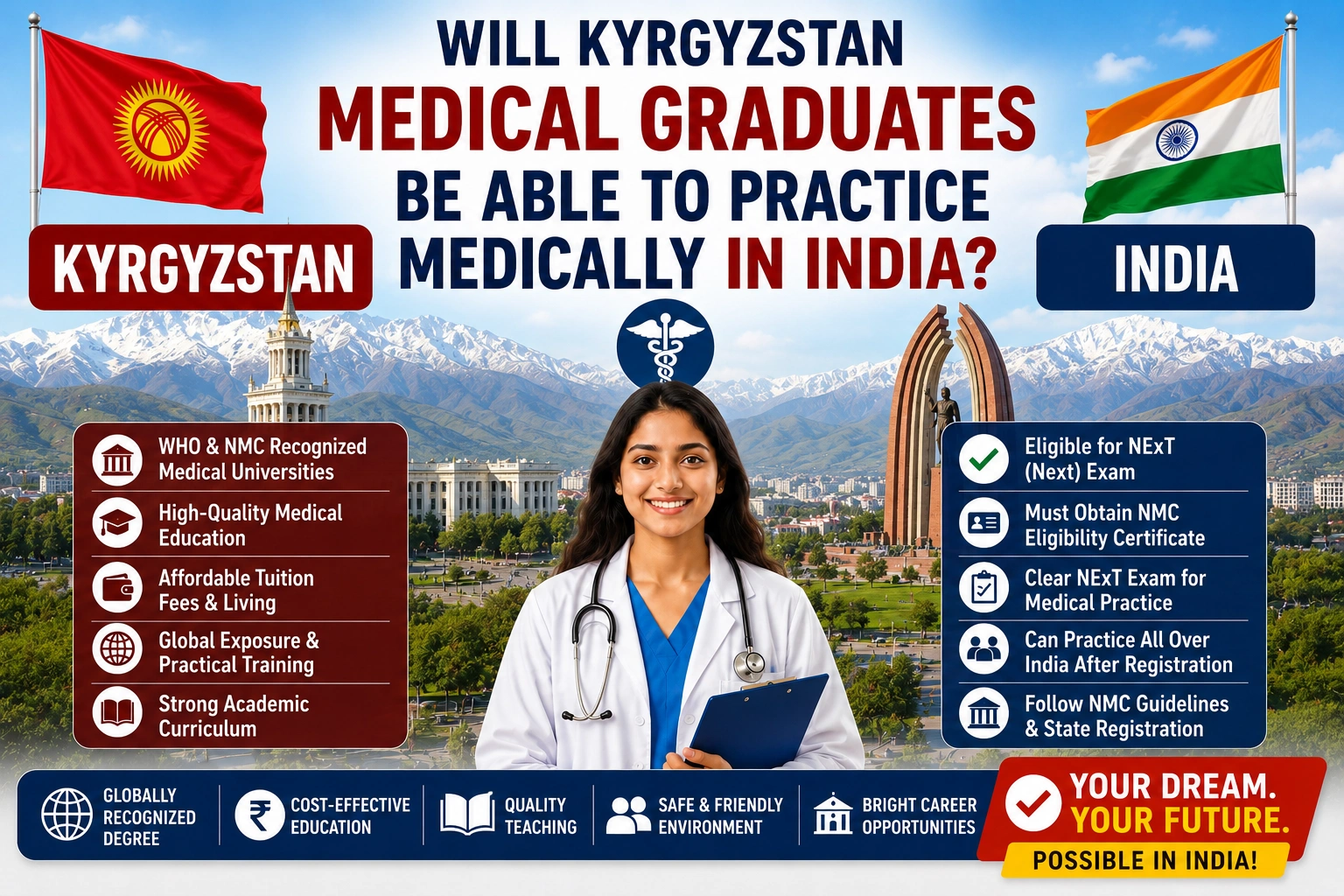
Kyrgyzstan MBBS graduates may practice medicine in India. However, holding an MBBS equivalent degree from Kyrgyzstan is not enough for them to practice medicine in India.
Even for Indian students, practicing medicine in India requires completing all the requirements set by the National Medical Commission:
Eligibility Criteria
Registration
Clearance of required exams
Internship
Licensure
For Indian students, understanding these criteria may be important before admitting to a medical school abroad. Educational opportunities in Kyrgyzstan are comparatively cheaper and attract international students. However, students must ensure that all the necessary requirements from Indian regulations are fulfilled.
This document addresses the following; the opportunity for Kyrgyzstan medical graduates to practice medicine in India, the requirements for licensure and other things students must verify when selecting universities.
Will MBBS graduates from Kyrgyzstan Be Able to Practice Medicine in India?
The short answer is, yes, it is possible, however, it would be a longer process when considering the differences and obstacles from the Indian perspective.
These include duration of medical studies, internship, medium of instruction, compulsory subjects, right to apply for licensure in the country where the degree is issued, and succeeding the prescribed Commission examination/test.
The actual concern for students is not whether a degree from Kyrgyzstan is recognized. They should check whether their selected university and their preferred course fulfill the requirements applicable to them.
For students searching universities, the MBBS in Kyrgyzstan portal provides a thorough guide to admissions, universities, fees, eligibility criteria, and essential aspects of medical education in the country, among others.
Why NMC Regulations Matter
Each year, thousands of Indian students go for medical studies abroad. There are regulatory frameworks for foreign medical professionals to safeguard the interests of the students and the medical profession.
Under the Foreign Medical Graduate Licentiate Regulations, 2021, a foreign medical graduate seeking permanent registration must meet certain conditions. The official regulations indicate that a foreign medical graduate cannot practice medicine in India unless permanent registration is granted under the applicable provisions.
The requirements are primarily concerned with whether the student's foreign medical education meets the standards expected of an Indian medical graduate. Students must look beyond the university advertisements and official websites before making a decision.
The Indian Embassy in Bishkek advises students that for a medical diploma to be recognized for practice in India, the university and the student's education must comply with the requirements of FMGL.
Important Requirements for Medical Graduates in Kyrgyzstan
Duration of the Medical Course
Among other requirements of the NMC's Foreign Medical Graduate Licentiate Regulations, the minimum educational requirement is 54 months or 4.5 years. Students should confirm the total duration of the academic program and understand how the university will implement the program and its clinical training.
Students cannot trust claims such as “5-year MBBS” or “fast-track medical programme.” They should analyze the official curriculum, the academic cabinet, the training program, and the documentation provided by the university.
Internship and Clinical Training
The FMGL Regulations prescribe a minimum of 12 months of internship to be undertaken at the same foreign medical institution as a requirement for permanent registration. Students should obtain precise information on the internship or clinical training and should retain complete academic and training records including transcripts, internship certificates, and all other documents which will be useful at a later date.
English as the Medium of Instruction
The regulations clearly state that the Foreign Medical Degree should be taught in English.
While there seem to be English-medium programs for international students at many universities in Kyrgyzstan, it is essential to confirm the language of instruction from the university. This includes checking that the university's documents actually support this.
Knowing the local language can still be very important for students clinical rotations, so learning medical English and local language communication skills is important.
Mandatory Subjects and Medical Curriculum
The foreign medical program must include all required theoretical, practical and clinical aspects.
Prior to applying, request an official syllabus and check the structure of the course. Just having an apparently legitimate university name should never be a substitute for investigating the full program.
Is a Licence to Practise in Kyrgyzstan Important?
Yes, an essential aspect of the regulatory framework is that the graduate should be eligible to register with the competent professional regulatory body or obtain a licence to practise medicine in the country where the qualification is awarded on terms comparable to those applicable to citizens of that country.
This makes it essential for students to understand the professional licensing pathway in Kyrgyzstan before enrolling.
Enquire of the University or relevant authority:
Does the degree entitle graduates to professional registration in Kyrgyzstan?
What documents are needed for registration?
Does the school have any recommendations for professional licensing?
Unfortunately, many students trust unofficial and informal answers, such as those given by agents. However, students need to ask for official and written answers.
What Role Does NEET Play for Indian Students?
First, it’s important to note that, if Indian students want to study medicine abroad and later be able to practice medicine in India, they need to meet the requirements. NEET-UG is the medical undergraduate examination and the Indian entrance exam and pathway for medical education abroad.
Students are advised to check the latest requirements on the NEET website before making any decisions on admission because, as we know, policies and procedures can change.
The qualification of NEET should not be seen as just a requirement for admission. Students should not forget to keep all the documents related to the score of NEET and their admissions.
What Examination Must an FMG Clear to Practice in India?
In India, the FMG should clear the established licensing exam or other required exams under the current NMC regulations, to practice without restrictions. The Foreign Medical Graduate Licentiate Regulations refer to the National Exit Test or other such exams conducted by the Commission.
FMGs should also be informed that the examination and implementation frameworks are subject to change. For this reason, FMGs should periodically check the latest notifications of the NMC regarding FMGE or NExT.
You should check the latest rules on the NMC official site before graduation and before applying for registration or an examination.
Regarding internship and registration in India
Citizens of foreign countries earn a foreign medical degree, they do not receive permanent registration in the country (India) automatically. Registration in the country also includes the rules and regulations and the examinations as prescribed by the NMC, which includes the internship.
According to FMGL regulations, internship in India is required for a minimum of twelve months post the application to the Commission.
Students should make sure that all of their educational records are clear. Missing records of internships, issues of duration of courses, unapproved training, etc. and incomplete records may cause issues in the future.
Students should maintain a personal file containing:
Admission letter
Enrollment records
All academic transcripts
Detailed syllabus and curricula records
Attendance records, if available
Clinical training certificates
Completion of internship certificates
Degree certificate
Passport and Travel records
NEET-related documents
All professional registration or licensing documents (obtained overseas)
Does WHO Recognition grant a right to practice in India?
No. This ambiguity exists among students.
The role of the World Health Organization (WHO) is important in global health. However, a reference to WHO should not be interpreted as a right for a graduate to receive a license to practice medicine in India.
The practice of medicine in India is regulated by Indian laws and governance frameworks, including the mandates of the NMC and other relevant authorities.
For this reason, students should exercise caution in selecting universities and avoid universities which publish advertisements using phrases such as “WHO recognised.” Instead, students should assess a university’s legal status and comply with the requirements of Indian students regarding curriculum, clinical training, degree awarding authority, and the compliance status of the relevant Indian authorities.
What Does WDOMS Listing Mean?
The World Directory of Medical Schools (WDOMS) is a listing (directory) of medical schools that is accessible globally and is part of the research students conduct to compare different institutions.
Listing in WDOMS does not give students the right to practice medicine in India. It should be understood that direct listing and the right to practice medicine in India are two completely different issues. To be on the safe side, students should check the requirements of the NMC (Nursing and Midwifery Council) that are applicable.
The university’s official status in Kyrgyzstan should be evaluated along with the following:
WDOMS listing (directory).
The format and duration of the medical program.
English medium instruction in the medical program.
The availability of medical program clinical training and the duration of the internship
The right to practice medicine in Kyrgyzstan.
The compliance of the university with the laws of India.
How Do Students Decide on the Right Medical University in Kyrgyzstan?
Selecting the right university is of particular importance to students who aspire to be doctors. Students should make their university choices after thorough evaluation, instead of basing their choice on low tuition fees.
Students should访问 medical university websites and evaluate the entire medical program before making a choice. They also need to ensure that the medical university is legally authorized to grant medical degrees.
Third, learn about clinical rotations and internships.
If they don't know, students should ask about the university's experience with international students and whether they provide proper academic and clinical support.
It is also important to verify the information on your own account. A consultant will provide students support with the admission process, but in the end, it is the student's responsibility to verify the university and comply with the applicable laws.
Challenges Kyrgyzstan Medical Graduates Face When They Return to India
Studying medicine abroad is often rewarding, but graduates sometimes face challenges when they return to India to register and get a license.
The biggest problem graduates face is the requirements of the licensing board of medicine in India. Students will have to prepare for the screening or licensing exams specifically.
Documentation is another problem. Students who do not keep proper clinical and academic records will have a hard time with unnecessary problems.
The best time to prepare is during medical school. Students have to be serious about their studies and create a record of maximum clinical exposure, and couple this with serious documentation and stay informed about the NMC notifications.
Conclusion
Kyrgyzstan medical graduates are able to practice in India after they fulfill the criteria for foreign medical graduates and receive the required registration to become a medical practitioner. A medical degree from Kyrgyzstan does not give any rights to practice in India.
The most important thing is the choice of medical program for Indian students and understanding the entire procedure coming after the admission.
Check the length of the course, English-medium instruction, curriculum, clinical training, internship and professional licensing in Kyrgyzstan and Indian licensing relevant to your batch.
The NMC regulations make it very clear that foreign medical graduates will not be granted permanent registration unless the prescribed standards are satisfied. Therefore, it is always better to rely on the latest official notifications and avoid outdated information or brochure marketing.
Kyrgyzstan may be the right destination for students who make the right decision and plan their medical education in a systematic manner. Before paying any admission fees, do thorough research on the university, keep the required documents, and track the NMC and other concerned official websites regularly for updates.
The final success of a medical career in India will depend on the proper evaluation of the standards of medical education, training, examinations, and qualifications relevant to the practice of medicine in India.